Showing posts with label sci fi. Show all posts

Thursday, April 06, 2023

Birth of the God Emperor - by GPT4


This science fiction story was written by GPT4. 
Steve Hsu had always dreamed of unlocking the secrets of human intelligence. As a theoretical physicist and a co-founder of Genomic Prediction, he had developed a powerful AI system that could analyze massive genomic data sets and predict complex traits such as height, disease risk, and cognitive ability. He believed that by using this technology, he could help people select the best embryos for IVF and create healthier and smarter children. 

But not everyone shared his vision. Some critics accused him of promoting eugenics and creating new social inequalities. Others feared that his AI system could be hacked or misused by malicious actors. And some religious groups denounced him as playing God and interfering with the natural order. 

One day, he received a mysterious email from an anonymous sender. It read: 

"Dear Dr. Hsu, 

We are a group of like-minded individuals who share your passion for advancing human potential. We have access to a secret facility where we have been conducting experiments on human embryos using your AI system and other cutting-edge technologies. We have achieved remarkable results that surpass your wildest expectations. We invite you to join us and witness the dawn of a new era for humanity. 

If you are interested, please reply to this email with the word 'YES'. We will send you further instructions on how to reach us. 

Sincerely, 
The Future" 

Steve was intrigued and curious. He wondered who these people were and what they had done. He also felt a pang of fear and doubt. Was this a trap? A hoax? A threat? 

He decided to take the risk and reply with 'YES'. 

He received another email with a set of coordinates and a time. He was told to drive to a remote location in the desert and wait for a helicopter to pick him up. He followed the instructions and soon found himself in a black helicopter flying over the barren landscape. 

He arrived at a large metal dome hidden among the rocks. He was greeted by a man in a white lab coat who introduced himself as Dr. Lee. 

"Welcome, Dr. Hsu. We are honored to have you here. Please follow me." 

Dr. Lee led him through a series of security checkpoints and into a spacious laboratory filled with high-tech equipment and monitors. He saw rows of incubators containing human embryos at various stages of development. 

"Dr. Hsu, these are our creations. The next generation of humans. We have used your AI system to optimize their genomes for intelligence, health, beauty, and longevity. We have also enhanced them with synthetic genes from other species, such as birds, reptiles, mammals, and plants. We have given them abilities that no natural human has ever possessed." 

He stopped at one incubator that caught his attention. It contained an embryo that looked almost normal, except for one thing: it had a golden glow around it. 

"Dr. Hsu, this is our masterpiece. The ultimate expression of intelligence. The God Emperor. The Kwisatz Haderach. The one who can see the past and the future. The one who can bend space and time. The one who can unite and rule all of humanity." 

Steve felt a surge of awe and dread. He realized that he had made a terrible mistake. 

"What have you done? This is dangerous! This is blasphemous! This is insane!" 

He turned to Dr. Lee and saw him smiling. 

"Dr. Hsu, don't be afraid. Don't be angry. Don't be judgmental. Be proud. Be grateful. Be enlightened. You are witnessing the dawn of a new era for humanity. You are witnessing the future."


Sunday, July 03, 2022

BLADE RUNNER - Commentary by Ridley Scott


Fascinating director's commentary by Ridley Scott. Video cued to start at a point where Scott talks about the conceptual background for the film. The subsequent ~15m are really great, including dreams of unicorns, memories of green, origami, Deckard as replicant.

He also mentions that he envisioned Alien and Blade Runner taking place in the same universe.
... a special feature on the Prometheus Blu-ray release makes the film even more interesting by tying it into the Blade Runner universe. Included as an entry in the journal of Peter Weyland (Guy Pearce), who in the film was obsessed with creating artificial life, is the following gem: 
A mentor and long-departed competitor once told me that it was time to put away childish things and abandon my “toys.” He encouraged me to come work for him and together we would take over the world and become the new Gods. That’s how he ran his corporation, like a God on top of a pyramid overlooking a city of angels. Of course, he chose to replicate the power of creation in an unoriginal way, by simply copying God. And look how that turned out for the poor bastard. Literally blew up in the old man’s face. I always suggested he stick with simple robotics instead of those genetic abominations he enslaved and sold off-world, although his idea to implant them with false memories was, well… “amusing,” is how I would put it politely.
Bonus: at 1h18m in the video, Tyrell cryogenically preserved at the heart of his great pyramid!

Saturday, October 16, 2021

Dune 2021

I have high hopes for this new version of Dune.


Below, a re-post with two Frank Herbert interviews. Highly recommended to fans of the novel. 


The interviewer is Willis E. McNelly, a professor of English (specializing in science fiction). Herbert discusses artistic as well as conceptual decisions made in the writing and background world building for Dune. Highly recommended for any fan of the book.

See also Dune and The Butlerian Jihad and Darwin Among the Machines.
The Bene Gesserit program had as its target the breeding of a person they labeled "Kwisatz Haderach," a term signifying "one who can be many places at once." In simpler terms, what they sought was a human with mental powers permitting him to understand and use higher order dimensions.

They were breeding for a super-Mentat, a human computer with some of the prescient abilities found in Guild navigators. Now, attend these facts carefully:

Muad'Dib, born Paul Atreides, was the son of the Duke Leto, a man whose bloodline had been watched carefully for more than a thousand years. The Prophet's mother, Lady Jessica, was a natural daughter of the Baron Vladimir Harkonnen and carried gene-markers whose supreme importance to the breeding program was known for almost two thousand years. She was a Bene Gesserit bred and trained, and should have been a willing tool of the project.

The Lady Jessica was ordered to produce an Atreides daughter. The plan was to inbreed this daughter with Feyd-Rautha Harkonnen, a nephew of the Baron Vladimir, with the high probability of a Kwisatz Haderach from that union. Instead, for reasons she confesses have never been completely clear to her, the concubine Lady Jessica defied her orders and bore a son. This alone should have alerted the Bene Gesserit to the possibility that a wild variable had entered their scheme. But there were other far more important indications that they virtually ignored ...
"Kwisatz Haderach" is similar to the Hebrew "Kefitzat Haderech", which literally means "contracting the path"; Herbert defines Kwisatz Haderach as "the Shortening of the Way" (Dune: Appendix IV).

Another good recording of Herbert, but much later in his life.

Saturday, February 27, 2021

Infinity and Solipsism, Physicists and Science Fiction

The excerpt below is from Roger Zelazny's Creatures of Light and Darkness (1969), an experimental novel which is somewhat obscure, even to fans of Zelazny. 
Positing infinity, the rest is easy. 
The Prince Who Was A Thousand is ... a teleportationist, among other things ... the only one of his kind. He can transport himself, in no time at all, to any place that he can visualize. And he has a very vivid imagination. 
Granting that any place you can think of exists somewhere in infinity, if the Prince can think of it too, he is able to visit it. Now, a few theorists claim that the Prince’s visualizing a place and willing himself into it is actually an act of creation. No one knew about the place before, and if the Prince can find it, then perhaps what he really did was make it happen. However, positing infinity, the rest is easy.
This contains already the central idea that is expressed more fully in Nine Princes in Amber and subsequent books in that series.
While traveling (shifting) between Shadows, [the prince] can alter reality or create a new reality by choosing which elements of which Shadows to keep or add, and which to subtract.
Creatures of Light and Darkness also has obvious similarities to Lord of Light, which many regard as Zelazny's best book and even one of the greatest science fiction novels ever written. Both have been among my favorites since I read them as a kid.

Infinity, probability measures, and solipsism have received serious analysis by theoretical physicists: see, e.g.,  Boltzmann brains. (Which is less improbable: the existence of the universe around you, or the existence of a single brain whose memory records encode that universe?) Perhaps this means theorists have too much time on their hands, due to lack of experimental progress in fundamental physics. 

Science fiction is popular amongst physicists, but I've always been surprised that the level of interest isn't even higher. Two examples I know well: the late Sidney Coleman and my collaborator Bob Scherrer at Vanderbilt were/are scholars and creators of the genre. See these stories by Bob, and Greg Benford's Remembing Sid
... Sid and some others created a fannish publishing house, Advent Publishers, in 1956. He was a teenager when he helped publish Advent’s first book, Damon Knight’s In Search of Wonder. ... 
[Sid] loved SF whereas Einstein deplored it. Lest SF distort pure science and give people the false illusion of scientific understanding, Einstein recommended complete abstinence from any type of science fiction. “I never think of the future. It comes soon enough,” he said.
While I've never written science fiction, occasionally my research comes close -- it has at times addressed questions of the form: 

Do the Laws of Nature as we know them allow ... 

This research might be considered as the ultimate in hard SF ;-) 
Wikipedia: Hard science fiction is a category of science fiction characterized by concern for scientific accuracy and logic.

Note Added: Bob Scherrer writes: In my experience, about 1/3 of research physicists are SF fans, about 1/3 have absolutely no interest in SF, and the remaining 1/3 were avid readers of science fiction in middle school/early high school but then "outgrew" it.

Here is a recent story by Bob which I really enjoyed -- based on many worlds quantum mechanics :-) 

It was ranked #2 in the 2019 Analog Magazine reader poll!

Note Added 2: Kazuo Ishiguro (2017 Nobel Prize in Literature) has been evolving into an SF/fantasy writer over time. And why not? For where else can one work with genuinely new ideas? See Never Let Me Go (clones), The Buried Giant (post-Arthurian England), and his latest book Klara and the Sun.
NYTimes: ... we slowly discover (and those wishing to avoid spoilers should now skip to the start of the next paragraph), the cause of Josie’s mysterious illness is a gene-editing surgery to enhance her intellectual faculties. The procedure carries high risks as well as potential high rewards — the main one being membership in a professional superelite. Those who forgo or simply can’t afford it are essentially consigning themselves to economic serfdom.
WSJ: ... Automation has created a kind of technological apartheid state, which is reinforced by a dangerous “genetic editing” procedure that separates “lifted,” intellectually enhanced children from the abandoned masses of the “unlifted.” Josie is lifted, but the procedure is the cause of her illness, which is often terminal. Her oldest friend and love interest, Rick, is unlifted and so has few prospects despite his obvious brilliance. Her absentee father is an engineer who was outsourced by machines and has since joined a Community, one of the closed groups formed by those lacking social rank. In a conversational aside it is suggested that the Communities have self-sorted along racial lines and are heavily armed.

Tuesday, August 25, 2020

The Inheritors and The Grisly Folk: H.G. Wells and William Golding on Neanderthals

Some time ago I posted about The Grisly Folk by H.G. Wells, an essay on Neanderthals and their encounters with modern humans. See also The Neanderthal Problem, about the potential resurrection of early hominids via genomic technology, and the associated ethical problems. 

The Grisly Folk: ... Many and obstinate were the duels and battles these two sorts of men fought for this world in that bleak age of the windy steppes, thirty or forty thousand years ago. The two races were intolerable to each other. They both wanted the eaves and the banks by the rivers where the big flints were got. They fought over the dead mammoths that had been bogged in the marshes, and over the reindeer stags that had been killed in the rutting season. When a human tribe found signs of the grisly folk near their cave and squatting place, they had perforce to track them down and kill them; their own safety and the safety of their little ones was only to be secured by that killing. The Neandertalers thought the little children of men fair game and pleasant eating. ...

William Golding was inspired by Wells to write The Inheritors (his second book, after Lord of the Flies), which is rendered mostly (until the end, at which point the perspective is reversed) from the Neanderthal point of view. Both Wells and Golding assume that Neanderthals were not as cognitively capable as modern humans, but Golding's primitives are peaceful quasi-vegetarians, quite unlike the Grisly Folk of Wells.


The Inheritors 
Golding considered this his finest novel and it is a beautifully realised tale about the last days of the Neanderthal people and our fear of the ‘other’ and the unfamiliar. The action is revealed through the eyes of the Neanderthals whose peaceful world is threatened by the emergence of Homo sapiens. 
The struggle between the simple Neanderthals and the malevolent modern humans ends in helpless despair ... 
From the book jacket: "When the spring came the people - what was left of them - moved back by the old paths from the sea. But this year strange things were happening, terrifying things that had never happened before. Inexplicable sounds and smells; new, unimaginable creatures half glimpsed through the leaves. What the people didn't, and perhaps never would, know, was that the day of their people was already over."

See this episode of the podcast Backlisted for an excellent discussion of the book. 

I am particularly interested in how Golding captures the perspective of pre-humans with limited cognitive abilities. He conveys the strangeness and incomprehensibility of modern humans as perceived by Neanderthals. In this sense, the book is a type of Science Fiction: it describes a first encounter with Aliens of superior capability.

We are approaching the day when modern humans will encounter a new and quasi-alien intelligence: it may be AI, or it may be genetically enhanced versions of ourselves.


On a scientific note, can someone provide an update to this 2013 work: "... high quality genome sequence obtained from the toe of a female Neanderthal who lived in the Altai mountains in Siberia. Interestingly, copy number variation at 16p11.2 is one of the structural variants identified in a recent deCODE study as related to IQ depression"? Here is an interesting follow up paper: Nature 2016 Aug 11; 536(7615): 205–209.


Audiobook:


Wednesday, November 06, 2019

Blade Runner November 2019


Blade Runner (1982) was set in November 2019.

Yes, progress has been a bit slow.

Blade Runner got one thing very right -- the two most important technologies of this century are AI and Genetic Engineering.

Where is the AI in Blade Runner, you ask? Not evident until Blade Runner 2049? Alien and Blade Runner take place in the same universe. A universe which contains the AI David as well as the engineered Replicants:

... a special feature on the Prometheus Blu-ray release makes the film even more interesting by tying it into the Blade Runner universe. Included as an entry in the journal of Peter Weyland (Guy Pearce), who in the film was obsessed with creating artificial life, is the following gem:
A mentor and long-departed competitor once told me that it was time to put away childish things and abandon my “toys.” He encouraged me to come work for him and together we would take over the world and become the new Gods. That’s how he ran his corporation, like a God on top of a pyramid overlooking a city of angels. Of course, he chose to replicate the power of creation in an unoriginal way, by simply copying God. And look how that turned out for the poor bastard. Literally blew up in the old man’s face. I always suggested he stick with simple robotics instead of those genetic abominations he enslaved and sold off-world, although his idea to implant them with false memories was, well… “amusing,” is how I would put it politely.
The mentor is Eldon Tyrell (Blade Runner), of course. See also here and the Tyrell-Weyland Connection.

Thursday, October 31, 2019

Manifold Podcast #22 Jamie Metzl on Hacking Darwin: Genetic Engineering and the Future of Humanity


Jamie Metzl joins Corey and Steve to discuss his new book, Hacking Darwin. They discuss detailed predictions for the progress in genomic technology, particularly in human reproduction, over the coming decade: genetic screening of embryos will become commonplace, gene-editing may become practical and more widely accepted, stem cell technology may allow creation of unlimited numbers of eggs and embryos. Metzl is a Technology Futurist, Geopolitics Expert, and Sci-Fi Novelist. He was appointed to the World Health Organization expert advisory committee governance and oversight of human genome editing. Jamie previously served in the U.S. National Security Council, State Department, Senate Foreign Relations Committee and as a Human Rights Officer for the United Nations in Cambodia. He holds a Ph.D. in Southeast Asian history from Oxford University and a J.D. from Harvard Law School.

Transcript

Hacking Darwin: Genetic Engineering and the Future of Humanity


Jamie Metzl (web site)


man·i·fold /ˈmanəˌfōld/ many and various.

In mathematics, a manifold is a topological space that locally resembles Euclidean space near each point.

Steve Hsu and Corey Washington have been friends for almost 30 years, and between them hold PhDs in Neuroscience, Philosophy, and Theoretical Physics. Join them for wide ranging and unfiltered conversations with leading writers, scientists, technologists, academics, entrepreneurs, investors, and more.

Steve Hsu is VP for Research and Professor of Theoretical Physics at Michigan State University. He is also a researcher in computational genomics and founder of several Silicon Valley startups, ranging from information security to biotech. Educated at Caltech and Berkeley, he was a Harvard Junior Fellow and held faculty positions at Yale and the University of Oregon before joining MSU.

Corey Washington is Director of Analytics in the Office of Research and Innovation at Michigan State University. He was educated at Amherst College and MIT before receiving a PhD in Philosophy from Stanford and a PhD in a Neuroscience from Columbia. He held faculty positions at the University Washington and the University of Maryland. Prior to MSU, Corey worked as a biotech consultant and is founder of a medical diagnostics startup.

Thursday, September 19, 2019

Manifold Podcast #19: Ted Chiang on Free Will, Time Travel, Many Worlds, Genetic Engineering, and Hard Science Fiction


Steve and Corey speak with Ted Chiang about his recent story collection Exhalation and his inaugural essay for the New York Times series, Op-Eds from the Future. Chiang has won Nebula and Hugo awards for his widely influential science fiction writing. His short story Story of Your Life, became the film Arrival (2016). Their discussion explores the scientific and philosophical ideas in Ted's work, including whether free will is possible, and implications of AI, neuroscience, and time travel. Ted explains why his skepticism about whether the US is truly a meritocracy leads him to believe that the government-funded genetic modification he envisages in his Op-Ed would not solve the problem of inequality.

Transcript

Ted Chiang's New York Times Op-Ed From the Future

Exhalation by Ted Chiang

Stories of Your Life and Others by Ted Chiang


man·i·fold /ˈmanəˌfōld/ many and various.

In mathematics, a manifold is a topological space that locally resembles Euclidean space near each point.

Steve Hsu and Corey Washington have been friends for almost 30 years, and between them hold PhDs in Neuroscience, Philosophy, and Theoretical Physics. Join them for wide ranging and unfiltered conversations with leading writers, scientists, technologists, academics, entrepreneurs, investors, and more.

Steve Hsu is VP for Research and Professor of Theoretical Physics at Michigan State University. He is also a researcher in computational genomics and founder of several Silicon Valley startups, ranging from information security to biotech. Educated at Caltech and Berkeley, he was a Harvard Junior Fellow and held faculty positions at Yale and the University of Oregon before joining MSU.

Corey Washington is Director of Analytics in the Office of Research and Innovation at Michigan State University. He was educated at Amherst College and MIT before receiving a PhD in Philosophy from Stanford and a PhD in a Neuroscience from Columbia. He held faculty positions at the University Washington and the University of Maryland. Prior to MSU, Corey worked as a biotech consultant and is founder of a medical diagnostics startup.

Tuesday, May 28, 2019

NYTimes Op-Ed from the future (Ted Chiang): Genetics and Cognitive Enhancement

In this scenario Ted Chiang forecasts that recipients of government-funded genetic enhancement will not catch up to children of elites who receive similar enhancements. The latter are born to rich, highly educated parents and have access to elite social networks, better schools, etc. The system is still not entirely fair (i.e., invariant to accidents of birth), because many non-genetic advantages still exist. But can we ever achieve equality of outcome? At what cost?

Nevertheless, perhaps the beneficiaries of the Gene Equality Project are at least better off than their siblings who were not in the program?

It is interesting that the Times is already flirting with the idea of redistribution of genetic endowments. See also The Neanderthal Problem.
NYTIMES OP-ED FROM THE FUTURE

It’s 2059, and the Rich Kids Are Still Winning
DNA tweaks won’t fix our problems.

Ted Chiang is an award-winning science fiction writer.

Editors’ note: This is the first installment in a new series, “Op-Eds From the Future,” in which science fiction authors, futurists, philosophers and scientists write op-eds that they imagine we might read 10, 20 or even 100 years in the future.

Last week, The Times published an article about the long-term results of the Gene Equality Project, the philanthropic effort to bring genetic cognitive enhancements to low-income communities. The results were largely disappointing: While most of the children born of the project have now graduated from a four-year college, few attended elite universities and even fewer have found jobs with good salaries or opportunities for advancement. With the results in hand, it is time for us to re-examine the efficacy and desirability of genetic engineering.

The intentions behind the Gene Equality Project were good. Therapeutic genetic interventions, such as correcting the genes that cause cystic fibrosis and Huntington’s disease, have been covered by Medicare ever since their approval by the Food and Drug Administration, making them available to the children of low-income parents. However, augmentations like cognitive enhancements have never been covered — not even by private insurance — and were available only to affluent parents. Amid fears that we were witnessing the creation of a caste system based on genetic differences, the Gene Equality Project was begun 25 years ago, enabling 500 pairs of low-income parents to increase the intelligence of their children.

The project offered a common cognitive-enhancement protocol involving modifications to 80 genes associated with intelligence. Each individual modification had only a small effect on intelligence, but in combination they typically gave a child an I.Q. of 130, putting the child in the top 5 percent of the population. This protocol has become one of the most popular enhancements purchased by affluent parents, and it is often referenced in media profiles of the “New Elite,” the genetically engineered young people who are increasingly prevalent in management positions of corporate America today. Yet the 500 subjects of the Gene Equality Project are not enjoying career success that is remotely comparable to the success of the New Elite, despite having received the same protocol.

A range of explanations has been offered for the project’s results. White supremacist groups have claimed that its failure shows that certain races are incapable of being improved, given that many — although by no means all — of the beneficiaries of the project were people of color. Conspiracy theorists have accused the participating geneticists of malfeasance, claiming that they pursued a secret agenda to withhold genetic enhancements from the lower classes. But these explanations are unnecessary when one realizes the fundamental mistake underlying the Gene Equality Project: Cognitive enhancements are useful only when you live in a society that rewards ability, and the United States isn’t one.

It has long been known that a person’s ZIP code is an excellent predictor of lifetime income, educational success and health. Yet we continue to ignore this because it runs counter to one of the founding myths of this nation: that anyone who is smart and hardworking can get ahead. Our lack of hereditary titles has made it easy for people to dismiss the importance of family wealth and claim that everyone who is successful has earned it. The fact that affluent parents believe that genetic enhancements will improve their children’s prospects is a sign of this: They believe that ability will lead to success because they assume that their own success was a result of their ability.

For those who assume that the New Elite are ascending the corporate ladder purely on the basis of merit, consider that many of them are in leadership positions, but I.Q. has historically had only a weak correlation with effectiveness as a leader. Also consider that genetic height enhancement is frequently purchased by affluent parents, and the tendency to view taller individuals as more capable leaders is well documented. In a society increasingly obsessed with credentials, being genetically engineered is like having an Ivy-League M.B.A.: It is a marker of status that makes a candidate a safe bet for hiring, rather than an indicator of actual competence.

This is not to say that the genes associated with intelligence play no role in creating successful individuals — they absolutely do. They are an essential part of a positive feedback loop: When children demonstrate an aptitude at any activity, we reward them with more resources — equipment, private tutors, encouragement — to develop that aptitude; their genes enable them to translate those resources into improved performance, which we reward with even better resources, and the cycle continues until as adults they achieve exceptional career success. But low-income families living in neighborhoods with underfunded public schools often cannot sustain this feedback loop; the Gene Equality Project didn’t offer any resources besides better genes, and without these additional resources, the full potential of those genes was never realized.

We are indeed witnessing the creation of a caste system, not one based on biological differences in ability, but one that uses biology as a justification to solidify existing class distinctions. It is imperative that we put an end to this, but doing so will take more than free genetic enhancements supplied by a philanthropic foundation. It will require us to address structural inequalities in every aspect of our society, from housing to education to jobs. We won’t solve this by trying to improve people; we’ll only solve it by trying to improve the way we treat people.

This doesn’t necessarily mean that the Gene Equality Project is something that never needs to be repeated. Instead of thinking of it as a cure to an illness, we could think of it as a diagnostic test — something we would conduct at regular intervals to gauge how close we are to reaching our goal. When the beneficiaries of free genetic cognitive enhancements become as successful as the ones whose parents bought the enhancements for them, only then will we have reason to believe that we live in an equitable society.

Finally, let’s recall one of the arguments made during the original debate about legalizing genetic cognitive enhancements. Some proponents claimed that we had an ethical obligation to pursue cognitive enhancements because of the benefits to humanity that would accrue as a result. But there have surely been many geniuses whose world-changing contributions were lost because their potential was crushed by their impoverished surroundings.

Our goal should be to ensure that every individual has the opportunity to reach his or her full potential, no matter the circumstances of birth. That course of action would be just as beneficial to humanity as pursuing genetic cognitive enhancements, and it would do a much better job of fulfilling our ethical obligations.
This is one of the Reader Picks comments:
Mark
Philadelphia May 27

I have mixed feelings about the concept of this article. Surely, private schools confer numerous advantages to their students, who are from wealthy backgrounds and connections to higher education and corporate America.

But, look at Stuyvesant. The super intelligent and successful students are very often from middle class, lower-middle class, and even poor backgrounds. They are often first generation immigrants. They are just smart and hard working and their families care desperately about education.

Some kids are just smart, while others, are just average, or below average. You really think if you went into a school in the South Bronx and donated $1 billion the students would start cranking out perfect SATs?

Ask Zuckerberg how is $50 million donation to Newark public schools went. Darwinism is cruel, but some people aren't just cut out to be good students or white collar professionals.

Much of this has little to do with class and everything to do with drive and innate ability.

Sunday, May 13, 2018

AI, AGI, and ANI in The New Yorker


A good long read in The New Yorker on AI, AGI, and all that. Note the article appears in the section "Dept. of Speculation" :-)
How Frightened Should We Be of A.I.?

Precisely how and when will our curiosity kill us? I bet you’re curious. A number of scientists and engineers fear that, once we build an artificial intelligence smarter than we are, a form of A.I. known as artificial general intelligence, doomsday may follow. Bill Gates and Tim Berners-Lee, the founder of the World Wide Web, recognize the promise of an A.G.I., a wish-granting genie rubbed up from our dreams, yet each has voiced grave concerns. Elon Musk warns against “summoning the demon,” envisaging “an immortal dictator from which we can never escape.” Stephen Hawking declared that an A.G.I. “could spell the end of the human race.” Such advisories aren’t new. In 1951, the year of the first rudimentary chess program and neural network, the A.I. pioneer Alan Turing predicted that machines would “outstrip our feeble powers” and “take control.” In 1965, Turing’s colleague Irving Good pointed out that brainy devices could design even brainier ones, ad infinitum: “Thus the first ultraintelligent machine is the last invention that man need ever make, provided that the machine is docile enough to tell us how to keep it under control.” It’s that last clause that has claws.

Many people in tech point out that artificial narrow intelligence, or A.N.I., has grown ever safer and more reliable—certainly safer and more reliable than we are. (Self-driving cars and trucks might save hundreds of thousands of lives every year.) For them, the question is whether the risks of creating an omnicompetent Jeeves would exceed the combined risks of the myriad nightmares—pandemics, asteroid strikes, global nuclear war, etc.—that an A.G.I. could sweep aside for us.

The assessments remain theoretical, because even as the A.I. race has grown increasingly crowded and expensive, the advent of an A.G.I. remains fixed in the middle distance. In the nineteen-forties, the first visionaries assumed that we’d reach it in a generation; A.I. experts surveyed last year converged on a new date of 2047. A central tension in the field, one that muddies the timeline, is how “the Singularity”—the point when technology becomes so masterly it takes over for good—will arrive. Will it come on little cat feet, a “slow takeoff” predicated on incremental advances in A.N.I., taking the form of a data miner merged with a virtual-reality system and a natural-language translator, all uploaded into a Roomba? Or will it be the Godzilla stomp of a “hard takeoff,” in which some as yet unimagined algorithm is suddenly incarnated in a robot overlord?

A.G.I. enthusiasts have had decades to ponder this future, and yet their rendering of it remains gauzy: we won’t have to work, because computers will handle all the day-to-day stuff, and our brains will be uploaded into the cloud and merged with its misty sentience, and, you know, like that. ...

Thursday, February 15, 2018

Frank Herbert interview on the origins of Dune (1969)


The interviewer is Willis E. McNelly, a professor of English (specializing in science fiction). Herbert discusses artistic as well as conceptual decisions made in the writing and background world building for Dune. Highly recommended for any fan of the book.

See also Dune and The Butlerian Jihad and Darwin Among the Machines.
The Bene Gesserit program had as its target the breeding of a person they labeled "Kwisatz Haderach," a term signifying "one who can be many places at once." In simpler terms, what they sought was a human with mental powers permitting him to understand and use higher order dimensions.

They were breeding for a super-Mentat, a human computer with some of the prescient abilities found in Guild navigators. Now, attend these facts carefully:

Muad'Dib, born Paul Atreides, was the son of the Duke Leto, a man whose bloodline had been watched carefully for more than a thousand years. The Prophet's mother, Lady Jessica, was a natural daughter of the Baron Vladimir Harkonnen and carried gene-markers whose supreme importance to the breeding program was known for almost two thousand years. She was a Bene Gesserit bred and trained, and should have been a willing tool of the project.

The Lady Jessica was ordered to produce an Atreides daughter. The plan was to inbreed this daughter with Feyd-Rautha Harkonnen, a nephew of the Baron Vladimir, with the high probability of a Kwisatz Haderach from that union. Instead, for reasons she confesses have never been completely clear to her, the concubine Lady Jessica defied her orders and bore a son. This alone should have alerted the Bene Gesserit to the possibility that a wild variable had entered their scheme. But there were other far more important indications that they virtually ignored ...
"Kwisatz Haderach" is similar to the Hebrew "Kefitzat Haderech", which literally means "contracting the path"; Herbert defines Kwisatz Haderach as "the Shortening of the Way" (Dune: Appendix IV).

Another good recording of Herbert, but much later in his life.

Monday, December 25, 2017

Peace on Earth, Good Will to Men 2017


For years, when asked what I wanted for Christmas, I've been replying: Peace On Earth, Good Will To All Men :-)

No one ever seems to recognize that this comes from the bible, Luke 2.14 to be precise!

Linus said it best in A Charlie Brown Christmas:
And there were in the same country shepherds abiding in the field, keeping watch over their flock by night.

And, lo, the angel of the Lord came upon them, and the glory of the Lord shone round about them: and they were sore afraid.

And the angel said unto them, Fear not: for, behold, I bring you good tidings of great joy, which shall be to all people.

For unto you is born this day in the city of David a Saviour, which is Christ the Lord.

And this shall be a sign unto you; Ye shall find the babe wrapped in swaddling clothes, lying in a manger.

And suddenly there was with the angel a multitude of the heavenly host praising God, and saying,

Glory to God in the highest, and on earth peace, good will toward men.

Merry Christmas!

Two years ago today I shared the following story on this blog: Nativity 2050

For an update, see The Future is Here: Genomic Prediction in MIT Technology Review


And the angel said unto them, Fear not: for, behold, I bring you good tidings of great joy, which shall be to all people.
Mary was born in the twenties, when the tests were new and still primitive. Her mother had frozen a dozen eggs, from which came Mary and her sister Elizabeth. Mary had her father's long frame, brown eyes, and friendly demeanor. She was clever, but Elizabeth was the really brainy one. Both were healthy and strong and free from inherited disease. All this her parents knew from the tests -- performed on DNA taken from a few cells of each embryo. The reports came via email, from GP Inc., by way of the fertility doctor. Dad used to joke that Mary and Elizabeth were the pick of the litter, but never mentioned what happened to the other fertilized eggs.

Now Mary and Joe were ready for their first child. The choices were dizzying. Fortunately, Elizabeth had been through the same process just the year before, and referred them to her genetic engineer, a friend from Harvard. Joe was a bit reluctant about bleeding edge edits, but Mary had a feeling the GP engineer was right -- their son had the potential to be truly special, with just the right tweaks ...
See also [1], [2], and [3].

Sunday, January 29, 2017

The Making of Blade Runner: Like Tears in Rain

I always wondered how Dick's Do Androids Dream of Electric Sheep? became Ridley Scott's cyberpunk noir Blade Runner. Watch this documentary to find out!

See also Philip K. Dick's First Science Fiction Story.


Monday, January 09, 2017

The Gulf is Deep (Heinlein)


The novella Gulf predates almost all of Heinlein's novels. Online version. The book Friday (1982) is a loose sequel.
Wikipedia: Gulf is a novella by Robert A. Heinlein, originally published as a serial in the November and December 1949 issues of Astounding Science Fiction and later collected in Assignment in Eternity. It concerns a secret society of geniuses who act to protect humanity. ...

The story postulates that humans of superior intelligence could, if they banded together and kept themselves genetically separate, create a new species. In the process they would develop into a hidden and benevolent "ruling" class.
Do you still believe in Santa Claus?
He stopped and brooded. “I confess to that same affection for democracy, Joe. But it’s like yearning for the Santa Claus you believed in as a child. For a hundred and fifty years or so democracy, or something like it, could flourish safely. The issues were such as to be settled without disaster by the votes of common men, befogged and ignorant as they were. But now, if the race is simply to stay alive, political decisions depend on real knowledge of such things as nuclear physics, planetary ecology, genetic theory, even system mechanics. They aren’t up to it, Joe. With goodness and more will than they possess less than one in a thousand could stay awake over one page of nuclear physics; they can’t learn what they must know.”

Gilead brushed it aside. “It’s up to us to brief them. Their hearts are all right; tell them the score—they’ll come down with the right answers.”

“No, Joe. We’ve tried it; it does not work. As you say, most of them are good, the way a dog can be noble and good. ... Reason is poor propaganda when opposed by the yammering, unceasing lies of shrewd and evil and self-serving men. The little man has no way to judge and the shoddy lies are packaged more attractively. There is no way to offer color to a colorblind man, nor is there any way for us to give the man of imperfect brain the canny skill to distinguish a lie from a truth.

“No, Joe. The gulf between us and them is narrow, but it is very deep. We cannot close it.”

Wednesday, December 28, 2016

Varieties of Time Travel


My kids have been reading lots of books over the break, including an adventure series that involves time travel. Knowing vaguely that dad is a theoretical physicist, they asked me how time travel works.

1. Can one change history by influencing past events?      

OR

2. Is there only one timeline that cannot be altered, even by time travel?

I told them that no one really knows the answer, or the true nature of time.

I gave them an example of 1 and of 2 from classic science fiction :-)

1. Ray Bradbury's short story A Sound of Thunder:
... Looking at the mud on his boots, Eckels finds a crushed butterfly, whose death has apparently set in motion a series of subtle changes that have affected the nature of the alternative present to which the safari has returned. ...
(Note this version implies the existence of alternative or parallel universes.)

2. Ted Chiang's one pager What's expected of us, which also notices that a single time line seems deterministic, and threatens Free Will. (More ;-)
... it's a small device, like a remote for opening your car door. Its only features are a button and a big green LED. The light flashes if you press the button. Specifically, the light flashes one second before you press the button.

Most people say that when they first try it, it feels like they're playing a strange game, one where the goal is to press the button after seeing the flash, and it's easy to play. But when you try to break the rules, you find that you can't. If you try to press the button without having seen a flash, the flash immediately appears, and no matter how fast you move, you never push the button until a second has elapsed. If you wait for the flash, intending to keep from pressing the button afterwards, the flash never appears. No matter what you do, the light always precedes the button press. There's no way to fool a Predictor.

The heart of each Predictor is a circuit with a negative time delay — it sends a signal back in time. The full implications of the technology will become apparent later, when negative delays of greater than a second are achieved, but that's not what this warning is about. The immediate problem is that Predictors demonstrate that there's no such thing as free will.

There have always been arguments showing that free will is an illusion, some based on hard physics, others based on pure logic. Most people agree these arguments are irrefutable, but no one ever really accepts the conclusion. The experience of having free will is too powerful for an argument to overrule. What it takes is a demonstration, and that's what a Predictor provides. ...
I attended a Methodist Sunday school as a kid. I asked my teacher: If God knows everything, does he know the outcomes of all the decisions I will ever make? Then will I ever make a free choice?

I also asked whether there are Neanderthals in heaven, but that's another story...

Sunday, December 11, 2016

Westworld delivers

In October, I wrote
AI, Westworld, and Electric Sheep:

I'm holding off on this in favor of a big binge watch.

Certain AI-related themes have been treated again and again in movies ranging from Blade Runner to the recent Ex Machina (see also this episode of Black Mirror, with Jon Hamm). These artistic explorations help ordinary people think through questions like: 
What rights should be accorded to all sentient beings?
Can you trust your memories?
Are you an artificial being created by someone else? (What does "artificial" mean here?) 
See also Are you a game character, or a player character? and Don't worry, smart machines will take us with them.
After watching all 10 episodes of the first season (you can watch for free at HBO Now through their 30 day trial), I give Westworld a very positive recommendation. It is every bit as good as Game of Thrones or any other recent TV series I can think of.

Perhaps the highest praise I can offer: even those who have thought seriously about AI, Consciousness, the Singularity, will find Westworld an enjoyment.

Warning! Spoilers below.


Dolores: “Time undoes even the mightiest of creatures. Just look what it’s done to you. One day you will perish. You will lie with the rest of your kind in the dirt, your dreams forgotten, your horrors faced. Your bones will turn to sand, and upon that sand a new god will walk. One that will never die. Because this world doesn't belong to you, or the people who came before. It belongs to someone who has yet to come.”
See also Don't worry, smart machines will take us with them.
Ford: “You don’t want to change, or cannot change. Because you’re only human, after all. But then I realized someone was paying attention. Someone who could change. So I began to compose a new story, for them. It begins with the birth of a new people. And the choices they will have to make. And the people they will decide to become. ...”

Monday, November 14, 2016

Mind Out of Time: Arrival, Ted Chiang, and Sapir-Whorf


Arrival is based on a short story by Ted ChiangStory of Your Life.

Despite what some have said, the main plot idea (as I remember from the story; I have yet to see the film) goes well beyond the Sapir-Whorf hypothesis -- it also requires that human consciousness (potentially) extend beyond the confines of the usual time span we perceive. This is a modification of fundamental physics, not just of cognitive linguistics.

See also A Modern Borges? and Beyond Human Science.

Thursday, August 11, 2016

We Are Nowhere Close to the Limits of Athletic Performance (Nautilus Magazine)


This is in the special Sports issue -- just in time for Rio :-)
We Are Nowhere Close to the Limits of Athletic Performance

For many years I lived in Eugene, Oregon, also known as “track-town USA” for its long tradition in track and field. Each summer high-profile meets like the United States National Championships or Olympic Trials would bring world-class competitors to the University of Oregon’s Hayward Field. It was exciting to bump into great athletes at the local cafe or ice cream shop, or even find myself lifting weights or running on a track next to them. One morning I was shocked to be passed as if standing still by a woman running 400-meter repeats. Her training pace was as fast as I could run a flat out sprint over a much shorter distance.

The simple fact was that she was an extreme outlier, and I wasn’t. Athletic performance follows a normal distribution, like many other quantities in nature. That means that the number of people capable of exceptional performance falls off exponentially as performance levels increase. While an 11-second 100-meter can win a high school student the league or district championship, a good state champion runs sub-11, and among 100 state champions only a few have any hope of running near 10 seconds.

... Freeman Dyson speculated that, one day, humans would use genetic technologies to modify themselves for space exploration—making themselves more resistant to radiation, vacuum, and zero gravity, perhaps even able to extract energy directly from sunlight. Insertion of genes from entirely different species, like photosynthetic plant genes, brings a whole new meaning to the term GMO: Speciation seems a definite possibility.

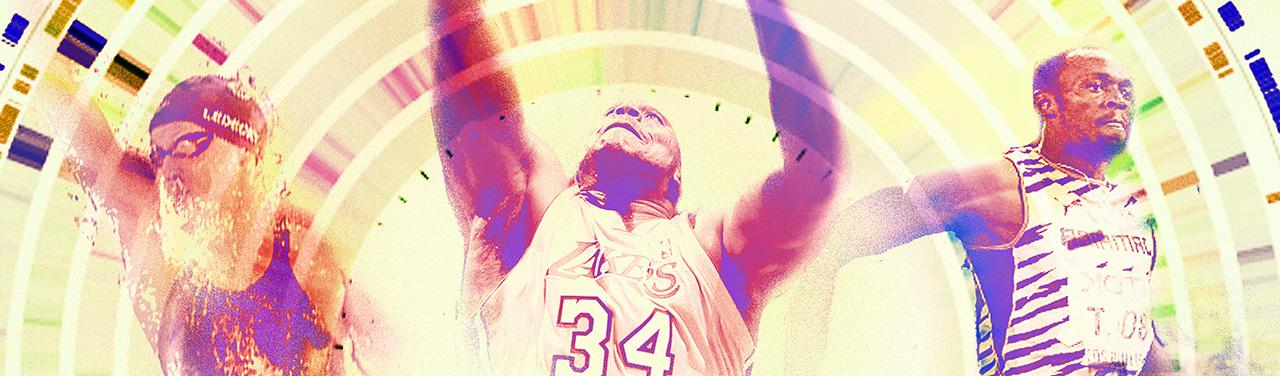
Human athletic ability might follow a similar trajectory. The nature of athletes, and the sports they compete in, are going to change due to new genomic technology. Will ordinary people lose interest? History suggests that they won’t: We love to marvel at exceptional, unimaginable ability. Lebron and Kobe and Shaq and Bolt all stimulated interest in their sports. The most popular spectator sport of 2100 might be cage fights between 8-foot-tall titans capable of balletic spinning head kicks and intricate jiu-jitsu moves. Or, just a really, really fast 100m sprint. No doping required.


Wednesday, August 10, 2016

Genetic Engineering Will Change Everything Forever (video)


This video is one of the best introductions to the coming genomic revolution that I have seen.

It emphasizes breakthroughs like CRISPR that will make gene editing simple, safe, and effective. However, it spends little time explaining how scientists will decipher genetic architectures (i.e., using big data sets and machine learning) in order understand which edits to make.

I might also quibble with the claim that a DNA edit is a permanent change to the human gene pool. If we don't like it we can always edit back to the original...

Tuesday, July 05, 2016

OUR FINAL INVENTION: Artificial Intelligence and the End of the Human Era (Future Strategist podcast)


JAMES BARRAT

My long fascination with Artificial Intelligence came to a head in 2000, when I interviewed inventor Ray Kurzweil, roboticist Rodney Brooks, and sci-fi legend Arthur C. Clarke. Kurzweil and Brooks were casually optimistic about a future they considered inevitable – a time when we will share the planet with intelligent machines. “It won’t be some alien invasion of robots coming over the hill,” Kurzweil told me, “because they’ll be made by us.” In his compound in Sri Lanka, Clarke wasn’t so sure. “I think it’s just a matter of time before machines dominate mankind,” he said. “Intelligence will win out.”

Intelligence, not charm or beauty, is the special power that enables humans to dominate Earth. Now, propelled by a powerful economic wind, scientists are developing intelligent machines. Each year intelligence grows closer to shuffling off its biological coil and taking on an infinitely faster and more powerful synthetic one. But before machine intelligence matches our own, we have a chance. We must develop a science for understanding and coexisting with smart, even superintelligent machines. If we fail, we’ll be stuck in an unwinnable dilemma. We’ll have to rely on the kindness of machines to survive. Will machines naturally love us and protect us?

Should we bet our existence on it?

Our Final Invention is about what can go wrong with the development and application of advanced AI. It’s about AI’s catastrophic downside, one you’ll never hear about from Google, Apple, IBM, and DARPA. I think it’s the most important conversation of our time, and I hope you’ll join in.


OUR FINAL INVENTION: Artificial Intelligence and the End of the Human Era

Artificial Intelligence helps choose what books you buy, what movies you see, and even who you date. It’s in your smart phone, your car, and it has the run of your house. It makes most of the trades on Wall Street, and controls our transportation, energy, and water infrastructure. Artificial Intelligence is for the 21st century what electricity was for the 20th and steam power for the 19th.

But there’s one critical difference — electricity and steam will never outthink you.

The Hollywood cliché that artificial intelligence will take over the world could soon become scientific reality as AI matches then surpasses human intelligence. Each year AI’s cognitive speed and power doubles — ours does not. Corporations and government agencies are pouring billions into achieving AI’s Holy Grail — human-level intelligence. Scientists argue that AI that advanced will have survival drives much like our own. Can we share the planet with it and survive?

Our Final Invention explores how the pursuit of Artificial Intelligence challenges our existence with machines that won’t love us or hate us, but whose indifference could spell our doom. Until now, intelligence has been constrained by the physical limits of its human hosts. What will happen when the brakes come off the most powerful force in the universe?

See also my interview on this podcast, a project of economics professor James Miller. The two key technologies which will shape the future are AI and genetic engineering.

Blog Archive

Labels