Showing posts sorted by relevance for query sidney coleman. Sort by date Show all posts

Thursday, November 03, 2011

The burden of students

I always enjoyed interacting with Sidney Coleman (sadly, now deceased) when I was a postdoc. I was quite pleased to find this interview, part of the AIP Oral History project.

His views about working with students are not surprising to me, despite the high quality of Harvard PhD students. The gap in brainpower between Sidney and even an exceptional graduate student might be vast. It's worth noting that Sidney had a large number of PhD students who became prominent theorists.

I often make the analogy between teaching (or training PhD students) and pushups or running. Perhaps unpleasant while you are doing it, but (hopefully) it makes you stronger. Certainly I learn a lot from teaching, if only from reviewing the material in preparation for lectures. If the students are exceptionally good, I might even learn things from questions asked in class.
But you do enjoy working with students, or do you?

Coleman: No. I hate it. You do it as part of the job. Well, that's of course false...or maybe more true than false when I say I hate it. Occasionally there's a student who is a joy to work with. But I certainly would be just as happy if I had no graduate students. There are plenty of colleagues around here whom I can work with. There are plenty of research fellows; junior faculty. This is true all through the Cambridge area. There's not only Harvard, there are people to work with at MIT, at Brandeis, and there are some good people at places like Northeastern... places loaded with physicists to collaborate with, to talk about physics ideas with, who are ready and KNOW basically how to do research. You know who's good and who's bad. It's not a question of their being embryonically possibly good or possibly rotten. So certainly if I want physicists to collaborate with I don't have to have graduate students. Occasionally there is a graduate student who is a joy to collaborate with. Both David (Politzer) and Eric (Weinberg) were of this kind, but they were essentially almost mature physicists. They were very bright by the time they came to me. In general, working with a graduate student is like teaching a course. It's tedious, unpleasant work. A pain in the neck. You do it because you're paid to do it. If I weren't paid to do it I certainly would never do it.
Interview with Dr. Sidney Coleman by Katherine Sopka at Harvard Physics Department, Cambridge, Massachusetts January 18, 1977.

Saturday, November 30, 2013

Feynman and the secret of magic

Lubos Motl seems to have taken offense at my last post: Feynman's Cognitive Style. This is a rather ironic outcome, given that I've been a "Feynman idolator" since I was in high school :-) In fact, I chose my college (Caltech), career, and even research specialization under his influence!

In the previous post, I noted that Feynman's cognitive profile was probably a bit lopsided -- he was stronger mathematically than verbally (these notions are ill-defined, but see the previous post and subsequent discussion). His research style was also influenced by an exceptional originality, creativity and stubborn streak of independence. Ultimately, this style may have led to greater contributions than if he had followed a more conventional path. But, it is nevertheless interesting to observe that his stubborn habit of ignoring the literature led to large gaps in his knowledge. (See earlier post for examples. Contrary to Lubos' impression I am not making fun of Feynman!) In Coleman's analysis below (taken from Gleick's Feynman biography -- the chapter on Genius), Feynman's refusal to read the literature is portrayed as a conscious choice, but I suspect it also had to do with cognitive profile, especially early in his career. Feynman often found it easier to invent his own solution to a problem than to understand someone else's published paper.

Lubos is upset that I might think that Schwinger was, at least in some ways, "smarter" than Feynman. Even so, Feynman is my hero, not Schwinger. Feynman had no rival in his generation when it came to originality and creativity. See also Success vs Ability and Out on the tail.

NYTimes: ... The generation coming up behind him, with the advantage of hindsight, still found nothing predictable in the paths of his thinking. If anything he seemed perversely and dangerously bent on disregarding standard methods. "I think if he had not been so quick people would have treated him as a brilliant quasi crank, because he did spend a substantial amount of time going down what later turned out to be dead ends," said Sidney Coleman, a theorist who first knew Feynman at Caltech in the 50's.

"There are lots of people who are too original for their own good, and had Feynman not been as smart as he was, I think he would have been too original for his own good," Coleman continued. "There was always an element of showboating in his character. He was like the guy that climbs Mont Blanc barefoot just to show that it can be done."

Feynman continued to refuse to read the current literature, and he chided graduate students who would begin their work on a problem in the normal way, by checking what had already been done. That way, he told them, they would give up chances to find something original.

"I suspect that Einstein had some of the same character," Coleman said. "I'm sure Dick thought of that as a virtue, as noble. I don't think it's so. I think it's kidding yourself. Those other guys are not all a collection of yo-yos. Sometimes it would be better to take the recent machinery they have built and not try to rebuild it, like reinventing the wheel. Dick could get away with a lot because he was so goddamn smart. He really could climb Mont Blanc barefoot."

Coleman chose not to study with Feynman directly. Watching Feynman work, he said, was like going to the Chinese opera. "When he was doing work he was doing it in a way that was just -- absolutely out of the grasp of understanding. You didn't know where it was going, where it had gone so far, where to push it, what was the next step. With Dick the next step would somehow come out of -- divine revelation."
The characterization below is one of my favorites. We all stand in awe of the magicians!
"There are two kinds of geniuses, the 'ordinary' and the 'magicians,' " wrote the mathematician Mark Kac. "An ordinary genius is a fellow that you and I would be just as good as, if we were only many times better. There is no mystery as to how his mind works. Once we understand what they have done, we feel certain that we, too, could have done it. It is different with the magicians. They are, to use mathematical jargon, in the orthogonal complement of where we are and the working of their minds is for all intents and purposes incomprehensible. Even after we understand what they have done, the process by which they have done it is completely dark. Richard Feynman is a magician of the highest caliber."

Wednesday, December 05, 2018

The Quantum Theory of Fields


Excerpt from Sidney Coleman's Erice lectures. The period he describes just predates my entry into physics.
This was a great time to be a high-energy theorist, the period of the famous triumph of quantum field theory. And what a triumph it was, in the old sense of the word: a glorious victory parade, full of wonderful things brought back from far places to make the spectator gasp with awe and laugh with joy. I hope some of that awe and joy has been captured here.
Physics students learn quantum mechanics and special relativity as undergraduates, but typically do not encounter a synthesis of the two until graduate school, in a course on quantum field theory. Undergraduate quantum mechanics focuses on non-relativistic particles, moving at much less than the speed of light (e.g., the electrons in atomic systems or ordinary matter). Special relativity, as first encountered by students, is a modification of Newtonian (classical) mechanics, and ignores quantum effects.

In quantum field theory (QFT), the wave function of quantum mechanics Ψ(x) becomes a wave functional Ψ[ Φ(x) ], valued over field configurations Φ(x) which are themselves functions of spacetime coordinates. Individual particles are excitations ("quanta") of quantum fields. I think it is fair to say that almost no student really gets a deep understanding of quantum field theory when they take it for the first time. It is simply too complex to digest quickly. QFT introduces new intuitive pictures, novel calculational tricks, strange physical and mathematical constructs.

And how could it be otherwise? All of these tools are necessary to make sense of the generalization of ordinary quantum mechanics (of a finite number of degrees of freedom) to a physical system with an infinite number of degrees of freedom.

I first took quantum field theory (Physics 205) in my last year at Caltech, taught by Fredrik Zachariasen. Zachariasen used Bjorken and Drell I and II and Ramond as the main textbooks. He was what Russian theorists sometimes refer to as a "strong calculator" -- he would fill the blackboard with equations as fast as we could note them down. However, I would say his approach to the subject was rather old-fashioned by that time, and while I learned a good bit about the Dirac equation, spinors, how to compute Feynman diagrams, and even about path integrals, my overall understanding of the subject was still lacking. If I had been there the following year I would have enjoyed John Preskill's version of 205 (see below), but alas I was already in graduate school by then.

I remember that I also studied Feynman's short volume (in the Frontiers in Physics series; not to be confused with his later popular book) Quantum Electrodynamics. I was very confused at the time about the relationship between particles and fields and about so-called Second Quantization.  Also, what happened to the Schrodinger equation? At no point did Zachariasen (nor, I think, do Bjorken and Drell) clarify that while Dirac deduced his equation via relativistic generalization of Schrodinger's, the two are not on the same logical footing.

It was only some years later that I realized that Feynman himself had been confused about these things when he wrote his early papers on the subject. (Feynman, when someone explained a creation operator and Fock space to him: "How can you create an electron? It disagrees with conservation of charge!") Do Feynman diagrams describe spacetime trajectories of particles? Or are they simply graphical representations of terms in a perturbative expansion that happen to correspond, intuitively but not exactly, to physical processes?

As a first year graduate student at Berkeley I took Physics 230 from Stanley Mandelstam, a true master of the subject. This course was far more theoretical than the one I had taken the previous year. Amazingly, Stanley taught without notes. The only day he brought a single page of paper to class was when he covered the BPHZ proof of renormalizability. (Or was it the day he derived the beta function for non-Abelian gauge theories? I might be conflating two different instances.) His lectures followed no specific textbook, although the recommended one was probably Itzykson and Zuber.

My final student encounter with a QFT course was as the grader for Physics 230, taught by Martin Halpern. (I am sad to discover, in finding this link, that Marty passed away earlier this year.) Marty was a high strung chain smoker, and I recall many hours in his office going over solutions to his homework problems. He was especially on edge that fall because Vaughan Jones from the math department (who was about to share the Fields Medal with Ed Witten!) had decided to learn QFT and was sitting in on the class. As might be expected, the mathematician's insistence on clarity and precision slowed Marty down significantly. This wasn't Marty's fault -- QFT has not, even today, been placed on a completely rigorous footing (at least, not to the satisfaction of mathematicians), even though it is (in the form of Quantum Electrodynamics and the Standard Model) the most precisely tested theoretical construct in science.

This post is long enough. Perhaps I will revisit the topic in the future with a discussion of Sidney Coleman's lectures on QFT at Harvard, where I went after graduate school. It's nice to see that these lectures have been rendered into a book by his former students. For many years one could check out videotapes (Sony Betamax!) of his lectures from the physics library at Harvard. This made me think, even then, that the future of many professors might someday be as glorified teaching assistants, helping to explain and clarify recorded or streamed lectures by the true masters.

If I have kindled your interest in the subject, I recommend my friend Tony Zee's book: Quantum Field Theory in a Nutshell. Also, John Preskill's fantastic lecture notes, covering basic as well as advanced topics. It took me some time to learn to decipher his handwriting, but it was worth it!

Let me end by noting that the physics students who took these classes with me are quite a remarkable group. Among them are a number of well-known theoretical physicists, as well as the odd startup founder, AI researcher, or hedge fund billionaire. You could do worse in this life than get to know some students of quantum field theory :-)


Sunday, December 06, 2015

The cult of genius?


In one of his early blog posts, Terence Tao (shown above with Paul Erdos in 1985) wrote
Does one have to be a genius to do maths? The answer is an emphatic NO. In order to make good and useful contributions to mathematics, one does need to work hard, learn one’s field well, learn other fields and tools, ask questions, talk to other mathematicians, and think about the “big picture”. And yes, a reasonable amount of intelligence, patience, and maturity is also required. But one does not need some sort of magic “genius gene” that spontaneously generates ex nihilo deep insights, unexpected solutions to problems, or other supernatural abilities.

The popular image of the lone (and possibly slightly mad) genius – who ignores the literature and other conventional wisdom and manages by some inexplicable inspiration (enhanced, perhaps, with a liberal dash of suffering) to come up with a breathtakingly original solution to a problem that confounded all the experts – is a charming and romantic image, but also a wildly inaccurate one, at least in the world of modern mathematics. We do have spectacular, deep and remarkable results and insights in this subject, of course, but they are the hard-won and cumulative achievement of years, decades, or even centuries of steady work and progress of many good and great mathematicians; the advance from one stage of understanding to the next can be highly non-trivial, and sometimes rather unexpected, but still builds upon the foundation of earlier work rather than starting totally anew. (This is for instance the case with Wiles‘ work on Fermat’s last theorem, or Perelman‘s work on the Poincaré conjecture.)

Actually, I find the reality of mathematical research today – in which progress is obtained naturally and cumulatively as a consequence of hard work, directed by intuition, literature, and a bit of luck – to be far more satisfying than the romantic image that I had as a student of mathematics being advanced primarily by the mystic inspirations of some rare breed of “geniuses”. This “cult of genius” in fact causes a number of problems, since nobody is able to produce these (very rare) inspirations on anything approaching a regular basis, and with reliably consistent correctness. (If someone affects to do so, I advise you to be very sceptical of their claims.) The pressure to try to behave in this impossible manner can cause some to become overly obsessed with “big problems” or “big theories”, others to lose any healthy scepticism in their own work or in their tools, and yet others still to become too discouraged to continue working in mathematics. Also, attributing success to innate talent (which is beyond one’s control) rather than effort, planning, and education (which are within one’s control) can lead to some other problems as well.
These are insightful comments, and deserve to be taken very seriously, coming as they do from the one of the youngest Fields Medalists in history and a legendary child prodigy.

But many readers misinterpreted Tao's remarks as minimizing the impact of native ability on success in research. Recently, Tao corrected this impression in the comment thread to his original post.
4 December, 2015 at 12:40 pm Terence Tao

It appears my previous comment may have have been interpreted in a manner differently from what I intended, which was as a statement of (lack of) empirical correlation rather than (lack of) causation. More precisely, the point I was trying to make with the above quote is this: if one considers a population of promising young mathematicians (e.g. an incoming PhD class at an elite mathematics department), they will almost all certainly have some reasonable level of intelligence, and some subset will have particularly exceptional levels of intelligence. A significant fraction of both groups will go on to become professional mathematicians of some decent level of accomplishment, with the fraction likely to (but not necessarily) be a bit higher when restricted to the group with exceptional intelligence. But if one were to try to use “exceptional levels of intelligence” as a predictor as to which members of the population will go on to become exceptionally successful and productive mathematicians, I believe this to be an extremely poor predictor, with the empirical correlation being low or even negative (cf. Berkson’s paradox).

Now, at the level of theoretical causation rather than empirical correlation, I would concede that if one were to take a given mathematician and somehow increase his or her level of intelligence to extraordinary levels, while keeping all other traits (e.g. maturity, work ethic, study habits, persistence, level of rigor and organisation, breadth and retention of knowledge, social skills, etc.) unchanged, then this would likely have a positive effect on his or her ability to be an extraordinarily productive mathematician. However, empirically one finds that mathematicians who did not exhibit precocious levels of intelligence in their youth are likely to be stronger in other areas which will often turn out to be more decisive in the long-term, at least when one restricts to populations that have already reached some level of mathematical achievement (e.g. admission to a top maths PhD program).

For instance, many difficult problems in mathematics require a slow, patient approach in which one methodically digests all the existing techniques in the literature and applies various combinations of them in turn to the problem, until one gets a deep enough understanding of the situation that one can isolate the key obstruction that needs to be overcome and the key new insight which, in conjunction with an appropriate combination of existing methods, will resolve the problem. A mathematician who is used to using his or her high levels of intelligence to quickly find original solutions to problems may not have the patience and stamina for such a systematic approach, and may instead inefficiently expend a lot of energy on coming up with creative but inappropriate approaches to the problem, without the benefit of being guided by the accumulated conventional wisdom gained from fully understanding prior approaches to the problem. Of course, the converse situation can also occur, in which an unusually intelligent mathematician comes up with a viable approach missed by all the more methodical people working on the problem, but in my experience this scenario is rarer than is sometimes assumed by outside observers, though it certainly can make for a more interesting story to tell.
Some comments on Tao's comment:

1. Individuals accepted into elite PhD programs in mathematics are already highly selected. I would guess, based on my familiarity with test scores of applicants to similar programs in theoretical physics, that a typical person in this population is well beyond +3 SD in overall cognitive (or at least mathematical) ability, which means fewer than one in a thousand in the general population. Tao doesn't say what he thinks the chances are for someone who has significantly less ability than this; I would say their chances at a research career in math are poor. Individuals with what Tao refers to as “exceptional levels of intelligence” would be at least +4 SD or more, making them fewer than one in ten thousand in the general population, or even much more rare. (To be totally frank I think a large fraction of good mathematicians are +4 SD and Tao is really talking about people who are exceptional even relative to them.)

2. Tao describes a schematic model with several quasi-independent input factors (raw cognitive ability, work ethic, maturity, breadth of knowledge, etc.) contributing to success. This is my working model as well. The claim that within the population of PhD students at top departments there might be only small or even negative correlation between factors such as raw ability and work ethic also seems plausible to me given a minimum threshold of undergraduate achievement (which can be obtained using various combinations of the individual factors) necessary for admission.

3. Tao's comments seem entirely consistent with results from SMPY (Study of Mathematically Precocious Youth), a longitudinal study of gifted children that finds increasing probability of success (e.g., STEM tenure at top research university) as ability increases from 99th to 99.99th percentile.


4. Should young people be made aware of the brute facts presented above? It seems terrible to limit one's ambitions based on some crudely measured construct like general cognitive ability or math ability. On the other hand, we do this all the time. When was the right time in my life to wise up about the fact that I would probably never make it to the NFL? After playing linebacker at 200 lbs for Division III Caltech (which doesn't even have a football team now), I was considering walking on at UC Berkeley as a 19 year old grad student. Should I have clung to my dream, or wised up about my dim future in Division I sports? :-)

5. Related to Tao's last remark the converse situation can also occur, in which an unusually intelligent mathematician comes up with a viable approach missed by all the more methodical people, see Sidney Coleman on Feynman:
"I think if he had not been so quick people would have treated him as a brilliant quasi crank, because he did spend a substantial amount of time going down what later turned out to be dead ends," said Sidney Coleman, a theorist who first knew Feynman at Caltech in the 50's.

"There are lots of people who are too original for their own good, and had Feynman not been as smart as he was, I think he would have been too original for his own good," Coleman continued. "There was always an element of showboating in his character. He was like the guy that climbs Mont Blanc barefoot just to show that it can be done."

Feynman continued to refuse to read the current literature, and he chided graduate students who would begin their work on a problem in the normal way, by checking what had already been done. That way, he told them, they would give up chances to find something original.

"I suspect that Einstein had some of the same character," Coleman said. "I'm sure Dick thought of that as a virtue, as noble. I don't think it's so. I think it's kidding yourself. Those other guys are not all a collection of yo-yos. Sometimes it would be better to take the recent machinery they have built and not try to rebuild it, like reinventing the wheel. Dick could get away with a lot because he was so goddamn smart. He really could climb Mont Blanc barefoot."


Related posts:

Success, Ability and All That

One hundred thousand brains

Bezos on the Big Brains

Annals of psychometry: IQs of eminent scientists

What is the difference?

Colleges ranked by Nobel, Fields, Turing and National Academies output

Out on the tail

Tuesday, October 08, 2013

Nobels for Higgs and Englert


Congratulations to Peter Higgs and François Englert on their Nobel prize. A bit of background from an earlier post How the Higgs boson became the Higgs boson:
IIRC, I met Peter Higgs in Erice in 1990. He was quite a nice fellow, but the story below by Steve Weinberg illustrates how capricious is the allocation of credit in science.

NYBooks: (Footnote 1) In his recent book, The Infinity Puzzle (Basic Books, 2011), Frank Close points out that a mistake of mine was in part responsible for the term “Higgs boson.” In my 1967 paper on the unification of weak and electromagnetic forces, I cited 1964 work by Peter Higgs and two other sets of theorists. This was because they had all explored the mathematics of symmetry-breaking in general theories with force-carrying particles, though they did not apply it to weak and electromagnetic forces. As known since 1961, a typical consequence of theories of symmetry-breaking is the appearance of new particles, as a sort of debris. A specific particle of this general class was predicted in my 1967 paper; this is the Higgs boson now being sought at the LHC.
As to my responsibility for the name “Higgs boson,” because of a mistake in reading the dates on these three earlier papers, I thought that the earliest was the one by Higgs, so in my 1967 paper I cited Higgs first, and have done so since then. Other physicists apparently have followed my lead. But as Close points out, the earliest paper of the three I cited was actually the one by Robert Brout and François Englert. In extenuation of my mistake, I should note that Higgs and Brout and Englert did their work independently and at about the same time, as also did the third group (Gerald Guralnik, C.R. Hagen, and Tom Kibble). But the name “Higgs boson” seems to have stuck.

[ Note that to Higgs' credit his is the only paper that clearly works out the properties of the excitation now known as the Higgs boson. ]
Jeffrey Goldstone showed (1961) that when rigid ("global") continuous symmetries are spontaneously broken by the vacuum (the vacuum configuration is not invariant under the symmetry), a massless boson necessarily results. This boson is the eponymous Goldstone boson: the particle excitation corresponding to small perturbations of the vacuum state in the direction of the symmetry. The natural next step is to ask what happens if the broken symmetry is a gauge (local) symmetry. This is the problem that Higgs et al. solved. But Goldstone had one of the first cracks at the problem. Indeed, Jeffrey deduced the existence of a massive excitation (i.e., the Higgs boson), but its physical reality was in question -- only apparent in certain "choices of gauge"; gauge theory was not then very well understood. According to legend, Sidney Coleman convinced Goldstone that the boson was only a gauge artifact. For years afterward Goldstone would say that Sidney, despite his obvious brilliance, was, when it really counted, always wrong!

I met Englert for the first time in 2008 at a workshop in Paris on the black hole information problem. Over coffee, he explained to me some mysterious comments 't Hooft had made in his talk. A real gentleman, and still very sharp.

A photo from the summer school in Erice, Sicily 1990. Higgs is in the blue socks and sandals, holding a glass of wine. I'm in a maroon shirt two rows back.


A portrait of Higgs in the physics department of the University of Edinburgh.

Wednesday, November 21, 2007

Monster minds

There's a story in Surely You're Joking, Mr. Feynman, about the first seminar Feynman gives at Princeton. He's just a graduate student, working on a formulation of electromagnetism in terms of advanced and retarded potentials with his advisor Wheeler:

...So it was to be my first technical talk, and Wheeler made arrangements with Eugene Wigner to put it on the regular seminar schedule.

A day or two before the talk I saw Wigner in the hall. "Feynman," he said, "I think that work you're doing with Wheeler is very interesting, so I've invited Russell to the seminar." Henry Norris Russell, the famous, great astronomer of the day, was coming to the lecture!

Wigner went on. "I think Professor von Neumann would also be interested." Johnny von Neumann was the greatest mathematician around. "And Professor Pauli is visiting from Switzerland, it so happens, so I've invited Professor Pauli to come" - Pauli was a very famous physicist- and by that time, I'm turning yellow. Finally, Wigner said, "Professor Einstein only rarely comes to our weekly seminars, but your work is so interesting that I've invited him specially, so he's coming too."

By this time I must have turned green... Then came the time for the talk and here are these monster minds in front of me waiting!

Last Friday Sean Carroll emailed me to ask if I'd give a short blackboard talk at an informal cosmology meeting they have on Monday morning at Caltech. My real talk was in the afternoon, so I said, sure, no problem. I thought I'd mainly be talking to grad students and postdocs, so I didn't prepare anything. My plan was to give some background on entropy, information, black holes, etc. so that they could better follow the afternoon talk.

To my surprise, rather than a bunch of grad students I found monster minds arrayed around the big oak table in 469 Lauritsen: Carroll, Kamionkowski, Wise, Preskill, Politzer (Nobel laureate), Ooguri and Stanley Deser! No need for elementary background. I was kind of nervous at first, but we ended up having a lively discussion that lasted over 90 minutes -- I pretty much covered my whole talk using the blackboard, and ended up giving it again using slides later in the day. We had a funny moment when I first started discussing the ADM energy of the monsters. I looked over at Deser (the "D" in ADM) and smiled; he smiled back and nodded slightly :-) Having Stanley in the audience helped a lot because the entropy packing I described depends on using negative gravitational binding energy to nearly cancel the energy of the constituent matter. He was quite familiar with these constructions and helped convince the audience that I wasn't nuts.

Ten years ago I wrote a paper (unpublished) showing how to obtain a zero energy configuration in GR out of massive constituents. Particle theorists I discussed it with all thought I was crazy, but the referee was a very erudite relativist, who pointed out that a similar result (using different constructions) had been obtained by ADM, Novikov and Zeldovich, and others long ago. (So my result wasn't really new, but at least it wasn't wrong...) I had suspected Deser of being the referee but he said it wasn't him. He thought it might have been Wald... :-)

I had a wonderful visit, clouded only by the news (received by email on my cellphone while chatting with Sean) that Sidney Coleman had passed away on Sunday.

Saturday, February 27, 2021

Infinity and Solipsism, Physicists and Science Fiction

The excerpt below is from Roger Zelazny's Creatures of Light and Darkness (1969), an experimental novel which is somewhat obscure, even to fans of Zelazny. 
Positing infinity, the rest is easy. 
The Prince Who Was A Thousand is ... a teleportationist, among other things ... the only one of his kind. He can transport himself, in no time at all, to any place that he can visualize. And he has a very vivid imagination. 
Granting that any place you can think of exists somewhere in infinity, if the Prince can think of it too, he is able to visit it. Now, a few theorists claim that the Prince’s visualizing a place and willing himself into it is actually an act of creation. No one knew about the place before, and if the Prince can find it, then perhaps what he really did was make it happen. However, positing infinity, the rest is easy.
This contains already the central idea that is expressed more fully in Nine Princes in Amber and subsequent books in that series.
While traveling (shifting) between Shadows, [the prince] can alter reality or create a new reality by choosing which elements of which Shadows to keep or add, and which to subtract.
Creatures of Light and Darkness also has obvious similarities to Lord of Light, which many regard as Zelazny's best book and even one of the greatest science fiction novels ever written. Both have been among my favorites since I read them as a kid.

Infinity, probability measures, and solipsism have received serious analysis by theoretical physicists: see, e.g.,  Boltzmann brains. (Which is less improbable: the existence of the universe around you, or the existence of a single brain whose memory records encode that universe?) Perhaps this means theorists have too much time on their hands, due to lack of experimental progress in fundamental physics. 

Science fiction is popular amongst physicists, but I've always been surprised that the level of interest isn't even higher. Two examples I know well: the late Sidney Coleman and my collaborator Bob Scherrer at Vanderbilt were/are scholars and creators of the genre. See these stories by Bob, and Greg Benford's Remembing Sid
... Sid and some others created a fannish publishing house, Advent Publishers, in 1956. He was a teenager when he helped publish Advent’s first book, Damon Knight’s In Search of Wonder. ... 
[Sid] loved SF whereas Einstein deplored it. Lest SF distort pure science and give people the false illusion of scientific understanding, Einstein recommended complete abstinence from any type of science fiction. “I never think of the future. It comes soon enough,” he said.
While I've never written science fiction, occasionally my research comes close -- it has at times addressed questions of the form: 

Do the Laws of Nature as we know them allow ... 

This research might be considered as the ultimate in hard SF ;-) 
Wikipedia: Hard science fiction is a category of science fiction characterized by concern for scientific accuracy and logic.

Note Added: Bob Scherrer writes: In my experience, about 1/3 of research physicists are SF fans, about 1/3 have absolutely no interest in SF, and the remaining 1/3 were avid readers of science fiction in middle school/early high school but then "outgrew" it.

Here is a recent story by Bob which I really enjoyed -- based on many worlds quantum mechanics :-) 

It was ranked #2 in the 2019 Analog Magazine reader poll!

Note Added 2: Kazuo Ishiguro (2017 Nobel Prize in Literature) has been evolving into an SF/fantasy writer over time. And why not? For where else can one work with genuinely new ideas? See Never Let Me Go (clones), The Buried Giant (post-Arthurian England), and his latest book Klara and the Sun.
NYTimes: ... we slowly discover (and those wishing to avoid spoilers should now skip to the start of the next paragraph), the cause of Josie’s mysterious illness is a gene-editing surgery to enhance her intellectual faculties. The procedure carries high risks as well as potential high rewards — the main one being membership in a professional superelite. Those who forgo or simply can’t afford it are essentially consigning themselves to economic serfdom.
WSJ: ... Automation has created a kind of technological apartheid state, which is reinforced by a dangerous “genetic editing” procedure that separates “lifted,” intellectually enhanced children from the abandoned masses of the “unlifted.” Josie is lifted, but the procedure is the cause of her illness, which is often terminal. Her oldest friend and love interest, Rick, is unlifted and so has few prospects despite his obvious brilliance. Her absentee father is an engineer who was outsourced by machines and has since joined a Community, one of the closed groups formed by those lacking social rank. In a conversational aside it is suggested that the Communities have self-sorted along racial lines and are heavily armed.

Thursday, March 10, 2022

Vlatko Vedral: Oxford Theoretical Physicist on Quantum Superposition of Living Creatures — Manifold Podcast #7


Vlatko Vedral is Professor in the Department of Physics at the University of Oxford and Centre for Quantum Technologies (CQT) at the National University of Singapore. He is known for his research on the theory of Entanglement and Quantum Information Theory. 

Steve and Vlatko discuss: 

1. History of quantum information theory, entanglement, and quantum computing 

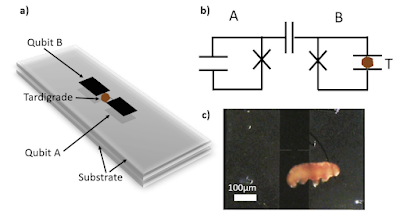
2. Recent lab experiments that create superposition states of macroscopic objects, including a living creature (tardigrade) 

3. Whether quantum mechanics implies the existence of many worlds: are you in a superposition state right now? 

4. Present status and future of quantum computing

Resources 


Entanglement Between Superconducting Qubits and a Tardigrade: https://arxiv.org/pdf/2112.07978.pdf 

Macroscopic Superposition States: entanglement of a macroscopic living organism (tardigrade) with a superconducting qubit (Infoproc blog discussion including Sidney Coleman talk Quantum Mechanics In Your Face!) 

Sunday, July 22, 2007

Many Worlds: A brief guide for the perplexed

I added this to the earlier post 50 years of Many Worlds and thought I would make it into a stand alone post as well.

Many Worlds: A brief guide for the perplexed

In quantum mechanics, states can exist in superpositions, such as (for an electron spin)

(state)   =   (up)   +   (down)

When a measurement on this state is performed, the Copenhagen interpretation says that the state (wavefunction) "collapses" to one of the two possible outcomes:

(up)     or     (down),

with some probability for each outcome depending on the initial state (e.g., 1/2 and 1/2 of measuring up and down). One fundamental difference between quantum and classical mechanics is that even if we have specified the state above as precisely as is allowed by nature, we are still left with only a probabilistic prediction for what will happen next. In classical physics knowing the state (e.g., position and velocity of a particle) allows perfect future prediction.

There is no satisfactory understanding of how or exactly when the Copenhagen wavefunction "collapse" proceeds. Indeed, collapse introduces confusing issues like consciousness: what, exactly, constitutes an "observer", capable of causing the collapse?

Everett suggested we simply remove wavefunction collapse from the theory. Then the state evolves in time always according to the Schrodinger equation. In fact, the whole universe can be described by a "universal wave function" which evolves according to the Schrodinger equation and never undergoes Copenhagen collapse.

Suppose we follow our electron state through a device which measures its spin. For example: by deflecting the electron using a magnetic field and recording the spin-dependent path of the deflected electron using a detector which amplifies the result. The result is recorded in some macroscopic way: e.g., a red or green bulb lights up depending on whether deflection was up or down. The whole process is described by the Schrodinger equation, with the final state being

(state)   =   (up) (device recorded up)   +   (down) (device recorded down)

Here "device" could, but does not necessarily, refer to the human or robot brain which saw the detector bulb flash. What matters is that the device is macroscopic and has a large (e.g., Avogadro's number) number of degrees of freedom. In that case, as noted by Everett, the two sub-states of the world (or device) after the measurement are effectively orthogonal (have zero overlap). In other words, the quantum state describing a huge number of emitted red photons and zero emitted green photons is orthogonal to the complementary state.

If a robot or human brain is watching the experiment, it perceives a unique outcome just as predicted by Copenhagen. That is, any macroscopic information processing device ends up in one of the possible macroscopic states (red light vs green light flash). The amplitude for those macroscopically different states to interfere is exponentially small, hence they can be treated thereafter as completely independent "branches" of the wavefunction.

Success! The experimental outcome is predicted by a simpler (sans collapse) version of the theory. The tricky part: there are now necessarily parts of the final state (wavefunction) describing both the up and down outcomes (I saw red vs I saw green). These are the many worlds of the Everett interpretation.

Personally, I prefer to call it No Collapse instead of Many Worlds -- why not emphasize the advantageous rather than the confusing part of the interpretation?

Some eminent physicists who (as far as I can tell) believe(d) in MW: Feynman, Gell-Mann, Hawking, Steve Weinberg, Bryce DeWitt, David Deutsch, Sidney Coleman ... In fact, I was told that Feynman and Gell-Mann each claim(ed) to have independently invented MW, without any knowledge of Everett!

Friday, December 17, 2021

Macroscopic Superposition States: entanglement of a macroscopic living organism (tardigrade) with a superconducting qubit


I have waited for this development since 2009 (see old post below). 
 
The fact that a macroscopic, living organism can be placed in a superposition state may come as a shock to many people, including a number of physicists. 

If a tardigrade can exist in a superposition state, why can't you? 

Are you in a superposition state right now? 

Is there some special class of objects that "collapse wavefunctions"? (Copenhagen) ... It's ridiculous, absurd. In any case we now know that tardigrades are not in that class.

Entanglement between superconducting qubits and a tardigrade 
https://arxiv.org/pdf/2112.07978.pdf 
K. S. Lee et al. 
Quantum and biological systems are seldom discussed together as they seemingly demand opposing conditions. Life is complex, "hot and wet" whereas quantum objects are small, cold and well controlled. Here, we overcome this barrier with a tardigrade -- a microscopic multicellular organism known to tolerate extreme physiochemical conditions via a latent state of life known as cryptobiosis. We observe coupling between the animal in cryptobiosis and a superconducting quantum bit and prepare a highly entangled state between this combined system and another qubit. The tardigrade itself is shown to be entangled with the remaining subsystems. The animal is then observed to return to its active form after 420 hours at sub 10 mK temperatures and pressure of 6×10⁻⁶ mbar, setting a new record for the conditions that a complex form of life can survive.

From the paper: 

In our experiments, we use specimens of a Danish population of Ramazzottius varieornatus Bertolani and Kinchin, 1993 (Eutardigrada, Ramazzottiidae). The species belongs to phylum Tardigrada comprising of microscopic invertebrate animals with an adult length of 50-1200 µm [12]. Importantly, many tardigrades show extraordinary survival capabilities [13] and selected species have previously been exposed to extremely low temperatures of 50 mK [14] and low Earth orbit pressures of 10−19 mbar [15]. Their survival in these extreme conditions is possible thanks to a latent state of life known as cryptobiosis [2, 13]. Cryptobiosis can be induced by various extreme physicochemical conditions, including freezing and desiccation. Specifically, during desiccation, tardigrades reduce volume and contract into an ametabolic state, known as a “tun”. Revival is achieved by reintroducing the tardigrade into liquid water at atmospheric pressure. In the current experiments, we used dessicated R. varieornatus tuns with a length of 100-150 µm. Active adult specimens have a length of 200-450 µm. The revival process typically takes several minutes. 
We place a tardigrade tun on a superconducting transmon qubit and observe coupling between the qubit and the tardigrade tun via a shift in the resonance frequency of the new qubit-tardigrade system. This joint qubit-tardigrade system is then entangled with a second superconducting qubit. We reconstruct the density matrix of this coupled system experimentally via quantum state tomography. Finally, the tardigrade is removed from the superconducting qubit and reintroduced to atmospheric pressure and room temperature. We observe the resumption of its active metabolic state in water.
****

Note Added: I wrote this post the day after getting a Covid booster and a shingles vaccine, so I was a little zonked out and was not able to look at the details at the time. 

The authors claim that the B qubit states B0 and B1 are entangled with two different internal states of T (tardigrade): B0 T0 , B1 T1. Then they further entangle B with the other qubit A to make more complex states. 

In the supplement they analyze the density matrix for this d=8 Hilbert space, and claim to have measured quantities which imply tripartite entanglement. The results seem to depend on theoretical modeling -- I don't think they made any direct measurements on T. 

They do not present any uncertainty analysis of the tripartite entanglement measure π.

The line in the main body of the paper that sounds convincing is We reconstruct the density matrix of this coupled system experimentally via quantum state tomography (see Fig 3), but the devil is in the details:
... a microscopic model where the charges inside the tardigrade are represented as effective harmonic oscillators that couple to the electric field of the qubit via the dipole mechanism... [This theoretical analysis results in the B0 T0 , B1 T1 system where T0 T1 are effective qubits formed of tardigrade internal degrees of freedom.] 
... We applied 16 different combinations of one-qubit gates on qubit A and dressed states of the joint qubit B-tardigrade system. We then jointly readout the state of both qubits using the cavity ...
      
Some commentary online is very skeptical of their claims, see here for example.

More (12/23/2021): One of the co-authors is Vlatko Vedral, a well-known theorist who works in this area. His recent blog post Entangled Tardigrades is worth a look. 

After thinking a bit more, the  B0 T0 , B1 T1  description of the system seems plausible to me. So, although they don't make direct measurements on T (only on the combined B-T system), it does seem reasonable to assert that the tardigrade (or at least some collective degree of freedom related to internal charges of it) has been placed into a superposition state. 

****


See this 2009 post: Schrodinger's virus
If the creature above (a tardigrade arthropod) can be placed in a superposition state, will you accept that you probably can be as well? And once you admit this, will you accept that you probably actually DO exist in a superposition state already?
It may be disturbing to learn that we live in a huge quantum multiverse, but was it not also disturbing for Galileo's contemporaries to learn that we live on a giant rotating sphere, hurtling through space at 30 kilometers per second? E pur si muove!
Related posts:  Gork revisited 2018  ,  Feynman and Everett


Of course there is no wavefunction collapse, only unitary evolution. 

Many people are confused about this -- they have not recovered from what they were taught as beginning students. They still believe in the Tooth Fairy ;-) 

You are Gork! 


Gork is a robot name made up by Sidney Coleman for his talk Quantum Mechanics, In Your Face! (video, Gork @40m or so). Before the word entanglement became fashionable, Sidney summarized this talk to me in his office as "Quantum Mechanics is just a theory of correlations, and we live in this tangle of correlations." He may not have said "tangle" -- I am not sure. But he was describing the Everett formulation, trying not to scare a young postdoc :-)


Macroscopic Superpositions in Isolated Systems 
R. Buniy and S. Hsu 
arXiv:2011.11661, to appear in Foundations of Physics 
For any choice of initial state and weak assumptions about the Hamiltonian, large isolated quantum systems undergoing Schrodinger evolution spend most of their time in macroscopic superposition states. The result follows from von Neumann's 1929 Quantum Ergodic Theorem. As a specific example, we consider a box containing a solid ball and some gas molecules. Regardless of the initial state, the system will evolve into a quantum superposition of states with the ball in macroscopically different positions. Thus, despite their seeming fragility, macroscopic superposition states are ubiquitous consequences of quantum evolution. We discuss the connection to many worlds quantum mechanics.

2021 witnessed other demonstrations of macroscopic entanglement: Quantum entanglement of two macroscopic objects is the Physics World 2021 Breakthrough of the Year.
... Quantum technology has made great strides over the past two decades and physicists are now able to construct and manipulate systems that were once in the realm of thought experiments. One particularly fascinating avenue of inquiry is the fuzzy border between quantum and classical physics. In the past, a clear delineation could be made in terms of size: tiny objects such as photons and electrons inhabit the quantum world whereas large objects such as billiard balls obey classical physics.
Over the past decade, physicists have been pushing the limits of what is quantum using drum-like mechanical resonators measuring around 10 microns across. Unlike electrons or photons, these drumheads are macroscopic objects that are manufactured using standard micromachining techniques and appear as solid as billiard balls in electron microscope images (see figure). Yet despite the resonators’ tangible nature, researchers have been able to observe their quantum properties, for example, by putting a device into its quantum ground state as Teufel and colleagues did in 2017.
This year, teams led by Teufel and Kotler and independently by Sillanpää went a step further, becoming the first to quantum-mechanically entangle two such drumheads. The two groups generated their entanglement in different ways. While the Aalto/Canberra team used a specially chosen resonant frequency to eliminate noise in the system that could have disturbed the entangled state, the NIST group’s entanglement resembled a two-qubit gate in which the form of the entangled state depends on the initial states of the drumheads. ...

Blog Archive

Labels