Glenn Luk has worked as an investment banker, private equity investor, and startup founder. He has closely analyzed aspects of the Chinese economy, including its GDP and high speed rail system.
Steve and Glenn discuss:
(00:00) - Introduction
(01:21) - Glenn Luk's Background: HK, Taiwan, China
(07:59) - Evolution of Chinese Companies and Economy
(14:58) - From Banking to Private Equity and Venture Capital
(23:08) - Founding a Healthcare Startup and Entrepreneurial Ventures
(26:35) - China's Development and Economic Policies
(41:17) - Comparing US and China's Economies and Cultures
(47:12) - Demographics and Consumer Behavior in China
(49:09) - China's Economy: Beyond GDP
(56:34) - High Speed Rail: huge success, or white elephant?
Russell Clark is a hedge fund investor who has lived and worked in both Japan and China. He writes the widely followed Substack Capital Flows and Asset Markets: https://www.russell-clark.com/
Steve and Russell discuss:
0:00 Introduction
0:52 Russell's background and experiences in Japan
13:25 Hong Kong and finance
31:53 China property bubble
48:54 Dollar status as global reserve currency
56:09 Japan and China economies from a long run perspective
1:05:07 Inflation, US economy, and macro observations
Yasheng Huang is the Epoch Foundation Professor of Global Economics and Management at the MIT Sloan School of Management. His new book is The Rise and Fall of the EAST: How Exams, Autocracy, Stability, and Technology Brought China Success, and Why They Might Lead to Its Decline.
Steve and Yasheng discuss:
0:00 Introduction
1:11 From Beijing to Harvard in the 1980s
15:29 Civil service exams and Huang's new book, "The Rise and Fall of the EAST"
37:14 Two goals: Developing human capital and indoctrination
48:33 Impact of the exam system
57:04 China's innovation peak and decline
1:12:23 Collaboration and relationship with the West
1:21:31 How will the U.S.-China relationship evolve?
David Paul Goldman is an American economic strategist and author, best known for his series of online essays in the Asia Times under the pseudonym Spengler with the first column published January 1, 2000.
Steve and David discuss:
0:00 Introduction
2:22 David’s background in music, finance, and Asia
16:55 Looking back at the financial crisis
23:04 Rise of the Chinese economy
29:44 How Huawei’s strength is tied to China’s economic power
36:49 Competition in the global electric vehicles market
38:06 Why David thinks European countries like Germany will become closer with China
45:29 U.S. manufacturing is falling behind
52:08 Potential for war and ongoing U.S.-China competition
Gregory Clark is Distinguished Professor of Economics at UC-Davis. He is an editor of the European Review of Economic History, chair of the steering committee of the All-UC Group in Economic History, and a Research Associate of the Center for Poverty Research at Davis. He was educated at Cambridge University and received a PhD from Harvard University.
His areas of research are long-term economic growth, the wealth of nations, economic history, and social mobility.
Steve and Greg discuss:
0:00 Introduction
2:31 Background in economics and genetics
10:25 The role of genetics in determining social outcomes
16:27 Measuring social status through marriage and occupation
36:15 Assortative mating and the industrial revolution
49:38 Criticisms of empirical data, engagement on genetics and economic history
1:12:12 Heckman and Landerso study of social mobility in US vs Denmark
1:24:32 Predicting cognitive traits
1:33:26 Assortative mating and increase in population variance
Sebastian Mallaby is a writer and journalist whose work covers financial markets, international relations, innovation, and technology. He is the author of "The Power Law: Venture Capital and the Making of the New Future."
Steve and Sebastian discuss venture capital, tech startups, business model and technology innovation, global adoption of the Silicon Valley model, and the future of innovation.
I've had numerous requests to comment on the conflict in Ukraine, but have been too busy to write anything.
For background on the situation, I highly recommend the discussion in the video below, released March 3 2022.
To save time, just listen to the presentations by Mearsheimer and McGovern, and their final comments at the end of the video. Both present historical details from the last decade or so that will shock people who only pay attention to mainstream Western media. (Also in the discussion: Jack Matlock, former US Ambassador to the Soviet Union, and Ted Postol, MIT professor and missile expert.)
Ray McGovern is a retired CIA analyst who served as Chief of the Soviet Foreign Policy Branch and preparer/briefer of the President’s Daily Brief. I featured another interview with him in an earlier post on the US catastrophe in Afghanistan: Tragedy of Empire / Mostly Sociopaths at the Top.
Corey Washington and I interviewed John Mearsheimer for the original Manifold, but the episode was not released. It's possible that I might release it some time in the future.
While military and diplomatic aspects of the conflict in Ukraine are worthy of attention, far more important are the long term consequences of Western hysteria and economic war on Russia. Tacit support for Russia from China, India, Brazil, Turkey, OPEC states, indeed perhaps the majority of the world population, may presage a new era of multipolarity and hard power confrontation between great powers.
Why do educated citizens of the countries listed above understand the situation better than the typical American or European? Because they are familiar with Western media propaganda and the history of US imperialism. They are much more likely to understand the facts described by Mearsheimer and McGovern about the recent history of NATO, Ukraine, and Russia leading up to this conflict.
PS I'm surprised there isn't more discussion of systemic risks from defaults of highly networked financial entities that are affected by sanctions on Russia.
This looks dangerous -- like the Lehman Brothers bankruptcy in 2008. Or am I missing some structural reforms that prevent that from happening again? (Maybe the earlier round of sanctions have already decoupled Russia enough...) Or will the central banks that effectively run our economies now simply issue a blanket put, allowing all of our clever money men to go back to sleep? People used to complain about "zombie companies" in some countries with excessive state intervention in their economies. It looks to me like we've had zombie financial markets for some time now...
Of course I think individuals in TW and UKR have every right to vote / fight for the government they want.
But they are not likely to get their way as the issue is much more important to their giant neighbor (RUS, PRC) than to the USA or soft Europeans in Brussels.
They are probably better off negotiating a peaceful coexistence with the nearby great power. Finland "Finlandized" itself and that was probably the best it could do...
What you are seeing right now in UKR is what great power realists like Mearsheimer *predicted* would happen IF the West gave too much hope to UKR without being willing to actually back it up.
Now, you may say that Joe Smith in Iowa *should* want to back up UKR or TW, send his son to fight on the front lines there. But it is not the case and we know that. We also knew it 10-15y ago when NATO expansion mischief got started and Mearsheimer made his early cautionary statements on this, as did Kennan, Nitze, Perry, Sam Nunn -- all the old cold warriors who ACTUALLY DEFEATED USSR and understood things better than today's leaders.
US won't even sanction RUS energy imports to this country... How much pain are we willing to endure for UKR?
We're going to fight this war to the last Ukrainian... If there isn't a negotiated settlement soon UKR will end up like Iraq and Afghanistan -- abandoned by the US and destroyed.
I can predict something very similar for TW, even though I have extended family living there right now. Does that count towards emotional commitment / empathy? I'm descended from KMT military officers on both sides of my family tree!
TW should negotiate for the best deal it can get from PRC and not count on the US to protect it.
######
US war hawks want to see PRC blow itself up fighting for TW. The conflict will destroy Asian economies and leave USA largely unscathed (just as WWII did). They don't care about the well-being of ~2-3 billion Asians.
Some of them just can't help themselves and want to see RUS blow itself up fighting in a UKR trap. But this group is very stupid as they are driving RUS into the arms of PRC and that is going to be very bad for USA.
Some US war hawks are smarter than others...
######
US to Ukraine, pointing at Russia: "Let's you and him fight."
######
William Burns is Biden's CIA Director, and was Ambassador to the Russian Federation. What did he write about Ukraine and NATO expansion? From Peter Beinart's substack:
Two years ago, Burns wrote a memoir entitled, The Back Channel. It directly contradicts the argument being proffered by the administration he now serves. In his book, Burns says over and over that Russians of all ideological stripes—not just Putin—loathed and feared NATO expansion. He quotes a memo he wrote while serving as counselor for political affairs at the US embassy in Moscow in 1995. ‘Hostility to early NATO expansion,” it declares, “is almost universally felt across the domestic political spectrum here.” On the question of extending NATO membership to Ukraine, Burns’ warnings about the breadth of Russian opposition are even more emphatic. “Ukrainian entry into NATO is the brightest of all redlines for the Russian elite (not just Putin),” he wrote in a 2008 memo to then-Secretary of State Condoleezza Rice. “In more than two and a half years of conversations with key Russian players, from knuckle-draggers in the dark recesses of the Kremlin to Putin’s sharpest liberal critics, I have yet to find anyone who views Ukraine in NATO as anything other than a direct challenge to Russian interests.”
While the Biden administration claims that Putin bears all the blame for the current Ukraine crisis, Burns makes clear that the US helped lay its foundations. By taking advantage of Russian weakness, he argues, Washington fueled the nationalist resentment that Putin exploits today. Burns calls the Clinton administration’s decision to expand NATO to include Poland, Hungary, and the Czech Republic “premature at best, and needlessly provocative at worst.” And he describes the appetite for revenge it fostered among many in Moscow during Boris Yeltsin’s final years as Russia’s president. “As Russians stewed in their grievance and sense of disadvantage,” Burns writes, “a gathering storm of ‘stab in the back’ theories slowly swirled, leaving a mark on Russia’s relations with the West that would linger for decades.”
As the Bush administration moved toward opening NATO’s doors to Ukraine, Burns’ warnings about a Russian backlash grew even starker. He told Rice it was “hard to overstate the strategic consequences” of offering NATO membership to Ukraine and predicted that “it will create fertile soil for Russian meddling in Crimea and eastern Ukraine.” Although Burns couldn’t have predicted the specific kind of meddling Putin would employ—either in 2014 when he seized Crimea and fomented a rebellion in Ukraine’s east or today—he warned that the US was helping set in motion the kind of crisis that America faces today. Promise Ukraine membership in NATO, he wrote, and “There could be no doubt that Putin would fight back hard.”
Were a reporter to read Burns’ quotes to White House press secretary Jen Psaki today, she’d likely accuse them of “parroting Russian talking points.” But Burns is hardly alone. From inside the US government, many officials warned that US policy toward Russia might bring disaster. William Perry, Bill Clinton’s Defense Secretary from 1994 to 1997, almost resigned because of his opposition to NATO expansion. He has since declared that because of its policies in the 1990s, “the United States deserves much of the blame” for the deterioration in relations with Moscow. Steven Pifer, who from 1998 to 2000 served as US ambassador to Ukraine, has called Bush’s 2008 decision to declare that Ukraine would eventually join NATO “a real mistake.” Fiona Hill, who gained fame during the Trump impeachment saga, says that as national intelligence officers for Russia and Eurasia she and her colleagues “warned” Bush that “Putin would view steps to bring Ukraine and Georgia closer to NATO as a provocative move that would likely provoke pre-emptive Russian military action.”
Oh, there's some historical background to all this? Some context? Wait I'm told every day this crisis just happened because Putin went crazy and wants to rebuild the USSR / Russian Empire.
Who is full of crap? Western governments and media today, or our CIA Director and former Ambassadors and Secretaries of Defense? The whole world ex-USA/EU can see this. It's only Westerners who are brainwashed.
Added March 7 2022: This is a long Chinese analysis of the military aspects of the war so far. They also cite Oryx estimates. Note comparisons near the end of Russian and PLA capabilities.
I certainly sympathize with "Putin bad", "Russia bad place for me to live", "democracy good" sentiments.
But suppose the realistic possible outcomes are:
1. Ukr is dominated by Russia but not destroyed in a war
2. Ukr is dominated by Russia after a brutal war, with its economy destroyed
3. (Low probability) Ukr escapes Russian domination thanks to strong US support (avoiding WWIII).
4. (Low probability) US strongly supports Ukr, leading to MAD, WWIII
To be very definite, suppose that
I. Given actual past US policies of ~2010-2022 probabilities are P(#1) = P(#2) = 45% and P(#3) = 9% and P(#4) = 1%
II. Following advice of Mearsheimer, frmr SecDefs Perry and McNamara, CIA director Burns, etc. etc. we have
P(#1) = 95% P(#2) = 4%, others much less than 1%. [ i.e., this is a counterfactual scenario that, in my opinion, turns out better! ]
I think this is a REALISTIC characterization. You may disagree. Under my assumptions II is better than I.
But this is not primarily a normative or moral discussion... we don't disgree there.
Note, in a standard utilitarian framework P(#4) dominates everything else!
I agree with Louis Gave's take on most of the topics discussed. Gavekal manages a China fixed income fund and some other China-focused funds, so he is talking his book. But the arguments stand on their own.
At ~45m, a good discussion of digital RMB and why it will break the technology record for fastest adoption by first 1 billion users. See earlier discussion (Ray Dalio) on de-dollarization and digital RMB here.
Insights from Ray Dalio and Paul Kennedy (The Rise and Fall of the Great Powers, 1987) on the balance of power and future global order. I was in graduate school when Kennedy's book was first published and I still have the hardcover first edition somewhere. Dalio and Kennedy have both carefully studied historical examples and present, in my opinion, a realistic view of what is happening. Kennedy mentions the PRC naval build up as a very explicit, material comparison of strength, whereas Dalio focuses on financial and economic matters. Elizabeth Economy provides some interesting comments on internal Chinese politics, but I am unsure how much insight any US analysts can have into the fine details of this.
The Naval War College Review article mentioned by Paul Kennedy is:
Panelists discuss the rise and fall of great powers and the competing grand strategies of the United States and China.
Speakers
Ray Dalio
Founder, Co-chairman, and Co-chief Investment Officer, Bridgewater Associates, LP; Author, The Changing World Order: Why Nations Succeed and Fail
CFR Member
Elizabeth C. Economy
Senior Fellow for China Studies, Council on Foreign Relations; Senior Fellow, Hoover Institution, Stanford University; Author, The Third Revolution: Xi Jinping and the New Chinese State; @LizEconomy
Paul M. Kennedy
J. Richardson Dilworth Professor of History and Director of International Security Studies, Yale University; Author, The Rise and Fall of the Great Powers
Bonus! Short WSJ piece on digital RMB rollout. SWIFT beware...
Greg Clark (UC Davis and London School of Economics) deserves enormous credit for producing a large multi-generational dataset which is relevant to some of the most fundamental issues in social science: inequality, economic development, social policy, wealth formation, meritocracy, and recent human evolution. If you have even a casual interest in the dynamics of human society you should study these results carefully...
Gregory Clark, University of California, Davis and LSE (March 1, 2021)
Economics, Sociology, and Anthropology are dominated by the belief that
social outcomes depend mainly on parental investment and community socialization. Using a lineage of 402,000 English people 1750-2020 we test whether such mechanisms better predict outcomes than a simple additive genetics model. The genetics model predicts better in all cases except for the transmission of wealth. The high persistence of status over multiple generations, however, would require in a genetic mechanism strong genetic assortative in mating. This has been until recently believed impossible. There is however, also strong evidence consistent with just such sorting, all the way from 1837 to 2020. Thus the outcomes here are actually the product of an interesting genetics-culture combination.
The correlational results in the table below were originally deduced by Fisher under the assumption of additive genetic inheritance: h2 is heritability, m is assortativity by genotype, r assortativity by phenotype. (Assortative mating describes the tendency of husband and wife to resemble each other more than randomly chosen M-F pairs in the general population.)
Fisher, R. A. 1918. “The Correlation between Relatives on the Supposition of Mendelian
Inheritance.” Transactions of the Royal Society of Edinburgh, 52: 399-433
Thanks to Clark the predictions of Fisher's models, applied to social outcomes, can now be compared directly to data through many generations and across many branches of English family trees. (Figures below from the paper.)
The additive model fits the data well, but requires high heritabilities h2 and a high level m of assortative mating. Most analysts, including myself, thought that the required values of m were implausibly large. However, using modern genomic datasets one can estimate the level of assortative mating by simply looking at the genotypes of married couples.
From the paper:
(p.26) a recent study from the UK Biobank, which has a collection of genotypes of individuals together with measures of their social characteristics, supports the idea that there is strong genetic assortment in mating. Robinson et al. (2017) look at the phenotype and
genotype correlations for a variety of traits – height, BMI, blood pressure, years of education - using data from the biobank. For most traits they find as expected that the genotype correlation between the parties is less than the phenotype correlation. But there is one
notable exception. For years of education, the phenotype correlation across spouses is 0.41 (0.011 SE). However, the correlation across the same couples for the genetic predictor of educational attainment is significantly higher at 0.654 (0.014 SE) (Robinson et al., 2017, 4). Thus couples in marriage in recent years in England were sorting on the genotype as opposed to the phenotype when it comes to educational status.
It is not mysterious how this happens. The phenotype measure here is just the number of years of education. But when couples interact they will have a much more refined sense of what the intellectual abilities of their partner are: what is their general knowledge, ability to
reason about the world, and general intellectual ability. Somehow in the process of matching modern couples in England are combining based on the weighted sum of a set of variations at several hundred locations on the genome, to the point where their correlation on this measure is 0.65.
The history of American power, as it is commonly written, is a weighty subject, a matter of military and economic heft, of ‘throw-weight’, of resource mobilisation and material culture, of ‘boots on the ground’. In his lecture, Adam Tooze examines an alternative, counterintuitive vision of America, as a power defying gravity. This image gives us a less materialistic, more fantastical and more unstable vision of America’s role in the world.
The Q&A at 1h03min is probably the best (at least most concise) part of the talk. I don't find the Geithner anecdote quite as important / symbolic as Tooze does. Geithner is expressing the point that financial markets and economies are heavily affected by animal spirits, investor confidence, etc. Geithner understands well how much the power of central banks depends on purely psychological multiplier effects.
From a YouTube comment, this outline:
1:10 - Tim Geithner; U.S. Treasury: America had been “defying gravity"
5:50 - U.S. was the “gravity” of world
11:07 - U.S. is now also subject to the “gravity” of world
13:28 - 100 years of 9 historic U.S. events; Overview
14:44 - Adam Tooze; Historian
“Ordering rather than Order, and the Disordering effects of efforts at Ordering.”
16:28 - Start at the beginning of 1800’s
17:12 - 1898 U.S. Imperialist power
17:50 - 1916 U.S. Globalist power
18:47 - Woodrow Wilson; U.S. President
22:46 - 1920s Republican domestic priority of Financial Austerity and Tax cuts.
25:59 - Great American Financial shocks/panics;
1857, 1873, 1893, 1896,
1907, 1920, 1929
26:49 - 1920s Great Depression
27:18 - 1930s U.S. Hyper militaristic power
31:51 - World War 2; One World, One War (1942)
33:48 - Post World War 2, Bretton Woods economic conference.
36:24 - Marshall Plan not the same as Bretton Woods...
41:10 - Cold War: Asia
43:30 - U.S. President Nixon abandons the Gold peg in 1971. Which results in inflation in G7 countries and Switzerland.
44:10 - Keynesian era 50s to 60s. Start of Neoliberalism or the Paul Volcker shock 1979.
45:07 - Cold War: Europe 1980s, Reagan & Gorbachev
47:13 - Concluding phase of the talk
1:01:56 - Challenges in 2019 and going forward; China and Climate Change
1:03:20 - Q&A
Also recommended: Tooze on US-China geopolitical competition (August 6 2020 Sinica podcast). This discussion focuses more on the present and future than the past and may be of more interest to readers.
This conversation with Tyler Cowen is excellent, with more focus on Europe.
This is part 3 of a discussion at the Paris School of Economics. Thomas Piketty is on the panel and his remarks are in part 2, following Tooze's presentation in part 1. I recommend part 3 as the most interesting. Topics covered include MMT, inequality, central banks, current sources of systemic risk. Note this discussion took place before the Covid19 pandemic. Tooze mentions individual hedge fund compensation in the hundreds of millions or billions of dollars. Typically in such cases a big chunk of this compensation is really returns from the individual's own net worth which is co-invested with the fund. So it's not directly comparable to other forms of compensation, such as salary or bonus.
... Before long, the Bank of England (the British equivalent of the Federal Reserve, whose economists are most free to speak their minds since they are not formally part of the government) rolled out an elaborate official report called “Money Creation in the Modern Economy,” replete with videos and animations, making the same point: existing economics textbooks, and particularly the reigning monetarist orthodoxy, are wrong. The heterodox economists are right. Private banks create money. Central banks like the Bank of England create money as well, but monetarists are entirely wrong to insist that their proper function is to control the money supply. In fact, central banks do not in any sense control the money supply; their main function is to set the interest rate—to determine how much private banks can charge for the money they create. Almost all public debate on these subjects is therefore based on false premises. For example, if what the Bank of England was saying were true, government borrowing didn’t divert funds from the private sector; it created entirely new money that had not existed before.
[[ Certainly central banks influence the money supply, but the degree to which they control animal spirits, lending practices and standards, the price of credit risk in general, etc. via a single part of the yield curve is highly debatable, dependent on many factors such as investor psychology and recent events, etc. etc. There is no doubt this is a complex question worthy of deep analysis ...
At any instant in time there is a certain level of tolerance for borrowing from the future (private and public debt), and merely by changing this level of tolerance one can in effect create money out of thin air ... This level of tolerance is a completely emergent phenomenon and no one fully controls it. ]]
... one of the most significant books to come out of the UK in recent years would have to be Robert Skidelsky’s Money and Government: The Past and Future of Economics. Ostensibly an attempt to answer the question of why mainstream economics rendered itself so useless in the years immediately before and after the crisis of 2008, it is really an attempt to retell the history of the economic discipline through a consideration of the two things—money and government—that most economists least like to talk about.
On the question of whether academic economists understand how the world works, I'll just reiterate that at the time of the last financial crisis (circa 2007-2008) I became aware through direct experience that many very prominent economists did not know what a Credit Default Swap was, did not know how the credit markets actually worked, did not know how credit risk was priced. Instead, their mental model consisted of coarse graining over all of this activity (quants, traders, mobs, speculators, thieves, fraudsters) as simply a (more or less) rational and efficient market not worthy of deep inspection.
They will all deny it now, of course. But I was there.
Note added: In the 1990s, in part due to the collapse of the Soviet empire and resulting mass emigration of top scientists to the West, there were very few opportunities in theoretical physics and related fields for young researchers. Consequently large numbers of extremely talented people left the field (largely against their will) and perhaps most of them ended up in finance. As might be expected a large number of big brains began thinking about previously obscure topics such as options pricing (derivatives, Black Scholes), credit risk, the yield curve, etc. Immediately it was noted, by myself and others, that methods from imaginary time quantum mechanics, path integrals, etc., could be applied to the pricing of derivatives -- especially exotic derivatives which had, up to that time, required significant computational resources to simulate.
The yield curve and credit derivatives are especially challenging problems. One reason is that they deal with a potentially infinite (if a continuous curve is assumed) number of degrees of freedom. As one of my former Caltech-Harvard collaborators (by the 1990s a quant-trader, now a hedge fund magnate) described it, modeling the yield curve compared to pricing equity derivatives is like quantum field theory compared to simple quantum mechanics.
In modeling the yield curve one immediately asks: what are the underlying dynamics? What are reasonable consistency conditions? What is the impact of a "shock" like a change in the Fed funds rate? A moment of reflection reveals that market psychology plays a huge role in setting the model parameters... A bit of historical investigation shows radical changes in the yield curve (and, consequently, the effective "money supply") over time. One can in effect create money out of thin air!
Polymath and economist Tyler Cowen (Holbert L. Harris Professor at GMU) joins Steve and Corey for a wide-ranging discussion. Are books just for advertising? Have blogs peaked? Are podcasts the future or just a bubble? Is technological change slowing? Is there less political correctness in China than the US? Tyler's new book, an apologia for big business, inspires a discussion of CEO pay and changing public attitudes toward socialism. They investigate connections between populism, stagnant wage growth, income inequality and immigration. Finally, they discuss the future global order and trajectories of the US, EU, China, and Russia.
In mathematics, a manifold is a topological space that locally resembles Euclidean space near each point.
Steve Hsu and Corey Washington have been friends for almost 30 years, and between them hold PhDs in Neuroscience, Philosophy, and Theoretical Physics. Join them for wide ranging and unfiltered conversations with leading writers, scientists, technologists, academics, entrepreneurs, investors, and more.
Steve Hsu is VP for Research and Professor of Theoretical Physics at Michigan State University. He is also a researcher in computational genomics and founder of several Silicon Valley startups, ranging from information security to biotech. Educated at Caltech and Berkeley, he was a Harvard Junior Fellow and held faculty positions at Yale and the University of Oregon before joining MSU.
Corey Washington is Director of Analytics in the Office of Research and Innovation at Michigan State University. He was educated at Amherst College and MIT before receiving a PhD in Philosophy from Stanford and a PhD in a Neuroscience from Columbia. He held faculty positions at the University Washington and the University of Maryland. Prior to MSU, Corey worked as a biotech consultant and is founder of a medical diagnostics startup.
This is a thoughtful discussion of OBOR and TPP. @44min and following, an insider's account of economic rapprochement between the US and China starting in 1978. Also, some interesting comments on political reforms necessary to escape the middle income trap.
China is heavily investing in two infrastructure routes: a “21st Century Maritime Silk Road” stretching from Southern China across the Indian Ocean to connect Southeast Asia, South Asia, and Africa to the Mediterranean; and a land-based Silk Road Economic Belt connecting Western China to Europe via Central Asia. Establishing these transcontinental trade routes will likely cost over one trillion dollars and will cover 65% of the world's population. This investment could help fill a wide “infrastructure investment gap” in China and the 68 other Asian, African, and European countries it passes through, however, traditional international development actors such as multilateral investment banks and developed nations are concerned about the outcomes, terms, and process that come with this massive investment. There are still a number of questions surrounding how China might protect the route after it's built and if the benefits will outweigh the risk. Should recipient countries be worried about political strings that might come attached to OBOR projects? What impact does this different unilateral, loan-based model have on the recipient countries? How likely is China to succeed in achieving these grand investment goals and how will a project of this scale continue to contribute to China’s own growth? What type of impact does this project have on global trade in general?
Born January 11, 1948 (age 70)
Education Cornell University (BA) Stanford University (MA, PhD)
Charles Thomas Fingar, born January 11, 1946, is a professor at Stanford University. In 1986 Fingar left Stanford to join the State Department. In 2005, he moved to the Office of the Director of National Intelligence as the Deputy Director of National Intelligence for Analysis and concurrently served as the Chairman of the National Intelligence Council until December 2008.[1] In January 2009, he rejoined Stanford University as a Payne Distinguished Lecturer in the Freeman Spogli Institute for International Studies.
Real talk from former Australian Prime Minister Paul Keating on the strategic outlook for Australia in Asia, the rise of China, and the likely future military balance of power in the Pacific region.
More from the Australian strategic viewpoint. Balance of power in the Western Pacific.
From the YouTube transcript:
29:18 [Eventually... Total] Chinese GDP is twice as large as America's so the idea that this great massive economy is going to be a strategic client of the United States that they are kept in line by the US 7th fleet that the US 7th fleet controls its coasts six miles off the ... territorial sea is of course nonsense but this is what the Pivot was all about. This is what Hillary Clinton and Barrack Obama's Pivot was all about was about the reestablishment of US power...
... you know it's simply unreal and if we try and become remain party to that piece of nonsense you know... that's not to say we don't need the US strategically in Asia as a balancing and conciliating power we do, but if we are party to the nonsense that we will line up for the United States to maintain its strategic hegemony in Asia over China we must have troubles...
The debate is a bit tedious but at least one gets a sense of the main points of contention between Frank and Landes.
I was already familiar with both of their positions. I knew Landes a bit because he was a Senior Fellow when I was a Junior Fellow at Harvard. We dined together on many occasions. If memory serves, he even asked my opinion on some of these issues, perhaps because I was a scientist with broad interests, and of Asian heritage. In those conversations he was much less antagonistic with me than with Frank :-)
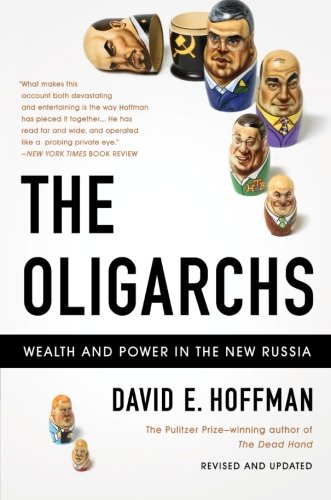
I read The Oligarchs: Wealth And Power In The New Russia many years ago. A passage which I found fascinating, and still remember today, describes the explorations of reformist Soviet economists toward market economics and price signals. Imagine groping dimly most of your adult life for subtle but monumental concepts that lie far down a forbidden path of reasoning.
Some leftists in the West are still groping for (or perhaps not even seeking) these ideas. Just as the Soviet economists failed to appreciate for most of their lives the monstrous nature of state control of the economy, many on the left take for granted the miraculous fruits of the market economy.
[Chapter 4: Anatoly Chubais] ... As perestroika dawned with the arrival of Gorbachev in 1985, the topics at the Leningrad seminars grew more ambitious. The participants began to broach an altogether bold idea: introducing some aspects of the market to Soviet socialism. For a long time, they intensely debated whether the economy could be saved by such reform concepts as self-financing or by decentralization, which meant allowing factory directors to make more of their own decisions. Later, as the years went on, they concluded that the existing machine was probably doomed and would have to be massively restructured. Still later, they spent many days contemplating the prospect of a “transition” to some new kind of a system. Even the notion of a “transition” was a thrilling idea.
... They had ample access to more radical texts in samizdat, the dog-eared, self-typed, or mimeographed manuscripts that were officially prohibited but widely distributed from hand to hand. ...
Then came a sudden bolt of inspiration. They were profoundly inspired by a two-volume, 630-page book published in 1980 by a Hungarian economics professor, János Kornai. The Economics of Shortage, more than any other text, offered an insight into the failings of Soviet socialism. Hungary had been at the forefront of more market-oriented economic reform in the Eastern Bloc since 1968, and Kornai’s groundbreaking work was almost entirely based on his observations about Hungary. But for the young scholars around Chubais, the work opened a window as no other Soviet or Western study had done on why the economy of shortage existed and how it functioned. Kornai examined the behavior of buyers, sellers, and producers in an absence of free prices, as well as the relationship between firms and the state under socialism and central planning. [ See János Kornai’s Contributions to Economic Analysis. ]
The book first arrived in Leningrad as smuggled photocopies and instantly “became a Bible,” Vasiliev recalled. “We had some ideas initially, but the book was kind of a catharsis. It pushed our thinking forward. You met a person and you said, ‘Have you read Kornai? Yes?’ And then it was a starting point for discussion. ...
But Kornai alone did not lead the Chubais team out of socialism; he just helped them see it much more clearly. The other great inspiration of those years came from the Austrian economist Friedrich von Hayek, one of the most trenchant early critics of socialism, who was especially acute in his searing denunciation of central planning. Although Hayek’s best-known work was The Road to Serfdom, a 1944 treatise about the dangers to individual liberty of socialism and central planning, Chubais took to heart a lesser-known economics text.11 It was an article that Hayek had published in 1945, “The Use of Knowledge in Society.”12 The article articulated clearly what the Leningrad scholars had been groping toward since the debate at the collective farm: that free prices were the single most powerful “indicator” to measure all the millions of decisions in a large, complex economy. ...
Hayek declared that the price system was a “marvel” which could free people from the “conscious control” of the central planners. At the time Chubais read this essay in Leningrad, the Soviet Union was the world’s largest example of “conscious control,” with rigid, fixed state prices set throughout the economy. Hayek, who won the 1974 Nobel Prize in economics for his work, had taken a battering ram to the underpinnings of Soviet socialism. Amazingly, his wisdom was smuggled past the KGB on those dog-eared photocopies, and it landed in the hands of an eager young generation of knowledge-hungry Leningrad academics.
Many years later, Chubais recalled the thrill of reading Hayek and instantly gave his own example of how Hayek’s theory worked in practice in the United States. “One person is selling hamburgers somewhere in New York,” he told me, “while another person is grazing cows somewhere in Arkansas to produce meat that will be used to make those hamburgers. But in order for that person in Arkansas to graze cows, there needs to be a price for meat, which tells him that he should graze cows.” ...
... “We started trying to think about real things, instead of all that bullshit we were engaged in during our formal jobs,” Glazkov said. The Gaidar-Chubais group produced a 120-page report, adapting some of the Hungarian and Yugoslav reforms to the Soviet system. They called for abandoning planning dictates and permitting some free market mechanisms. When Gaidar’s boss came back one day, he brought bad news: the plan had been rejected. “Which meant we were to give up our fruitless daydreaming” and come up with something “on a more mundane level,” Gaidar recalled. But when Gaidar went home that day and turned on the television, he heard Gorbachev deliver a speech using some of the same terms they had put in the rejected report. It was a strange time ...
One of the world’s leading economists of inequality, Branko Milanovic presents a bold new account of the dynamics that drive inequality on a global scale. Drawing on vast data sets and cutting-edge research, he explains the benign and malign forces that make inequality rise and fall within and among nations. He also reveals who has been helped the most by globalization, who has been held back, and what policies might tilt the balance toward economic justice.
Global Inequality takes us back hundreds of years, and as far around the world as data allow, to show that inequality moves in cycles, fueled by war and disease, technological disruption, access to education, and redistribution. The recent surge of inequality in the West has been driven by the revolution in technology, just as the Industrial Revolution drove inequality 150 years ago. But even as inequality has soared within nations, it has fallen dramatically among nations, as middle-class incomes in China and India have drawn closer to the stagnating incomes of the middle classes in the developed world. A more open migration policy would reduce global inequality even further.
These slides are from one of the best sessions I attended at scifoo. Bill Janeway's perspective was both theoretical and historical, but in addition we had Sam Altman of Y Combinator to discuss Airbnb and other examples of 2 way market platforms (Uber, etc.) that may be enjoying speculative bubbles at the moment.
See also Andrew Odlyzko (Caltech '71 ;-) on British railway manias for specific cases of speculative funding of useful infrastructure: here, here and here.
The tail of the (green) 2000 curve seems slightly off to me: ~10 million individuals with >$100k annual income? (~ $400k per annum for a family of four; but there are many more than 10 million "one percenters" in the US/Europe/Japan/China/etc.)