Showing posts with label psychology. Show all posts

Tuesday, October 10, 2023

SMPY 65: Help support the SMPY Longitudinal Study


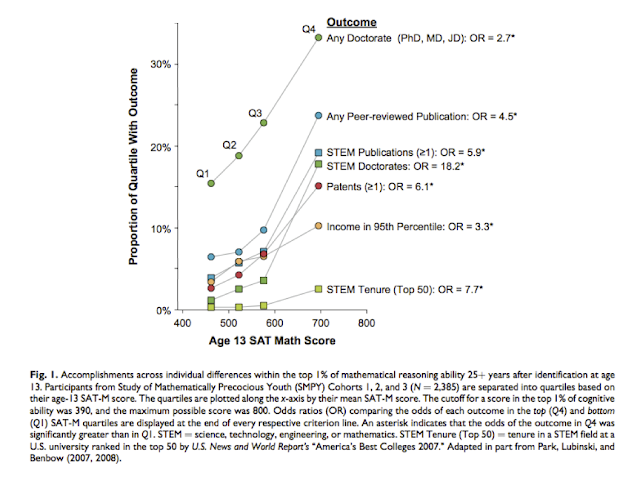
The Study of Mathematically Precocious Youth (SMPY) needs your help to support the Age-65 phase of their unique longitudinal study. 


For decades, co-directed by David Lubinski and Camilla P. Benbow, SMPY has been a beacon of enlightenment, tracking five cohorts comprising over 5,000 remarkably gifted individuals. In doing so, we have unraveled the secrets to nurturing brilliance. However, we are confronted with a disconcerting reality: the effective methods to identify and cultivate intellectual talent are under siege, threatened by political ideology. 

Our 14-minute documentary and the 3-page feature in Nature underscore the dire need to provide our most gifted youths with the educational opportunities they deserve. They are the architects of solutions and the architects of the future itself. 

Here are some compelling longitudinal findings from SMPY's extensive research:
• Prodigies destined for eminent careers can be identified as early as age 13. 
• There is no plateau of ability; even within the top 1%, variations in mathematical, spatial, and verbal abilities profoundly impact educational, occupational, and creative outcomes. 
• The blend of specific abilities, such as mathematical, spatial, and verbal aptitudes, shapes the nature of one's accomplishments and career trajectory.


More information:

Long

Short


DONATE HERE

Indicate "Please designate this gift to Study of Mathematically Precocious Youth" in the Special Instructions.


Thursday, August 24, 2023

Aella: Sex Work, Sex Research, and Data Science — Manifold #42


Aella is a sex worker, sex researcher, and data scientist. 


Interviews with ex-prostitutes on the pimp life (Las Vegas) 

An earlier Aella interview with Reason: 


Audio-only and Transcript:

Steve and Aella discuss: 

(00:00) - Introduction 
(01:22) - Aella's background and upbringing 
(12:45) - Aella's experiences as a sex worker and escorting 
(29:52) - Pimp culture 
(38:01) - Seeking Arrangement 
(43:50) - Cheating 
(46:50) - OnlyFans, farming simps 
(51:49) - Incels and sex work 
(56:24) - Porn and Gen-Z 
(01:12:43) - Embryo screening 
(01:21:43) - How far off is IVG?

Thursday, December 15, 2022

Geoffrey Miller: Evolutionary Psychology, Polyamorous Relationships, and Effective Altruism — Manifold #26


Geoffrey Miller is an American evolutionary psychologist, author, and a professor of psychology at the University of New Mexico. He is known for his research on sexual selection in human evolution. 


Miller's Wikipedia page.

Steve and Geoffrey discuss: 

0:00 Geoffrey Miller's background, childhood, and how he became interested in psychology 
14:44 How evolutionary psychology is perceived and where the field is going 
38:23 The value of higher education: sobering facts about retention 
49:00 Dating, pickup artists, and relationships 
1:11:27 Polyamory 
1:24:56 FTX, poly, and effective altruism 
1:34:31 AI alignment

Thursday, November 17, 2022

Abdel Abdellaoui: Genetics, Psychiatric Traits, and Educational Attainment — Manifold #24


Abdel Abdellaoui is Assistant Professor of Genetics in the Department of Psychiatry, Amsterdam UMC, University of Amsterdam. 

Abdel Abdellaoui is a geneticist who has been involved in a wide range of studies on psychiatric genetics, behavioral genetics, and population genetics. He is particularly interested in how collective behaviors, such as migration and mate choice, influence the genetic makeup of populations and the relationship between genetic risk factors and environmental exposures. 

Steve and Abdel discuss: 

00:00 Abdel’s background: education, family history, research career 
10:23 Abdel’s research focus: polygenic traits, geographical stratification 
21:43 Correlations across geographical regions 
33:21 Educational Attainment 
38:51 Comparisons across data sets 
44:48 Longevity 
52:04 Reaction to NIH restricting access to data on educational attainment 

Abdel Abdellaoui on Google Scholar: 
https://scholar.google.com/citations?user=hsyseKEAAAAJ&hl=en

Wednesday, September 28, 2022

The Future of Human Evolution -- excerpts from podcast interview with Brian Chau


1. The prospect of predicting cognitive ability from DNA, and the consequences. Why the main motivation has nothing to do with group differences. This segment begins at roughly 47 minutes. 

2. Anti-scientific resistance to research on the genetics of cognitive ability. My experience with the Jasons. Blank Slate-ism as a sacralized, cherished belief of social progressives. This segment begins at roughly 1 hour 7 minutes. 


1. Starts at roughly 47 minutes. 

Okay, let's just say hypothetically my billionaire friend is buddies with the CEO of 23andMe and let's say on the down low we collected some SAT scores of 1M or 2M people. I think there are about 10M people that have done 23andMe, let's suppose I manage to collect 1-2M scores for those people. I get them to opt in and agree to the study and da da da da and then Steve runs his algos and you get this nice predictor. 

But you’ve got to do it on the down low. Because if it leaks out that you're doing it, People are going to come for you. The New York Times is going to come for you, everybody's going to come for you. They're going to try to trash the reputation of 23andMe. They're going to trash the reputation of the billionaire. They're going to trash the reputation of the scientists who are involved in this. But suppose you get it done. And getting it done as you know very well is a simple run on AWS and you end up with this predictor which wow it's really complicated it depends on 20k SNPs in the genome ... 

For anybody with an ounce of intellectual integrity, they would look back at their copy of The Mismeasure of Man which has sat magisterially on their bookshelf since they were forced to buy it as a freshman at Harvard. They would say, “WOW! I guess I can just throw that in the trash right? I can just throw that in the trash.” 

But the set of people who have intellectual integrity and can process new information and then reformulate the opinion that they absorbed through social convention – i.e., that Gould is a good person and a good scientist and wise -- is tiny. The set of people who can actually do that is like 1% of the population. So you know maybe none of this matters, but in the long run it does matter. … 

Everything else about that hypothetical: the social scientists running the longitudinal study, getting the predictor in his grubby little hands and publishing the validation, but people trying to force you to studiously ignore the results, all that has actually already happened. We already have something which correlates ~0.4 with IQ. Everything else I said has already been done but it's just being studiously ignored by the right thinking people. 

 … 

Some people could misunderstand our discussion as being racist. I'm not saying that any of this has anything to do with group differences between ancestry groups. I'm just saying, e.g., within the white population of America, it is possible to predict from embryo DNA which of 2 brothers raised in the same family will be the smart one and which one will struggle in school. Which one will be the tall one and which one will be not so tall. 


2. Starts at roughly 1 hour 7 minutes. 

I've been in enough places where this kind of research is presented in seminar rooms and conferences and seen very negative attacks on the individuals presenting the results. 

I'll give you a very good example. There used to be a thing called the Jasons. During the cold war there was a group of super smart scientists called the Jasons. They were paid by the government to get together in the summers and think about technological issues that might be useful for defense and things like war fighting. … 

I had a meeting with the (current) Jasons. I was invited to a place near Stanford to address them about genetic engineering, genomics, and all this stuff. I thought okay these are serious scientists and I'll give them a very nice overview of the progress in this field. This anecdote takes place just a few years ago. 

One of the Jasons present is a biochemist but not an expert on genomics or machine learning. This biochemist asked me a few sharp questions which were easy to answer. But then at some point he just can't take it anymore and he grabs all his stuff and runs out of the room. ...

Saturday, February 05, 2022

Annals of Psychometry: Wordcels and Shape Rotators


Fun with psychometrics! 

Did it all start with High V, Low M, a 2011 post about Stephen J. Gould?

A famous theoretical physicist once complained acerbically to me about someone's paper we were discussing:
It is nothing more than the calculus of words.
Yet there are people who have nothing more than the calculus of words with which to build their models of the world. See Bounded Cognition, and Oppenheimer:
Mathematics is "an immense enlargement of language, an ability to talk about things which in words would be simply inaccessible."

From A Song of Shapes and Words by Roon.
There are many verbally gifted writers and speakers that, when pressed to visualize some math problem in their mind's eye, must helplessly watch their normally high-octane intelligence sputter and fail. They often write or talk at a blistering clip, and can navigate complex mazes of abstractions — and yet, when it comes time to make contact with the real world or accomplish practical tasks, they may be helpless. They'll do great in English class, and terrible in Physics. They can be very fun to listen to due to their terrifying leaps in logic and the exceptional among them will be natural leaders. 
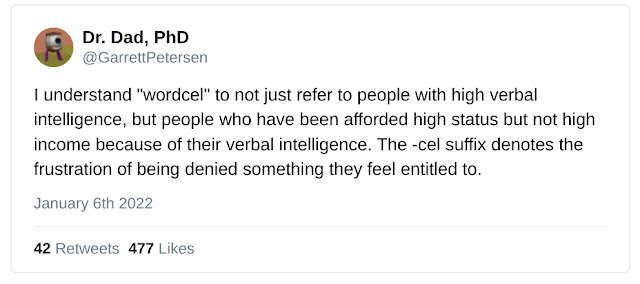
The wordcel moniker describes more than just one’s level of verbal skill: it’s also a socioeconomic classifier that refers to people whose verbal ability borders on self-sabotage (thus the “-cel”). Perhaps they’re driven mad by political rage, postmodernism, and disconnection from reality. It might refer to the priestly figures who work in the culture factories of the New York Times with their incomes and social prestige both precipitously declining only for the unperturbed masses on the internet to tell them in unison: “learn to code”! There’s even an implication that these folks are entirely rent-seekers (wrong, but directionally interesting). 
... 
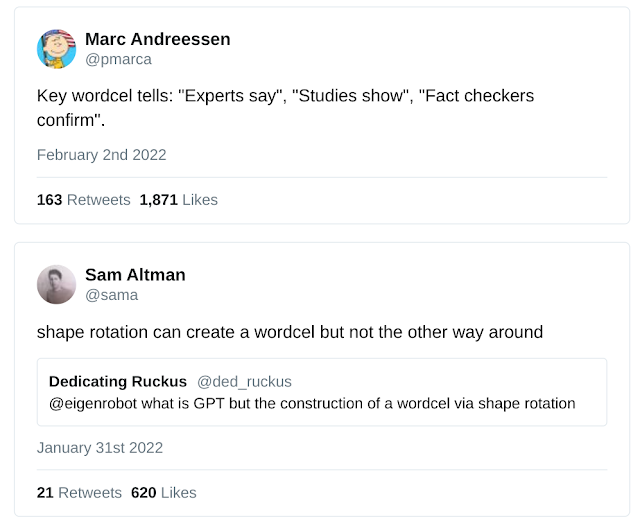
The shape rotators have been a minor force until very recent history. Though they’ve produced a significant portion of human progress through feats of engineering excellence, they were rarely celebrated until the dawn of the Enlightenment, perhaps 500 years ago. While the long-lasting glory of the Roman aqueducts is renowned to this day, nobody knows the chief engineer behind the project (probably Marcus Vipsanius Agrippa, but who’s counting). Today their stock is climbing to the moon. The world’s richest (self-made) men are almost uniformly engineers, computer scientists, or physicists. Vast portions of society that in a prior age might have been organized by government bureaucrats or private sector shot-callers have been handed over to cybernetic self-organizing systems designed and run by mathematical wizards. We have been witness to the slow, and then rapid transfer of power from the smooth-talking Don Drapers of boardroom acclaim to the multi-armed bandits of Facebook Ads. 
It’s clear that these big tech CEOs are verbally gifted, but by affinity and by practice they are in the rotator camp. Elon continually attributes his success to studying physics in college. Zuck programmed the original iteration of Facebook himself. Larry & Sergei did an entire PhD in linear algebra based information retrieval, a platonic ideal of shape rotation. Of the ten largest companies in the world, several are driven by fundamental technical breakthroughs. Society at large seems to respect and fear the forces of technology more and more as its cultural and financial capital rises.

There is some conflation between Math ability and Spatial ability in this recent talk of Wordcels and Shape Rotators. Math and Spatial ability are positively correlated but are actually separate factors that emerge from PCA in psychometrics. Look carefully at the arrows in the figure below -- if you can't read the figure you might be a wordcel ;-)

Note also that in the SMPY/SVPY data physicists dominated the wordcels even in their own verbal domain. This is also confirmed here.


See post from 2016 reproduced below, especially point #3.
3. There are systematic differences in cognitive abilities and profiles in different fields (business, medicine, engineering, physics, etc.)
This figure displays the math, verbal and spatial scores of gifted children tested at age 12, and their eventual college majors and career choices. This group is cohort 2 of the SMPY/SVPY study: each child scored better than 99.5 percentile on at least one of the M-V sections of the SAT.


Scores are normalized in units of SDs, within this cohort of gifted children. (So above and below average are defined with respect to the gifted population of >99th percentile kids, not relative to the general population.) The vertical axis is V, the horizontal axis is M, and the length of the arrow reflects spatial ability: pointing to the right means above the group average, to the left means below average; note the arrow for business majors should be twice as long as indicated but there was not enough space on the diagram. The spatial score is obviously correlated with the M score. More data here.


SMPY at 50: Research Associate position (2016)

I'm posting the job ad below for David Lubinski. The Study of Mathematically Precocious Youth (SMPY) is the most systematic long term study of individuals of high cognitive ability since the Terman Study.

SMPY helps to establish a number of important facts about individuals of high ability:

1. We can (at least crudely) differentiate between individuals at the 99th, 99.9th and 99.99th percentiles. Exceptional talent can be identified through testing, even at age 13.

2. Probability of significant accomplishment, such as STEM PhD, patents awarded, tenure at leading research university, exceptional income, etc. continues to rise as ability level increases, even within the top 1%.

3. There are systematic differences in cognitive abilities and profiles in different fields (business, medicine, engineering, physics, etc.)

4. Men and women of exceptional ability differ in life aspirations and preferences.

No one can claim to understand high level human capital, technological innovation, scientific progress, or exceptional achievement without first familiarizing themselves with these results.

Needless to say, I think this Research Associate position will entail important and fascinating work.
Research Associate:

The Study of Mathematically Precocious Youth (SMPY) seeks a full-time post-doctoral Research Associate for study oversight, conducting research, writing articles, laboratory management, and statistical analyses using the vast SMPY data base. SMPY is a four-decade longitudinal study consisting of 5 cohorts and over 5,000 intellectually talented participants. One chief responsibility of this position will be to manage laboratory details associated with launching an age-50 follow-up of two of SMPY’s most exceptional cohorts: a cohort of 500 profoundly gifted participants initially identified by age 13 in the early 1980s, and a second cohort of over 700 top STEM graduate students identified and psychologically profiled in 1992 as first- and second-year graduate students. Candidates with interests in assessing individual differences, talent development, and particularly strong statistical-technical skills are preferred. Send vitae, cover letter stating interests, (pre)reprints, and three letters of recommendation to: Dean Camilla P. Benbow, Department of Psychology & Human Development, 0552 Peabody College, Vanderbilt University, Nashville, TN, 37203. The position will remain open until a qualified applicant is selected. For additional information, please contact either co-director: Camilla P. Benbow, camilla.benbow@vanderbilt.edu, or David Lubinski, david.lubinski@vanderbilt.edu.

http://www.vanderbilt.edu/Peabody/SMPY/. Vanderbilt University is an Equal Opportunity/Affirmative Action Employer.

We are aiming for a June 30th start date but that’s flexible.
Some relevant figures based on SMPY results of Lubinski, Benbow, and collaborators. See links above for more discussion of the data displayed.


Wednesday, January 26, 2022

Monday, January 10, 2022

Recent Papers on Socio-Economic Status and Student Achievement: Marks and O'Connell

I received the message below from Michael O'Connell, University College Dublin, and Gary Marks, University of Melbourne. 

See also this recent post: Social and Educational Mobility: Denmark vs USA (James Heckman), and links therein. 
Dear Scholar, 
 
There is a widely-held perception that many of life’s key outcomes are fundamentally driven by people’s socio-economic status (SES). More specifically, there is a view that children’s educational attainment is largely a by-product of their familial SES. As a consequence of this pervasive paradigm, much of the energy in seeking to ameliorate or resolve poor educational attainment is based around trying to use SES as a social lever. 

However, in the six papers listed below, published between 2019-2022, evidence has been gathered demonstrating that SES is only very modestly correlated with educational attainment. Furthermore, once a child’s cognitive ability is taken into account, even the modest link between SES and attainment diminishes to slight influence. This is true of datasets drawn from international groups of young people, as well as those from the US, UK, or Ireland. Future attempts to aid and study young people experiencing difficulty with educational attainment should be built on an awareness of the limited role of SES. 

Gary N Marks   Michael O’Connell 


1. O’Connell, M. and Marks, G.N. (2022) 
Cognitive ability and conscientiousness are more important than SES for educational attainment: An analysis of the UK Millennium Cohort Study
Personality and Individual Differences, 188 
https://doi.org/10.1016/j.paid.2021.111471 
Highlights Antecedents of educational attainment of great interest Dominant paradigm focuses on SES of children. Cognitive ability and conscientiousness have stronger record in research findings. Using new UK MCS longitudinal survey data, GCSE state exam performance assessed Cognitive ability and conscientiousness explained far more than SES measures 


2. Marks, G. N. (2021) 
Is the relationship between socioeconomic status (SES) and student achievement causal? Considering student and parent abilities
Educational Research and Evaluation, 10.1080/13803611.2021.1968442: 1-24. 
Abstract Most studies on the relationship between students’ socioeconomic status (SES) and student achievement assume that its effects are sizable and causal. A large variety of theoretical explanations have been proposed. However, the SES–achievement association may reflect, to some extent, the inter-relationships of parents’ abilities, SES, children’s abilities, and student achievement. The purpose of this study is to quantify the role of SES vis-à-vis child and parents’ abilities, and prior achievement. Analyses of a covariance matrix that includes supplementary correlations for fathers and mothers’ abilities derived from the literature indicate that more than half of the SES–achievement association can be accounted for by parents’ abilities. SES coefficients decline further with the addition of child’s abilities. With the addition of prior achievement, the SES coefficients are trivial implying that SES has little or no contemporaneous effects. These findings are not compatible with standard theoretical explanations for SES inequalities in achievement. 


3. Marks, G. N. and O’Connell, M. (2021) 
No Evidence for Cumulating Socioeconomic Advantage. Ability Explains Increasing SES Effects with Age on Children’s Domain Test scores 
Intelligence, 88    
https://doi.org/10.1016/j.intell.2021.101582 
Highlights Data analysed for five domains for children of the NLSY79 mothers study. SES effects increase for only some domains and not substantially. No increase in SES effects when considering mother's or children's prior ability. Effects of child's prior ability on test scores increase substantially with age. SES effects are small net of mother's ability. 
 
4. Marks, G. N. and O'Connell, M. (2021) 
Inadequacies in the SES–Achievement model: Evidence from PISA and other studies 
Review of Education, 9(3): e3293. 
https://doi.org/10.1002/rev3.3293 
Abstract Students’ socioeconomic status (SES) is central to much research and policy deliberation on educational inequalities. However, the SES model is under severe stress for several reasons. SES is an ill-defined concept, unlike parental education or family income. SES measures are frequently based on proxy reports from students; these are generally unreliable, sometimes endogenous to student achievement, only low to moderately intercorrelated, and exhibit low comparability across countries and over time. There are many explanations for SES inequalities in education, none of which achieves consensus among research and policy communities. SES has only moderate effects on student achievement, and its effects are especially weak when considering prior achievement, an important and relevant predictor. SES effects are substantially reduced when considering parent ability, which is causally prior to family SES. The alternative cognitive ability/genetic transmission model has far greater explanatory power; it provides logical and compelling explanations for a wide range of empirical findings from student achievement studies. The inadequacies of the SES model are hindering knowledge accumulation about student performance and the development of successful policies. 
 
5. O'Connell, M. and Marks, G. N. (2021) 
Are the effects of intelligence on student achievement and well-being largely functions of family income and social class? Evidence from a longitudinal study of Irish adolescents
Intelligence, 84: 101511. 10.1016/j.intell.2020.101511 
Highlights Power of cognitive ability and social class contrasted. Large representative sample from longitudinal study, waves 1–3, of 6216 children Outcomes were attainments, difficulties and relationships. Cognitive ability explained large amounts of variance. Social background only minor effects 
 
6. O'Connell, M. (2019) 
Is the impact of SES on educational performance overestimated? Evidence from the PISA survey 
Intelligence, 75: 41-47 
https://doi.org/10.1016/j.intell.2019.04.005 
Highlights Policy-makers overly attribute differences in educational performance to SES. PISA survey used to assess roles of parental education and household income. Combining them concealed differences in outcomes between rich and poor countries. Household income important in poor countries, parental education in rich countries.

Saturday, November 27, 2021

Social and Educational Mobility: Denmark vs USA (James Heckman)


Despite generous social programs such as free pre-K education, free college, and massive transfer payments, Denmark is similar to the US in key measures of inequality, such as educational outcomes and cognitive test scores. 

While transfer payments can equalize, to some degree, disposable income, they do not seem to be able to compensate for large family effects on individual differences in development. 

These observations raise the following questions: 

1. What is the best case scenario for the US if all progressive government programs are implemented with respect to child development, free high quality K12 education, free college, etc.?

2. What is the causal mechanism for stubborn inequality of outcomes, transmitted from parent to child (i.e., within families)? 

Re #2: Heckman and collaborators focus on environmental factors, but do not (as far as I can tell) discuss genetic transmission. We already know that polygenic scores are correlated to the education and income levels of parents, and (from adoption studies) that children tend to resemble their biological parents much more strongly than their adoptive parents. These results suggest that genetic transmission of inequality may dominate environmental transmission.
  
See 


The Contribution of Cognitive and Noncognitive Skills to Intergenerational Social Mobility (McGue et al. 2020)


Note: Denmark is very homogenous in ancestry, and the data presented in these studies (e.g., polygenic scores and social mobility) are also drawn from European-ancestry cohorts. The focus here is not on ethnicity or group differences between ancestry groups. The focus is on social and educational mobility within European-ancestry populations, with or without generous government programs supporting free college education, daycare, pre-K, etc.

Lessons for Americans from Denmark about inequality and social mobility 
James Heckman and Rasmus Landersø 
Abstract Many progressive American policy analysts point to Denmark as a model welfare state with low levels of income inequality and high levels of income mobility across generations. It has in place many social policies now advocated for adoption in the U.S. Despite generous Danish social policies, family influence on important child outcomes in Denmark is about as strong as it is in the United States. More advantaged families are better able to access, utilize, and influence universally available programs. Purposive sorting by levels of family advantage create neighborhood effects. Powerful forces not easily mitigated by Danish-style welfare state programs operate in both countries.
Also discussed in this episode of EconTalk podcast. Russ does not ask the obvious question about disentangling family environment from genetic transmission of inequality.
 

The figure below appears in Game Over: Genomic Prediction of Social Mobility. It shows SNP-based polygenic score and life outcome (socioeconomic index, on vertical axis) in four longitudinal cohorts, one from New Zealand (Dunedin) and three from the US. Each cohort (varying somewhat in size) has thousands of individuals, ~20k in total (all of European ancestry). The points displayed are averages over bins containing 10-50 individuals. For each cohort, the individuals have been grouped by childhood (family) social economic status. Social mobility can be predicted from polygenic score. Note that higher SES families tend to have higher polygenic scores on average -- which is what one might expect from a society that is at least somewhat meritocratic. The cohorts have not been used in training -- this is true out-of-sample validation. Furthermore, the four cohorts represent different geographic regions (even, different continents) and individuals born in different decades.


The figure below appears in More on SES and IQ.

Where is the evidence for environmental effects described above in Heckman's abstract: "More advantaged families are better able to access, utilize, and influence universally available programs. Purposive sorting by levels of family advantage create neighborhood effects"? Do parents not seek these advantages for their adopted children as well as for their biological children? Or is there an entirely different causal mechanism based on shared DNA?


Tuesday, September 07, 2021

Kathryn Paige Harden Profile in The New Yorker (Behavior Genetics)

This is a good profile of behavior geneticist Paige Harden (UT Austin professor of psychology, former student of Eric Turkheimer), with a balanced discussion of polygenic prediction of cognitive traits and the culture war context in which it (unfortunately) exists.
Can Progressives Be Convinced That Genetics Matters? 
The behavior geneticist Kathryn Paige Harden is waging a two-front campaign: on her left are those who assume that genes are irrelevant, on her right those who insist that they’re everything. 
Gideon Lewis-Kraus
Gideon Lewis-Kraus is a talented writer who also wrote a very nice article on the NYTimes / Slate Star Codex hysteria last summer.

Some references related to the New Yorker profile:
1. The paper Harden was attacked for sharing while a visiting scholar at the Russell Sage Foundation: Game Over: Genomic Prediction of Social Mobility 

2. Harden's paper on polygenic scores and mathematics progression in high school: Genomic prediction of student flow through high school math curriculum 

3. Vox article; Turkheimer and Harden drawn into debate including Charles Murray and Sam Harris: Scientific Consensus on Cognitive Ability?

A recent talk by Harden, based on her forthcoming book The Genetic Lottery: Why DNA Matters for Social Equality


Regarding polygenic prediction of complex traits 

I first met Eric Turkheimer in person (we had corresponded online prior to that) at the Behavior Genetics Association annual meeting in 2012, which was back to back with the International Conference on Quantitative Genetics, both held in Edinburgh that year (photos and slides [1] [2] [3]). I was completely new to the field but they allowed me to give a keynote presentation (if memory serves, together with Peter Visscher). Harden may have been at the meeting but I don't recall whether we met. 

At the time, people were still doing underpowered candidate gene studies (there were many talks on this at BGA although fewer at ICQG) and struggling to understand GCTA (Visscher group's work showing one can estimate heritability from modestly large GWAS datasets, results consistent with earlier twins and adoption work). Consequently a theoretical physicist talking about genomic prediction using AI/ML and a million genomes seemed like an alien time traveler from the future. Indeed, I was.

My talk is largely summarized here:
On the genetic architecture of intelligence and other quantitative traits 
https://arxiv.org/abs/1408.3421 
How do genes affect cognitive ability or other human quantitative traits such as height or disease risk? Progress on this challenging question is likely to be significant in the near future. I begin with a brief review of psychometric measurements of intelligence, introducing the idea of a "general factor" or g score. The main results concern the stability, validity (predictive power), and heritability of adult g. The largest component of genetic variance for both height and intelligence is additive (linear), leading to important simplifications in predictive modeling and statistical estimation. Due mainly to the rapidly decreasing cost of genotyping, it is possible that within the coming decade researchers will identify loci which account for a significant fraction of total g variation. In the case of height analogous efforts are well under way. I describe some unpublished results concerning the genetic architecture of height and cognitive ability, which suggest that roughly 10k moderately rare causal variants of mostly negative effect are responsible for normal population variation. Using results from Compressed Sensing (L1-penalized regression), I estimate the statistical power required to characterize both linear and nonlinear models for quantitative traits. The main unknown parameter s (sparsity) is the number of loci which account for the bulk of the genetic variation. The required sample size is of order 100s, or roughly a million in the case of cognitive ability.
The predictions in my 2012 BGA talk and in the 2014 review article above have mostly been validated. Research advances often pass through the following phases of reaction from the scientific community:
1. It's wrong ("genes don't affect intelligence! anyway too complex to figure out... we hope")
2. It's trivial ("ofc with lots of data you can do anything... knew it all along")
3. I did it first ("please cite my important paper on this")
Or, as sometimes attributed to Gandhi: "First they ignore you, then they laugh at you, then they fight you, then you win.”


Technical note

In 2014 I estimated that ~1 million genotype | phenotype pairs would be enough to capture most of the common SNP heritability for height and cognitive ability. This was accomplished for height in 2017. However, the sample size of well-phenotyped individuals is much smaller for cognitive ability, even in 2021, than for height in 2017. For example, in UK Biobank the cognitive test is very brief (~5 minutes IIRC, a dozen or so questions), but it has not even been administered to the full cohort as yet. In the Educational Attainment studies the phenotype EA is only moderately correlated (~0.3 ?) or so with actual cognitive ability.

Hence, although the most recent EA4 results use 3 million individuals [1], and produce a predictor which correlates ~0.4 with actual EA, the statistical power available is still less than what I predicted would be required to train a really good cognitive ability predictor.

In our 2017 height paper, which also briefly discussed bone density and cognitive ability prediction, we built a cognitve ability predictor roughly as powerful as EA3 using only ~100k individuals with the noisy UKB test data. So I remain confident that  ~million individuals with good cognitive scores (e.g., SAT, AFQT, full IQ test) would deliver results far beyond what we currently have available. We also found that our predictor, built using actual (albeit noisy) cognitive scores exhibits less power reduction in within-family (sibling) analyses compared to EA. So there is evidence that (no surprise) EA is more influenced by environmental factors, including so-called genetic nurture effects, than is cognitive ability.

A predictor which captures most of the common SNP heritability for cognitive ability might correlate ~0.5 or 0.6 with actual ability. Applications of this predictor in, e.g., studies of social mobility or educational success or even longevity using existing datasets would be extremely dramatic.

Sunday, March 21, 2021

The Contribution of Cognitive and Noncognitive Skills to Intergenerational Social Mobility (McGue et al. 2020)

If you have the slightest pretension to expertise concerning social mobility, meritocracy, inequality, genetics, psychology, economics, education, history, or any related subjects, I urge you to carefully study this paper.
The Contribution of Cognitive and Noncognitive Skills to Intergenerational Social Mobility  
(Psychological Science https://doi.org/10.1177/0956797620924677)
Matt McGue, Emily A. Willoughby, Aldo Rustichini, Wendy Johnson, William G. Iacono, James J. Lee 
We investigated intergenerational educational and occupational mobility in a sample of 2,594 adult offspring and 2,530 of their parents. Participants completed assessments of general cognitive ability and five noncognitive factors related to social achievement; 88% were also genotyped, allowing computation of educational-attainment polygenic scores. Most offspring were socially mobile. Offspring who scored at least 1 standard deviation higher than their parents on both cognitive and noncognitive measures rarely moved down and frequently moved up. Polygenic scores were also associated with social mobility. Inheritance of a favorable subset of parent alleles was associated with moving up, and inheritance of an unfavorable subset was associated with moving down. Parents’ education did not moderate the association of offspring’s skill with mobility, suggesting that low-skilled offspring from advantaged homes were not protected from downward mobility. These data suggest that cognitive and noncognitive skills as well as genetic factors contribute to the reordering of social standing that takes place across generations.
From the paper:
We believe that a reasonable explanation of our findings is that the degree to which individuals are more or less skilled than their parents contributes to their upward or downward mobility. Behavioral genetic and genomic research has established the heritability of social achievements (Conley, 2016) as well as the skills thought to underlie them (Bouchard & McGue, 2003). Nonetheless, these associations may be due to passive gene–environment correlation, whereby high-achieving parents both transmit genes and provide a rearing environment that promotes their children’s social success (Scarr & McCartney, 1983). Our within-family design controlled for passive gene–environment correlation effects. Although offspring inherit all of their genes from their parents, they inherit a random subset of parental alleles because of meiotic segregation. Consequently, some offspring inherit a favorable subset of their parents’ alleles, whereas others inherit a less favorable subset. We found, as did previous researchers (Belsky et al., 2018), that the inheritance of a favorable subset of alleles was associated with an increased likelihood of upward mobility... 
...In summary, our analysis of intergenerational social mobility in a sample of 2,594 offspring from 1,321 families found that (a) most individuals were educationally and occupationally mobile, (b) mobility was predicted by offspring–parent differences in skills and genetic endowment, and (c) the relationship of offspring skills with social mobility did not vary significantly by parent social background. In an era in which there is legitimate concern over social stagnation, our findings are noteworthy in identifying the circumstances when parents’ educational and occupational success is not reproduced across generations.

See also Game Over: Genomic Prediction of Social Mobility (PNAS July 9, 2018: 201801238). Both papers provide out of sample validation of polygenic predictors for cognitive ability, specifically of the relationship to intergenerational social mobility.


Thursday, June 11, 2020

Warren Hatch on Seeing the Future in the Era of COVID-19: Manifold Episode #50


Steve and Corey talk to Warren Hatch, President and CEO of Good Judgment Inc. Warren explains what makes someone a good forecaster and how the ability to integrate and assess information allows cognitively diverse teams to outperform prediction markets. The hosts express skepticism about whether the incentives at work in large organizations would encourage the adoption of approaches that might lead to better forecasts. Warren describes the increasing depth of human-computer collaboration in forecasting. Steve poses the long-standing problem of assessing alpha in finance and Warren suggests that the emerging alpha-brier metric, linking process and outcome, might shed light on the issue. The episode ends with Warren describing Good Judgment’s open invitation to self-identified experts to join a new COVID forecasting platform.

Transcript

Good Judgment Inc
.

Good Judgment Open

Superforecasting: The Art and Science of Prediction

Noriel Roubini (Wikipedia)


man·i·fold /ˈmanəˌfōld/ many and various.

In mathematics, a manifold is a topological space that locally resembles Euclidean space near each point.

Steve Hsu and Corey Washington have been friends for almost 30 years, and between them hold PhDs in Neuroscience, Philosophy, and Theoretical Physics. Join them for wide ranging and unfiltered conversations with leading writers, scientists, technologists, academics, entrepreneurs, investors, and more.

Steve Hsu is VP for Research and Professor of Theoretical Physics at Michigan State University. He is also a researcher in computational genomics and founder of several Silicon Valley startups, ranging from information security to biotech. Educated at Caltech and Berkeley, he was a Harvard Junior Fellow and held faculty positions at Yale and the University of Oregon before joining MSU.

Corey Washington is Director of Analytics in the Office of Research and Innovation at Michigan State University. He was educated at Amherst College and MIT before receiving a PhD in Philosophy from Stanford and a PhD in a Neuroscience from Columbia. He held faculty positions at the University Washington and the University of Maryland. Prior to MSU, Corey worked as a biotech consultant and is founder of a medical diagnostics startup.

Tuesday, June 02, 2020

Re-Post: Joe Cesario on Police Decision Making and Racial Bias in Deadly Force Decisions (Manifold Episode #11)

Re-posting this because of its relevance to the terrible events in Minneapolis.

Manifold Episode #11: Joe Cesario on Police Decision Making and Racial Bias in Deadly Force Decisions


Manifold Show Page    YouTube Channel

Corey and Steve talk with Joe Cesario about his recent work which argues that, contrary to activist claims and media reports, there is no widespread racial bias in police shootings. Joe discusses his analysis of national criminal justice data and his experimental studies with police officers in a specially designed realistic simulator. He maintains that racial bias does exist in other uses of force such as tasering but that the decision to shoot is fundamentally different: it is driven by specific events and context, rather than race.

Cesario is associate professor of Psychology at Michigan State University. He studies social cognition and decision-making. His recent topics of study include police use of deadly force and computational modeling of fast decisions. Cesario is dedicated to reform in the practice, reporting, and publication of psychological science.

Is There Evidence of Racial Disparity in Police Use of Deadly Force? Analyses of Officer-Involved Fatal Shootings in 2015–2016
https://journals.sagepub.com/doi/abs/...

Example of officer completing shooting simulator
https://youtu.be/Le8zoqk-UVo

Overview of Current Research on Officer-Involved Shootings
https://www.cesariolab.com/police

Joseph Cesario Lab
https://www.cesariolab.com/


man·i·fold /ˈmanəˌfōld/ many and various.

In mathematics, a manifold is a topological space that locally resembles Euclidean space near each point.

Steve Hsu and Corey Washington have been friends for almost 30 years, and between them hold PhDs in Neuroscience, Philosophy, and Theoretical Physics. Join them for wide ranging and unfiltered conversations with leading writers, scientists, technologists, academics, entrepreneurs, investors, and more.

Steve Hsu is VP for Research and Professor of Theoretical Physics at Michigan State University. He is also a researcher in computational genomics and founder of several Silicon Valley startups, ranging from information security to biotech. Educated at Caltech and Berkeley, he was a Harvard Junior Fellow and held faculty positions at Yale and the University of Oregon before joining MSU.

Corey Washington is Director of Analytics in the Office of Research and Innovation at Michigan State University. He was educated at Amherst College and MIT before receiving a PhD in Philosophy from Stanford and a PhD in a Neuroscience from Columbia. He held faculty positions at the University Washington and the University of Maryland. Prior to MSU, Corey worked as a biotech consultant and is founder of a medical diagnostics startup.


Thursday, May 21, 2020

University of California to end use of SAT and ACT

University of California Will End Use of SAT and ACT in Admissions (NYT)

This decision by the UC Regents (most of whom are political appointees) is counter to the recommendation of the faculty task force recently assigned to study standardized testing in admissions. It is obvious to anyone who looks at the graphs below that SAT/ACT have significant validity (technical term used in psychometrics) in predicting college performance for all ethnic groups.


See Report of the University of California Academic Council Standardized Testing Task Force for more.
... SAT and HSGPA are stronger predictors than family income or race. Within each of the family income or ethnicity categories there is substantial variation in SAT and HSGPA, with corresponding differences in student success. See bottom figure and combined model R^2 in second figure below; R^2 varies very little across family income and ethnic categories. ...

Test Preparation and SAT scores: "...combined effect of coaching on the SAT I is between 21 and 34 points. Similarly, extensive meta-analyses conducted by Betsy Jane Becker in 1990 and by Nan Laird in 1983 found that the typical effect of commercial preparatory courses on the SAT was in the range of 9-25 points on the verbal section, and 15-25 points on the math section."

Scott Adams on Trump, and his book Loserthink – Manifold Podcast #47


Corey and Steve talk to Scott Adams, creator of Dilbert and author of Loserthink. Steve reviews some of Scott's predictions, including of Trump’s 2016 victory. Scott (who once semi-humorously described himself as “left of Bernie”) describes what he describes as Trump's unique "skill stack". Scott highlights Trump's grasp of the role of psychology in economics, and maintains that honesty requires admitting that we do not know whether many of Trump’s policies are good or bad. Scott explains why he thinks it is mistaken to assume leaders are irrational.

Transcript

Scott Adams (Blog and Podcast)

Loserthink: How Untrained Brains Are Ruining America

Kihlstrom J. F. (1997). Hypnosis, memory and amnesia. Philosophical transactions of the Royal Society of London. Series B, Biological sciences, 352(1362), 1727–1732. https://doi.org/10.1098/rstb.1997.0155

Hypnosis and Memory (Blog Post)


man·i·fold /ˈmanəˌfōld/ many and various.

In mathematics, a manifold is a topological space that locally resembles Euclidean space near each point.

Steve Hsu and Corey Washington have been friends for almost 30 years, and between them hold PhDs in Neuroscience, Philosophy, and Theoretical Physics. Join them for wide ranging and unfiltered conversations with leading writers, scientists, technologists, academics, entrepreneurs, investors, and more.

Steve Hsu is VP for Research and Professor of Theoretical Physics at Michigan State University. He is also a researcher in computational genomics and founder of several Silicon Valley startups, ranging from information security to biotech. Educated at Caltech and Berkeley, he was a Harvard Junior Fellow and held faculty positions at Yale and the University of Oregon before joining MSU.

Corey Washington is Director of Analytics in the Office of Research and Innovation at Michigan State University. He was educated at Amherst College and MIT before receiving a PhD in Philosophy from Stanford and a PhD in a Neuroscience from Columbia. He held faculty positions at the University Washington and the University of Maryland. Prior to MSU, Corey worked as a biotech consultant and is founder of a medical diagnostics startup.

Thursday, March 05, 2020

Kaja Perina on the Dark Triad: Narcissism, Machiavellianism, and Psychopathy - Manifold Podcast #36


Kaja Perina is the Editor in Chief of Psychology Today. Kaja, Steve, and Corey discuss so-called Dark Triad personality traits: Narcissism, Machiavellianism, and Psychopathy. Do these traits manifest more often in super successful people? What is the difference between Sociopathy and Psychopathy? Are CEOs often "warm sociopaths"? Can too much empathy be a liability? Corey laments Sociopathy in academic Philosophy. Kaja explains the operation of Psychology Today. Steve reveals his Hypomania diagnoses.

2:33 - Psychopathology and the Dark Triad
11:34 - Do these traits manifest more often in super successful people?
17:52 - Can too much empathy be a liability?
35:16 - Corey laments Sociopathy in academic Philosophy
50:32 - Kaja explains the operation of Psychology Today
1:01:06 - Steve reveals his Hypomania diagnoses

Transcript

Kaja Perina (Psychology Today)

Related: Nice Guys Finish Last (2012 post), more Hypomania


man·i·fold /ˈmanəˌfōld/ many and various.

In mathematics, a manifold is a topological space that locally resembles Euclidean space near each point.

Steve Hsu and Corey Washington have been friends for almost 30 years, and between them hold PhDs in Neuroscience, Philosophy, and Theoretical Physics. Join them for wide ranging and unfiltered conversations with leading writers, scientists, technologists, academics, entrepreneurs, investors, and more.

Steve Hsu is VP for Research and Professor of Theoretical Physics at Michigan State University. He is also a researcher in computational genomics and founder of several Silicon Valley startups, ranging from information security to biotech. Educated at Caltech and Berkeley, he was a Harvard Junior Fellow and held faculty positions at Yale and the University of Oregon before joining MSU.

Corey Washington is Director of Analytics in the Office of Research and Innovation at Michigan State University. He was educated at Amherst College and MIT before receiving a PhD in Philosophy from Stanford and a PhD in a Neuroscience from Columbia. He held faculty positions at the University Washington and the University of Maryland. Prior to MSU, Corey worked as a biotech consultant and is founder of a medical diagnostics startup.

Thursday, January 09, 2020

Zach Hambrick on Psychometrics and the Science of Expertise -- Manifold Podcast #28


MSU Psychology Professor Zach Hambrick joins Corey and Steve to discuss general cognitive ability, the science of personnel selection, and research on the development of skills and expertise. Is IQ really the single best predictor of job performance? Corey questions whether g is the best predictor across all fields and whether its utility declines at a certain skill level. What does the experience of the US military tell us about talent selection? Is the 10,000 hour rule for skill development valid? What happened to the guy who tried to make himself into a professional golfer through 10,000 hours of golf practice?

Transcript

Science of Expertise

Zach Hambrick (Faculty Profile)

Armed Services Vocational Aptitude Battery

Project 100,000 (1960s DoD Program)

Test Validity Study Report (CLA)

The Validity and Utility of Selection Methods in Personnel Psychology

Sunday, December 15, 2019

Feynman and Tukey (Working Memory); Dom and Brexit


I received this message over the weekend.
Dear Dr. Hsu,

With great interest I regularly read your excellent Information Processing Blog. With regard to your assessment of Dom Cummings' achievements I am at variance with yours. But I guess you will like the anecdote referring to Feynman.

I tried to comment directly on your blog but the whole procedure was somewhat cumbersome, so I mail my comment directly to you. Please feel free to post it at the comment section under my full name. See the comment attached.

I am a retired psychology prof from University of Mannheim, Germany specializing in intelligence research, research methodology, assessment and evaluation research.

Best regards
Werner W. Wittmann
The letter:
IQ makes the difference

If you want to learn more about what kind of difference differences in IQ make read the research of Dave Lubinski and Camilla Benbow what differences highly gifted youngsters accomplish after several decades. Dave makes their publications available at https://my.vanderbilt.edu/smpy/publications/david-lubinski/

But let me turn to a funnier anecdote for physicists like Steve Hsu

A 35 year gap:

Physicists are among the smartest high IQ people, there is no doubt. If you want a single case example take Richard Feynman. If we could have lured him to psychology an important concept probably would have been published 35 years earlier.

In 1939 Feynman as a graduate student at Princeton experimented just for fun together with his friend John Tukey (who later became the famous statistician) to assess the ability of measuring time by counting.(Gleick,1992) They run stairs up and down to accelerate their heartbeats and trained themselves at the same time to count seconds and steps. Feynman’s performance deteriorated when he talked but not when he read. Tukey instead performed well when he recited poems aloud and worse when he read. So both have detected what is now known as the two slave systems of working memory, namely the phonological loop and the visuo-spatial sketchpad. Now you get a feeling how much more psychology would have been advanced if brains like theirs had been invested in my discipline at that time.

As a true and convinced European I am really sorry that the English left us, the Scots and the Northern-Irish didn’t want it and maybe one day the fame of tearing the United Kingdom into parts goes to Cummings as well?

What I would say to Cummings:

“If a thing is not worth doing, it is not worth doing well.” ― John W. Tukey

But he did it and now…

Boris Johnson probably to Cummings: “The moor has pled guilty the moor can go” ?

References:
Gleick,J.(1992) Genius. The life and science of Richard Feynman. New York: Pantheon Books. 
Lubinski, D., Benbow, C.P., & Kell, H.J. (2014). Life paths and accomplishments of mathematically precocious males and females four decades later. Psychological Science, 25, 2217–2232.

From Wikipedia about Working Memory 
In 1974, Baddeley and Hitch[11] introduced the multicomponent model of working memory. The theory proposed a model containing three components: the central executive, the phonological loop, and the visuospatial sketchpad with the central executive functioning as a control center of sorts, directing info between the phonological and visuospatial components.[12] The central executive is responsible inter alia for directing attention to relevant information, suppressing irrelevant information and inappropriate actions, and coordinating cognitive processes when more than one task is simultaneously performed. A "central executive" is responsible for supervising the integration of information and for coordinating "slave systems" that are responsible for the short-term maintenance of information. One slave system, the phonological loop (PL), stores phonological information (that is, the sound of language) and prevents its decay by continuously refreshing it in a rehearsal loop. It can, for example, maintain a seven-digit telephone number for as long as one repeats the number to oneself again and again.[13] The other slave system, the visuospatial sketchpad, stores visual and spatial information. It can be used, for example, for constructing and manipulating visual images and for representing mental maps. The sketchpad can be further broken down into a visual subsystem (dealing with such phenomena as shape, colour, and texture), and a spatial subsystem (dealing with location).

Re: Brexit, see these remarks from Now it can be told: Dominic Cummings and the Conservative victory 2019
I don't know enough to have a high confidence or high conviction opinion concerning Brexit. Intelligent and thoughtful people disagree strongly over whether it is a good idea or a potential disaster.

Nevertheless, I can admire Dom's effectiveness as a political strategist and chief advisor to the Prime Minister. I do know him well enough to state with high confidence that his intentions are idealistic, not selfish, and that he (someone who has spent decades thinking about UK government, foreign policy, relations with Europe) sincerely thinks Brexit is in the best interests of the British people. Dom has deeper insights and better intuition about these issues than I do!

Being a rationalist, Dom has pointed out on his own blog that it is impossible to know with high confidence what the future implications of most political decisions are... In that sphere one cannot avoid decision making under extreme uncertainty.
The epistemically careful may end up like Zhou Enlai. When asked about consequences of the French Revolution, the late premier is reported to have said: Too early to tell. Be prepared to find that thoughtful people, pressed for an opinion, can disagree...

Wednesday, August 28, 2019

College quality measures highly correlated to student SAT scores


Research by Brown, Chabris, and Wai shows that quality of students is strongly correlated to other quality measures of a college. (Thanks to a reader for sending the link!) See also this global analysis of university quality rankings.

Of course, causality is complex: schools with strong reputations, large endowments, etc. can attract top applicants. But how did those schools acquire those reputations and endowments in the first place?
Salon: ... Though there is often public controversy over the value of standardized tests, research shows that these tests are quite robust measures to predict academic performance, career potential, creativity and job performance.

Critics of the SAT say it tests for students’ wealth, not caliber. While it is true that wealthier parents tend to have students with higher test scores, it turns out the research robustly shows that test scores, even when you consider socioeconomic status, are predictive of later outcomes.

We first found high correlations between our test score rankings and U.S. News national university rank – 0.892 – and liberal arts college rank – 0.890 – even though U.S. News weights these scores only about 8% in their formula. ...


See also Universities Ranked By SAT Score (2013):


Schools with the strongest students (e.g., as measured by SAT) produce graduates who make outstanding contributions at per capita rates easily 10x or 100x higher than others: see Where Nobel winners get their start (Nature) and Colleges ranked by Nobel, Fields, Turing and National Academies output.


Thursday, June 27, 2019

Manifold Podcast #13: Joe Cesario on Political Bias and Problematic Research Methods in Social Psychology


Corey and Steve continue their discussion with Joe Cesario and examine methodological biases in the design and conduct of experiments in social psychology and ideological bias in the interpretation of the findings. Joe argues that experiments in his field are designed to be simple, but that in making experimental set ups simple researchers remove critical factors that actually matter for a police officer making a decision in the real world. In consequence, he argues that the results cannot be taken to show anything about actual police behavior. Joe maintains that social psychology as a whole is biased toward the left politically and that this affects how courses are taught and research conducted. Steve points out the university faculty on the whole tend to be shifted left relative to the general population. Joe, Corey, and Steve discuss the current ideological situation on campus and how it can be alienating for students from conservative backgrounds.

Joseph Cesario's Lab
https://www.cesariolab.com/

Transcript
https://manifoldlearning.com/2019/06/27/episode-013-transcript/


man·i·fold /ˈmanəˌfōld/ many and various.

In mathematics, a manifold is a topological space that locally resembles Euclidean space near each point.

Steve Hsu and Corey Washington have been friends for almost 30 years, and between them hold PhDs in Neuroscience, Philosophy, and Theoretical Physics. Join them for wide ranging and unfiltered conversations with leading writers, scientists, technologists, academics, entrepreneurs, investors, and more.

Steve Hsu is VP for Research and Professor of Theoretical Physics at Michigan State University. He is also a researcher in computational genomics and founder of several Silicon Valley startups, ranging from information security to biotech. Educated at Caltech and Berkeley, he was a Harvard Junior Fellow and held faculty positions at Yale and the University of Oregon before joining MSU.

Corey Washington is Director of Analytics in the Office of Research and Innovation at Michigan State University. He was educated at Amherst College and MIT before receiving a PhD in Philosophy from Stanford and a PhD in a Neuroscience from Columbia. He held faculty positions at the University Washington and the University of Maryland. Prior to MSU, Corey worked as a biotech consultant and is founder of a medical diagnostics startup.

Blog Archive

Labels