Glenn Luk has worked as an investment banker, private equity investor, and startup founder. He has closely analyzed aspects of the Chinese economy, including its GDP and high speed rail system.
Steve and Glenn discuss:
(00:00) - Introduction
(01:21) - Glenn Luk's Background: HK, Taiwan, China
(07:59) - Evolution of Chinese Companies and Economy
(14:58) - From Banking to Private Equity and Venture Capital
(23:08) - Founding a Healthcare Startup and Entrepreneurial Ventures
(26:35) - China's Development and Economic Policies
(41:17) - Comparing US and China's Economies and Cultures
(47:12) - Demographics and Consumer Behavior in China
(49:09) - China's Economy: Beyond GDP
(56:34) - High Speed Rail: huge success, or white elephant?
Russell Clark is a hedge fund investor who has lived and worked in both Japan and China. He writes the widely followed Substack Capital Flows and Asset Markets: https://www.russell-clark.com/
Steve and Russell discuss:
0:00 Introduction
0:52 Russell's background and experiences in Japan
13:25 Hong Kong and finance
31:53 China property bubble
48:54 Dollar status as global reserve currency
56:09 Japan and China economies from a long run perspective
1:05:07 Inflation, US economy, and macro observations
Louis-Vincent Gave of Gavekal discusses China's economic growth, its focus on education, and the global implications of its economic and political policies.
I'm in the Philippines now. I flew here after the semester ended, in order to meet with outsourcing (BPO = Business Process Outsourcing) companies that run call centers for global brands. This industry accounts for ~8% of Philippine GPD (~$40B per annum), driven by comparative advantages such as the widespread use of English here and relatively low wages.
I predict that AIs of the type produced by my startup SuperFocus.ai will disrupt the BPO industry in coming years, with dramatic effects on the numbers of humans employed in areas like customer support. I was just interviewed for the podcast of the AI expert at IBPAP, the BPO trade association - he is tasked with helping local companies adopt AI technology, and adapt to a world with generative LLMs like GPT4. I'll publish a link to that interview when it goes live.
During my visit the latest PISA results were released. This year they provided data with students grouped by Socio-Economic Status [1], so that students in different countries, but with similar levels of wealth and access to educational resources, can be compared directly. See figures below - OECD mean ~500, SD~100.
Quintiles are defined using the *entire* international PISA student pool.
These figures allow us to compare equivalent SES cohorts across countries and to project how developing countries will perform as they get richer and improve schooling.
In some countries, such as Turkey or Vietnam, the small subset of students that are in the top quintile of SES (among all PISA students tested) already score better than the OECD average for students with similar SES. On the other hand, for most developing countries, such as the Philippines, Indonesia, Saudi Arabia, Brazil, Mexico, etc. even the highest quintile SES students score similarly to or worse than the most deprived students in, e.g., Turkey, Vietnam, Japan, etc.
Note the top 20% SES quintile among all PISA takers is equivalent to roughly top ~30% SES among Japanese. If the SES variable is even crudely accurate, typical kids in this category are not deprived in any way and should be able to achieve their full cognitive potential. In developing countries only a small percentage of students are in this quintile - they are among the elites with access to good schools, nutrition, and potentially with educated parents. Thus it is very bad news that even this subgroup of students score so poorly in almost all developing countries (with exceptions like Turkey and Vietnam). It leads to gloomy projections regarding human capital, economic development, etc. in most of the developing world.
I had not seen a similar SES analysis before this most recent PISA report. I was hoping to see data showing catch up in cognitive ability with increasing SES in developing countries. The results indicate that cognitive gaps will be very difficult to ameliorate.
In summary, the results suggest that many of these countries will not reach OECD-average levels of human capital density even if they somehow catch up in per capita GDP.
This suggests a Gloomy Prospect for development economics. Catch up in human capital density looks difficult for most developing countries, with only a few exceptions (e.g., Turkey, Vietnam, Iran, etc.).
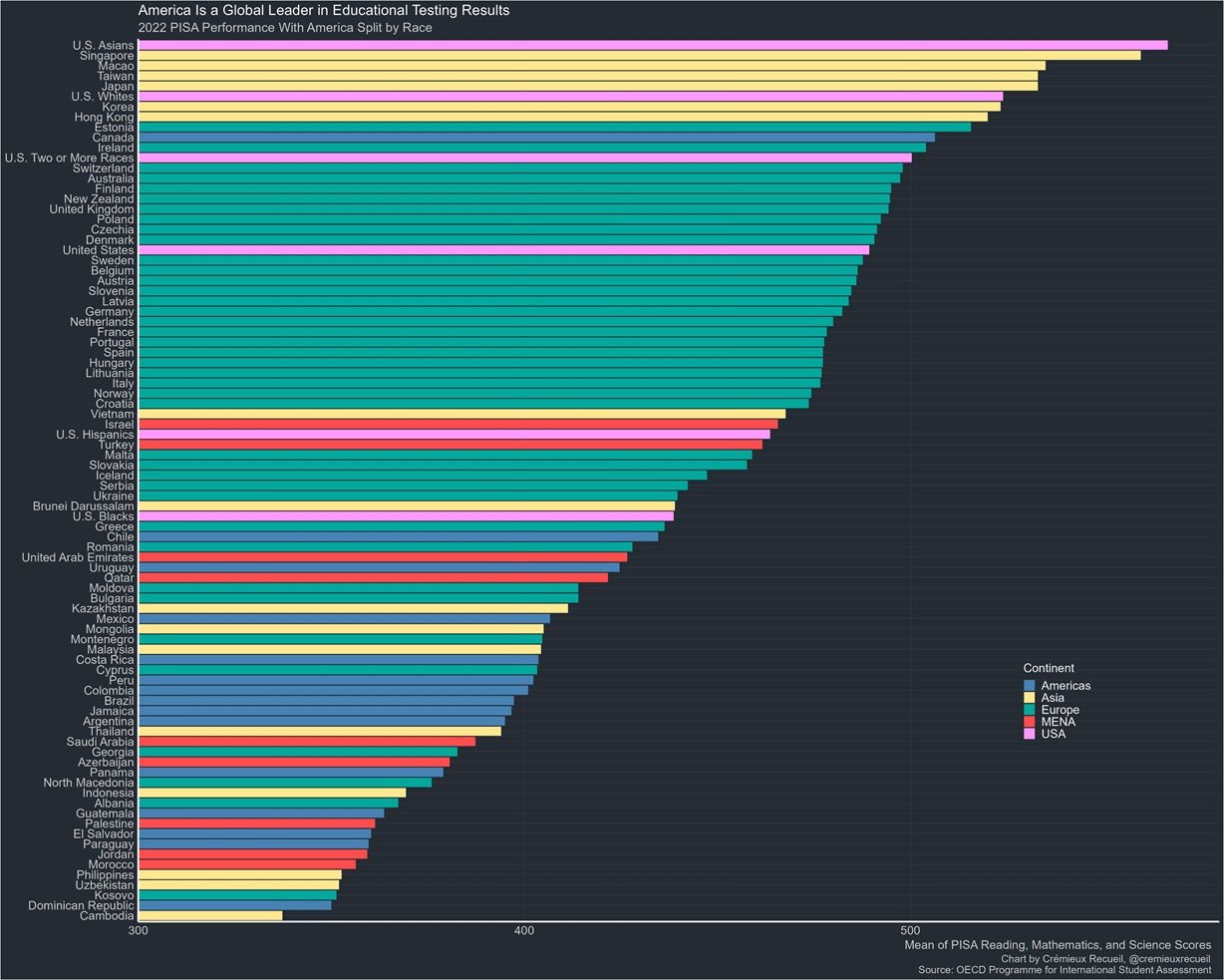
Here is the obligatory US students by ancestry group vs Rest of World graph that reflects: 1. strong US spending on education (vs Rest of World) and 2. selective immigration to the US, at least for some groups.
Yasheng Huang is the Epoch Foundation Professor of Global Economics and Management at the MIT Sloan School of Management. His new book is The Rise and Fall of the EAST: How Exams, Autocracy, Stability, and Technology Brought China Success, and Why They Might Lead to Its Decline.
Steve and Yasheng discuss:
0:00 Introduction
1:11 From Beijing to Harvard in the 1980s
15:29 Civil service exams and Huang's new book, "The Rise and Fall of the EAST"
37:14 Two goals: Developing human capital and indoctrination
48:33 Impact of the exam system
57:04 China's innovation peak and decline
1:12:23 Collaboration and relationship with the West
1:21:31 How will the U.S.-China relationship evolve?
I discuss 10 key graphs related to meritocracy and university admissions. Predictive power of SATs and other factors in elite admissions decisions. College learning outcomes - what do students learn? The four paths to elite college admission. Laundering prestige at the Ivies.
Gilles Saint-Paul is Professeur à l'Ecole Normale Supérieure. He is a
graduate of Ecole Polytechnique in Engineering and received his PhD
from MIT in Economics. Gilles and Steve discuss the French elite
education system, the Yellow Vest movement, French politics and
populism, and Saint-Paul's paper on marriage markets and hypergamy.
0:00 Introduction
1:43 Gilles Saint-Paul's background and education
6:31 French and American elite education - Les Grandes Ecoles
Steve discusses the AI competition between Microsoft and Google, the competition between the U.S. and China in STEM, China’s new IVF policy, and a Science Magazine survey on polygenic screening of embryos.
00:00 Introduction
02:37 Bing vs Bard: LLMs and hallucination
20:52 China demographics & STEM
34:29 China IVF now covered by national health insurance
40:28 Survey on embryo screening in Science: ~50% of those under 35 would use it to enhance congnitivie ability
Kishore Mahbubani is Distinguished Fellow at the Asia Research Institute, National University of Singapore.
Kishore enjoyed two distinct careers: in diplomacy (1971 to 2004) and in academia (2004 to 2019). He is a prolific writer and speaker on geopolitics and East-West relations.
He was twice Singapore’s Ambassador to the UN and served as President of the UN Security Council in January 2001 and May 2002.
Mr. Mahbubani joined academia in 2004, when he was appointed the Founding Dean of the Lee Kuan Yew School of Public Policy (LKY School), NUS. He was Dean from 2004 to 2017.
In this episode Steve and Kishore discuss:
0:00 Introduction
2:52 Upbringing in Singapore and Asia's rise
11:35 How western thinking influences China-U.S. relations
23:05 Is China a threat to U.S. hegemony in Asia?
25:52 The United States' long-term strategy for China
32:13 How trade with ASEAN influences U.S.-China relations
40:58 Can ASEAN countries play a diplomatic role between U.S. and China
43:05 Xi Jinping's leadership and the zero-sum view of China
Gregory Clark is Distinguished Professor of Economics at UC-Davis. He is an editor of the European Review of Economic History, chair of the steering committee of the All-UC Group in Economic History, and a Research Associate of the Center for Poverty Research at Davis. He was educated at Cambridge University and received a PhD from Harvard University.
His areas of research are long-term economic growth, the wealth of nations, economic history, and social mobility.
Steve and Greg discuss:
0:00 Introduction
2:31 Background in economics and genetics
10:25 The role of genetics in determining social outcomes
16:27 Measuring social status through marriage and occupation
36:15 Assortative mating and the industrial revolution
49:38 Criticisms of empirical data, engagement on genetics and economic history
1:12:12 Heckman and Landerso study of social mobility in US vs Denmark
1:24:32 Predicting cognitive traits
1:33:26 Assortative mating and increase in population variance
I've had numerous requests to comment on the conflict in Ukraine, but have been too busy to write anything.
For background on the situation, I highly recommend the discussion in the video below, released March 3 2022.
To save time, just listen to the presentations by Mearsheimer and McGovern, and their final comments at the end of the video. Both present historical details from the last decade or so that will shock people who only pay attention to mainstream Western media. (Also in the discussion: Jack Matlock, former US Ambassador to the Soviet Union, and Ted Postol, MIT professor and missile expert.)
Ray McGovern is a retired CIA analyst who served as Chief of the Soviet Foreign Policy Branch and preparer/briefer of the President’s Daily Brief. I featured another interview with him in an earlier post on the US catastrophe in Afghanistan: Tragedy of Empire / Mostly Sociopaths at the Top.
Corey Washington and I interviewed John Mearsheimer for the original Manifold, but the episode was not released. It's possible that I might release it some time in the future.
While military and diplomatic aspects of the conflict in Ukraine are worthy of attention, far more important are the long term consequences of Western hysteria and economic war on Russia. Tacit support for Russia from China, India, Brazil, Turkey, OPEC states, indeed perhaps the majority of the world population, may presage a new era of multipolarity and hard power confrontation between great powers.
Why do educated citizens of the countries listed above understand the situation better than the typical American or European? Because they are familiar with Western media propaganda and the history of US imperialism. They are much more likely to understand the facts described by Mearsheimer and McGovern about the recent history of NATO, Ukraine, and Russia leading up to this conflict.
PS I'm surprised there isn't more discussion of systemic risks from defaults of highly networked financial entities that are affected by sanctions on Russia.
This looks dangerous -- like the Lehman Brothers bankruptcy in 2008. Or am I missing some structural reforms that prevent that from happening again? (Maybe the earlier round of sanctions have already decoupled Russia enough...) Or will the central banks that effectively run our economies now simply issue a blanket put, allowing all of our clever money men to go back to sleep? People used to complain about "zombie companies" in some countries with excessive state intervention in their economies. It looks to me like we've had zombie financial markets for some time now...
Of course I think individuals in TW and UKR have every right to vote / fight for the government they want.
But they are not likely to get their way as the issue is much more important to their giant neighbor (RUS, PRC) than to the USA or soft Europeans in Brussels.
They are probably better off negotiating a peaceful coexistence with the nearby great power. Finland "Finlandized" itself and that was probably the best it could do...
What you are seeing right now in UKR is what great power realists like Mearsheimer *predicted* would happen IF the West gave too much hope to UKR without being willing to actually back it up.
Now, you may say that Joe Smith in Iowa *should* want to back up UKR or TW, send his son to fight on the front lines there. But it is not the case and we know that. We also knew it 10-15y ago when NATO expansion mischief got started and Mearsheimer made his early cautionary statements on this, as did Kennan, Nitze, Perry, Sam Nunn -- all the old cold warriors who ACTUALLY DEFEATED USSR and understood things better than today's leaders.
US won't even sanction RUS energy imports to this country... How much pain are we willing to endure for UKR?
We're going to fight this war to the last Ukrainian... If there isn't a negotiated settlement soon UKR will end up like Iraq and Afghanistan -- abandoned by the US and destroyed.
I can predict something very similar for TW, even though I have extended family living there right now. Does that count towards emotional commitment / empathy? I'm descended from KMT military officers on both sides of my family tree!
TW should negotiate for the best deal it can get from PRC and not count on the US to protect it.
######
US war hawks want to see PRC blow itself up fighting for TW. The conflict will destroy Asian economies and leave USA largely unscathed (just as WWII did). They don't care about the well-being of ~2-3 billion Asians.
Some of them just can't help themselves and want to see RUS blow itself up fighting in a UKR trap. But this group is very stupid as they are driving RUS into the arms of PRC and that is going to be very bad for USA.
Some US war hawks are smarter than others...
######
US to Ukraine, pointing at Russia: "Let's you and him fight."
######
William Burns is Biden's CIA Director, and was Ambassador to the Russian Federation. What did he write about Ukraine and NATO expansion? From Peter Beinart's substack:
Two years ago, Burns wrote a memoir entitled, The Back Channel. It directly contradicts the argument being proffered by the administration he now serves. In his book, Burns says over and over that Russians of all ideological stripes—not just Putin—loathed and feared NATO expansion. He quotes a memo he wrote while serving as counselor for political affairs at the US embassy in Moscow in 1995. ‘Hostility to early NATO expansion,” it declares, “is almost universally felt across the domestic political spectrum here.” On the question of extending NATO membership to Ukraine, Burns’ warnings about the breadth of Russian opposition are even more emphatic. “Ukrainian entry into NATO is the brightest of all redlines for the Russian elite (not just Putin),” he wrote in a 2008 memo to then-Secretary of State Condoleezza Rice. “In more than two and a half years of conversations with key Russian players, from knuckle-draggers in the dark recesses of the Kremlin to Putin’s sharpest liberal critics, I have yet to find anyone who views Ukraine in NATO as anything other than a direct challenge to Russian interests.”
While the Biden administration claims that Putin bears all the blame for the current Ukraine crisis, Burns makes clear that the US helped lay its foundations. By taking advantage of Russian weakness, he argues, Washington fueled the nationalist resentment that Putin exploits today. Burns calls the Clinton administration’s decision to expand NATO to include Poland, Hungary, and the Czech Republic “premature at best, and needlessly provocative at worst.” And he describes the appetite for revenge it fostered among many in Moscow during Boris Yeltsin’s final years as Russia’s president. “As Russians stewed in their grievance and sense of disadvantage,” Burns writes, “a gathering storm of ‘stab in the back’ theories slowly swirled, leaving a mark on Russia’s relations with the West that would linger for decades.”
As the Bush administration moved toward opening NATO’s doors to Ukraine, Burns’ warnings about a Russian backlash grew even starker. He told Rice it was “hard to overstate the strategic consequences” of offering NATO membership to Ukraine and predicted that “it will create fertile soil for Russian meddling in Crimea and eastern Ukraine.” Although Burns couldn’t have predicted the specific kind of meddling Putin would employ—either in 2014 when he seized Crimea and fomented a rebellion in Ukraine’s east or today—he warned that the US was helping set in motion the kind of crisis that America faces today. Promise Ukraine membership in NATO, he wrote, and “There could be no doubt that Putin would fight back hard.”
Were a reporter to read Burns’ quotes to White House press secretary Jen Psaki today, she’d likely accuse them of “parroting Russian talking points.” But Burns is hardly alone. From inside the US government, many officials warned that US policy toward Russia might bring disaster. William Perry, Bill Clinton’s Defense Secretary from 1994 to 1997, almost resigned because of his opposition to NATO expansion. He has since declared that because of its policies in the 1990s, “the United States deserves much of the blame” for the deterioration in relations with Moscow. Steven Pifer, who from 1998 to 2000 served as US ambassador to Ukraine, has called Bush’s 2008 decision to declare that Ukraine would eventually join NATO “a real mistake.” Fiona Hill, who gained fame during the Trump impeachment saga, says that as national intelligence officers for Russia and Eurasia she and her colleagues “warned” Bush that “Putin would view steps to bring Ukraine and Georgia closer to NATO as a provocative move that would likely provoke pre-emptive Russian military action.”
Oh, there's some historical background to all this? Some context? Wait I'm told every day this crisis just happened because Putin went crazy and wants to rebuild the USSR / Russian Empire.
Who is full of crap? Western governments and media today, or our CIA Director and former Ambassadors and Secretaries of Defense? The whole world ex-USA/EU can see this. It's only Westerners who are brainwashed.
Added March 7 2022: This is a long Chinese analysis of the military aspects of the war so far. They also cite Oryx estimates. Note comparisons near the end of Russian and PLA capabilities.
I certainly sympathize with "Putin bad", "Russia bad place for me to live", "democracy good" sentiments.
But suppose the realistic possible outcomes are:
1. Ukr is dominated by Russia but not destroyed in a war
2. Ukr is dominated by Russia after a brutal war, with its economy destroyed
3. (Low probability) Ukr escapes Russian domination thanks to strong US support (avoiding WWIII).
4. (Low probability) US strongly supports Ukr, leading to MAD, WWIII
To be very definite, suppose that
I. Given actual past US policies of ~2010-2022 probabilities are P(#1) = P(#2) = 45% and P(#3) = 9% and P(#4) = 1%
II. Following advice of Mearsheimer, frmr SecDefs Perry and McNamara, CIA director Burns, etc. etc. we have
P(#1) = 95% P(#2) = 4%, others much less than 1%. [ i.e., this is a counterfactual scenario that, in my opinion, turns out better! ]
I think this is a REALISTIC characterization. You may disagree. Under my assumptions II is better than I.
But this is not primarily a normative or moral discussion... we don't disgree there.
Note, in a standard utilitarian framework P(#4) dominates everything else!
Richard Sander is Jesse Dukeminier Professor at UCLA Law School.
AB Harvard, JD, PhD (Economics) Northwestern.
Sander has studied the structure and effects of law school admissions policies. He coined the term "Mismatch" to describe negative consequences resulting from large admissions preferences.
Topics discussed:
1. Early life: educational background and experience with race and
politics in America.
2. Mismatch Theory: basic observation and empirical evidence; Law
schools and Colleges; Duke and UC data; data access issues.
3. CA Prop 209 and Prop 16.
4. SCOTUS and Harvard / UNC admissions case
5. Intellectual climate on campus, freedom of speech
A Conversation on the Nature, Effects, and Future of Affirmative Action in Higher Education Admissions (with Peter Arcidiacono, Thomas Espenshade, and Stacy Hawkins), University of Pennsylvania Journal of Constitutional Law 683 (2015)
Despite generous social programs such as free pre-K education, free college, and massive transfer payments, Denmark is similar to the US in key measures of inequality, such as educational outcomes and cognitive test scores.
While transfer payments can equalize, to some degree, disposable income, they do not seem to be able to compensate for large family effects on individual differences in development.
These observations raise the following questions:
1. What is the best case scenario for the US if all progressive government programs are implemented with respect to child development, free high quality K12 education, free college, etc.?
2. What is the causal mechanism for stubborn inequality of outcomes, transmitted from parent to child (i.e., within families)?
Re #2: Heckman and collaborators focus on environmental factors, but do not (as far as I can tell) discuss genetic transmission. We already know that polygenic scores are correlated to the education and income levels of parents, and (from adoption studies) that children tend to resemble their biological parents much more strongly than their adoptive parents. These results suggest that genetic transmission of inequality may dominate environmental transmission.
Note: Denmark is very homogenous in ancestry, and the data presented in these studies (e.g., polygenic scores and social mobility) are also drawn from European-ancestry cohorts. The focus here is not on ethnicity or group differences between ancestry groups. The focus is on social and educational mobility within European-ancestry populations, with or without generous government programs supporting free college education, daycare, pre-K, etc.
Abstract
Many progressive American policy analysts point to Denmark as a model welfare state with low levels of income inequality and high levels of income mobility across generations. It has in place many social policies now advocated for adoption in the U.S. Despite generous Danish social policies, family influence on important child outcomes in Denmark is about as strong as it is in the United States. More advantaged families are better able to access, utilize, and influence universally available programs. Purposive sorting by levels of family advantage create neighborhood effects. Powerful forces not easily mitigated by Danish-style welfare state programs operate in both countries.
Also discussed in this episode of EconTalk podcast. Russ does not ask the obvious question about disentangling family environment from genetic transmission of inequality.
The figure below appears in Game Over: Genomic Prediction of Social Mobility. It shows SNP-based polygenic score and life outcome (socioeconomic index, on vertical axis) in four longitudinal cohorts, one from New Zealand (Dunedin) and three from the US. Each cohort (varying somewhat in size) has thousands of individuals, ~20k in total (all of European ancestry). The points displayed are averages over bins containing 10-50 individuals. For each cohort, the individuals have been grouped by childhood (family) social economic status. Social mobility can be predicted from polygenic score. Note that higher SES families tend to have higher polygenic scores on average -- which is what one might expect from a society that is at least somewhat meritocratic. The cohorts have not been used in training -- this is true out-of-sample validation. Furthermore, the four cohorts represent different geographic regions (even, different continents) and individuals born in different decades.
Where is the evidence for environmental effects described above in Heckman's abstract: "More advantaged families are better able to access, utilize, and influence universally available programs. Purposive sorting by levels of family advantage create neighborhood effects"? Do parents not seek these advantages for their adopted children as well as for their biological children? Or is there an entirely different causal mechanism based on shared DNA?
I agree with Louis Gave's take on most of the topics discussed. Gavekal manages a China fixed income fund and some other China-focused funds, so he is talking his book. But the arguments stand on their own.
At ~45m, a good discussion of digital RMB and why it will break the technology record for fastest adoption by first 1 billion users. See earlier discussion (Ray Dalio) on de-dollarization and digital RMB here.
This is a good discussion of Eurasian geopolitics, Russia-China relations, decline of US empire, multipolarity, etc.
Note Diesen, originally from Norway and now a professor there, was previously professor at the Higher School of Economics in Moscow. I find his writing on Russia and Eurasian geostrategy much more realistic than what is produced by most US or European academics and analysts.
His latest book:
Will the increased economic connectivity across the Eurasian supercontinent transform Europe into the western peninsula of Greater Eurasia? The unipolar era entailed the US organising the two other major economic regions of the world, Europe and Asia, under US leadership. The rise of “the rest”, primarily Asia with China at the centre, has ended the unipolar era and even 500-years of Western dominance. China and Russia are leading efforts to integrate Europe and Asia into one large region. The Greater Eurasian region is constructed with three categories of economic connectivity – strategic industries built on new and disruptive technologies; physical connectivity with bimodal transportation corridors; and financial connectivity with new development banks, trading currencies and payments systems. China strives for geoeconomic leadership by replacing the US leadership position, while Russia endeavours to reposition itself from the dual periphery of Europe and Asia to the centre of a grand Eurasian geoeconomic constellation. Europe, positioned between the trans-Atlantic region and Greater Eurasia, has to adapt to the new international distribution of power to preserve its strategic autonomy.
Bonus: A good discussion of hypersonic missile technology and its strategic implications. See also LEO SAR, hypersonics, and the death of the naval surface ship. Effective ranges of hypersonic weapons that can be launched from land-based mobile TEL, submarine, small naval surface combatant, fighter jet, etc. are now in the thousands of kilometers. Combined with ubiquitous satellite imaging, we have a revolution in military affairs...
Alibaba and Amazon are set to fight it out for global e-commerce dominance. Both are building out distribution networks all over the world. It might not be winner take all, but there are huge returns to scale so there may be only a few winners that dominate in the future.
Alibaba has some big advantages: lower cost structure (PRC salaries) and better direct contacts with the factories in China that produce the goods.
All of these companies form the C2M (consumer to manufacturer) layer that provides the following functions.
1. Fulfillment and inventory management
2. Product and price discovery
3. Product evaluation, trust and consumer confidence
Item #1 has both physical and information infrastructure components, and is the most expensive to build. Items #2 and #3 can be built entirely virtually with much lower barrier to entry.
Just for fun I checked on AliExpress and I could find many of the same products as on Amazon, but at much lower prices. Not surprising, as it's all made in China these days.
At the moment Amazon delivery to US customers is much faster, but the situation varies by country and is changing rapidly.
This Ditchley conference will focus on China, its internal state and sense of self today, its role in the region and world, and how these might evolve in years to come.
There are broadly two current divergent narratives about China. The first is that China’s successful response to the pandemic has accelerated China’s ascent to be the world’s pre-eminent economic power. The Made in China 2025 strategy will also see China take the lead in some technologies beyond 5G, become self-sufficient in silicon chip production and free itself largely of external constraints on growth. China’s internal market will grow, lessening dependence on exports and that continued growth will maintain the bargain between the Chinese people and the Chinese Communist Party through prosperity and stability. Retaining some elements of previous Chinese strategy though, this confidence is combined with a degree of humility: China is concerned with itself and its region, not becoming a global superpower or challenging the US. Economic supremacy is the aim but military strategy remains focused on defence, not increasing international leverage or scope of action.
The second competing narrative is that China’s position is more precarious than it appears. The Belt and Road Initiative will bring diplomatic support from client countries but not real economic gains. Human rights violations will damage China abroad. Internally the pressures on natural resources will prove hard to sustain. Democratic and free-market innovation, combined with a bit more industrial strategy, will outstrip China’s efforts. Careful attention to supply chains in the West will meanwhile reduce critical reliance on China and curb China’s economic expansion. This perceived fragility is often combined though with a sense of heightened Chinese ambition abroad, not just through the Belt and Road Initiative but in challenging the democratic global norms established since 1989 by presenting technologically-enabled and effective authoritarian rule as an alternative model for the world, rather than just a Chinese solution.
What is the evidence today for where we should settle between these narratives? What trends should we watch to determine likely future results? ...
[Suggested background reading at link above.]
Unfortunately this meeting will be virtual. The video below gives some sense of the unique charm of in-person workshops at Ditchley.
See also this 2020 post about an earlier Ditchley meeting I attended: World Order Today
1. It is possible that by 2050 the highly able STEM workforce in PRC will be ~10x larger than in the US and comparable to or larger than the rest of the world combined. Here "highly able" means roughly top few percentile math ability in developed countries (e.g., EU), as measured by PISA at age 15.
[ It is trivial to obtain this kind of estimate: PRC population is ~4x US population and fraction of university students in STEM is at least ~2x higher. Pool of highly able 15 year olds as estimated by PISA or TIMMS international testing regimes is much larger than in US, even per capita. Heinsohn's estimate is somewhat high because he uses PISA numbers that probably overstate the population fraction of Level 6 kids in PRC. Current PISA studies disproportionately sample from more developed areas of China. At bottom (asterisk) he uses results from Taiwan/Macau that give a smaller ~20x advantage of PRC vs USA. My own ~10x estimate is quite conservative in comparison. ]
2. The trajectory of international patent filings shown below is likely to continue.
Insights from Ray Dalio and Paul Kennedy (The Rise and Fall of the Great Powers, 1987) on the balance of power and future global order. I was in graduate school when Kennedy's book was first published and I still have the hardcover first edition somewhere. Dalio and Kennedy have both carefully studied historical examples and present, in my opinion, a realistic view of what is happening. Kennedy mentions the PRC naval build up as a very explicit, material comparison of strength, whereas Dalio focuses on financial and economic matters. Elizabeth Economy provides some interesting comments on internal Chinese politics, but I am unsure how much insight any US analysts can have into the fine details of this.
The Naval War College Review article mentioned by Paul Kennedy is:
Panelists discuss the rise and fall of great powers and the competing grand strategies of the United States and China.
Speakers
Ray Dalio
Founder, Co-chairman, and Co-chief Investment Officer, Bridgewater Associates, LP; Author, The Changing World Order: Why Nations Succeed and Fail
CFR Member
Elizabeth C. Economy
Senior Fellow for China Studies, Council on Foreign Relations; Senior Fellow, Hoover Institution, Stanford University; Author, The Third Revolution: Xi Jinping and the New Chinese State; @LizEconomy
Paul M. Kennedy
J. Richardson Dilworth Professor of History and Director of International Security Studies, Yale University; Author, The Rise and Fall of the Great Powers
Bonus! Short WSJ piece on digital RMB rollout. SWIFT beware...
Greg Clark (UC Davis and London School of Economics) deserves enormous credit for producing a large multi-generational dataset which is relevant to some of the most fundamental issues in social science: inequality, economic development, social policy, wealth formation, meritocracy, and recent human evolution. If you have even a casual interest in the dynamics of human society you should study these results carefully...
Gregory Clark, University of California, Davis and LSE (March 1, 2021)
Economics, Sociology, and Anthropology are dominated by the belief that
social outcomes depend mainly on parental investment and community socialization. Using a lineage of 402,000 English people 1750-2020 we test whether such mechanisms better predict outcomes than a simple additive genetics model. The genetics model predicts better in all cases except for the transmission of wealth. The high persistence of status over multiple generations, however, would require in a genetic mechanism strong genetic assortative in mating. This has been until recently believed impossible. There is however, also strong evidence consistent with just such sorting, all the way from 1837 to 2020. Thus the outcomes here are actually the product of an interesting genetics-culture combination.
The correlational results in the table below were originally deduced by Fisher under the assumption of additive genetic inheritance: h2 is heritability, m is assortativity by genotype, r assortativity by phenotype. (Assortative mating describes the tendency of husband and wife to resemble each other more than randomly chosen M-F pairs in the general population.)
Fisher, R. A. 1918. “The Correlation between Relatives on the Supposition of Mendelian
Inheritance.” Transactions of the Royal Society of Edinburgh, 52: 399-433
Thanks to Clark the predictions of Fisher's models, applied to social outcomes, can now be compared directly to data through many generations and across many branches of English family trees. (Figures below from the paper.)
The additive model fits the data well, but requires high heritabilities h2 and a high level m of assortative mating. Most analysts, including myself, thought that the required values of m were implausibly large. However, using modern genomic datasets one can estimate the level of assortative mating by simply looking at the genotypes of married couples.
From the paper:
(p.26) a recent study from the UK Biobank, which has a collection of genotypes of individuals together with measures of their social characteristics, supports the idea that there is strong genetic assortment in mating. Robinson et al. (2017) look at the phenotype and
genotype correlations for a variety of traits – height, BMI, blood pressure, years of education - using data from the biobank. For most traits they find as expected that the genotype correlation between the parties is less than the phenotype correlation. But there is one
notable exception. For years of education, the phenotype correlation across spouses is 0.41 (0.011 SE). However, the correlation across the same couples for the genetic predictor of educational attainment is significantly higher at 0.654 (0.014 SE) (Robinson et al., 2017, 4). Thus couples in marriage in recent years in England were sorting on the genotype as opposed to the phenotype when it comes to educational status.
It is not mysterious how this happens. The phenotype measure here is just the number of years of education. But when couples interact they will have a much more refined sense of what the intellectual abilities of their partner are: what is their general knowledge, ability to
reason about the world, and general intellectual ability. Somehow in the process of matching modern couples in England are combining based on the weighted sum of a set of variations at several hundred locations on the genome, to the point where their correlation on this measure is 0.65.
After PPP correction the PRC economy is significantly larger than the US economy, so it's important to understand what nominal GDP and its adjusted counterpart represent.
This 2019 video follows a 26 year old woman during a typical weekend day. She lives in a $330 per month apartment in central Shanghai, a short walk to her office where she works as an advertising copywriter. You get a look at the apps she uses to order food and household supplies, keep up with fashion and culinary trends, pay at restaurants, etc.
Her monthly budget is about $2300 USD per month, and as far as I can tell her lifestyle would cost more than twice as much in NYC (e.g., Brooklyn), San Francisco, Chicago, or even a somewhat smaller US city. So the nominal to PPP correction of 2x may actually be conservative! Some have suggested that the PRC government deliberately understates its GDP in order to continue to claim "developing nation" status, and to not alarm US hawks (as if that were possible).
In late 2010 I was in Shanghai for a physics meeting, and blogged about dollar-yuan purchasing power parity (PPP).
1 USD = 6.64 RMB. Average salary in Shanghai is reportedly 65k RMB or about USD $10k per annum. ... The IMF estimates that the PPP (purchasing power parity) vs nominal exchange rate adjustment for China is about a factor of 2 (i.e., PPP GDP is about twice nominal GDP). That doesn't sound entirely crazy to me but it's very dependent on choice of goods for the PPP basket. ...