Recent interview with Razib Khan. We've known each other IRL for about 20 years now, so this conversation has a slightly different character than other interviews I've done.
I highly recommend his substack and podcast, particularly if you are interested in ancient DNA, human evolution, deep history.
Alex Murshak is a Michigan State grad working as an AI engineer in Austin TX. This conversation is Episode 13 of his podcast Hacking State.
Episode description:
Steve and I speak about polygenic risk scoring and embryo selection, using AI to predict phenotype from genotype, in-vitro fertilization (IVF), egg freezing, eugenic public policy, addressing Christians' and right-wing traditionalists' concerns over reproductive technology, Superfocus AI's plan to eliminate hallucination in large language models (LLMs) by separating memory from inference, introspection for LLM error correction, and surviving the failed cancellation attempt at MSU.
I discuss 10 key graphs related to meritocracy and university admissions. Predictive power of SATs and other factors in elite admissions decisions. College learning outcomes - what do students learn? The four paths to elite college admission. Laundering prestige at the Ivies.
Richard Hanania, Rob Henderson, and I were scheduled for a June 2023 panel as part of the University of Austin (UATX) Forbidden Courses series. I missed the panel due to travel issues, but we gathered on this podcast to recreate the fun!
Topics:
0:00 Introduction
1:20 The University of Austin and forbidden courses
17:37 Will woke campus culture change anytime soon?
29:57 Common people vs elites on affirmative action
35:42 Why it’s uncomfortable to disagree about affirmative action
41:22 Fraud and misrepresentation in higher ed
44:20 The adversity carveout in the Supreme Court affirmative action ruling
50:10 Standardized testing and elite university admissions
1:06:18 Divergent views among racial and ethnic groups on affirmative action; radicalized Asian American males
1:10:00 Differences between East and South Asians in the West
1:23:03 Class-based preferences and standardized tests
Richard Sander is Jesse Dukeminier Professor at UCLA Law School. AB Harvard, JD, PhD (Economics) Northwestern.
Steve and Richard discuss the recent Supreme Court ruling in Students For Fair Admissions vs Harvard and UNC.
Sander has studied the structure and effects of law school admissions policies. He coined the term "Mismatch" to describe negative consequences resulting from large admissions preferences.
0:00 Introduction
1:09 Richard Sander’s initial reaction to the Supreme Court ruling
4:03 How data influenced the court’s decision
7:58 Overview of the court’s ruling
11:27 Carve outs in the court’s ruling
16:59 The litigation landscape
21:25 Workarounds to race-blind admissions and the UC system
32:22 Remedies: What will happen with Harvard and UNC now?
38:02 The landscape of college admissions
44:47 Effects of the Supreme Court ruling beyond higher education
Geoffrey Miller is an American evolutionary psychologist, author, and a professor of psychology at the University of New Mexico. He is known for his research on sexual selection in human evolution.
Anna I. Krylov (Russian: Анна Игоревна Крылова) is Professor of Chemistry at the University of Southern California (USC), working in the field of theoretical and computational quantum chemistry.
Krylov is an outspoken advocate of freedom of speech and academic freedom. She is a founding member of the Academic Freedom Alliance and a member of its academic leadership committee.
Her paper, The Peril of Politicizing Science, launched a national conversation among scientists and the general public on the growing influence of political ideology in STEM. It has received over 80,000 views and, according to Altmetric, was the all-time highest-ranked article in the Journal of Physical Chemistry Letters.
Steve and Anna discuss:
0:00 Anna Krylov’s background, upbringing in USSR
7:03 Ideological control and censorship for the greater good?
14:59 How ideology underpins DEI work in academic institutions
30:40 Captured institutions
37:05 How much is UC Berkeley spending on DEI, and where the money is going
41:46 Krylov thinks it can get worse
52:09 An idea for defeating preference falsification at universities
I had been at Harvard as an Assistant Professor in the mid-sixties and then came back in 1969 as a Full Professor. That was immediately after the student uprisings, building takeovers, and so on, at Harvard the previous spring. When I arrived in the fall of 1969, there was a philosophy course listed in the catalog entitled “Capitalism.” And the course description was “a moral examination of capitalism.” Of course, for most students, then, it would be taken for granted that a moral examination would be a moral condemnation of capitalism. But that’s not what I intended. We were going to read critics of capitalism. But we were also planning to read defenses of capitalism, and I was going to construct some of my own in the lectures. Some of the graduate students in the philosophy department knew what ideas I held, and they weren’t very happy about a course being taught in the department defending those ideas. Now it was true that there was another course in the department on Marxism by someone who was then a member of the Maoist Progressive Labor Party and students did not object to that. But still some students objected to my giving a lecture course on capitalism. I remember early in the fall (I guess I was scheduled to give the course in the spring term), a graduate student came to me at a departmental reception we had, and said, “We don’t know if you’re going to be allowed to give this course.” I said “What do you mean, not allowed to give this course?” He said, “Well, we know what ideas you hold. We just don’t know whether you will be allowed to give the course.” And I said, “If you come and disrupt my course, I’m going to beat the shit out of you!” And the student was taken aback and said, “But you are taking all this very personally.” And I said, “What do you mean, personally? You are threatening to disrupt my course! you can do other things; you can stand outside the room and hand out leaflets. You can ask students not to register for my course. But if you come into my classroom while I am lecturing and disrupt the class, then I take that very personally.” In fact, at some point later in the term, this student and some others said they were going to make up leaflets and hand them out outside of my classroom. I said, “That’s fine; that would be really exciting.” Then they didn’t get around to doing it, and so I prodded them, “Where are the leaflets? I was counting on something special happening with the leaflets.” But it turned out that it was a lot of trouble to write up a leaflet, to get them run off on a mimeograph machine, and so they never got around to doing it. Thus I never had the privilege of being “leafleted” at Harvard. It seemed to me that sort of antagonism only lasted for a very short period of time and diminished fast. There was no longer any strong personal animosity after that. Maybe it was the general toning down of things in the country in the early 70’s, and I just benefited from the de-radicalization of the university.
More fun photos from this old post Forever Young :-)
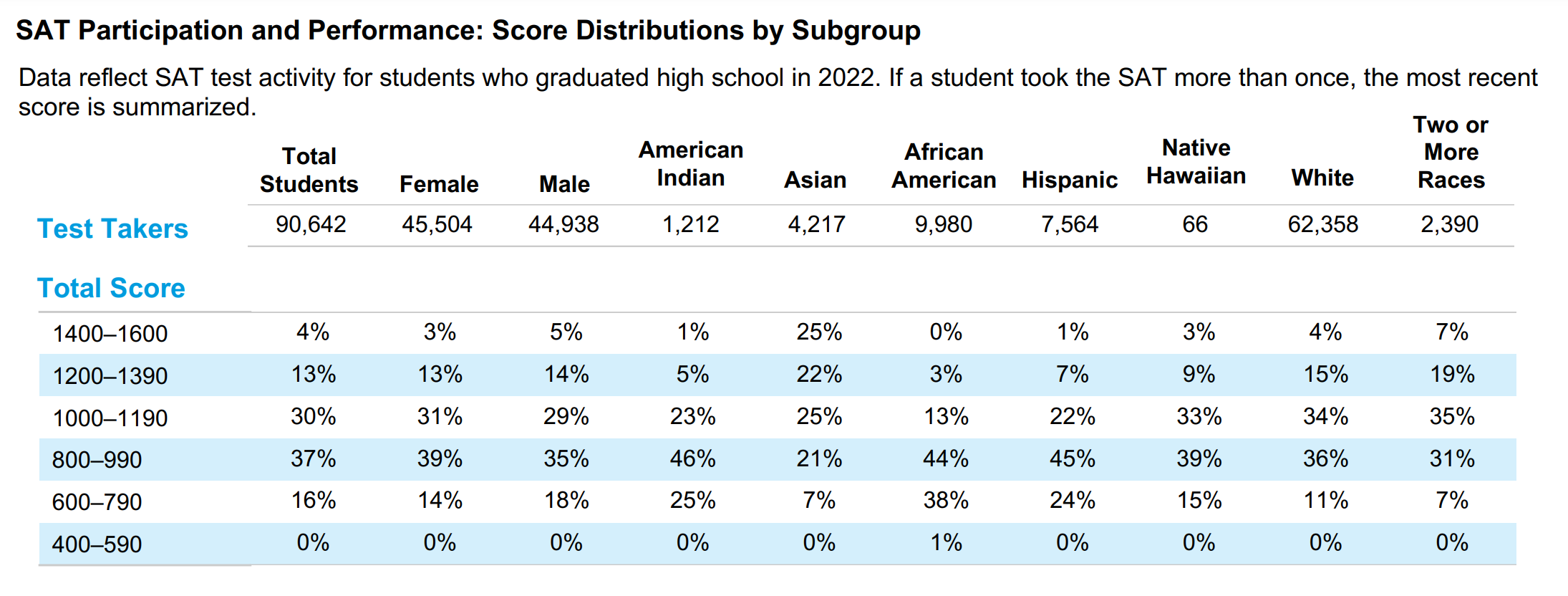
The state of Michigan required all public HS seniors to take the SAT last year (~91k out of ~107k total seniors in the state). This generated an unusually representative score sample. Full report.
I'm aware of this stuff because my kids attend a public HS here.
To the uninformed, the results are shocking in a number of ways. Look specifically at the top band with scores in the 1400-1600 range. These are kids who have a chance at elite university admission, based on academic merit. For calibration, the University of Michigan median SAT score is above 1400, and at top Ivies it is around 1500.
Some remarks:
1. In the top band there are many more males than females.
2. The Asian kids are hitting the ceiling on this test.
3. There are very few students from under-represented groups who score in the top band.
4. By looking at the math score distribution (see full report) one can estimate how many students in each group are well-prepared enough to complete a rigorous STEM major -- e.g., pass calculus-based physics.
Previously I have estimated that PRC is outproducing the US in top STEM talent by a factor as large as 10x. In a decade or two the size of their highly skilled STEM workforce (e.g., top engineers, AI researchers, biotech scientists, ...) could be 10x as large as that of the US and comparable to the rest of the world, ex-China.
This is easy to understand: their base population is about 4x larger and their K12 performance on international tests like PISA is similar to what is found in the table above for the Asian category. The fraction of PRC kids who perform in the top band is probably at least several times larger than the overall US fraction. (Asian vs White in the table above is about 6x, or 7x on the math portion.) Also, the fraction of college students who major in STEM is much larger in PRC than in the US.
Rob Henderson grew up in foster homes in California, joined the Air Force at 17, attended Yale on the G.I. Bill, and is currently a Gates Fellow at Cambridge University (UK). He is an acute observer of American society and has coined the term Luxury Beliefs to describe ideas and opinions that confer status on the rich at very little cost, while taking a toll on the lower class.
Steve and Rob discuss:
00:00 Early life and foster experience
20:21 Rob’s experience in the Air Force
31:26 Transitioning from the Air Force to Yale and then Cambridge
44:04 Dating and socializing as an older student
50:06 Reflections on the Yale Halloween email controversy
1:01:10 Personal incentives and careerists in higher education
1:09:45 Luxury beliefs and how they show up in elite institutions
1:31:08 Age and moral judgments
1:42:50 Rob on resisting legacy academia and his future
The guest for this episode is a recent graduate of Harvard College, now pursuing a STEM PhD at another elite university. We have withheld his identity so that he can speak candidly.
Steve and his guest discuss:
0:00 Anonymous student’s academic background and admission to Harvard
21:37 Intellectual curiosity at Harvard
29:36 Academic rigor at Harvard and the difference between classes in STEM and the humanities
46:47 Access to tenured professors at Harvard
50:08 The benefits of the Harvard connection and wider pool of opportunities
58:46 Competing with off-scale students
1:00:48 Ideological climate on campus, wokeism, and controversial public speakers
1:23:11 Dating at Harvard
1:26:52 Z-scores and other metrics to add to the admissions process
Typology used for all applicants, at least as late as 1988:
1. S First-rate scholar in Harvard departmental terms.
2. D Candidate's primary strength is his academic strength, but it doesn't look strong enough to quality as an S (above).
3. A All-Amercan‚ healthy, uncomplicated athletic strengths and style, perhaps some extracurricular participation, but not combined with top academic credentials.
4. W Mr. School‚ significant extracurricular and perhaps (but not necessarily) athletic participation plus excellent academic record.
5. X Cross-country style‚ steady man who plugs and plugs and plugs, won't quit when most others would. Gets results largely through stamina and consistent effort.
6. P PBH [Phillips Brooks House] style: in activities and personal concerns.
7. C Creative in music, art, writing.
8. B Boondocker‚ unsophisticated rural background.
9. T Taconic, culturally depressed background, low income.
10. K Krunch‚ main strength is athletic, prospective varsity athlete. [ Sometimes also "H Horse" :-) ]
11. L Lineage‚ candidate probably couldn't be admitted without the extra plus of being a Harvard son, a faculty son, or a local boy with ties to the university community.
12. O Other‚ use when none of the above are applicable.
Richard Lowery is a professor of finance at the McCombs School of Business at the University of Texas, Austin. In this conversation, he describes the ideological climate of his university and the consequent negative effects on undergraduate education and freedom of expression on campus.
Steve and Richard discuss:
0:00 Richard Lowery's academic and political background
9:01 Campus environment for academics and faculty members
12:19 Cultural and political dynamics at academic institutions
23:04 How students experience campus culture and political influences
32:13 Public awareness and interest in campus culture
35:50 What happened to the Liberty Institute at UT Austin
This is a long interview I did recently with Cactus Chu, a math prodigy turned political theorist and podcaster. (Unfortunately I can't embed the podcast here.)
Richard Sander is Jesse Dukeminier Professor at UCLA Law School.
AB Harvard, JD, PhD (Economics) Northwestern.
Sander has studied the structure and effects of law school admissions policies. He coined the term "Mismatch" to describe negative consequences resulting from large admissions preferences.
Topics discussed:
1. Early life: educational background and experience with race and
politics in America.
2. Mismatch Theory: basic observation and empirical evidence; Law
schools and Colleges; Duke and UC data; data access issues.
3. CA Prop 209 and Prop 16.
4. SCOTUS and Harvard / UNC admissions case
5. Intellectual climate on campus, freedom of speech
A Conversation on the Nature, Effects, and Future of Affirmative Action in Higher Education Admissions (with Peter Arcidiacono, Thomas Espenshade, and Stacy Hawkins), University of Pennsylvania Journal of Constitutional Law 683 (2015)
By coincidence, I was just in contact over the weekend with several of the people involved in the effort to end discrimination against Asian Americans in elite college admissions.
This has been a long road, but perhaps victory is near.
... SFFA founder Edward J. Blum, who has spearheaded more than two dozen lawsuits challenging affirmative action and voting rights laws around the U.S., heralded the court’s move.
“Harvard and the University of North Carolina have racially gerrymandered their freshman classes in order to achieve prescribed racial quotas,” he wrote in a statement. “Every college applicant should be judged as a unique individual, not as some representative of a racial or ethnic group.”
... The facts are just so embarrassing to Harvard that with some modest adjustment in its admissions practices it might be able to absorb a judgment against it and get on with life more or less as usual. The vagueness of the category on which Harvard was relying to make sure that it kept its Asian undergraduates at the level that it wished, the so-called personality score, is such a floppy nothing of an empty basket — that’s not gonna do anymore.
There is something profoundly disturbing about Harvard using these flaccid categories to achieve something like a quota. The court papers show how the system was invented to keep the number of Jews down in the late 1920s and early 1930s. It’s all pretty bad, and part of the badness is that colleges have been both compelled and allowed to do what they’re doing under the rubric of "diversity," which conceals from view the actual operation of the whole system, and what they are in fact aiming to achieve. It’s substituting one vocabulary for another in a way that creates a climate of dishonesty. What goes on in the admissions office is increasingly mysterious, and what happens once students are admitted — that is something to which little attention is paid by educators themselves.
1. Asian Americans (not foreign students from Asia, but individuals of Asian heritage who are US citizens or permanent residents) have been discriminated against in admission to elite institutions of higher education for over 30 years.
To put it bluntly, Asian Americans must, on average, outperform all other groups in order to have an equal chance of admission to universities like Harvard or Yale. If one were to replace Asian Americans with Jews in the previous sentence, it would describe the situation in the early 20th century. Looking back, we are rightfully ashamed and outraged at the conduct of elite universities during this period. Future Americans, and observers all over the world, will eventually have the same reaction to how Asian Americans are treated today by these same institutions.
2. Asian American success, e.g., as measured using metrics such as income, wealth, or education, is problematic for simplistic narratives that emphasize race and "white supremacy" over a more realistic and multifaceted analysis of American society.
3. Efforts to guarantee equal outcomes, as opposed to equal opportunities, are anti-meritocratic and corrosive to social cohesion, undermine basic notions of fairness, and handicap the United States in scientific and technological competition with other nations.
The Table of Contents, reproduced below, gives an idea of the important topics covered. Xu had an insider's view of the Students for Fair Admission v. Harvard trial, now awaiting appeal to the Supreme Court. He also describes the successful effort by a grass roots coalition of Asian Americans to defeat CA Proposition 16, which would have reinstated racial preferences in the public sector (including college admissions) which were prohibited by Proposition 209 in 1996.
Over the years I have had many conversations on this topic with well-meaning (but often poorly informed) parents of all ethnic and cultural backgrounds. I cannot help but ask these people
Are you OK with discrimination against your child? What did they do to deserve it?
Are you going to let virtue-signaling administrators at the university devalue the hard work and hard-won accomplishments of your son or daughter? Are you going to do anything about it?
and I cannot help but think
If you won't do anything about it, then f*ck you. Your kids deserve better parents.
Kenny calls it a Fight for Meritocracy. That's what it is -- a fight. Don't forget that Meritocracy is just a fancy word for fairness. It's a fight for your kid, and all kids, to be treated fairly.
I highly recommend the book. These issues are of special concern to Asian Americans, but should be of interest to anyone who wants to know what is really happening in American education today.
Last week MSU hosted a virtual meeting on Freedom of Speech and Intellectual Diversity on Campus. I particularly enjoyed several of the talks, including the ones by Randall Kennedy (Harvard), Conor Friesdorf (The Atlantic), and Cory Clark (UPenn). Clark had some interesting survey data I had never seen before. I hope the video from the meeting will be available soon.
In the meantime, here are some survey results from Eric Kaufmann (University of London). The full report is available at the link.
In this recent podcast interview Kaufmann discusses the woke takeover of academia and other institutions.
Stylized facts:
1. Academia has always been predominantly left, but has become more and more so over time. This imbalance is stronger in Social Science and Humanities (SSH) than in STEM, but even in STEM the faculty are predominantly left of center relative to the general population.
2. Leftists are becoming more and more intolerant of opposing views.
3. Young academics (PhD students and junior faculty) are the least tolerant of all.
In my opinion the unique importance of research universiites originates from their commitment to the search for Truth. This commitment is being supplanted by a focus on social justice, with extremely negative consequences.
Figure 1. Note: Excludes STEM academics. Labels refer to hypothetical scenarios in which respondents are asked whether they would support a campaign to dismiss a staff member who found the respective conclusions in their research. Brackets denote sample size.
Figure 2. Note: Includes STEM academics. Based on a direct question rather than a concealed list technique.
Figure 3. Note: SSH refers to social sciences and humanities. Sample size in brackets. STEM share of survey responses: US and Canada academic: 10%; UK mailout: zero; UK YouGov SSH active: zero; UK YouGov All: 53%; UK PhDs: 55%; North American PhDs: 63%.
Randall Kennedy, "The Race Question and Freedom of Expression."
Randall Kennedy is the Michael R. Klein Professor at Harvard Law School, preeminent authority on the First Amendment in its relation to the American struggle for civil rights.
Day One: Intellectual Diversity - Friday, April 9
11:30am - 1:00pm EST
Panel 1: What are the empirical facts about lack of intellectual diversity in academia and what are the causes of existing imbalances?
Paper: Lee Jussim, Distinguished Professor and Chair, Department of Psychology, Rutgers University, author of The Politics of Social Psychology.
Discussant: Philip Tetlock, Annenberg University Professor, University of Pennsylvania, author of “Why so few conservatives and should we care?” and Cory Clark, Visiting Scholar, Department of Psychology, University of Pennsylvania, author of “Partisan Bias and its Discontents.”
2:00pm - 3:30pm EST
Panel 2: In what precise ways and to what degree is this imbalance a problem?
Paper: Joshua Dunn, Professor and Chair, Department of Political Science, University of Colorado, co-author of Passing on the Right: Conservative Professors in the Progressive University.
Discussant: Amna Khalid, Associate Professor of History, Carleton College, author of “Not A Vast Right-Wing Conspiracy: Why Left-Leaning Faculty Should Care About Threats to Free Expression on Campus."
4:00pm - 5:45pm EST
Panel 3: What is To Be Done?
Paper: Musa Al-Gharbi, Paul F. Lazarsfeld Fellow in Sociology, Columbia University and Managing Editor, Heterodox Academy, author of “Why Care About Ideological Diversity in Social Research? The Definitive Response.”
Paper: Conor Friedersdorf, Staff writer at The Atlantic and frequent contributor to its special series “The Speech Wars,” author of “Free Speech Will Survive This Moment.”
Day Two: Freedom of Speech - Saturday, April 10
11:30am - 1:00pm EST
Panel 1: An empirical accounting of the recent challenges to free speech on campus from left and right. What is the true character of the problem or problems here and do they constitute a “crisis”?
Paper: Jonathan Marks, Professor and Chair, Department of Politics and International Relations, Ursinus College, author of Let's Be Reasonable: A Conservative Case for Liberal Education.
Respondent: April Kelly-Woessner, Dean of the School of Public Service and Professor of Political Science at Elizabethtown College, author of The Still Divided Academy
2:00pm - 3:45pm EST
Panel 2: But is Free speech, as traditionally interpreted, even the right ideal? -- a Debate
Ulrich Baer, University Professor of Comparative Literature, German, and English, NYU, author of What Snowflakes Get Right: Free Speech and Truth on Campus
Keith Whittington, Professor of Politics, Princeton University, author of Speak Freely: Why Universities Must Defend Free Speech.
4:30pm - 6:15pm EST
Panel 3: What is To Be Done?
Paper: Nancy Costello, Associate Clinical Professor of Law, MSU. Founder and Director of the First Amendment Law Clinic -- the only law clinic in the nation devoted to the defense of student press rights. Also, Director of the Free Expression Online Library and Resource Center.
Paper: Jonathan Friedman, Project Director for campus free speech at PEN America – “a program of advocacy, analysis, and outreach in the national debate around free speech and inclusion at colleges and universities.”



.png)


