Stephen Grugett is the co-founder of Manifold Markets, the world's largest prediction market platform where people bet on politics, tech, sports, and more.
Steve and Stephen discuss:
0:00 Introduction
0:52 Stephen Grugett’s background
5:20 The genesis and mission of Manifold Markets
11:25 The play money advantage: Legalities and user engagement
20:47 Manifold’s user base and the power of calibration
23:35 Simplifying prediction markets for broader engagement
27:31 Revenue streams and future business directions
30:46 Legal challenges in prediction markets
31:47 Dating markets
32:53 The Art of PR
38:32 Global reach and community engagement
39:27 The future of Manifold Markets and user predictions
43:38 Life in the Bay Area; Tech, culture, and crazy stuff
Did it all start with High V, Low M, a 2011 post about Stephen J. Gould?
A famous theoretical physicist once complained acerbically to me about someone's paper we were discussing:
It is nothing more than the calculus of words.
Yet there are people who have nothing more than the calculus of words with which to build their models of the world.
See Bounded Cognition, and Oppenheimer:
Mathematics is "an immense enlargement of language, an ability to talk about things which in words would be simply inaccessible."
There are many verbally gifted writers and speakers that, when pressed to visualize some math problem in their mind's eye, must helplessly watch their normally high-octane intelligence sputter and fail. They often write or talk at a blistering clip, and can navigate complex mazes of abstractions — and yet, when it comes time to make contact with the real world or accomplish practical tasks, they may be helpless. They'll do great in English class, and terrible in Physics. They can be very fun to listen to due to their terrifying leaps in logic and the exceptional among them will be natural leaders.
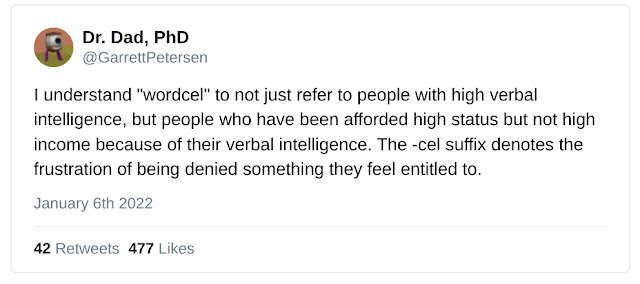
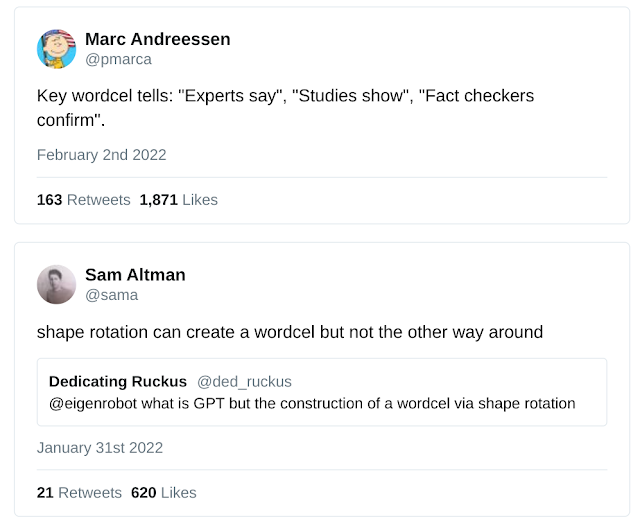
The wordcel moniker describes more than just one’s level of verbal skill: it’s also a socioeconomic classifier that refers to people whose verbal ability borders on self-sabotage (thus the “-cel”). Perhaps they’re driven mad by political rage, postmodernism, and disconnection from reality. It might refer to the priestly figures who work in the culture factories of the New York Times with their incomes and social prestige both precipitously declining only for the unperturbed masses on the internet to tell them in unison: “learn to code”! There’s even an implication that these folks are entirely rent-seekers (wrong, but directionally interesting).
...
The shape rotators have been a minor force until very recent history. Though they’ve produced a significant portion of human progress through feats of engineering excellence, they were rarely celebrated until the dawn of the Enlightenment, perhaps 500 years ago. While the long-lasting glory of the Roman aqueducts is renowned to this day, nobody knows the chief engineer behind the project (probably Marcus Vipsanius Agrippa, but who’s counting). Today their stock is climbing to the moon. The world’s richest (self-made) men are almost uniformly engineers, computer scientists, or physicists. Vast portions of society that in a prior age might have been organized by government bureaucrats or private sector shot-callers have been handed over to cybernetic self-organizing systems designed and run by mathematical wizards. We have been witness to the slow, and then rapid transfer of power from the smooth-talking Don Drapers of boardroom acclaim to the multi-armed bandits of Facebook Ads.
It’s clear that these big tech CEOs are verbally gifted, but by affinity and by practice they are in the rotator camp. Elon continually attributes his success to studying physics in college. Zuck programmed the original iteration of Facebook himself. Larry & Sergei did an entire PhD in linear algebra based information retrieval, a platonic ideal of shape rotation. Of the ten largest companies in the world, several are driven by fundamental technical breakthroughs. Society at large seems to respect and fear the forces of technology more and more as its cultural and financial capital rises.
There is some conflation between Math ability and Spatial ability in this recent talk of Wordcels and Shape Rotators. Math and Spatial ability are positively correlated but are actually separate factors that emerge from PCA in psychometrics. Look carefully at the arrows in the figure below -- if you can't read the figure you might be a wordcel ;-)
Note also that in the SMPY/SVPY data physicists dominated the wordcels even in their own verbal domain. This is also confirmed here.
See post from 2016 reproduced below, especially point #3.
This figure displays the math, verbal and spatial scores of gifted children tested at age 12, and their eventual college majors and career choices. This group is cohort 2 of the SMPY/SVPY study: each child scored better than 99.5 percentile on at least one of the M-V sections of the SAT.
Scores are normalized in units of SDs, within this cohort of gifted children. (So above and below average are defined with respect to the gifted population of >99th percentile kids, not relative to the general population.) The vertical axis is V, the horizontal axis is M, and the length of the arrow reflects spatial ability: pointing to the right means above the group average, to the left means below average; note the arrow for business majors should be twice as long as indicated but there was not enough space on the diagram. The spatial score is obviously correlated with the M score. More data here.
SMPY helps to establish a number of important facts about individuals of high ability:
1. We can (at least crudely) differentiate between individuals at the 99th, 99.9th and 99.99th percentiles. Exceptional talent can be identified through testing, even at age 13.
2. Probability of significant accomplishment, such as STEM PhD, patents awarded, tenure at leading research university, exceptional income, etc. continues to rise as ability level increases, even within the top 1%.
Needless to say, I think this Research Associate position will entail important and fascinating work.
Research Associate:
The Study of Mathematically Precocious Youth (SMPY) seeks a full-time post-doctoral Research Associate for study oversight, conducting research, writing articles, laboratory management, and statistical analyses using the vast SMPY data base. SMPY is a four-decade longitudinal study consisting of 5 cohorts and over 5,000 intellectually talented participants. One chief responsibility of this position will be to manage laboratory details associated with launching an age-50 follow-up of two of SMPY’s most exceptional cohorts: a cohort of 500 profoundly gifted participants initially identified by age 13 in the early 1980s, and a second cohort of over 700 top STEM graduate students identified and psychologically profiled in 1992 as first- and second-year graduate students. Candidates with interests in assessing individual differences, talent development, and particularly strong statistical-technical skills are preferred. Send vitae, cover letter stating interests, (pre)reprints, and three letters of recommendation to: Dean Camilla P. Benbow, Department of Psychology & Human Development, 0552 Peabody College, Vanderbilt University, Nashville, TN, 37203. The position will remain open until a qualified applicant is selected. For additional information, please contact either co-director: Camilla P. Benbow, camilla.benbow@vanderbilt.edu, or David Lubinski, david.lubinski@vanderbilt.edu.
http://www.vanderbilt.edu/Peabody/SMPY/. Vanderbilt University is an Equal Opportunity/Affirmative Action Employer.
We are aiming for a June 30th start date but that’s flexible.
Some relevant figures based on SMPY results of Lubinski, Benbow, and collaborators. See links above for more discussion of the data displayed.
Great discussion and insider views of AI/ML research.
Academics think of themselves as trailblazers, explorers — seekers of the truth.
Any fundamental discovery involves a significant degree of risk. If an idea is guaranteed to work then it moves from the realm of research to engineering. Unfortunately, this also means that most research careers will invariably be failures at least if failures are measured via “objective” metrics like citations.
Today we discuss the recent article from Mark Saroufim called Machine Learning: the great stagnation. We discuss the rise of gentleman scientists, fake rigor, incentives in ML, SOTA-chasing, "graduate student descent", distribution of talent in ML and how to learn effectively.
Topics include: OpenAI, GPT-3, RL: Dota & Starcraft, conference papers, incentives and incremental research, Is there an ML stagnation? Is theory useful? Is ML entirely empirical these days? How to suceed as a researcher, Why everyone is forced to become their own media company, and much more.
If you don't want to watch the video, read these (by Mark Saroufim) instead:
...This tiny sliver of humanity, with their relatively small cadre of financiers, engineers, data scientists, and marketers, now control the exploitation of our personal data, what Alibaba founder, Jack Ma calls the “electricity of the 21st century.” Their “super platforms,” as one analyst noted, “now operate as “digital gatekeepers” lording over “e-monopsonies” that control enormous parts of the economy. Their growing power, notes a recent World Bank Study, is built on “natural monopolies” that adhere to web-based business, and have served to further widen class divides not only in the United States but around the world.
The rulers of the Valley and its Puget Sound doppelganger now account for eight of the 20 wealthiest people on the planet. Seventy percent of the 56 billionaires under 40 live in the state of California, with 12 in San Francisco alone. In 2017, the tech industry, mostly in California, produced 11 new billionaires. The Bay Area has more billionaires on the Forbes 400 list than any metro region other than New York and more millionaires per capita than any other large metropolis.
For an industry once known for competition, the level of concentration is remarkable. Google controls nearly 90 percent of search advertising, Facebook almost 80 percent of mobile social traffic, and Amazon about 75 percent of US e-book sales, and, perhaps most importantly, nearly 40 percent of the world’s “cloud business.” Together, Google and Apple control more than 95 percent of operating software for mobile devices, while Microsoft still accounts for more than 80 percent of the software that runs personal computers around the world.
The wealth generated by these near-monopolies funds the tech oligarchy’s drive to monopolize existing industries such as entertainment, education, and retail, as well as those of the future, such as autonomous cars, drones, space exploration, and most critically, artificial intelligence. Unless checked, they will have accumulated the power to bring about what could best be seen as a “post-human” future, in which society is dominated by artificial intelligence and those who control it.
What Do the Oligarchs Want?
The oligarchs are creating a “a scientific caste system,” not dissimilar to that outlined in Aldous Huxley’s dystopian 1932 novel, Brave New World. Unlike the former masters of the industrial age, they have little use for the labor of middle- and working-class people—they need only their data. Virtually all their human resource emphasis relies on cultivating and retaining a relative handful of tech-savvy operators. “Software,” Bill Gates told Forbes in 2005, “is an IQ business. Microsoft must win the IQ war, or we won’t have a future.”
Perhaps the best insight into the mentality of the tech oligarchy comes from an admirer, researcher Greg Ferenstein, who interviewed 147 digital company founders. The emerging tech world has little place for upward mobility, he found, except for those in the charmed circle at the top of the tech infrastructure; the middle and working classes become, as in feudal times, increasingly marginal.
This reflects their perception of how society will evolve. Ferenstein notes that most oligarchs believe “an increasingly greater share of economic wealth will be generated by a smaller slice of very talented or original people. Everyone else will increasingly subsist on some combination of part-time entrepreneurial ‘gig work’ and government aid.” Such part-time work has been growing rapidly, accounting for roughly 20 percent of the workforce in the US and Europe, and is expected to grow substantially, adds McKinsey. ...
James Cham is a partner at Bloomberg Beta, a venture capital firm focused on the future of work. James invests in companies applying machine intelligence to businesses and society. Prior to Bloomberg Beta, James was a Principal at Trinity Ventures and a VP at Bessemer Venture Partners. He was educated in computer science at Harvard and at the MIT Sloan School of Business.
In mathematics, a manifold is a topological space that locally resembles Euclidean space near each point.
Steve Hsu and Corey Washington have been friends for almost 30 years, and between them hold PhDs in Neuroscience, Philosophy, and Theoretical Physics. Join them for wide ranging and unfiltered conversations with leading writers, scientists, technologists, academics, entrepreneurs, investors, and more.
Steve Hsu is VP for Research and Professor of Theoretical Physics at Michigan State University. He is also a researcher in computational genomics and founder of several Silicon Valley startups, ranging from information security to biotech. Educated at Caltech and Berkeley, he was a Harvard Junior Fellow and held faculty positions at Yale and the University of Oregon before joining MSU.
Corey Washington is Director of Analytics in the Office of Research and Innovation at Michigan State University. He was educated at Amherst College and MIT before receiving a PhD in Philosophy from Stanford and a PhD in a Neuroscience from Columbia. He held faculty positions at the University Washington and the University of Maryland. Prior to MSU, Corey worked as a biotech consultant and is founder of a medical diagnostics startup.
Show PageYouTube Channel Noor Siddiqui, Thiel Fellow, on Stanford and Silicon Valley – Episode #3
Corey and Steve interview Noor Siddiqui, a student at Stanford studying AI, Machine Learning, and Genomics. She was previously a Thiel Fellow, and founded a medical collaboration technology startup after high school. The conversation covers topics like college admissions, Tiger parenting, Millennials, Stanford, Silicon Valley startup culture, innovation in the US healthcare industry, and Simplicity and Genius.
man·i·fold /ˈmanəˌfōld/ many and various.
In mathematics, a manifold is a topological space that locally
resembles Euclidean space near each point.
Steve Hsu and Corey Washington have been friends for almost 30 years, and between them hold PhDs in Neuroscience, Philosophy, and Theoretical Physics. Join them for wide ranging and unfiltered conversations with leading writers, scientists, technologists, academics, entrepreneurs, investors, and more.
Steve Hsu is VP for Research and Professor of Theoretical Physics at Michigan State University. He is also a researcher in computational genomics and founder of several Silicon Valley startups, ranging from information security to biotech. Educated at Caltech and Berkeley, he was a Harvard Junior Fellow and held faculty positions at Yale and the University of Oregon before joining MSU.
Corey Washington is Director of Analytics in the Office of Research and Innovation at Michigan State University. He was educated at Amherst College and MIT before receiving a PhD in Philosophy from Stanford and a PhD in a Neuroscience from Columbia. He held faculty positions at the University Washington and the University of Maryland. Prior to MSU, Corey worked as a biotech consultant and is founder of a medical diagnostics startup.
I don't work in Big Tech so I don't know whether his numbers are realistic. If they are realistic, then I'd say careers in Big Tech (for someone with the ability to do high level software work) dominate all the other (risk-adjusted) options right now. This includes finance, startups, etc.
No wonder the cost of living in the bay area is starting to rival Manhattan!
MIT Center for Energy and Environmental Policy Research
We perform a detailed analysis of Uber and Lyft ride-hailing driver economics by pairing results from a survey of over 1100 drivers with detailed vehicle cost information. Results show that per hour worked, median profit from driving is $3.37/hour before taxes, and 74% of drivers earn less than the minimum wage in their state. 30% of drivers are actually losing money once vehicle expenses are included. On a per-mile basis, median gross driver revenue is $0.59/mile but vehicle operating expenses reduce real driver profit to a median of $0.29/mile. For tax purposes the $0.54/mile standard mileage deduction in 2016 means that nearly half of drivers can declare a loss on their taxes. If drivers are fully able to capitalize on these losses for tax purposes, 73.5% of an estimated U.S. market $4.8B in annual ride-hailing driver profit is untaxed.
Note Uber disputes this result and claims the low hourly result is due in part to the researchers misinterpreting one of the survey questions. Uber's analysis puts the hourly compensation at ~$15.
Some perspectives from a Berlin tech guy who has also worked in China.
To some extent Europe is like the Midwest of the US: a source of human capital for SV and other places. Europe and the Midwest have strong universities and produce talented individuals, but lack a mature tech ecosystem which includes access to venture funding, exits (acquisition by big established companies), and a culture of risk taking and innovation.
My meeting in Beijing with Hugo Barra, who runs all international expansion for Xiaomi — the cool smartphone maker and highest-valued startup in China, at around $45 billion or so — was scheduled for 11 pm, but got delayed because of other meetings, so it started at midnight. (Hugo had a flight to catch at 6:30 am after that.)
In China, there is a company work culture at startups that's called 9/9/6. It means that regular work hours for most employees are from 9 am to 9 pm, six days a week. If you thought Silicon Valley has intense work hours, think again.
For founders and top executives, it's often 9/11/6.5. That's probably not very efficient and useful (who's good as a leader when they're always tired and don't know their kids?) but totally common.
Teams get locked up in hotels for weeks before a product launch, where they only work, sleep and work out, to drive 100 percent focus without distractions and make the launch date. And while I don't think long hours are any measure of productivity, I was amazed by the enormous hunger and drive. ...
I'm in Mountain View to give a talk at 23andMe. Their latest funding round was $250M on a (reported) valuation of $1.5B. If I just add up the Crunchbase numbers it looks like almost half a billion invested at this point...
Abstract: We apply methods from Compressed Sensing (L1-penalized regression; Donoho-Tanner phase transition with noise) to the UKBB dataset of 500k SNP genotypes. We construct genomic predictors for several complex traits. Our height predictor captures nearly all of the predicted SNP heritability for this trait -- thereby resolving the missing heritability problem. Actual heights of most individuals in validation tests are within a few cm of predicted heights. I also discuss application of these methods to polygenic disease risk: sparsity estimates (of the number of causal loci), combined with phase transition scaling analysis, allow estimates of the amount of case | control data required to construct good predictors.
Here's how people + robots handle your spit sample to produce a SNP genotype:
I need to replace my old iPhone 6, and, predictably, this led me down the rabbit hole of learning about mobile phones, the mobile industry, and even mobile technologies. Some quick remarks: from the least to most expensive phones, Chinese companies are now competitive with industry leaders like Samsung and Apple. The Chinese market is hyper-competitive: small innovative startups (Oppo, OnePlus, etc.) compete with medium sized entities (e.g., Xiaomi, only recently a small startup itself) and giants like Huawei and Lenovo (Motorola). To gauge the landscape, watch phone reviews by Indiantechies (or this guy in Germany), who tend to be very focused on cost performance and have access to handsets not sold in the US.
Huawei's Kirin 970 chipset includes a dedicated "Neural Processor Unit" (NPU), optimized for the matrix operations used in machine learning. An NPU allows the phone to execute ML code for tasks such as image and voice recognition, language translation, etc. without relying on cloud connectivity. At the moment it is mostly a marketing gimmick, but one can imagine in a few years (perhaps earlier!) the NPU could be as important to the phone experience as the GPU.
Here's a review of the Mate 10 Pro, Huawei's $1k flagship phone, with a brief demo of some of the AI features:
The NPU appears to be based on technology licensed from a small Beijing startup, Cambricon. The founder is an alumnus of the Special Class for Gifted Young, University of Science and Technology of China. I've reviewed many Physics PhD applications from 19 year old graduates of this program. There is an SV bidding war over chip designers in this area, ever since the advent of Google's proprietary TPU (and software package Tensorflow), which accounts for most of its computation at data centers around the world.
Here's a quick demo of text recognition and machine translation from Chinese to English:
Some marketing video about the AI processor:
From cat recognition to Her or Joi? How long? I was recently offered the opportunity to be a beta tester for a startup that is building a smartphone AI assistant. I was intrigued but didn't want to give them access to all of my information...
PS One of the reasons I am leaving iOS for Android is that Google Assistant is getting very good, whereas in my experience Siri is terrible!
MIT Technology Review reports on our startup Genomic Prediction. Some basic points worth clarifying:
1. GP's first product, announced at the annual ASRM (American Society of Reproductive Medicine) meeting this week, tests chromosomal abnormality. It is a less expensive but more accurate version of existing tests.
2. The polygenic product, to be launched in 2018, checks for hundreds of known single-gene ("Mendelian") disease risks, and will likely have some true polygenic predictive capabilities. This last part is the main emphasis of the story, but it is just one component of the overall product offering. The article elides a lot of challenging laboratory work on DNA amplification, etc.
3. GP will only deliver results requested by an IVF physician. It is not a DTC (Direct to Consumer) company.
4. All medical risk analysis proceeds from statistical data (analyzing groups of people) to produce recommendations concerning a specific individual.
5. I am on the Board of Directors of GP but am not an employee of the company.
Will you be among the first to pick your kids’ IQ? As machine learning unlocks predictions from DNA databases, scientists say parents could have choices never before possible.
Nathan Treff was diagnosed with type 1 diabetes at 24. It’s a disease that runs in families, but it has complex causes. More than one gene is involved. And the environment plays a role too.
So you don’t know who will get it. Treff’s grandfather had it, and lost a leg. But Treff’s three young kids are fine, so far. He’s crossing his fingers they won’t develop it later.
Now Treff, an in vitro fertilization specialist, is working on a radical way to change the odds. Using a combination of computer models and DNA tests, the startup company he’s working with, Genomic Prediction, thinks it has a way of predicting which IVF embryos in a laboratory dish would be most likely to develop type 1 diabetes or other complex diseases. Armed with such statistical scorecards, doctors and parents could huddle and choose to avoid embryos with failing grades.
IVF clinics already test the DNA of embryos to spot rare diseases, like cystic fibrosis, caused by defects in a single gene. But these “preimplantation” tests are poised for a dramatic leap forward as it becomes possible to peer more deeply at an embryo’s genome and create broad statistical forecasts about the person it would become.
The advance is occurring, say scientists, thanks to a growing flood of genetic data collected from large population studies. ...
Spotting outliers
The company’s plans rely on a tidal wave of new knowledge showing how small genetic differences can add up to put one person, but not another, at high odds for diabetes, a neurotic personality, or a taller or shorter height. Already, such “polygenic risk scores” are used in direct-to-consumer gene tests, such as reports from 23andMe that tell customers their genetic chance of being overweight.
For adults, risk scores are little more than a novelty or a source of health advice they can ignore. But if the same information is generated about an embryo, it could lead to existential consequences: who will be born, and who stays in a laboratory freezer.
“I remind my partners, ‘You know, if my parents had this test, I wouldn’t be here,’” says Treff, a prize-winning expert on diagnostic technology who is the author of more than 90 scientific papers.
Genomic Prediction was founded this year and has raised funds from venture capitalists in Silicon Valley, though it declines to say who they are. Tellier, whose inspiration is the science fiction film Gattaca, says the company plans to offer reports to IVF doctors and parents identifying “outliers”—those embryos whose genetic scores put them at the wrong end of a statistical curve for disorders such as diabetes, late-life osteoporosis, schizophrenia, and dwarfism, depending on whether models for those problems prove accurate. ...
This week, Genomic Prediction manned a booth at the annual meeting of the American Society for Reproductive Medicine. That organization, which represents fertility doctors and scientists, has previously said it thinks testing embryos for late-life conditions, like Alzheimer’s, would be “ethically justified.” It cited, among other reasons, the “reproductive liberty” of parents.
... Hsu’s prediction is that “billionaires and Silicon Valley types” will be the early adopters of embryo selection technology, becoming among the first “to do IVF even though they don’t need IVF.” As they start producing fewer unhealthy children, and more exceptional ones, the rest of society could follow suit.
“I fully predict it will be possible,” says Hsu of selecting embryos with higher IQ scores. “But we’ve said that we as a company are not going to do it. It’s a difficult issue, like nuclear weapons or gene editing. There will be some future debate over whether this should be legal, or made illegal. Countries will have referendums on it.”
WSJ: Daimler to Work With Matternet to Develop Delivery Van Drones
Auto maker investing $562.75 million to design electric vans that can host aerial deliveries
Daimler AG said on Wednesday it would join with U.S. startup Matternet to develop drones for its delivery vans and invest €500 million ($562.7 million) over the next five years in designing electric, networked vans.
Daimler, the maker of Mercedes-Benz cars and trucks, acquired a minority stake in Menlo Park, Calif.-based Matternet as part of the partnership, a spokeswoman said. Daimler’s overall investment in the initiative, called adVANce, will go to vehicle digitization, automation, robotics and mobility solutions technologies.
“We are looking beyond the vehicle to the whole value chain and the entire environment of our clients,” said van division chief Volker Mornhinweg. The goal is to turn vans into “intelligent, interconnected data centers,” he said.
Isle of Deep Learning
Isle of Physics
Moldbug's Lair
Alt-Right Hills
Dark Enlightenment Volcano
Paleo Crossing
Satoshi Mines
Secret Cloud Empire of Amazon
Fjords of Sisu
Algomonopolia (Google, Facebook, ...)
a16z Unicorn Hunting Ground
Lean Startup Town
SJW Cathedral
Manosphere Tar Pit
Global Bro-Science Laboratory
NSA
Academia
Efficient Market Temple
Graveyard of Boomer Dreams
Ghost of Industrial Past
If these memes are unfamiliar, you need to spend more time on the internet or in the bay area :-)
Highly recommended! I blogged about this guy 5 years ago here: From physics to Goldman to Y Combinator. The book is hilarious and pretty accurate, AFAICT. I don't know much about Facebook corporate culture or that particular era of ad monetization, but the finance and startup stuff all rings true.
The reality is, Silicon Valley capitalism is very simple:
Investors are people with more money than time.
Employees are people with more time than money.
Entrepreneurs are the seductive go-between.
Startups are business experiments performed with other people's money.
I was a Berkeley PhD student in physics when the first dot-com bubble grew to bursting and popped around 2001. Between the month-long backpacking trips and the telenovela-esque romances, I switched thesis topic three times, and felt my twenty-something vitality slipping away in academic wankery. Inspired by Michael Lewis’ Liar’s Poker and the prior example of many a failed physicist, I looked for a Wall Street gig as a way out. Very improbably, I landed a job on the trading desk of Goldman Sachs, earning twice what my tenured professor made, pricing and modeling credit derivatives at ground-zero of the credit bubble. I may have owned one pair of lace-up shoes at the time, but I got used to speaking in quantities of hundreds of millions of dollars, and thinking a million was a ‘buck’, i.e., a rounding error for most purposes. I was very far away indeed from Berkeley.
Right around 2008, when Lehman Brothers and Bear Stearns blew up, I knew the financial jig would be up for a while (and possibly forever), unlike most of my colleagues, who seemed to think orgies of rapacious greed lasted forever. The only piece of the US economy that would be spared the apocalypse was clear in my mind: the Bay Area tech of my languid grad school days, and all that VC money that (hopefully) hadn’t touched the mortgage bubble..
Two weeks later, I started as employee number seventy-something at a venture-backed advertising startup so incompetent and vile I’ll save the historical distaste for later. Bookended as it was by experiences at Facebook and Goldman, my time there was instructive in its awfulness and how not to run a company. But there was one piece of upside: I learned how online advertising worked, specifically its ad exchange variants. As a ‘research scientist’ I tortured every piece of data until it confessed, and used it to predict user behavior, value of media purchased, and optimal bids in the largest ad auctions in the world. Dull stuff you might say, but it’s what pays for the Internet, and it would set me light-years ahead of anyone inside Facebook Ads, when the time came.
But we’re jumping ahead.
Along with the two best engineers at Shitty Unnamed Company, I applied and was accepted to Y Combinator, the Valley’s leading startup incubator. We pitched some wild, ridiculous idea around local businesses that was doomed from the start, which eventually morphed into a novel tool for managing Google search campaigns for small businesses. The tool was beautiful, innovative, and didn’t make us a dime. More bad news: We got vindictively and frivolously sued by Shitty Company and fought an existential legal battle we narrowly won by being lying, ruthless little shits. We couldn’t raise money. We had co- founder and morale issues. Every ill that plagues early-stage startups visited us in turn, like some admonitory biblical tale about what happens if you fuck with the Israelites. ...
... Every startup entrepreneur faces the immense disadvantage of playing a crooked, complex game for the first time, against a world composed mostly of masters. Arrayed against you is an army of wily, self-interested venture capitalists who know term sheets better than their wife’s ass. Or seductive sales execs who could make pedophilia and genocide enforceable via a legal contract. Or petulant co-founders with hidden agendas and momentarily suppressed grievances. Or ungrateful employees who are exploiting your startup until they can start their own. Or thick-headed journalists with urgent deadlines who just want you for a misleading quote. You get trounced again and again, and the only hope is that you learn something of the game before expiring. This is your principal challenge as a first-time entrepreneur: to learn the game faster than you burn cash and relationships.
All beings so far have created something beyond themselves; and do you want to be the ebb of this great flood and even go back to the beasts rather than overcome man? What is the ape to man? A laughingstock or a painful embarrassment. And man shall be just that for the superman: a laughingstock or a painful embarrassment. You have made your way from worm to man, and much in you is still worm. Once you were apes, and even now, too, man is more ape than any ape. What is great in man is that he is a bridge and not an end. -- Thus Spoke Zarathustra
The kind of thoughts one has while overlooking Lake Como from a grand villa :-)
The New Atlantis: Friedrich Nietzsche gets a bad rap, for celebrating the will to power and leaving good morals by the wayside; in growing numbers, Americans are beginning to feel the same uneasy skepticism toward the Silicon Valley moguls who have come to thoroughly dominate our economy and imagination. For critics on the left as well as the right, today’s tech titans are uncomfortably squishy, or indifferent, when it comes to partisan, ideological matters. ...
... As Nietzsche knew, a democratic society like ours is supremely unlikely to produce any bona fide supermen. But supernerds? They’re multiplying like rabbits, and they’ve got an open field. Nothing can stop them; certainly not the rest of us.
According to Peter Thiel, however, that scary conclusion is false, for an even scarier reason. In interviews, speeches, and his new book of adapted college lectures, Zero to One, Thiel — the most political and theoretical of the supernerds — raises the prospect of a remarkably comprehensive failure among our best and brightest.
... Thiel’s critique, it turns out, has much in common with Nietzsche’s: Nietzsche worries that Darwinian competition breeds mediocre humans, while Thiel complains that commercial competition breeds mediocre companies. The principle of incremental success produces no true success at all; instead, it suppresses creative genius.
Zero to One is mainly “about how to build companies that create new things,” as Thiel writes in the preface. ...
Thiel begins by distinguishing between two kinds of technological progress: horizontal progress, which means “copying things that work — going from 1 to n,” and vertical progress, which means “doing new things — going from 0 to 1.” The modern world, says Thiel, “experienced relentless [vertical] technological progress from the advent of the steam engine in the 1760s all the way up to about 1970.”
... “Making small changes to things that already exist might lead you to a local maximum,” he writes, “but it won’t help you find the global maximum.” And with limited resources in a global economy, nothing less than the world is at stake. To find the global maximum, entrepreneurs must “transcend the daily brute struggle for survival” by building “creative monopolies” — creating markets where none exist, rather than dumping their energies into wringing the last marginal dollar of value from markets choked with belligerent competitors. For example, Google, as Thiel points out, has basically held a monopoly over Internet search since the early 2000s. For Thiel, the benefits of creative monopolies extend far beyond the companies themselves. While we typically think of monopolies as exploitative and domineering, “creative monopolists give customers more choices by adding entirely new categories of abundance to the world.”
Creative monopolies require what Thiel calls “definite optimism,” which involves making bold, specific plans for the future, and taking risks to fulfill them. ...
... Overtly, we’re increasingly at the mercy of our technological overlords. Covertly, our social life has become crippled by something so powerful that it can render even the most promising supernerd all but powerless, to say nothing of you and me. Our kryptonite is a cosmic idea, one with which Nietzsche was all too familiar: “the people have won — or ‘the slaves’ or ‘the mob’ or ‘the herd’ or whatever you like to call them,” Nietzsche said about the self-styled democratic free spirits. “‘The masters’ have been disposed of; the morality of the common man has won.” Nietzsche despised this mob-ification of morals. ...
As Francis Fukuyama put it in Our Posthuman Future (2002) ... a division between the metaphorical 1 and 99 percent might come about through a biotechnological revolution — something about which even the most assertive of our supernerds at Google are still cagey. ...
“We live in a world,” Thiel told the Dinner for Western Civilization, “in which courage is in far shorter supply than genius.” As he puts it in Zero to One: “Brilliant thinking is rare, but courage is in even shorter supply.” ...
Almost all the startup people I know watch Silicon Valley (HBO), and they agree with me that it unerringly captures the essence of startup life in a hilarious way. Also good: Billions (Showtime) on the hedge fund world.
New Yorker: ... “The first part of the job is making sure we get the specifics right, because our audience won’t tolerate any mistakes,” ...
Dotan worked part-time for a few weeks, but then came on full-time. At first, he oversaw a staff of four: an expert in file compression; a user-interface engineer, to help write the code on the characters’ screens; a C-level tech executive; and a Silicon Valley lawyer, to draft realistic contracts. By the end of the first season, Dotan’s staff had grown to twelve. “If someone is holding a document on the show, that document is written out, in full, the way that it would be in real life,” ...
“Some Valley big shots have no idea how to react to the show,” Miller told me. “They can’t decide whether to be offended or flattered. And they’re mystified by the fact that actors have a kind of celebrity that they will never have—there’s no rhyme or reason to it, but that’s the way it is, and it kills them.” Miller met Musk at the after-party in Redwood City. “I think he was thrown by the fact that I wasn’t being sycophantic—which I couldn’t be, because I didn’t realize who he was at the time. He said, ‘I have some advice for your show,’ and I went, ‘No thanks, we don’t need any advice,’ which threw him even more. And then, while we’re talking, some woman comes up and says ‘Can I have a picture?’ and he starts to pose—it was kinda sad, honestly—and instead she hands the camera to him and starts to pose with me. It was, like, Sorry, dude, I know you’re a big deal—and, in his case, he actually is a big deal—but I’m the guy from ‘Yogi Bear 3-D,’ and apparently that’s who she wants a picture with.”
The three biggest public companies in the world, as measured by market capitalization, are Apple, the Google parent company Alphabet, and Microsoft. Are they enlightened agents of philanthrocapitalism or robber-baron monopolies? “In the real Silicon Valley, as on the show, there is a cohort of people who have a real sense of purpose and actually think they’re going to change the world, and then there’s a cohort of people who say farcical things about their apps that they clearly don’t believe themselves,” Sam Altman, who runs the startup incubator Y Combinator, told me. The show accurately reflects this complexity because the people who make it—like all thoughtful people, including the most powerful people in Silicon Valley—can’t decide how they feel about Silicon Valley. “I swing back and forth,” Clay Tarver, one of the show’s writers and producers, told me. “The more I meet these people and learn about them, the more I come away thinking that, despite all the bullshit and greed, there actually is something exciting and hopeful going on up there.”