Showing posts with label security. Show all posts

Monday, January 10, 2022

Twilight Struggles: Kazakhstan edition


If you are scratching your head about what happened in Kazakhstan (perhaps as you were last summer about Afghanistan, remember that?), it may be because you only look at mainstream Western sources of information. You might also be the kind of person who swallows whole US propaganda stories about Ukraine, Syria, Xinjiang, Huawei, January 6, RussiaGate, etc.
Dmitry Orlov on January 09, 2022 · at 5:22 pm EST/EDT [ Comment on this blog post by the Saker ] 
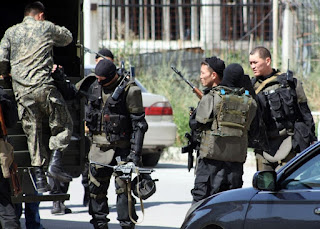
What happened in KZ was a paramilitary attack meticulously organized but launched in haste by Western intelligence that had the goal of destroying the statehood of KZ. It was not an attempt to take it over (no time for that) but simply to destroy. The entire state structure was sufficiently rotten that the defense/security agencies couldn’t even pick sides and became demoralized and inactive, but once the Russians were called in to help they immediately knew which side would win and fell back in line. The West’s goal was to set KZ ablaze prior to the talks in Geneva in order to have a better negotiating position vis-à-vis Russia: “You want to divide spheres of influence? Well, we already did that for you—in Kazakhstan!” Keep in mind, the RU-KZ border is open, undefendable and almost 8000km long, running from Volgograd to Tomsk in Siberia, making KZ, as a failed state, a major headache for Russia. Obviously, Russia knew that KZ, rife with Western NGOs and accompanying corruption, and with a weakening economy, could easily be tipped over, and prepared for just this case. Now that the attack on KZ statehood has failed and a mop-up operation is in progress, this has given Russia a huge trump card for the Geneva talks. The West has played its cards and lost. There will be no more color revolutions in the post-Soviet space. Its operatives in KZ are being hunted down and eliminated. Those in positions of authority in KZ have learned the same lesson as Lukashenko: they cannot trust the West; they have to trust Moscow.
On any particular issue Orlov might be right or he might be wrong, but guaranteed on certain topics he knows a lot more than the "experts" found on television or in the NYTimes. In recent years I have spent significant time with Western foreign policy and defense "experts" in think tank settings and I have to say that they are often poorly informed or miscalibrated in the confidence levels assigned to their predictions. Sadly, elites in the West have largely been fooled by their own propaganda, and often have entirely unrealistic views of what is really happening in the world. Alternative sources of information, especially individuals with good local knowledge, are always useful.
Wikipedia: Dmitry Orlov (Russian: Дми́трий Орло́в; born 1962) is a Russian-American engineer and writer on subjects related to "potential economic, ecological and political decline and collapse in the United States", something he has called "permanent crisis".[1] Orlov believes collapse will be the result of huge military budgets, government deficits, an unresponsive political system ... 
Orlov was born in Leningrad (now Saint Petersburg) and moved to the United States at the age of 12. He has a BS in Computer Engineering and an MA in Applied Linguistics. He was an eyewitness to the collapse of the Soviet Union over several extended visits to his Russian homeland between the late 1980s and mid-1990s. ... 
In 2006 Orlov published an online manifesto, "The New Age of Sail." In 2007 he and his wife sold their apartment in Boston and bought a sailboat, fitted with solar panels and six months supply of propane, and capable of storing a large quantity of food stuffs. He calls it a “survival capsule.” ...

Here is a different (internal coup and counter-coup) interpretation of events which is quite unlike Orlov's. I have not seen any evidence presented yet of foreign involvement, but perhaps I am not looking at the right sources...

Wednesday, June 30, 2021

Six Ways From Sunday: Tucker vs NSA


Chuck Schumer: You take on the intelligence community, they have six ways from Sunday to get back at you.


Tucker Carlson has potential as a politician -- there is at least a small chance that someday he'll be POTUS. The intelligence services are, I am sure, very interested in any kompromat they can acquire on him for future use. You mean foreign intel services? No, I mean our intel services :-(

Clarification, from comments
The post is not primarily about Tucker. It's about intel services spying on American citizens. 
Most importantly, Tucker's story is credible: some whistleblower saw intercepted Tucker emails and contacted him to let him know he is under surveillance. But as anyone paying attention knows, we are ALL under surveillance due to "bulk collection" revealed many years ago, e.g., by Snowden. The Rogers saga and FISC report show that this bulk-collected data is not very well protected from intel agency types who want to have a peek at it...  
Re: bulk collection, non-denial denials ("not an intelligence target of the Agency" ha ha), see
Wikipedia: According to a report in The Washington Post in July 2014, relying on information furnished by Snowden, 90% of those placed under surveillance in the U.S. are ordinary Americans, and are not the intended targets. The newspaper said it had examined documents including emails, message texts, and online accounts, that support the claim.
Below is a Rogers timeline covering illegal spying using NSA data. This illegal use of data is a matter of record -- undisputed, but also largely unreported. The FISC (FISA court) report on this illegal use of data appeared in April 2017; the author is Rosemary Collyer, the head FISA judge. The report was originally classified Top Secret but was later declassified and released with redactions. Collyer uses the phrase "institutional lack of candor" when referring to behavior of federal agencies in their dealings with FISC over this issue. ... 
The court learned in October 2016 that analysts ... were conducting prohibited database searches “with much greater frequency than had previously been disclosed to the court.” The forbidden queries were searches of Upstream Data using US-person identifiers. The report makes clear that as of early 2017 NSA Inspector General did not even have a good handle on all the ways that improper queries could be made to the system. ... 
March 2016 – NSA Director Rogers becomes aware of improper access to raw FISA data. 
April 2016 – Rogers orders the NSA compliance officer to run a full audit on 702 NSA compliance. 
April 18 2016 – Rogers shuts down FBI/NSD contractor access to the FISA Search System. 
Mid-October 2016 – DNI Clapper submits a recommendation to the White House that Director Rogers be removed from the NSA. 
October 20 2016 – Rogers is briefed by the NSA compliance officer on the Section 702 NSA compliance audit and “About” query violations. 
October 21 2016 – Rogers shuts down all “About" query activity. Rogers reports the activity to DOJ and prepares to go before the FISA Court. 
October 21 2016 – DOJ & FBI seek and receive a Title I FISA probable cause order authorizing electronic surveillance on Carter Page from the FISC. At this point, the FISA Court is unaware of the Section 702 violations. 
October 24 2016 – Rogers verbally informs the FISA Court of Section 702(17) violations. 
October 26 2016 – Rogers formally informs the FISA Court of 702(17) violations in writing. 
November 17 2016 (morning) – Rogers travels to meet President-Elect Trump and his Transition Team in Trump Tower. Rogers does not inform DNI James Clapper. 
November 17 2016 (evening) – Trump Transition Team announces they are moving all transition activity to Trump National Golf Club in New Jersey.
I was recently in a Zoom meeting on geopolitics that included Admiral Rogers. I wanted to ask him privately about the above. Perhaps someday I'll get the chance.
 

Caption: NSA Director Rogers describes to Congress how little privacy Americans have from government surveillance. 

Alternate Caption: NSA Director Rogers tells Congress how much legal oversight remains over the activities of intel services.

Wednesday, April 28, 2021

Let The Bodies Pile High In Their Thousands (Boris Johnson)


In the UK:
Recording a conversation in secret is not a criminal offence and is not prohibited. As long as the recording is for personal use you don’t need to obtain consent or let the other person know.
The security man in the foyer of No 10 Downing Street asks that you turn off your phone and deposit it in a wooden cubby shelf built into the wall. I sometimes wondered what the odds were that someone might walk out with my phone -- a disaster, obviously.

But it is not difficult to keep your phone as close attention is not paid. (Or, one could enter with more than one phone.) I'm not saying I have ever disobeyed the rules but I know that it is possible. 

Of course the No 10 staffers all have their phones, which are necessary for their work throughout the day. Thus every meeting at the heart of British government is in danger of being surreptitiously but legally recorded.
Dominic Cummings 'has audio recordings of key government conversations', ally claims (Daily Mail
Dominic Cummings 'has audio recordings of key government conversations' and 'can back up a lot of his claims', ally of the former chief adviser says. 
Dominic Cummings kept audio recordings of key conversations, an ally claims Former chief adviser is locked in an explosive war of words with Boris Johnson. 
Whitehall source said officials did not know extent of material Mr Cummings has. 
Dominic Cummings kept audio recordings of key conversations in government, an ally claimed last night. The former chief adviser is locked in an explosive war of words with Boris Johnson after Downing Street accused him of a string of damaging leaks. 
No 10 attempted to rubbish his claims on Friday night, saying it was not true that the Prime Minister had discussed ending a leak inquiry after a friend of his fiance Carrie Symonds was identified as the likely suspect. But an ally of Mr Cummings said the PM's former chief adviser had taken a treasure trove of material with him when he left Downing Street last year, including audio recordings of discussions with senior ministers and officials. 
'Dom has stuff on tape,' the ally said. 'They are mad to pick a fight with him because he will be able to back up a lot of his claims.
Dom is an admirer of Bismarck. Never underestimate him.
"With a gentleman I am always a gentleman and a half, and when I have to do with a pirate, I try to be a pirate and a half."
Tories scramble to defend Johnson: Politics Weekly podcast (Guardian)

Note the media have no idea what is really going on, as usual.

Thursday, May 21, 2020

How Pompeo's CIA and Sheldon Adelson spied on Julian Assange


An amazing story. I met Assange's attorney at an event in London last summer...

The mysterious death of the Chinese ambassador to Israel happened just a few days after Pompeo's visit with Bibi. A coincidence, I am sure... we have it on good authority from the media and other experts that these conspiracy theories are merely fever dreams.

Sunday, April 26, 2020

GOOG AI directs me to interview with Ari Ben-Menashe on Jeffrey Epstein


People talk about a future cybernetic era in which human intelligence will be fused in some way with machine intelligence (AI). To a degree, that era has already arrived. The GOOG AI watches almost everything I do -- not just my search queries, but pages I access via Chrome, seminars and interviews I watch on YouTube, my meetings on Google Calendar, what topics I discuss over gmail, where I travel, etc. I can now depend on it to make useful recommendations. (I hope the AI remains friendly to me in the future...)

This morning it suggested the interview below with Ari Ben-Menashe. Probably because it knows I have been interested in Jeffrey Epstein (see post Epstein and the Big Lie from Aug 2019), the activities of intelligence services (see, e.g., Twilight Struggles in a Wilderness of Mirrors: Admiral Mike Rogers, the NSA, and Obama-era Political Spying), and also nuclear weapons history.

Ben-Menashe was an Israeli intelligence operative, best known for his role in Iran-Contra in the 1980s. He was also one of the main sources for the book The Samson Option, by Sy Hersh (the journalist who uncovered both My Lai and Abu Ghraib). The Samson Option describes how the world became aware of the Israeli nuclear program, thanks to whistle-blower Mordechai Vanunu. After revealing the secret program to the British Sunday Times, Vanunu was kidnapped by Israeli intelligence agents, stood trial in Israel, and spent almost 20 years in prison. Ben-Menashe worked with publisher Robert Maxwell (Ghislaine Maxwell's father) to locate Vanunu in London and to capture him using a honey trap (female agent).

Ben-Menashe knew Jeffrey Epstein and Ghislaine Maxwell through Robert Maxwell. He states on the record that Epstein was involved in a honeypot operation for Israeli intelligence.

Ben-Menashe also comments on topics such as:
Epstein's "suicide" in MCC (where, by coincidence, Ben-Menashe was also held in the aftermath of Iran-Contra).

Ghislaine Maxwell's current location.

Robert Maxwell's mysterious death.

How Epstein could live and operate as if he had a 10-11 figure net worth when his actual wealth was one or two orders of magnitude less.
I do not know whether any of this is true, but I found the interview interesting.


Warning: in the comments I will censor anti-Jewish remarks.

Saturday, December 21, 2019

Twilight Struggles in a Wilderness of Mirrors: Admiral Mike Rogers, the NSA, and Obama-era Political Spying


I believe that if the full story is told about Obama-era political spying, Admiral Mike Rogers (former head of NSA) will emerge as a hero. Sources say Rogers has been cooperating with the ongoing Durham investigation. Look for significant developments in the case as we approach the 2020 election...

Below is a Rogers timeline covering illegal spying using NSA data. This illegal use of data is a matter of record -- undisputed, but also largely unreported. The FISC (FISA court) report on this illegal use of data appeared in April 2017; the author is Rosemary Collyer, the head FISA judge. The report was originally classified Top Secret but was later declassified and released with redactions. Collyer uses the phrase "institutional lack of candor" when referring to behavior of federal agencies in their dealings with FISC over this issue.

Just this week, Collyer ordered the FBI to report on its abuse of FISA in surveillance of the Trump campaign, as documented in the Horowitz DOJ IG report.

More background on the earlier abuses here:
The court learned in October 2016 that analysts ... were conducting prohibited database searches “with much greater frequency than had previously been disclosed to the court.” The forbidden queries were searches of Upstream Data using US-person identifiers. The report makes clear that as of early 2017 NSA Inspector General did not even have a good handle on all the ways that improper queries could be made to the system.
Timeline:
November 2015-April 2016 – The FBI and DOJ’s National Security Division (NSD) uses private contractors to access raw FISA information using “To” and “From” FISA-702(16) & “About” FISA-702(17) queries.

February 2016 NYT reports: Obama Administration Set to Expand Sharing of Data That N.S.A. Intercepts "The new system would permit analysts at other intelligence agencies to obtain direct access to raw information from the N.S.A.’s surveillance to evaluate for themselves."

March 2016 – NSA Director Rogers becomes aware of improper access to raw FISA data.

April 2016 – Rogers orders the NSA compliance officer to run a full audit on 702 NSA compliance.

April 18 2016 – Rogers shuts down FBI/NSD contractor access to the FISA Search System.

Mid-October 2016 – DNI Clapper submits a recommendation to the White House that Director Rogers be removed from the NSA.

October 20 2016 – Rogers is briefed by the NSA compliance officer on the Section 702 NSA compliance audit and “About” query violations.

October 21 2016 – Rogers shuts down all “About Query” activity. Rogers reports the activity to DOJ and prepares to go before the FISA Court.

October 21 2016 – DOJ & FBI seek and receive a Title I FISA probable cause order authorizing electronic surveillance on Carter Page from the FISC. At this point, the FISA Court is unaware of the Section 702 violations.

October 24 2016 – Rogers verbally informs the FISA Court of Section 702(17) violations.

October 26 2016 – Rogers formally informs the FISA Court of 702(17) violations in writing.

November 17 2016 (morning) – Rogers travels to meet President-Elect Trump and his Transition Team in Trump Tower. Rogers does not inform DNI James Clapper.

November 17 2016 (evening) – Trump Transition Team announces they are moving all transition activity to Trump National Golf Club in New Jersey.
Parts of the timeline are from this 2018 article, which contains much more background. However, note that the events listed above are almost entirely a matter of public record now.

The 2017 FISC report does not reveal the exact nature of the abuses of NSA surveillance data, only that the abuses occurred, and in large volume. However, Rogers' behavior suggests very strongly that some of the abuses involved spying on political opposition.

Key issues:
Who were the FBI/DOJ contractors making the illegal queries? (Fusion GPS? Opposition research firms?)

Note that Upstream Data includes intercepts from the internet backbone -- essentially ALL of our communications pass through such channels and are potentially stored at NSA data centers.

Did FBI seek the Carter Page FISA warrant because earlier (illegal) access to NSA data was interrupted by Rogers?

What did Rogers reveal to the Trump transition team that caused them to move operations from Trump Tower to a golf course in New Jersey?

FBI had access not just to ongoing communications, but stored past communications (within "two hops") of Carter Page and other Trump campaign staff. They must have known very early on (it is suggested, by early 2017) that there was no Russian collusion. So what was the purpose of the Mueller investigation?
I believe Durham's investigation will be able to address many of these questions, although results may be classified and not shared with the public.

More fun facts: (Note I've always thought NSA the most competent and least political among CIA, FBI, NSA.)
James Clapper was the architect of the Russia Report – Assessing Russian Activities and Intentions in Recent U.S. Elections. It was used to push the entire Russia Narrative...

The report was technically created by a joint effort between the CIA (former Director John Brennan), FBI (former Director James Comey) and the NSA (current Director Mike Rogers) – and assembled by the DNI (former Director James Clapper).

The joint report contains one significant caveat:

CIA and FBI have high confidence in this judgment; NSA has only moderate confidence.

Rogers stated in Senate hearing testimony that his confidence did not reach even this threshold: "I wouldn’t call it a discrepancy, I’d call it an honest difference of opinion between three different organizations and in the end I made that call.…It didn’t have the same level of sourcing and the same level of multiple sources."

Monday, October 07, 2019

Combat Drones


These are inexpensive, slow-moving drones -- but potentially quite effective. The Turkish drone should have "lock in" capability on stationary targets, so that the radio link to the operator is unnecessary near the end of the flight (i.e., the drone is invulnerable to jamming near the target).

A larger drone such as an ASBM (Anti-Ship Ballistic Missile) or UAV would not need the operator to perform the targeting  -- it could have enough AI/ML to recognize an aircraft carrier from ~10km distance (e.g., using some combination of visual, IR, radar imaging). Given a satellite fix on the carrier location, just launch to that coordinate and let the AI/ML do final targeting.

See also

Death from the Sky: Drone Assassination

Assassination by Drone

Strategic Implications of Drone/Missile Strikes on Saudi Arabia

Sunday, September 22, 2019

Strategic Implications of Drone/Missile Strikes on Saudi Arabia


The Iranian / Houthi drone shown above might look like a toy, but it is likely capable of flying hundreds of miles, perhaps using GPS guidance and optical imaging for final targeting. Compare to the hobbyist radio controlled jet aircraft in the video at bottom. These weapons are inexpensive and easy to engineer, yet potentially very effective.

In Machine Intelligence Threatens Overpriced Aircraft Carriers (2017) I noted that
Within ~10y (i.e., well within projected service life of US carriers) I expect missile systems of the type currently only possessed by Russia and PRC to be available to lesser powers. I expect that a road-mobile ASBM weapon with good sensor/ML capability, range ~1500km, will be available for ~$10M. Given a rough (~10km accuracy) fix on a carrier, this missile will be able to arrive in that area and then use ML/sensors for final targeting. There is no easy defense against such weapons. Cruise missiles which pose a similar threat will also be exported. This will force the US to be much more conservative in the use of its carriers, not just against Russia and PRC, but against smaller countries as well.

... Basic missile technology is old, well-understood, and already inexpensive (compared, e.g., to the cost of fighter jets). ML/sensor capability is evolving rapidly and will be enormously better in 10y. ... Despite BS claims over the years (and over $100B spent by the US), anti-missile technology is not effective...

One only has to localize the carrier to within few x 10km for initial launch, letting the smart final targeting do the rest. The initial targeting location can be obtained through many methods, including aircraft/drone probes, targeting overflight by another kind of missile, LEO micro-satellites, or even (surreptitious) cooperation from Russia/PRC (or a commercial vendor!) via their satellite network.
Anthony Cordesman writes for the Center for Strategic and International Studies (CSIS):
The Strategic Implications of the Strikes on Saudi Arabia:

.. UCAV/RPV (drone) and cruise missile attacks offer precision strike options with high levels of accuracy from small, easily dispersible systems that are very hard to locate and target... Iranian systems do have both GPS and imagery capability to home in even more precisely on a target. UCAV/RPVs and cruise missiles are also small air defense targets compared to fighters, can fly evasively, and have flight profiles that are hard to detect. Saudi fighter and SAM intercept capabilities to cover wide areas with any effectiveness are uncertain, and ballistic missile defenses can only cope with a different threat.

This is why the success of the existing strikes will – at a minimum — act as a major incentive to Iran, the Hezbollah, and other such powers to develop such forces as well as precision guided ballistic missiles and cruise missiles.

... Looking further into the future, the strikes on Saudi Arabia provide a clear strategic warning that the US era of air supremacy in the Gulf, and the near U.S. monopoly on precision strike capability, is rapidly fading. UCAV/RPVs, cruise missiles, and precision strike ballistic missiles are all entering Iranian inventory and have begun to spread to the Houthi and Hezbollah. Nations like North Korea are following, and other areas of military confrontation like India and Pakistan will follow. All of these systems can be used at low levels of conflict intensity and in “gray area” wars...
We are entering an era in which an inexpensive, easy to obtain device can fly rapidly (~500mph if jet powered), evasively, and automatically to a designated GPS coordinate. It can even use visual or radar information to adjust final targeting. Terrorists could easily attack any public event: i.e., large stadium (sporting event or concert), public speech by politician, etc. They could also attack key infrastructure such as a power station or oil pipeline/refinery. It's the era of the mobile smart IED...

See also Assassination by Drone.


Wednesday, March 13, 2019

Othram: the future of DNA forensics


I've blogged frequently about the impact of the genomic revolution on embryo selection in IVF and precision health (complex disease risk prediction).

DNA forensics -- the use of DNA for identification of criminals, victims, military remains, etc. -- will also be transformed by inexpensive genotyping and powerful informatics.

The existing FBI standard (CODIS) for DNA identification uses only 20 markers (STRs -- previously only 13 loci were used!). By contrast, genome wide sequencing can reliably call millions of genetic variants. For the first time, the cost curves for these two methods have crossed: modern sequencing costs no more than extracting CODIS markers using the now ~30 year old technology.

What can you do with millions of genetic markers?

1. Determine relatedness of two individuals with high precision. This allows detectives to immediately identify a relative (ranging from distant cousin to sibling or parent) of the source of the DNA sample, simply by scanning through large DNA databases. In many cases this narrows the pool of suspects to ~100 or fewer individuals. With only 20 CODIS markers this is not possible. Some notorious cold cases have already been solved using this method, with more examples every few weeks.

2. Phenotype and Ancestry reports: in addition to ethnicity, we can now predict cosmetic traits such as hair color, eye color, skin tone (i.e., light to dark), baldness, height, BMI, and bodyfat percentage. (The last two are the least accurate, although outliers are still identifiable.) Again, not remotely possible using CODIS markers.

I'm a co-founder of Othram, a startup providing 1&2 above to law enforcement, the military, and other customers.

Recently I visited Othram's brand new 4000 square foot lab which will be entirely dedicated to forensic applications of advanced sequencing and genomic prediction. The lab has specialized air handling and sample processing infrastructure, and will soon be home to an Illumina NovaSeq. The guy at bottom is CEO David Mittelman.


On the legal status of large DNA databases, such as those of 23andMe and Ancestry: these firms have genotyped 5M and 10M individuals, respectively, with both numbers set to double in the next year. Their datasets are large enough to, e.g., immediately return a first- or second-cousin match for most searches on DNA from someone of primarily European heritage. Using such resources the majority of crimes with DNA evidence become easy to solve. The Genomic Panopticon is nearly a reality.

Both 23andMe and Ancestry have, on grounds of customer privacy, resisted law enforcement requests to search for matches to forensic DNA. However, one of their smaller competitors, FamilyTreeDNA, revealed that it is routinely collaborating with FBI. I do not believe that 23andMe or Ancestry can resist a court order if vigorously pursued. The situation is similar to that of ISPs and web email providers in the early days of the internet. They also resisted cooperation with law enforcement on privacy grounds, but in the end had to capitulate. All such firms today have compliance departments that process law enforcement queries on a routine basis. I would be very surprised if 23andMe and Ancestry don't end up with a similar accommodation, despite their current posture.

Thursday, September 20, 2018

Social Credit in China


I can't vouch for the accuracy of this documentary, but I suspect the opinions of the people interviewed -- white collar mom with high social credit score, and blacklisted investigative journalist -- are representative. Probably too much emphasis on cameras and face recognition, when in fact the smartphone each person is carrying generates as much or more data about their activities. See also PanOpticon in my Pocket.

Coming soon to the US?

Black Mirror:

Monday, September 03, 2018

PanOpticon in my Pocket: 0.35GB/month of surveillance, no charge!

Your location is monitored roughly every 10 minutes, if not more often, thanks to your phone. There are multiple methods: GPS or wifi connections or cell-tower pings, or even Bluetooth. This data is stored forever and is available to certain people for analysis. Technically the data is anonymous, but it is easy to connect your geolocation data to your real world identity -- the data shows where you sleep at night (home address) and work during the day. It can be cross-referenced with cookies placed on your browser by ad networks, so your online activities (purchases, web browsing, social media) can be linked to your spatial-temporal movements.

Some quantities which can be easily calculated using this data: How many people visited a specific Toyota dealership last month? How many times did someone test drive a car? Who were those people who test drove a car? How many people stopped / started a typical 9-5 job commute pattern? (BLS only dreams of knowing this number.) What was the occupancy of a specific hotel or rental property last month? How many people were on the 1:30 PM flight from LAX to Laguardia last Friday? Who were they? ...

Of course, absolute numbers may be noisy, but diffs from month to month or year to year, with reasonable normalization / averaging, can yield insights at the micro, macro, and individual firm level.

If your quant team is not looking at this data, it should be ;-)

Google Data Collection
Professor Douglas C. Schmidt, Vanderbilt University
August 15, 2018

... Both Android and Chrome send data to Google even in the absence of any user interaction. Our experiments show that a dormant, stationary Android phone (with Chrome active in the background) communicated location information to Google 340 times during a 24-hour period, or at an average of 14 data communications per hour. In fact, location information constituted 35% of all the data samples sent to Google. In contrast, a similar experiment showed that on an iOS Apple device with Safari (where neither Android nor Chrome were used), Google could not collect any appreciable data (location or otherwise) in the absence of a user interaction with the device.

e. After a user starts interacting with an Android phone (e.g. moves around, visits webpages, uses apps), passive communications to Google server domains increase significantly, even in cases where the user did not use any prominent Google applications (i.e. no Google Search, no YouTube, no Gmail, and no Google Maps). This increase is driven largely by data activity from Google’s publisher and advertiser products (e.g. Google Analytics, DoubleClick, AdWords)11. Such data constituted 46% of all requests to Google servers from the Android phone. Google collected location at a 1.4x higher rate compared to the stationary phone experiment with no user interaction. Magnitude wise, Google’s servers communicated 11.6 MB of data per day (or 0.35 GB/month) with the Android device. This experiment suggests that even if a user does not interact with any key Google applications, Google is still able to collect considerable information through its advertiser and publisher products.

f. While using an iOS device, if a user decides to forgo the use of any Google product (i.e. no Android, no Chrome, no Google applications), and visits only non-Google webpages, the number of times data is communicated to Google servers still remains surprisingly high. This communication is driven purely by advertiser/publisher services. The number of times such Google services are called from an iOS device is similar to an Android device. In this experiment, the total magnitude of data communicated to Google servers from an iOS device is found to be approximately half of that from the Android device.

g. Advertising identifiers (which are purportedly “user anonymous” and collect activity data on apps and 3rd-party webpage visits) can get connected with a user’s Google identity. This happens via passing of device-level identification information to Google servers by an Android device. Likewise, the DoubleClick cookie ID (which tracks a user’s activity on the 3rd-party webpages) is another purportedly “user anonymous” identifier that Google can connect to a user’s Google Account if a user accesses a Google application in the same browser in which a 3rd-party webpage was previously accessed. Overall, our findings indicate that Google has the ability to connect the anonymous data collected through passive means with the personal information of the user.

Friday, August 24, 2018

Death from the Sky: Drone Assassination


This is a ~$1000 drone, max velocity ~70kph (~45mph), range ~30min flying time, controller range ~5km. It's only 1 kilo -- so payload is limited. It is optimized for photography, not for speed or range or payload. But it gives you an idea of what is possible at the same cost as, say, a couple of cheap AR15s... A real hobbyist could construct something cheaper, faster, with bigger payload. But this you can buy with one click ready to go.

It's never been easier for a bad guy to deliver an explosive charge (e.g., fraction of a kilo) to a target from a mile away. Operating a drone like this takes almost no training.

Defeating two of them coming from different directions, staggered by a few seconds, would be extremely hard even for an active security detail. Follow the target in their car and detonate the drone near the gas tank when the car stops at an intersection. Or have the drone waiting near the intersection if you know the route in advance.

If your target is commercial aviation, hit a 747 near its fuel tank as it waits to take off. A sitting duck, and no fooling around with military gear like MANPADs -- remember, you can be a mile or more away from the airport, sitting on your hotel room balcony, or in your car ready to hit the freeway.

Will this ever happen? Thank goodness terrorists tend to be incompetent... But 9/11 was a good example of what can happen when they are not.

See also Assassination by Drone.


Saturday, August 04, 2018

Assassination by Drone

I have been waiting for this to happen:
Reuters: CARACAS - Drones loaded with explosives detonated close to a military event where Venezuelan President Nicolas Maduro was giving a speech on Saturday, but he and top government officials alongside him escaped unharmed from what Information Minister Jorge Rodriguez called an “attack” targeting the leftist leader. Seven National Guard soldiers were injured, Rodriguez added.
See this 2015 post on drone racing and ask yourself how you'd stop one of these drones from getting close to its target.

Countermeasures will be quite difficult, especially if drone operators use sophisticated frequency hopping control.

One doesn't even need pilot operators. The drones can be programmed to fly to a GPS coordinate using an evasive approach.

1. The exact coordinate can be marked by someone in the audience of a public appearance of the target.

2. It would be a formidable challenge even to stop some medium sized drones, each with a few kilo payload, from flying through the windows of the Oval Office (known GPS coordinate; known presence of targets at specific times).


This is still Science Fiction, for now:


Twenty years ago I told a PhD student that a terrorist -- willing to die and able to fly an airplane -- could probably take out the White House. After 9/11 he reminded me that I had identified this hole in the system well in advance. It's the same thing here with small and medium size drones. They are accessible to non-state actors with limited resources, and very difficult to defeat, even for state security.

Wednesday, March 21, 2018

The Face of the Deep State: John Brennan perjury


Just for fun, Google John Brennan perjury and follow the trail. Here is former CIA Director Brennan raging at President Trump:
Here is The Guardian, charging Brennan with lying about CIA spying on the Senate in 2014. What do Democrat Senators Feinstein and Wyden think of Brennan's credibility? No need to guess, just keep reading.
Guardian: CIA director John Brennan lied to you and to the Senate. Fire him. (2014)

As reports emerged Thursday that an internal investigation by the Central Intelligence Agency’s inspector general found that the CIA “improperly” spied on US Senate staffers when researching the CIA’s dark history of torture, it was hard to conclude anything but the obvious: John Brennan blatantly lied to the American public. Again.

“The facts will come out,” Brennan told NBC News in March after Senator Dianne Feinstein issued a blistering condemnation of the CIA on the Senate floor, accusing his agency of hacking into the computers used by her intelligence committee’s staffers. “Let me assure you the CIA was in no way spying on [the committee] or the Senate,” he said.

After the CIA inspector general’s report completely contradicted Brennan’s statements, it now appears Brennan was forced to privately apologize to intelligence committee chairs in a “tense” meeting earlier this week. Other Senators on Thursday pushed for Brennan to publicly apologize and called for an independent investigation. Sen. Ron Wyden said it well:

Ron Wyden (@RonWyden)
@CIA broke into Senate computer files. Then tried to have Senate staff prosecuted. Absolutely unacceptable in a democracy.

July 31, 2014
Here is Brennan, under oath, claiming no knowledge of the origins of the Steele dossier or whether it was used in a FISA application -- May 23, 2017! Credible?


See also How NSA Tracks You (Bill Binney).

Saturday, March 03, 2018

How NSA Tracks You (Bill Binney)


Anyone who is paying attention knows that the Obama FBI/DOJ used massive government surveillance powers against the Trump team during and after the election. A FISA warrant on Carter Page (and Manafort and others?) was likely used to mine stored communications of other Trump team members. Hundreds of "mysterious" unmasking requests by Susan Rice, Samantha Powers, etc. were probably used to identify US individuals captured in this data.

I think it's entirely possible that Obama et al. thought they were doing the right (moral, patriotic) thing -- they really thought that Trump might be colluding with the Russians. But as a civil libertarian and rule of law kind of guy I want to see it all come to light. I have been against this kind of thing since GWB was president -- see this post from 2005!

My guess is that NSA is intercepting and storing big chunks of, perhaps almost all, US email traffic. They're getting almost all metadata from email and phone traffic, possibly much of the actual voice traffic converted to text using voice recognition. This used to be searchable only by a limited number of NSA people (although that number grew a lot over the years; see 2013 article and LOVEINT below), but now available to many different "intel" agencies in the government thanks to Obama.

Situation in 2013: https://www.npr.org/templates/story/story.php?storyId=207195207

(Note Title 1 FISA warrant grants capability to look at all associates of target... like the whole Trump team.)

Obama changes in 2016: https://www.nytimes.com/2016/02/26/us/politics/obama-administration-set-to-expand-sharing-of-data-that-nsa-intercepts.html
NYT: "The new system would permit analysts at other intelligence agencies to obtain direct access to raw information from the N.S.A.’s surveillance to evaluate for themselves. If they pull out phone calls or email to use for their own agency’s work, they would apply the privacy protections masking innocent Americans’ information... ” HA HA HA I guess that's what all the UNmasking was about...
More on NSA capabilities: https://en.wikipedia.org/wiki/LOVEINT (think how broad their coverage has to be for spooks to be able to spy on their wife or girlfriend)

See also FISA, EO 12333, Bulk Collection, and All That.
Wikipedia: William Edward Binney[3] is a former highly placed intelligence official with the United States National Security Agency (NSA)[4] turned whistleblower who resigned on October 31, 2001, after more than 30 years with the agency.

He was a high-profile critic of his former employers during the George W. Bush administration, and later criticized the NSA's data collection policies during the Barack Obama administration. 
From the transcript of Binney's talk:
07:45
ways that they basically collect data
07:48
first it's they use the corporations
07:50
that run the fiber-optic lines and they
07:53
get them to allow them to put taps on
07:55
them and I'll show you some of the taps
07:57
where they are and and if that doesn't
07:59
work they use the foreign government to
08:00
go at their own telecommunications
08:02
companies to do the similar thing and if
08:04
that doesn't work they'll tap the line
08:06
anywhere they can get to it and they
08:08
won't even know it you know the
08:09
government's know that communications
08:11
companies will even though they're
08:12
tapped so that's how they get into it
08:14
then I get into fiber lines and this is
08:17
this is a the prism program ...

that was published
08:30
out of the Snowden material and they've
08:32
all focused on prism well prism is
08:36
really the the minor program I mean the
08:40
major program is upstream that's where
08:42
they have the fiber-optic taps on
08:43
hundreds of places around in the world
08:45
that's where they're collecting off the
08:47
fiber lined all the data and storing it
2016 FISC reprimand of Obama administration. The court learned in October 2016 that analysts at the National Security Agency were conducting prohibited database searches “with much greater frequency than had previously been disclosed to the court.” The forbidden queries were searches of Upstream Data using US-person identifiers. The report makes clear that as of early 2017 NSA Inspector General did not even have a good handle on all the ways that improper queries could be made to the system. (Imagine Snowden-like sys admins with a variety of tools that can be used to access raw data.) Proposed remedies to the situation circa-2016/17 do not inspire confidence (please read the FISC document).


Thursday, March 23, 2017

Nunes, Trump, Obama and Who Watches the Watchers?


I've made this separate entry from the update to my earlier discussion FISA, EO 12333, Bulk Collection, and All That. I believe the Nunes revelations from yesterday support my contention that the Trump team intercepts are largely "incidental" collections (e.g., bulk collections using tapped fiber, etc.) under 12333, and the existence of many (leaked) intel reports featuring these intercepts is likely a consequence of Obama's relaxation of the rules governing access to this bulk data. At least, the large number of possible leakers helps hide the identities of the actual leakers!

EO12333 + Obama OKs unprecedented sharing of this info as he leaves office = recent leaks? Note the use of the term "incidentally" and the wide dissemination (thanks to Obama policy change as he left office).
WSJ: ... “I recently confirmed that on numerous occasions the intelligence community incidentally collected information about U.S. citizens involved in the Trump transition,” Mr. Nunes said, reading a brief statement to reporters on Capitol Hill on Wednesday afternoon. “Details about U.S. persons associated with the incoming administration—details with little or no apparent foreign intelligence value—were widely disseminated in intelligence community reporting.”

... Mr. Nunes added that it was “possible” the president himself had some of his communication intercepted, and has asked the Federal Bureau of Investigation, National Security Agency and other intelligence agencies for more information.
The change put in place as Obama left office is probably behind the large number of circulating reports that feature "incidentally" captured communications of the Trump team. The NYTimes article below is from February.
NYTimes: ... Until now, National Security Agency analysts have filtered the surveillance information for the rest of the government. They search and evaluate the information and pass only the portions of phone calls or email that they decide is pertinent on to colleagues at the Central Intelligence Agency, the Federal Bureau of Investigation and other agencies. And before doing so, the N.S.A. takes steps to mask the names and any irrelevant information about innocent Americans.

[ So FBI is only getting access to this data for the first time. It is interesting that Nunes said that NSA would comply with his request for more information but that FBI has not complied. It seems possible that FBI does not yet have good internal controls over how its agents use these new privileges. ]

The new system would permit analysts at other intelligence agencies to obtain direct access to raw information from the N.S.A.’s surveillance to evaluate for themselves. If they pull out phone calls or email to use for their own agency’s work, they would apply the privacy protections masking innocent Americans’ information — a process known as “minimization” — at that stage, Mr. Litt said.

... FISA covers a narrow band of surveillance: the collection of domestic or international communications from a wire on American soil, leaving most of what the N.S.A. does uncovered. In the absence of statutory regulation, the agency’s other surveillance programs are governed by rules the White House sets under a Reagan-era directive called Executive Order 12333.

... [it is unclear what] rules say about searching the raw data using names or keywords intended to bring up Americans’ phone calls or email that the security agency gathered “incidentally” under the 12333 surveillance programs ...
It appears that the number of individuals allowed to search bulk, incidentally collected data has been enlarged significantly. Who watches these watchers? (There must now be many thousands...)
Sophos: Obama administration signs off on wider data-sharing for NSA ... Patrick Toomey, a lawyer for the American Civil Liberties Union (ACLU), put it in an interview with the New York Times, 17 intelligence agencies are now going to be “rooting… through Americans’ emails with family members, friends and colleagues, all without ever obtaining a warrant”.

The new rules mean that the FBI, the CIA, the DEA, and intelligence agencies of the US military’s branches and more, will be able to search through raw signals intelligence (SIGINT): intercepted signals that include all manner of people’s communications, be it via satellite transmissions, phone calls and emails that cross network switches abroad, as well as messages between people abroad that cross domestic network switches.
AddedQuick and dirty summary of new rules governing access to raw SIGINT. Note, lots of room for abuse in what I quote below:
Section III: ... NSA may make raw SIGINT available through its own systems, through a shared IC or other government capability (like a cloud environment), or by transferring the information to the IC element's information systems.

Section V: ... Communications solely between U.S. persons “inadvertently retrieved during the selection of foreign communications” will be destroyed except if they contain significant foreign intelligence or counterintelligence as determined by the IC element.

Section VI: ... An IC element may disseminate U.S. person information "derived solely from raw SIGINT" under these procedures ... if ... the information is “necessary to understand the foreign intelligence or counterintelligence information,”
Here are the entities who now have access (thanks Obama!) to raw SIGINT, and seem to have the discretionary power to "unmask" US citizens appearing in the data.
IC elements are defined under 3.5(h) of E.O. 12333 as: (1) The Office of the Director of National Intelligence; (2) The Central Intelligence Agency; (3) The National Security Agency; (4) The Defense Intelligence Agency; (5) The National Geospatial-Intelligence Agency; (6) The National Reconnaissance Office; (7) The other offices within the Department of Defense for the collection of specialized national foreign intelligence through reconnaissance programs; (8) The intelligence and counterintelligence elements of the Army, the Navy, the Air Force, and the Marine Corps; (9) The intelligence elements of the Federal Bureau of Investigation; (10) The Office of National Security Intelligence of the Drug Enforcement Administration; (11) The Office of Intelligence and Counterintelligence of the Department of Energy; (12) The Bureau of Intelligence and Research of the Department of State; (13) The Office of Intelligence and Analysis of the Department of the Treasury; (14) The Office of Intelligence and Analysis of the Department of Homeland Security; (15) The intelligence and counterintelligence elements of the Coast Guard; and (16) Such other elements of any department or agency as may be designated by the President, or designated jointly by the Director and the head of the department or agency concerned, as an element of the Intelligence Community.

Tuesday, March 21, 2017

FISA, EO 12333, Bulk Collection, and All That


Some basic questions for the experts:

1. To what extent does EO12333 allow surveillance of US individuals without FISA warrant?

2. To what extent are US voice conversations recorded via bulk collection (and preserved for, e.g., 5 or more years)? The email answer is clear ... But now automated voice recognition and transcription make storage of voice conversations much more scalable.

3. To what extent do Five Eyes intel collaborators have direct access to preserved data?

4. Are "experts" and media pundits and Senators even asking the right questions on this topic? For example, can stored bulk-collected voice data from a US individual be accessed by NSA without FISA approval by invoking 12333? How can one prevent a search query on stored data from producing results of this type?

See, e.g., Overseas Surveillance in an Interconnected World (Brennan Center for Justice at NYU School of Law), ACLU.org, and Executive Order 12333 (epic.org):
EPIC has tracked the government's reliance on EO 12333, particularly the reliance on Section 1:12(b)(13), which authorizes the NSA to provide "such administrative and technical support activities within and outside the United States as are necessary to perform the functions described in sections (1) through (12) above, including procurement." This provision appears to have opened the door for the NSA's broad and unwarranted surveillance of U.S. and foreign citizens.

Executive Order 12333 was signed by President Ronald Reagan on December 4, 1981. It established broad new surveillance authorities for the intelligence community, outside the scope of public law. EO 12333 has been amended three times. It was amended by EO 13284 on January 23, 2003 and was then amended by EO 13555 on August 27, 2004. EO 13555 was subtitled "Strengthened Management of the Intelligence Community" and reflected the fact that the Director of National Intelligence (DNI) now existed as the head of the intelligence community, rather than the CIA which had previously served as the titular head of the IC. EO 13555 partially supplemented and superseded EO 12333. On July 30, 2008, President George W. Bush signed EO 13470, which further supplemented and superseded EO 12333 to strengthen the role of the Director of National Intelligence.

Since the Snowden revaluations there has been a great deal of discussion regarding the activities of the IC community, but relatively little attention has been paid to EO 12333. EO 12333 often serves an alternate basis of authority for surveillance activities, above and beyond Section 215 and 702. As Bruce Schneier has emphasized, "Be careful when someone from the intelligence community uses the caveat "not under this program," or "not under this authority"; almost certainly it means that whatever it is they're denying is done under some other program or authority. So when[NSA General Counsel Raj] De said that companies knew about NSA collection under Section 702, it doesn't mean they knew about the other collection programs." Senator Dianne Feinstein (D-CA), Chair of the Senate Intelligence Committee, has said in August 2013 that, "The committee does not receive the same number of official reports on other NSA surveillance activities directed abroad that are conducted pursuant to legal authorities outside of FISA (specifically Executive Order 12333), but I intend to add to the committee's focus on those activities." In July 2014, a former Obama State Department official, John Napier Tye, wrote an Op-Ed in the Washington Post calling for greater scrutiny of EO 12333. Tye noted that "based in part on classified facts that I am prohibited by law from publishing, I believe that Americans should be even more concerned about the collection and storage of their communications under Executive Order 12333 than under Section 215."
Tye in the WaPo:
... [EO 12333] authorizes collection of the content of communications, not just metadata, even for U.S. persons. Such persons cannot be individually targeted under 12333 without a court order. However, if the contents of a U.S. person’s communications are “incidentally” collected (an NSA term of art) in the course of a lawful overseas foreign intelligence investigation, then Section 2.3(c) of the executive order explicitly authorizes their retention. It does not require that the affected U.S. persons be suspected of wrongdoing and places no limits on the volume of communications by U.S. persons that may be collected and retained.

[ E.g., NSA could "incidentally" retain the email of a US individual which happens to be mirrored in Google or Yahoo data centers outside the US, as part of bulk collection for an ongoing (never ending) foreign intelligence or anti-terrorism investigation... ]

“Incidental” collection may sound insignificant, but it is a legal loophole that can be stretched very wide. Remember that the NSA is building a data center in Utah five times the size of the U.S. Capitol building, with its own power plant that will reportedly burn $40 million a year in electricity.
See also Mining your data at NSA (source of image at top).

UPDATE: EO12333 + Obama OKs unprecedented sharing of this info as he leaves office = recent leaks? Note the use of the term "incidentally" and the wide dissemination (thanks to Obama policy change as he left office).
WSJ: ... “I recently confirmed that on numerous occasions the intelligence community incidentally collected information about U.S. citizens involved in the Trump transition,” Mr. Nunes said, reading a brief statement to reporters on Capitol Hill on Wednesday afternoon. “Details about U.S. persons associated with the incoming administration—details with little or no apparent foreign intelligence value—were widely disseminated in intelligence community reporting.”

... Mr. Nunes added that it was “possible” the president himself had some of his communication intercepted, and has asked the Federal Bureau of Investigation, National Security Agency and other intelligence agencies for more information.


The change put in place as Obama left office is probably behind the large number of circulating reports that feature "incidentally" captured communications of the Trump team. The NYTimes article below is from February.
NYTimes: ... Until now, National Security Agency analysts have filtered the surveillance information for the rest of the government. They search and evaluate the information and pass only the portions of phone calls or email that they decide is pertinent on to colleagues at the Central Intelligence Agency, the Federal Bureau of Investigation and other agencies. And before doing so, the N.S.A. takes steps to mask the names and any irrelevant information about innocent Americans.

The new system would permit analysts at other intelligence agencies to obtain direct access to raw information from the N.S.A.’s surveillance to evaluate for themselves. If they pull out phone calls or email to use for their own agency’s work, they would apply the privacy protections masking innocent Americans’ information — a process known as “minimization” — at that stage, Mr. Litt said.

... FISA covers a narrow band of surveillance: the collection of domestic or international communications from a wire on American soil, leaving most of what the N.S.A. does uncovered. In the absence of statutory regulation, the agency’s other surveillance programs are governed by rules the White House sets under a Reagan-era directive called Executive Order 12333.

... [it is unclear what] rules say about searching the raw data using names or keywords intended to bring up Americans’ phone calls or email that the security agency gathered “incidentally” under the 12333 surveillance programs ...
It appears that the number of individuals allowed to search bulk, incidentally collected data has been enlarged significantly. Who watches these watchers? (There must now be many thousands...)
Sophos: ... Patrick Toomey, a lawyer for the American Civil Liberties Union (ACLU), put it in an interview with the New York Times, 17 intelligence agencies are now going to be “rooting… through Americans’ emails with family members, friends and colleagues, all without ever obtaining a warrant”.

The new rules mean that the FBI, the CIA, the DEA, and intelligence agencies of the US military’s branches and more, will be able to search through raw signals intelligence (SIGINT): intercepted signals that include all manner of people’s communications, be it via satellite transmissions, phone calls and emails that cross network switches abroad, as well as messages between people abroad that cross domestic network switches.

Tuesday, July 01, 2014

Snowden finale


Anyone care to make predictions?
Alternet: ... According to The Sunday Times of London, Glenn Greenwald will publish the names of Americans targeted by the NSA.

“One of the big questions when it comes to domestic spying is, ‘Who have been the NSA’s specific targets?’” he told the Times. “Are they political critics and dissidents and activists? Are they genuinely people we’d regard as terrorists? What are the metrics and calculations that go into choosing those targets and what is done with the surveillance that is conducted? Those are the kinds of questions that I want to still answer.”

Greenwald has promised that this will be the “biggest” revelation of the nearly two million classified files he received from Edward Snowden, and that “Snowden’s legacy would be ‘shaped in large part’ by this ‘finishing piece’ still to come.” In a May interview with GQ, Greenwald spoke of this “finale:”

"I think we will end the big stories in about three months or so [June or July 2014]. I like to think of it as a fireworks show: You want to save your best for last. There's a story that from the beginning I thought would be our biggest, and I'm saving that. The last one is the one where the sky is all covered in spectacular multicolored hues. This will be the finale, a big missing piece. Snowden knows about it and is excited about it."

Friday, June 14, 2013

Spy vs Spy


You'd have to be very naive to think that national intelligence agencies don't have dedicated hacking and information security penetration operations. In fact, if the US lacked this capability our spymasters would be derelict in their duty. Most of the complaining about foreign hacking or signals intelligence is just playing to (the dumb or naive part of) the domestic audience.

It was always amusing to play spot the Fed at Def Con ;-)

The manpower necessary to practice traditional SIGINT can be found in well-defined places -- you need people with CS, EE, Physics and Math backgrounds. For crypto you need very smart guys with math ability. But hacking/cracking involves a certain obsessive-compulsive personality component: you have to focus really hard on ugly bits of (often poorly designed) code and immerse yourself in the inelegant details. There's also an associated anti-authoritarian streak, which clashes with the nature of government service. So it's challenging for the spooks to recruit and retain hacker/cracker talent. The suits coexist uneasily with the "wild-type" found at places like Def Con. (Did I ever mention I almost accepted a summer job offer from the Institute for Defense Analysis after I graduated from Caltech? That's yet another story ...)

Here's something about TAO ("Tailored Access Operations"!), within the NSA.
Foreign Policy: ... By the time Obama became president of the United States in January 2009, TAO had become something akin to the wunderkind of the U.S. intelligence community. "It's become an industry unto itself," a former NSA official said of TAO at the time. "They go places and get things that nobody else in the IC [intelligence community] can."

Given the nature and extraordinary political sensitivity of its work, it will come as no surprise that TAO has always been, and remains, extraordinarily publicity shy. Everything about TAO is classified top secret codeword, even within the hypersecretive NSA. Its name has appeared in print only a few times over the past decade, and the handful of reporters who have dared inquire about it have been politely but very firmly warned by senior U.S. intelligence officials not to describe its work for fear that it might compromise its ongoing efforts. According to a senior U.S. defense official who is familiar with TAO's work, "The agency believes that the less people know about them [TAO] the better."

The word among NSA officials is that if you want to get promoted or recognized, get a transfer to TAO as soon as you can. The current head of the NSA's SIGINT Directorate, Teresa Shea, 54, got her current job in large part because of the work she did as chief of TAO in the years after the 9/11 terrorist attacks, when the unit earned plaudits for its ability to collect extremely hard-to-come-by information during the latter part of George W. Bush's administration. We do not know what the information was, but sources suggest that it must have been pretty important to propel Shea to her position today. But according to a recently retired NSA official, TAO "is the place to be right now."

There's no question that TAO has continued to grow in size and importance since Obama took office in 2009, which is indicative of its outsized role. In recent years, TAO's collection operations have expanded from Fort Meade to some of the agency's most important listening posts in the United States. There are now mini-TAO units operating at the huge NSA SIGINT intercept and processing centers at NSA Hawaii at Wahiawa on the island of Oahu; NSA Georgia at Fort Gordon, Georgia; and NSA Texas at the Medina Annex outside San Antonio, Texas; and within the huge NSA listening post at Buckley Air Force Base outside Denver.

The problem is that TAO has become so large and produces so much valuable intelligence information that it has become virtually impossible to hide it anymore. The Chinese government is certainly aware of TAO's activities. The "mountains of data" statement by China's top Internet official, Huang Chengqing, is clearly an implied threat by Beijing to release this data. Thus it is unlikely that President Obama pressed President Xi too hard at the Sunnydale summit on the question of China's cyber-espionage activities. As any high-stakes poker player knows, you can only press your luck so far when the guy on the other side of the table knows what cards you have in your hand.


Thursday, April 25, 2013

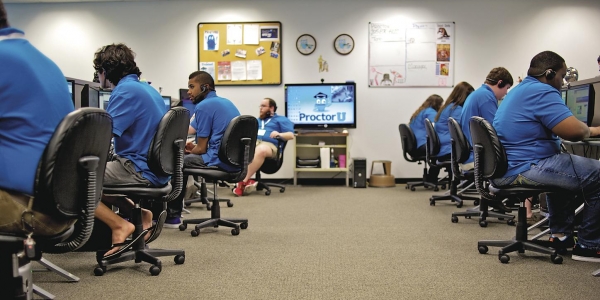
How to beat online exam proctoring


Part of the potential of online education is to break the "credentialing chokehold" of traditional universities. But in order for a credential to have value, one has to be sure that the holder has actually mastered the subject matter. Thus, security in testing is important. Certainly, students can cheat at traditional universities, but the problem becomes much more severe for online-only education in which the educational institution may never have physical contact with the student. A security hole in an online proctoring system can be exploited wholesale, by thousands of people in different locations. (See also Magical Mystery Moocs and Whither Higher Education?)

Here is how to beat the online proctoring systems described in a recent Chronicle of Higher Education article.

Attach a second monitor to the test taker's computer (e.g., via a long cable) which is visible only to a hidden confederate, or otherwise arrange to have the image on the main screen visible to the hidden confederate.

The confederate works out problems and transmits answers via, e.g., tapping on the test-taker's leg, using a long stick (not visible to webcam). Another possibility is for the confederate to use a laser pointer (or other projection device) pointed at the wall behind the test taker's monitor. The confederate could also just hide under the desk/table at which the test taker sits. Most of these methods will work on multiple choice tests, but the projection method could even work on essay or programming tests. A commenter also suggests running multiple virtual machines (VMs) on the test taker's computer, one for the testing app and the other for secret communication. A quick toggle on the keyboard will make this difficult to detect by existing security measures.

Eventually I can imagine students setting up special "test (cheating) rooms" for this purpose. Ideally the monitoring company should obtain POV data from the test taker to defeat these methods.
Chronicle: ... The old biases against online education have begun to erode, but companies that offer remote-proctoring services still face an uphill battle in persuading skeptics, many of whom believe that the duty of preserving academic integrity should not be entrusted to online watchers who are often thousands of miles from the test-takers. So ProctorU and other players have installed a battery of protocols aimed at making their systems as airtight as possible.

The result is a monitoring regime that can seem a bit Orwellian. Rather than one proctor sitting at the head of a physical classroom and roaming the aisles every once in a while, remote proctors peer into a student's home, seize control of her computer, and stare at her face for the duration of a test, reading her body language for signs of impropriety. ...

Blog Archive

Labels