Showing posts with label geeks. Show all posts

Monday, October 12, 2015

Neoreaction and the Dark Enlightenment

An essay on neoreaction and the dark enlightenment from The Awl.

See also Fukuyama and Zhang on the China Model , Is there a China model? and Power and paranoia in Silicon Valley.
The Darkness Before the Right

A right-wing politics for the coming century is taking shape. And it’s not slowing down.

... Land’s case for democratic dysfunction is simply stated. Democracy is structurally incapable of rational leadership due to perverse incentive structures. It is trapped in short-termism by the electoral cycle, hard decisions become political suicide, and social catastrophe is acceptable as long as it can be blamed on the other team. Moreover, inter-party competition to “buy votes” leads to a ratchet effect of ever-greater state intervention in the economy—and even if this is periodically reversed, in the long-run it only moves in one direction. ... Rather than accept creeping democratic socialism (which leads to “zombie apocalypse”), Land would prefer to simply abolish democracy and appoint a national CEO. This capitalist Leviathan would be, at a bare minimum, capable of rational long-term planning and aligning individual incentive structures with social well-being (CEO-as-Tiger-Mom). Individuals would have no say in government, but would be generally left alone, and free to leave. This right of “exit” is, for Land, the only meaningful right, and it’s opposed to democratic “voice,” where everyone gets a say, but is bound by the decisions of the majority—the fear being that the majority will decide to self-immolate.

Anti-democratic sentiment is uncommon in the West, so Land’s conclusions appear as shocking, deliberate provocations, which they partly are. ... Pointing to Singapore, Hong Kong, and Shanghai, it argues that economically and socially effective government legitimizes itself, with no need for elections. And this view isn’t limited to the internet right. ...

This brand of authoritarian capitalism has a certain fascist sheen, but in truth it’s closer to a rigidly formalized capitalist technocracy. There’s no mass mobilization, totalitarian social reorganization, or cult of violence here; governing will be done by the governors, and popular sovereignty replaced by the market Mandate of Heaven. There is a strange sort of disillusioned cultural conservatism here as well, albeit one absolutely stripped of moralism. In fact, what’s genuinely creepy about it is the near-sociopathic lack of emotional attachment; it’s a sort of pure incentive-based functionalism, as if from the perspective of a computer or alien. If a person doesn’t produce quantifiable value, they are, objectively, not valuable. Everything else is sentimentality.

...

Capitalism, in this view, is less something we do than something done to us. Contra business-class bromides about the market as the site of creative expression, for Land, as for Marx, capitalism is a fundamentally alien institution in which “the means of production socially impose themselves as an effective imperative.” This means simply that the competitive dynamics of capitalism drive technical progress as an iron law. If one capitalist doesn’t want to build smarter, better machines, he’ll be out-competed by one who does. If Apple doesn’t make you an asshole, Google will. If America doesn’t breed genetically modified super-babies, China will. The market doesn’t run on “greed,” or any intentionality at all. Its beauty—or horror—is its impersonality. Either you adapt, or you die.

Accelerating technological growth, then, is written into capitalism’s DNA. Smart machines make us smarter allowing us to make smarter machines, in a positive feedback loop that quickly begins to approach infinity, better known in this context as “singularity.” ...
Somehow I ended up on this "map of neoreaction" -- without my consent, of course. Who are all these people? ;-)

Sunday, December 28, 2014

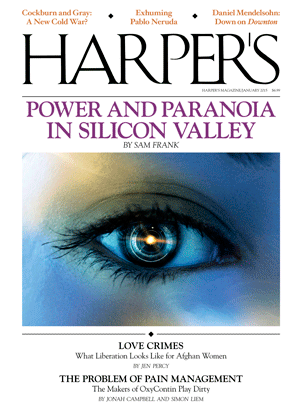
Power and paranoia in Silicon Valley


Plenty of fear and loathing of the nerd rapture backed by powerful VCs in this Harper's article. Ungated version.

Discussed in depth at LessWrong.
... Be explorers; take advantage of this vast new landscape that’s been opened up to us in this time and this place; and bear the torch of applied rationality like brave explorers. And then, like, keep in touch by email.” The workshop attendees put giant Post-its on the walls expressing the lessons they hoped to take with them. A blue one read RATIONALITY IS SYSTEMATIZED WINNING. Above it, in pink: THERE ARE OTHER PEOPLE WHO THINK LIKE ME. I AM NOT ALONE.

... I talked to one of my roommates, a Google scientist who worked on neural nets. The CFAR workshop [[ Center For Applied Rationality ]] was just a whim to him, a tourist weekend. “They’re the nicest people you’d ever meet,” he said, but then he qualified the compliment. “Look around. If they were effective, rational people, would they be here? Something a little weird, no?”

... Were they really going to save the world? From what? “Imagine there is a set of skills,” he said. “There is a myth that they are possessed by the whole population, and there is a cynical myth that they’re possessed by 10% of the population. They’ve actually been wiped out in all but about one person in three thousand.” It is important, Vassar said, that his people, “the fragments of the world,” lead the way during “the fairly predictable, fairly total cultural transition that will predictably take place between 2020 and 2035 or so.” We pulled up outside the Rose Garden Inn. He continued: “You have these weird phenomena like Occupy where people are protesting with no goals, no theory of how the world is, around which they can structure a protest. Basically this incredibly, weirdly, thoroughly disempowered group of people will have to inherit the power of the world anyway, because sooner or later everyone older is going to be too old and too technologically obsolete and too bankrupt. The old institutions may largely break down or they may be handed over, but either way they can’t just freeze. These people are going to be in charge, and it would be helpful if they, as they come into their own, crystallize an identity that contains certain cultural strengths like argument and reason.” I didn’t argue with him, except to press, gently, on his particular form of elitism. His rationalism seemed so limited to me, so incomplete. “It is unfortunate,” he said, “that we are in a situation where our cultural heritage is possessed only by people who are extremely unappealing to most of the population.” That hadn’t been what I’d meant. I had meant rationalism as itself a failure of the imagination. “The current ecosystem is so totally fucked up,” Vassar said. “But if you have conversations here” -- he gestured at the hotel -- “people change their mind and learn and update and change their behaviors in response to the things they say and learn. That never happens anywhere else.” ...
Makes me wish I still lived in the Bay Area :-)  My MIRI interview.

Wednesday, June 22, 2011

On empathy: psychopaths, sociopaths and aspies

Last week a startup CTO, who didn't know my background, characterized all CEOs as "warm sociopaths" :-) He is at least partly right: many business and political leaders are good at reading other people's thoughts and emotions, but lack genuine concern for their well being. On the other hand, many geeks are very bad at mind reading or emotional perception, yet adhere to a strict moral code.

Cambridge cognitive scientist Simon Baron-Cohen (his cousin is the comic Sacha) classifies different low-empathy types below. See this podcast talk and this earlier post about his book on autism and the systematizing / empathizing spectrum. His latest book is specifically about empathy.

I’m O.K., You’re a Psychopath (NYTimes): ... For Baron-Cohen, psychopaths are just one population lacking in empathy. ... Baron-Cohen calls these ... groups “Zero-Negative” because there is “nothing positive to recommend them” and they are “unequivocally bad for the sufferer and those around them.” He provides a thoughtful discussion of the usual sad tangle of bad genes and bad environments that lead to the creation of these Zero-Negative individuals.

People with autism and Asperger’s syndrome, Baron-Cohen argues, are also empathy-deficient, though he calls them “Zero-Positive.” They differ from psychopaths and the like because they possess a special gift for systemizing; they can “set aside the temporal dimension in order to see — in stark relief — the eternal repeating patterns in nature.” This capacity, he says, can lead to special abilities in domains like music, science and art. More controversially, he suggests, this systemizing impulse provides an alternative route for the development of a moral code — a strong desire to follow the rules and ensure they are applied fairly. Such individuals can thereby be moral without empathy, “through brute logic alone.”

David Brooks addresses related themes in his recent book Social Animals. I highly recommend this podcast talk. His opening monologue is actually very funny -- he notes the similarity between politicians and people with the genetic condition Williams Syndrome :-)

Wikipedia: ... Most individuals with Williams syndrome are highly verbal and overly sociable, having what has been described as a "cocktail party" type personality, and exhibit a remarkable blend of cognitive strengths and weaknesses.[3] Individuals with WS hyperfocus on the eyes of others in social engagements.

... While patients with Williams syndrome often have abnormal proficiency in verbal skills, they do not perform better on verbal tasks than average. This syndrome is characterized more by a deficiency in other areas of processing. [Glib, but often mildly retarded.]

I would guess that "neurotypicals" strike aspies the way that Williams sufferers strike the rest of us. Imagine how disturbing it must be to live in a society dominated by and structured around people so different from yourself.

PhD Comics: the movie

PHD Movie Trailer from PHD Comics on Vimeo.


I met Jorge Cham, the cartoonist who draws PhD Comics, a few years ago at Sci Foo. Cham was a roboticist (grad school at Stanford and ME instructor at Caltech) before becoming a full time cartoonist. I notice this movie was made in collaboration with a Caltech theatre company.


Tuesday, June 14, 2011

Foo: exuberant geeks


Making the future.


CTOs and CEOs and Founders and Inventors and Creators.


Never before have the economic and creative prospects been so good for a young person with quantitative or technical abilities. In my generation we had fewer options: defense, academia or big stodgy corporations. Today you can code or analyze data or build mathematical models for a hedge fund, a bank, a social networking startup, a web publisher, an e-commerce site, a video game company, Google, etc., etc. If you can manage a team and communicate your vision to investors and partners, all the better. The sky is the limit.


"The Times gets a billion impressions a day. How do they optimize their ad revenue? To get real-time or nearly real-time analysis of, say, how many people in Wisconsin who were on Zappos within the last hour also viewed a Style section article, we need a big hadoop deployment and in-memory database that let's the user slice through a 100 dimensional parameter space. It's business intelligence on a supercomputer. Remnant ad space is auctioned on AdSense to competing bots, with the whole thing -- cookie analysis, automated bidding, ad fetching and placement -- taking place over 500 milliseconds."

"We're empowering people in rural India by giving them access to piece-rate work over the internet."

"90% of mechanical turk work is web spam." :-)

"They tried to buy us with shares priced on a secondary market, but I wouldn't trade my execution risk against that valuation risk."

"Yes, it's a flashlight but it's LED with a lithium ion battery. 3000 lumens shined into a burglar's eyes will blind them for 20 minutes. Those fins are for heat dissipation; the tip reaches 180 degrees."

"Computer vision is next. Much easier than NLP, but it'll be hacks strung together like everything else."


A few more Foo Camp 2011 photos here. Scott Berkun shares his insights here.

Thursday, July 23, 2009

Bitter geeks

From Googler Mark Chu-Carroll, a post and ensuing 600+ comments on how horrible high school is for some geeks. Mark writes the blog Good Math, Bad Math and seems fairly well adjusted now, despite the lingering bitterness. My main advice is to get his kid studying MMA/BJJ/Judo/Wrestling rather than Karate ;-)

Original post (with 400+ comments), follow up post (with 200+ comments).

... I graduated from high school in 1984. Which means that this year is my graduating class's 25th year reunion. As a result, a bunch of people from my high school class have been trying to friend me on facebook, sending me email, and trying to convince me to come to the reunion.

I don't feel like replying to them individually, which is why I'm writing here.

As pretty much any reader of this blog who isn't a total idiot must have figured out by now, I'm a geek. I have been since I was a kid. My dad taught me about bell curves and standard deviations when I was in third grade, and I thought it was pretty much the coolest damn thing I'd ever seen. That's the kind of kid I was. I was also very small - 5 foot 1 when I started high school, 5 foot three my junior year. Even when I shot up in height, to nearly 5 foot eleven between junior and senior year, I weighed under 120 pounds. So think small, skinny, hyperactive, geek.

Like most geek kids, I had a rough time in school. I don't think that my experience was particularly unusual. I know a lot of people who had it worse. But I think that it was slightly worse than average, because the administration in the school system that I went to tolerated an extraordinary amount of violent bullying. Almost every geeky kid gets socially ostracized. Almost all get mocked. In fact, almost all face some physical abuse. The main determinant of just how much physical abuse they get subjected to is the school administration. And the administration at my school really didn't care: "Bruises? He must just be uncoordinated and bumps into things. Broken fingers? Hey, it happens. We're sure it must have been an accident. What do you want, an armed guard to follow your kid around?"

In high school, I didn't have a single real friend in my graduating class. I had a very few friends who graduated a year before me; I had a few who graduated one or two years after me. But being absolutely literal, there was not a single person in my graduating class who came close to treating me like a friend. Not one.

Like I said before, the way I was by my classmates in high school was pretty typical for a geek. At best, I was ignored. At worst, I was beaten. In between, I was used as a sort of status enhancer: telling people that you'd seen me doing some supposedly awful or hysterical thing was a common scheme for getting ahead in certain social circles. ...

... Now it's twenty five years since I got out of that miserable fucking hell-hole. And people from my high school class are suddenly getting in touch, sending me email, trying to friend me on Facebook, and trying to convince me to bring my family to the reunion. (It's a picnic reunion, full family invited.) Even some of the people who used to beat the crap out of me on a regular basis are getting in touch as if we're old friends.

My reaction to them... What the fuck is wrong with you people? Why would you think that I would want to have anything to do with you? How do you have the chutzpah to act as if we're old friends? How dare you? I see the RSVP list that one of you sent me, and I literally feel nauseous just remembering your names.

The only positive thing that ever came out of my time with you people is that my children are studying karate. My son will, most likely, have his black belt by the time he finishes fourth grade. He's a hyperactive little geek, just like me. ...

Luckily for me my high school years were among the best of my life. My 20th reunion was a blast -- it went by way, way too fast!

Thursday, April 30, 2009

Life path integral

I think this web cartoon by Abstruse Goose is hilarious! (Thanks to DB for sending it to me :-)

Who is the artist? I did a quick search and didn't find anything -- is he/she deliberately anonymous (other than the Chinese characters on the upper left)?

For the perplexed: see earlier post path integrals.

Tuesday, January 06, 2009

Beamtimes and Lifetimes

The episode of The Big Bang Theory that I described in my previous post reminded me of Beamtimes and Lifetimes, by anthropologist and historian Sharon Traweek (UCLA).


The book is a detailed portrait of the world of particle physics from a cultural anthropologist's perspective. Traweek did "field work" among the very odd tribe of particle physicists at KEK, SLAC and Fermilab :-) Though imperfect, it paints a very recognizable picture of our community. I found it quite enlightening when I read it as a grad student.

Friday, January 02, 2009

The Big Bang Theory and teleportation


Have a look at the opening segment (video below) of this episode of The Big Bang Theory. I've had exactly the same conversation about teleportation (or transporters on Star Trek) more times than I can count. Sheldon (taller guy, on the left in the picture) is the theorist and Leonard is the experimentalist, both at Caltech.

On teleportation from A to B: let's reverse the time ordering of steps and see if it bothers you. If I were to first produce an exact replica of you at the desired location B, would you then be willing to step into a disintegration chamber at A?

Opening segment (Amazon); full episode - The Jerusalem Duality (avi video)

Another bit of dialog from the episode; Rajnesh is an astrophysicist.
Rajnesh Koothrappali: Do you know what he (Sheldon) did? He watched me work for 10 minutes, and then started to design a simple piece of software that could replace me.
Leonard Hofstadter: Is that even possible?
Rajnesh Koothrappali: As it turns out, yes.

Monday, July 14, 2008

Foo camp 2008 coverage

Nice article and photos here (Techcrunch) and here. My sessions were "The information security industry is broken" with John Viega and Dan Kaminski, and "The technology of hand to hand fighting: MMA" :-)

Techcrunch: Shangri La for geeks

275 or so people congregated on the small town of Sebastopol, located 60 miles north of San Francisco in the heart of wine country, for the 2008 Foo Camp this last weekend. Attendees included technologists, professors, researchers engineers, major company executives, billionaire entrepreneurs, students, press and the odd astronaut.

They all had one thing in common - a love of technology. Foo Camp, which stand for Friends of O’Reilly, is an annual three day tech event put on by O’Reilly Media at their Sebasopol headquarters. They supply a huge lawn area where attendees put up tents, food and drinks, bathrooms, Wifi and one very large blank piece of paper marked off in a grid.

There is no structure to the event - if an attendee wants to hold a session on anything at all, they simply write the name of the session somewhere on the grid, which tells people what day/time and place the session will be held. People attend any sessions they like, and with 15 or so happening at any given time, there may be 2 people, or 75 people, in any particular session.

Sessions this year included, to name just a few: “how to fly the space shuttle” by a former astronaut, “the future of news,” “user generated meta data,” “the metrics of virtual worlds,” “decentralizing social networks” and “online hate/trolling.”

In one session on Sunday that I co-led with Tim O’Reilly and Danny Sullivan, we debated the need for competitive search. This was an offshoot of a previousdebate we held on our blogs, but this time with audience participation in real time (including people from the companies being discussed).

The sessions are in an unconference format, meaning the leaders are there to guide the discussion only. Audience participation isn’t just encouraged, it’s a well exercised right (in the picture to the right, you can see Wikipedia founder Jimmy Wales behind the table with his hand raised to make a comment in the “user generated meta data” session led by Esther Dyson). With so many different types of interesting people in any given session at any time, the conversations tend to be fascinating, and occasionally explosive. ...


Thursday, December 27, 2007

Nerds!


I haven't read this yet, but am looking forward to it. (OK, maybe I just like the title and cover :-)

Here is the author's web page; he's a psychology professor at Bennington.

Q: Do other countries have this problem?

A: The idea that it is unattractive or unappealing to be intelligent is not a universal concept. Not in Asia, certainly not in India. There's no concept in India that being good at math and science and technology has negative social consequences. That's the reason there are so many Indian engineers.

Q: Why did this grow out of American culture?

A: Historically, America is a place for men of action, for men who discover things, make things with their hands, have practical intelligence as opposed to book learning. Book-learning was suspect — the musty old European way, as opposed to practical, snazzy America. I think this tradition has never gone away.

The problem is that now it just doesn't work anymore. You can't do anything unless you pay attention in school. You can't invent things without knowing calculus. If you don't study math, it won't work. Benjamin Franklin was an American genius, a model of the American tinkerer, but the Ben Franklin model is not working anymore.

Q. Wasn't everyone talking about the need for better math and science education back in the days of Sputnik?

A: What's new is the sexualization of it. Kids live in such a sexualized world. ... (If you are called a nerd or a geek, it's) not just creepy or weird, you're labeled as someone who is never going to get laid. There's a lot more at stake because kids are so much more exposed to a culture that's all about being attractive, having sex early.

The nerds and the geek stereotype is that if you're doing well in math and science, you are completely unattractive to the opposite sex.

All the nerd and geek self-tests, what they ask you is: Are you good at science and math? Are you unwashed? Have you never had a date? You don't know anyone's phone number except your mothers?

Blog Archive

Labels