Showing posts with label bobby fischer. Show all posts

Sunday, November 24, 2013

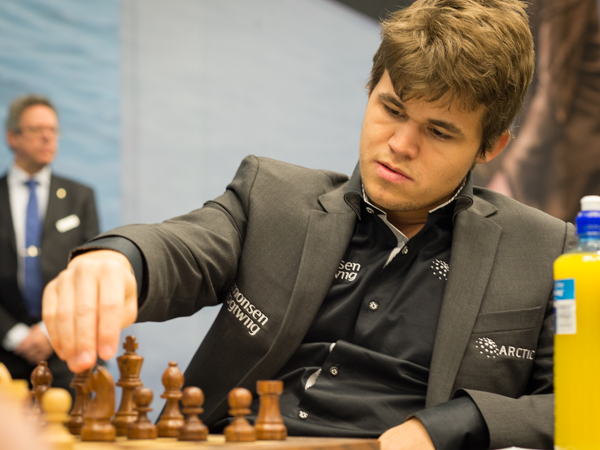
Sven Magnus Øen Carlsen


I am curious about what serious chess players think of Elo scores across generations -- is there a Flynn Effect? Current world champ Magnus Carlsen has the highest score of all time. It seems possible that due to computer training today's players are much better than those of the past -- we'll never know how giants like Bobby Fischer would have developed using today's methods. By Elo score Fischer is only 14th on the all-time list!

I thought interest in chess would decline after Deep Blue defeated Kasparov. But apparently the game is still thriving.

The excerpts below are from an old interview in Der Spiegel:
Carlsen: ... my success mainly has to do with the fact that I had the opportunity to learn more, more quickly. It has become easier to get hold of information. The players from the Soviet Union used to be at a huge advantage; in Moscow they had access to vast archives, with countless games carefully recorded on index cards. Nowadays anyone can buy this data on DVD for 150 euros; one disk holds 4.5 million games. There are also more books than there used to be. And then of course I started working with a computer earlier than Vladimir Kramnik or Viswanathan Anand.

SPIEGEL: When exactly?

Carlsen: I was eleven or twelve. I used the computer to prepare for tournaments, and I played on the Internet. Nowadays, children start using a computer at an even earlier age; they are already learning the rules on screen. In that sense I am already old-fashioned. Technological progress leads to younger and younger top players, everywhere in the world.

SPIEGEL: Is being young an advantage in modern chess?

Carlsen: As a young player you have a lot of energy, a lot of strength, you are very motivated. But young players are often not good at defending a position; they cannot cope well when fate turns against them. The fact is simply that experience is a central issue. One of the most important things in chess is pattern recognition: the ability to recognise typical themes and images on the board, characteristics of a position and their consequences. To a certain degree you can learn that while training, but there is nothing like playing routine. I have always made sure to get that. I am only 19, but I have certainly already played a thousand games in the classic style.
This is also interesting:
SPIEGEL: Mr Carlsen, what is your IQ?

Carlsen: I have no idea. I wouldn’t want to know it anyway. It might turn out to be a nasty surprise.

SPIEGEL: Why? You are 19 years old and ranked the number one chess player in the world. You must be incredibly clever.

Carlsen: And that’s precisely what would be terrible. Of course it is important for a chess player to be able to concentrate well, but being too intelligent can also be a burden. It can get in your way. I am convinced that the reason the Englishman John Nunn never became world champion is that he is too clever for that.

SPIEGEL: How that?

Carlsen: At the age of 15, Nunn started studying mathematics in Oxford; he was the youngest student in the last 500 years, and at 23 he did a PhD in algebraic topology. He has so incredibly much in his head. Simply too much. His enormous powers of understanding and his constant thirst for knowledge distracted him from chess.

SPIEGEL: Things are different in your case?

Carlsen: Right. I am a totally normal guy. My father is considerably more intelligent than I am.
Der Spiegel carefully tested Kasparov's IQ at 135, as discussed here. See also The Laskers and the Go master.

Tuesday, May 17, 2011

Kasparov on Fischer


Kasparov reviews Frank Brady's biography of Bobby Fischer. See also here.

NYBooks: ... I was hoping for a little more meat on the topic of the nature of prodigy and Fischer’s early development, beyond his own famous comment “I just got good”—but perhaps there is nothing more. The nature of genius may not be definable. Fischer’s passion for puzzles was combined with endless hours of studying and playing chess. The ability to put in those hours of work is in itself an innate gift. Hard work is a talent.

Generations of artists, authors, mathematicians, philosophers, and psychologists have pondered what exactly it is that makes for a great chess player. More recently, scientists with advanced brain-scanning machines have joined the hunt, looking for hot spots of activity as a master contemplates a move. An obsessive-competitive streak is enough to create a good squash player or a good (or bad) investment banker. It’s not enough to create someone like Fischer.

This is not meant to be a compliment, necessarily. Many strong chess players go on to successful careers as currency and stock traders, so I suppose there is considerable crossover in the pattern-matching and intuitive calculation skills required. But the aptitude for playing chess is nothing more than that. My argument has always been that what you learn from using the skills you have—analyzing your strengths and weaknesses—is far more important. If you can program yourself to learn from your experiences by assiduously reviewing what worked and what did not, and why, success in chess can be very valuable indeed. In this way, the game has taught me a great deal about my own decision-making processes that is applicable in other areas, but that effort has little to do with natural gifts.

Fischer’s brilliance was enough to make him a star. It was his relentless, even pathological dedication that transformed the sport. Fischer investigated constantly, studying every top-level game for new ideas and improvements. He was obsessed with tracking down books and periodicals, even learning enough Russian to expand his range of sources. He studied each opponent, at least those he considered worthy of preparation. Brady recounts dining with Fischer and hearing a monologue of the teen’s astonishingly deep analysis of David Bronstein’s openings before the two were to meet in the Mar del Plata tournament in 1960. No one had ever prepared this deeply outside of world championship matches. Today, every game of chess ever played, going back centuries, is available at the click of a mouse to any beginner. But in the pre-computer era, Fischer’s obsessive research was a major competitive advantage.

In his play, Fischer was amazingly objective, long before computers stripped away so many of the dogmas and assumptions humans have used to navigate the game for centuries. Positions that had been long considered inferior were revitalized by Fischer’s ability to look at everything afresh. His concrete methods challenged basic precepts, such as the one that the stronger side should keep attacking the forces on the board. Fischer showed that simplification—the reduction of forces through exchanges—was often the strongest path as long as activity was maintained. The great Cuban José Capablanca had played this way half a century earlier, but Fischer’s modern interpretation of “victory through clarity” was a revelation. His fresh dynamism started a revolution; the period from 1972 to 1975, when Fischer was already in self-exile as a player, was more fruitful in chess evolution than the entire preceding decade.

Fischer’s uncompromising approach had an even greater impact on the chess world than his results. I am not referring to any “special moves,” as often suspected by those unfamiliar with the game. It was simply that Fischer played every game to the death, as if it were his last. It was this fighting spirit that his contemporaries recall most about him as a chess player.

Sunday, January 23, 2011

Chess is better


The NYTimes reviews a new biography of Bobby Fischer. 19-year-old Bobby Fischer after a visit to a brothel in Curaçao: “Chess is better,” Fischer said.

... Mr. Brady also makes use of unusually good source material, from Fischer’s own unpublished manuscript to 50 years’ worth of his own conversations with Fischer’s associates, mentors and relatives. Note the omission of the word “friends.” Fischer never had them.

Mr. Brady met Fischer when the prodigy was a 10-year-old boy in New York, followed his career closely and sat with hushed audiences watching Fischer play tournaments. He drew on the archives of Jack Collins, Fischer’s mentor, and Regina Fischer, his mother. When Regina, the Jewish mother of this rabidly anti-Semitic Jewish son, began to understand the depths of her son’s bigotry, she wrote a prophetic letter that appears in these pages, delivering words that could have been Fischer’s epitaph: “The greater the person’s mind and talent, the greater the destruction.”

What changed boyish, chess-loving Bobby into the erratic, loathsome old crackpot and man without a country that he would eventually become? Mr. Brady is not in the business of tossing around facile judgments or easy answers. Instead, he gets as close as he can to a Bobby’s-eye point of view for “Endgame” and tries to convey what Fischer’s character-warping experiences as a public figure may have been like, and how they shaped him. Mr. Brady can credibly describe what went on in his subject’s mind during the 1956 so-called Game of the Century, when this 13-year-old nobody defeated Donald Byrne, a 25-year-old college professor, and shocked onlookers with his cunning and audacity. When Fischer made the especially daring sacrifice of a knight, a tournament referee said, “a murmur went through the tournament room after this move, and the kibitzers thronged to Fischer’s table as fish to a hole in the ice.” [WASN'T IT A QUEEN SACRIFICE?]

See also here and this post from 2008:

Dick Cavett, blogging in the Times, treats us to some recollections of and reflections on Bobby Fischer. Although I've read several biographies of Fischer, I doubt I've seen much live footage of him. The clip below is wonderful and a bit surprising -- it captures a moment, one we'll never see again.

Cavett's focus on Fischer's physical appearance (his height, eyes, even shoulders) is interesting, perhaps odd, but understandable given that celebrity itself is his (Cavett's) main expertise. Sylvia Nasar devoted an equivalent amount of attention to John Nash's appearance in A Beautiful Mind.

I suppose Go is actually better than Chess ;-)

Edward Lasker: "While the baroque rules of Chess could only have been created by humans, the rules of Go are so elegant, organic, and rigorously logical that if intelligent life forms exist elsewhere in the universe, they almost certainly play Go."

I'm sympathetic to this point of view. The rules of Go seem to be a natural embodiment of two dimensional notions of encirclement and control of space. They are much simpler and less arbitrary than those of Chess. I can't say anything about the strategic and tactical subtlety of the game, since I don't play, but experts seem to think it is quite deep (certainly it is more challenging for AI than Chess, if only for combinatorial reasons). One problem with Lasker's contention is that Go doesn't seem to have been invented independently by any human civilizations other than ancient China (supposedly 4000 years ago)!

Sunday, February 24, 2008

Dick Cavett on Bobby Fischer

Dick Cavett, blogging in the Times, treats us to some recollections of and reflections on Bobby Fischer. Although I've read several biographies of Fischer, I doubt I've seen much live footage of him. The clip below is wonderful and a bit surprising -- it captures a moment, one we'll never see again.

Cavett's focus on Fischer's physical appearance (his height, eyes, even shoulders) is interesting, perhaps odd, but understandable given that celebrity itself is his (Cavett's) main expertise. Sylvia Nasar devoted an equivalent amount of attention to John Nash's appearance in A Beautiful Mind.

The comments on the original post are well worth reading -- many are from the generation that experienced Fischer's meteoric ascent firsthand. See here for a followup.


NYTimes: It must seem strange to people too young to remember that there was once a chess champion — of all things — who became arguably the most famous celebrity on earth. And that his long-anticipated match against the reigning Russian champion, Boris Spassky, was broadcast and watched worldwide as if it were the Super Bowl, except that chess drew a much bigger audience.

There was another element that added to the drama. With Fischer the American and Spassky the Russkie, the monumental match was seen as a Cold War battle.

The Russian chess champions considered themselves the undoubted best. Time out of mind the Soviet chess dynasty had reigned supreme, viewing themselves as a rightful symbol of Soviet superiority in all fields.

PBS broadcast the drama in sports fashion, complete with play-by-play commentary by Shelby Lyman, who himself became a household name. People stayed home from work, glued to their sets, and PBS got its highest ratings ever. The country and the world became chess-crazy. And Fischer-crazy. Chess sets, dusty on the shelves, suddenly sold in the millions.

We ordinary mortals can only try to imagine what it might feel like to be both young and so greatly gifted at a complex art. And to be better at it than any other living being, past or present. There are plenty of geniuses and lots of famous people, but few are both. Is anyone really capable of surviving such a double burden?

We assume that geniuses are blessed creatures who don’t have to work hard to achieve their goals. Hard for us, easy for them. But Bobby as a kid — IQ pushing 200 — put in 10 to 15 hours a day of brain power and heavy concentration that would kill an ordinary person. (Or at least me.)

The chess world was already well aware of this kid prodigy. But they were unprepared for him to suddenly go up against the acknowledged top player of the day in the United States Chess Championship. And win — at the age of thirteen. When asked what happened, he said, “I got better.”

What does such dedication to seemingly unreachable goals — until he reached them — do to the rest of you, the over-achiever? Touchingly, when he returned to my show after having disposed of Spassky, triumphant in the eyes of the world, he opined that he might be wise to try developing some of the rest of himself. He had begun to see that a life of nothing but chess was “kind of limited.” (He went to dinner in Reykjavik with friends. “Bobby couldn’t follow the conversation,” one said. “He sort of backed into the corner, got out his little pocket chess set and played with himself.”) He announced on my show that he was now “reading a lot of magazines, trying to keep up with what’s going on in the world.” He was still in his twenties.

Until the advent of Bobby Fischer, my image of a young chess genius was not flattering. I pictured a sort of wizened and unpopular youth, small of frame, reclusive, short, with messy hair, untended acne, thick glasses and shirt sticking out in back. And also perhaps, as the great V. Nabokov wrote in describing somewhat genderless piano prodigies with eye trouble, obscure ailments, “and something vaguely misshapen about their eunuchoid hindquarters.”

**********

Getting Fischer on my show that first time, before the big match, was considered a major catch at the time. If anyone in the audience shared my image of what a chess genius probably looked like, Bobby’s entrance erased it.

Here was no Nabokovian homunculus. There appeared, somewhat disconcerted, a tall and handsome lad with football-player shoulders, impeccably suited, a little awkward of carriage and unsure how to negotiate the unfamiliarity of the set, the bright lights, the wearing of make-up, the band music, the hand-shaking and the thundering ovation — all at the same time. I had hoped to avoid the cliché “gangling,” but Bobby gangled. He sort of lurched into his chair.

Once seated, he was something to behold. Six foot two (tall in those days), athletic in build, perfect in grooming, and with striking features. The face radiated intelligence. You couldn’t confuse him with anyone you’d ever seen.

And there were the eyes.

Cameras fail to convey the effect of his eyes when they were looking at you. A bit of Svengali perhaps, but vulnerable. And only the slightest hint of a sort of theatrical menace, the menace that so disconcerted his opponents.

Looking out over the audience, I could clearly see entranced women gazing at him as if willing to offer their hearts — and perhaps more — to the hunky chess master.

When I asked him about such matters, he said that the awful demands of his life — the global travel; the constant study, sometimes until dawn, followed by play; the punishing five-hour sessions at full concentration, day after day — all this made it “pretty hard to . . . [hesitates] . . . build up a relationship.” He seemed quite surprised with himself, as did friends watching, that he had allowed so revealing a moment. (That old Cavett magic, no doubt.)

One thing he said in that first appearance became famous. At one point I asked him what, in terms of thrills, the chess equivalent might be of, say, hitting a home run. His answer: “I like the moment when I break a man’s ego.” There was a trace of a chill in his laughter.

... I’ve sat for a while trying to figure out how to close. A faint glimmer of a bit of poetry had been swimming elusively in my head, just out of reach. And then it emerged.

It’s from E.E.Cummings’ famous poem about another lionized and legendary figure who, after triumph and glamour, also did not have “a good death”: Buffalo Bill.

With Cummings’ quirky punctuation, it’s a short poem, with no title but referred to by its first three words: “Buffalo Bill’s / defunct.”

Its closing lines somehow seem appropriate here. They are:

Jesus
he was a handsome man
and what I want to know is
how do you like your blue-eyed boy
Mister Death

From the comments:

... The finest thing about Bobby ...is that he made being smart, that is intellectualism, a cool thing. He was brilliant, knew it, was outwardly proud of it and not only could perform great feats with it but he said that he would and then did and did so far beyond the wildest dreams of anyone. So thank you Bobby and thank you Dick.

The truly great thing about Bobby Fischer was an audacious courage that for lack of a better comparison I mention Muhamid Ali and even though Bobby’s courage was on its own level there were similarities in the “not afraid of nothin” certainty with which they went about their business. Fischer’s march through the qualifying rounds of the world championship are simply unfathomable. Bobby the destroyer of ego was in full bloom and the completeness and ruthlessness was scary to watch even though I could not look away.

Even to people who play high level chess, the things he lay before the world were unbelieveable to see. It was watching that runup to the world championship that confirmed my inklings that a man could become mad in chess and accept it fully as more than reality and that here was such a man who not only possessed a fine and strong intellect but also the courage to throw it against or into the madness, the howling inferno that chess on that level can become. I was witnessing my own personal dark fear displayed on the largest stage and at a scale bigger than life in a man with one of the finest minds and the profound courage to risk it entirely. The outcome of the championship was certain to everyone by quarter finals.

Thank you so much Bobby and to borrow a few words to help express my love from Don McClane:

“but I could have told you Bobby, this world was never meant for one as beautiful as you”

Conrad Elledge

Saturday, January 19, 2008

So long, Bobby


I like to remember how you began, not how you ended...

NYTimes: There may be only three human activities in which miraculous accomplishment is possible before adulthood: mathematics, music and chess. These are abstract, almost invented realms, closed systems bounded by rules of custom or principle. Here, the child learns, is how elements combine and transform; here are the laws that govern their interactions; and here are the possibilities that emerge as you play with signs, symbols, sounds or pieces. Nothing else need be known or understood — at least at first. A child’s gifts in such realms can seem otherworldly, the achievements effortlessly magical. But as Bobby Fischer’s death on Thursday might remind us, even abstract gifts can exact a terrible price.

In 1956 Mr. Fischer, at 13, displayed powers that were not only prodigious but also uncanny. A game he played against Donald Byrne, one of the top 10 players in the United States, became known as “the Game of the Century,” so packed was it with brilliance and daring (and Mr. Fischer’s sacrifice of a queen). “I just got good,” he explained — as indeed he did, winning 8 of the 10 United States Championship tournaments held after 1958 and then, of course, in 1972, breaking the long hold that Soviet chess had on the international championship.

“All I want to do, ever,” he said, “is play chess.” And many thought him the best player — ever. Garry Kasparov once said that he imagined Mr. Fischer as a kind of centaur, a human player mythologically combined with the very essence of chess itself.

But of course accompanying Mr. Fischer’s triumphs were signs of something else. His aggressive declarations and grandiose pronouncements were once restricted to his chosen playing field. (“Chess is war over the board. The object is to crush the opponent’s mind.”) Eventually, they grew in scope, evolving into ever more sweeping convictions about the wider world.

Blog Archive

Labels