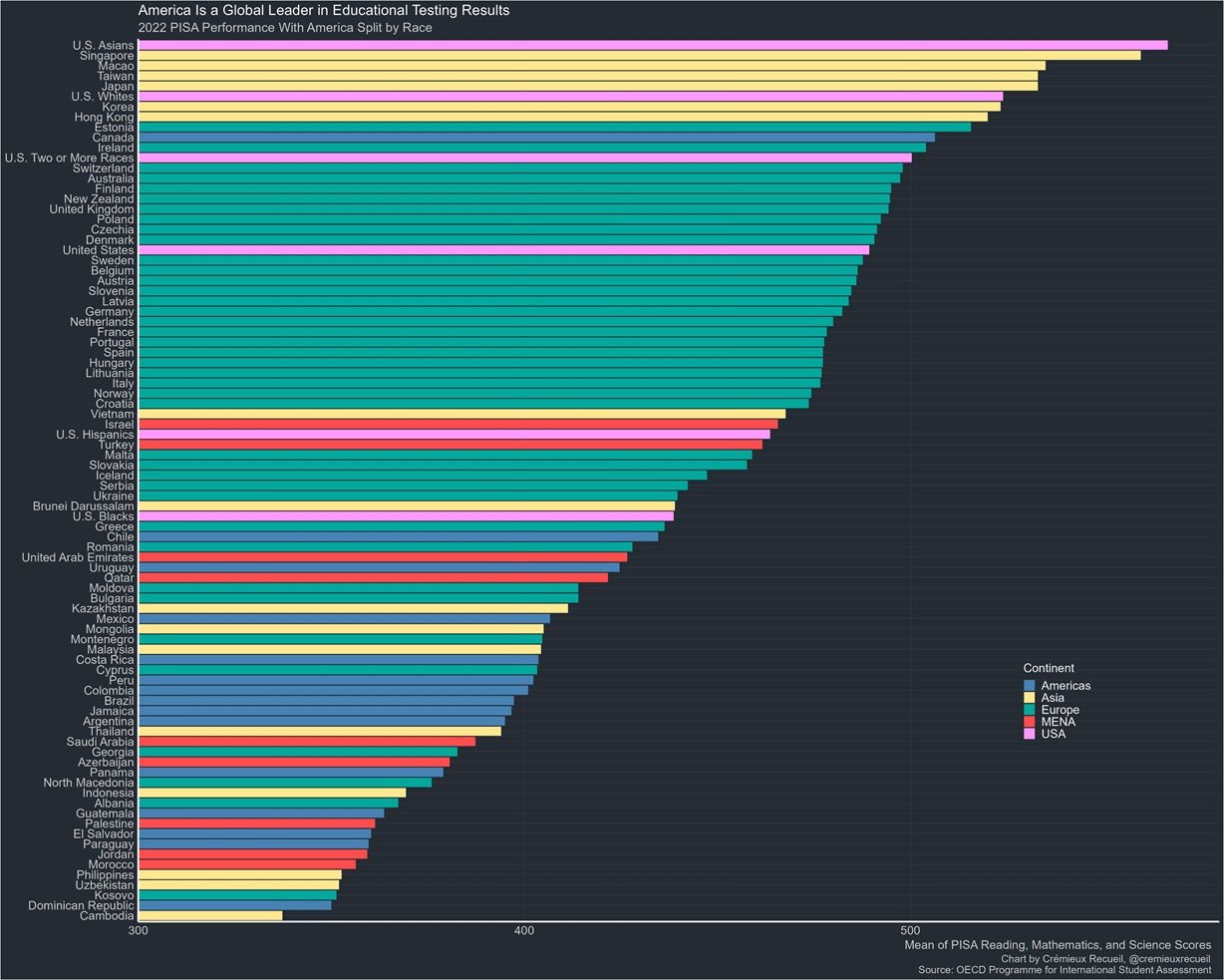
Quintiles are defined using the *entire* international PISA student pool. These figures allow us to compare equivalent SES cohorts across countries and to project how developing countries will perform as they get richer and improve schooling.
Pessimism of the Intellect, Optimism of the Will Favorite posts | Manifold podcast | Twitter: @hsu_steve
Wednesday, December 13, 2023
PISA 2023 and the Gloomy Prospect
Quintiles are defined using the *entire* international PISA student pool. These figures allow us to compare equivalent SES cohorts across countries and to project how developing countries will perform as they get richer and improve schooling.
Tuesday, October 10, 2023
SMPY 65: Help support the SMPY Longitudinal Study
The Study of Mathematically Precocious Youth (SMPY) needs your help to support the Age-65 phase of their unique longitudinal study.
• Prodigies destined for eminent careers can be identified as early as age 13.
• There is no plateau of ability; even within the top 1%, variations in mathematical, spatial, and verbal abilities profoundly impact educational, occupational, and creative outcomes.
• The blend of specific abilities, such as mathematical, spatial, and verbal aptitudes, shapes the nature of one's accomplishments and career trajectory.
More information:
Indicate "Please designate this gift to Study of Mathematically Precocious Youth" in the Special Instructions.
Thursday, August 24, 2023
Aella: Sex Work, Sex Research, and Data Science — Manifold #42
Thursday, July 13, 2023
Richard Hanania & Rob Henderson: The Rise of Wokeness and the Influence of Civil Rights Law — Manifold #39
Thursday, March 02, 2023
Prof. Gilles Saint-Paul (Ecole Normale): the Yellow Vests, French Politics, and Hypergamy (Manifold #31)
Thursday, January 19, 2023
Dominic Cummings: Vote Leave, Brexit, COVID, and No. 10 with Boris — Manifold #28
Wednesday, September 28, 2022
The Future of Human Evolution -- excerpts from podcast interview with Brian Chau
The transcript excerpts below are from my recent conversation with Brian Chau (aka Cactus Chu) on his podcast.
— steve hsu (@hsu_steve) September 28, 2022
Segments begin at 47m and 1h07m.
They have been lightly edited.https://t.co/RJ68FasfJchttps://t.co/TnSuNaxhnQ
Thursday, June 16, 2022
Greg Clark: Genetics and Social Mobility — Manifold Episode #14
Thursday, March 03, 2022
Manifold Podcast #6: Richard Sander on Affirmative Action, Mismatch Theory, and Academic Freedom
Monday, January 10, 2022
Recent Papers on Socio-Economic Status and Student Achievement: Marks and O'Connell
Dear Scholar,There is a widely-held perception that many of life’s key outcomes are fundamentally driven by people’s socio-economic status (SES). More specifically, there is a view that children’s educational attainment is largely a by-product of their familial SES. As a consequence of this pervasive paradigm, much of the energy in seeking to ameliorate or resolve poor educational attainment is based around trying to use SES as a social lever.However, in the six papers listed below, published between 2019-2022, evidence has been gathered demonstrating that SES is only very modestly correlated with educational attainment. Furthermore, once a child’s cognitive ability is taken into account, even the modest link between SES and attainment diminishes to slight influence. This is true of datasets drawn from international groups of young people, as well as those from the US, UK, or Ireland. Future attempts to aid and study young people experiencing difficulty with educational attainment should be built on an awareness of the limited role of SES.Gary N Marks Michael O’Connell1. O’Connell, M. and Marks, G.N. (2022)
Cognitive ability and conscientiousness are more important than SES for educational attainment: An analysis of the UK Millennium Cohort Study
Personality and Individual Differences, 188
https://doi.org/10.1016/j.paid.2021.111471
Highlights Antecedents of educational attainment of great interest Dominant paradigm focuses on SES of children. Cognitive ability and conscientiousness have stronger record in research findings. Using new UK MCS longitudinal survey data, GCSE state exam performance assessed Cognitive ability and conscientiousness explained far more than SES measures
2. Marks, G. N. (2021)
Is the relationship between socioeconomic status (SES) and student achievement causal? Considering student and parent abilities
Educational Research and Evaluation, 10.1080/13803611.2021.1968442: 1-24.
Abstract Most studies on the relationship between students’ socioeconomic status (SES) and student achievement assume that its effects are sizable and causal. A large variety of theoretical explanations have been proposed. However, the SES–achievement association may reflect, to some extent, the inter-relationships of parents’ abilities, SES, children’s abilities, and student achievement. The purpose of this study is to quantify the role of SES vis-à-vis child and parents’ abilities, and prior achievement. Analyses of a covariance matrix that includes supplementary correlations for fathers and mothers’ abilities derived from the literature indicate that more than half of the SES–achievement association can be accounted for by parents’ abilities. SES coefficients decline further with the addition of child’s abilities. With the addition of prior achievement, the SES coefficients are trivial implying that SES has little or no contemporaneous effects. These findings are not compatible with standard theoretical explanations for SES inequalities in achievement.
3. Marks, G. N. and O’Connell, M. (2021)
No Evidence for Cumulating Socioeconomic Advantage. Ability Explains Increasing SES Effects with Age on Children’s Domain Test scores
Intelligence, 88
https://doi.org/10.1016/j.intell.2021.101582
Highlights Data analysed for five domains for children of the NLSY79 mothers study. SES effects increase for only some domains and not substantially. No increase in SES effects when considering mother's or children's prior ability. Effects of child's prior ability on test scores increase substantially with age. SES effects are small net of mother's ability.
4. Marks, G. N. and O'Connell, M. (2021)
Inadequacies in the SES–Achievement model: Evidence from PISA and other studies
Review of Education, 9(3): e3293.
https://doi.org/10.1002/rev3.3293
Abstract Students’ socioeconomic status (SES) is central to much research and policy deliberation on educational inequalities. However, the SES model is under severe stress for several reasons. SES is an ill-defined concept, unlike parental education or family income. SES measures are frequently based on proxy reports from students; these are generally unreliable, sometimes endogenous to student achievement, only low to moderately intercorrelated, and exhibit low comparability across countries and over time. There are many explanations for SES inequalities in education, none of which achieves consensus among research and policy communities. SES has only moderate effects on student achievement, and its effects are especially weak when considering prior achievement, an important and relevant predictor. SES effects are substantially reduced when considering parent ability, which is causally prior to family SES. The alternative cognitive ability/genetic transmission model has far greater explanatory power; it provides logical and compelling explanations for a wide range of empirical findings from student achievement studies. The inadequacies of the SES model are hindering knowledge accumulation about student performance and the development of successful policies.
5. O'Connell, M. and Marks, G. N. (2021)
Are the effects of intelligence on student achievement and well-being largely functions of family income and social class? Evidence from a longitudinal study of Irish adolescents
Intelligence, 84: 101511. 10.1016/j.intell.2020.101511
Highlights Power of cognitive ability and social class contrasted. Large representative sample from longitudinal study, waves 1–3, of 6216 children Outcomes were attainments, difficulties and relationships. Cognitive ability explained large amounts of variance. Social background only minor effects
6. O'Connell, M. (2019)
Is the impact of SES on educational performance overestimated? Evidence from the PISA survey
Intelligence, 75: 41-47
https://doi.org/10.1016/j.intell.2019.04.005
Highlights Policy-makers overly attribute differences in educational performance to SES. PISA survey used to assess roles of parental education and household income. Combining them concealed differences in outcomes between rich and poor countries. Household income important in poor countries, parental education in rich countries.
Saturday, November 27, 2021
Social and Educational Mobility: Denmark vs USA (James Heckman)
Lessons for Americans from Denmark about inequality and social mobility
James Heckman and Rasmus Landersø
Abstract Many progressive American policy analysts point to Denmark as a model welfare state with low levels of income inequality and high levels of income mobility across generations. It has in place many social policies now advocated for adoption in the U.S. Despite generous Danish social policies, family influence on important child outcomes in Denmark is about as strong as it is in the United States. More advantaged families are better able to access, utilize, and influence universally available programs. Purposive sorting by levels of family advantage create neighborhood effects. Powerful forces not easily mitigated by Danish-style welfare state programs operate in both countries.Also discussed in this episode of EconTalk podcast. Russ does not ask the obvious question about disentangling family environment from genetic transmission of inequality.
Saturday, October 30, 2021
Slowed canonical progress in large fields of science (PNAS)
Slowed canonical progress in large fields of science
Johan S. G. Chu and James A. Evans
PNAS October 12, 2021 118 (41) e2021636118
Significance The size of scientific fields may impede the rise of new ideas. Examining 1.8 billion citations among 90 million papers across 241 subjects, we find a deluge of papers does not lead to turnover of central ideas in a field, but rather to ossification of canon. Scholars in fields where many papers are published annually face difficulty getting published, read, and cited unless their work references already widely cited articles. New papers containing potentially important contributions cannot garner field-wide attention through gradual processes of diffusion. These findings suggest fundamental progress may be stymied if quantitative growth of scientific endeavors—in number of scientists, institutes, and papers—is not balanced by structures fostering disruptive scholarship and focusing attention on novel ideas.
Abstract In many academic fields, the number of papers published each year has increased significantly over time. Policy measures aim to increase the quantity of scientists, research funding, and scientific output, which is measured by the number of papers produced. These quantitative metrics determine the career trajectories of scholars and evaluations of academic departments, institutions, and nations. Whether and how these increases in the numbers of scientists and papers translate into advances in knowledge is unclear, however. Here, we first lay out a theoretical argument for why too many papers published each year in a field can lead to stagnation rather than advance. The deluge of new papers may deprive reviewers and readers the cognitive slack required to fully recognize and understand novel ideas. Competition among many new ideas may prevent the gradual accumulation of focused attention on a promising new idea. Then, we show data supporting the predictions of this theory. When the number of papers published per year in a scientific field grows large, citations flow disproportionately to already well-cited papers; the list of most-cited papers ossifies; new papers are unlikely to ever become highly cited, and when they do, it is not through a gradual, cumulative process of attention gathering; and newly published papers become unlikely to disrupt existing work. These findings suggest that the progress of large scientific fields may be slowed, trapped in existing canon. Policy measures shifting how scientific work is produced, disseminated, consumed, and rewarded may be called for to push fields into new, more fertile areas of study.
A toy model of the dynamics of scientific research, with probability distributions for accuracy of experimental results, mechanisms for updating of beliefs by individual scientists, crowd behavior, bounded cognition, etc. can easily exhibit parameter regions where progress is limited (one could even find equilibria in which most beliefs held by individual scientists are false!). Obviously the complexity of the systems under study and the quality of human capital in a particular field are important determinants of the rate of progress and its character.
In physics it is said that successful new theories swallow their predecessors whole. That is, even revolutionary new theories (e.g., special relativity or quantum mechanics) reduce to their predecessors in the previously studied circumstances (e.g., low velocity, macroscopic objects). Swallowing whole is a sign of proper function -- it means the previous generation of scientists was competent: what they believed to be true was (at least approximately) true. Their models were accurate in some limit and could continue to be used when appropriate (e.g., Newtonian mechanics).
In some fields (not to name names!) we don't see this phenomenon. Rather, we see new paradigms which wholly contradict earlier strongly held beliefs that were predominant in the field* -- there was no range of circumstances in which the earlier beliefs were correct. We might even see oscillations of mutually contradictory, widely accepted paradigms over decades.
It takes a serious interest in the history of science (and some brainpower) to determine which of the two regimes above describes a particular area of research. I believe we have good examples of both types in the academy.
* This means the earlier (or later!) generation of scientists in that field was incompetent. One or more of the following must have been true: their experimental observations were shoddy, they derived overly strong beliefs from weak data, they allowed overly strong priors to determine their beliefs.
Saturday, May 08, 2021
Three Thousand Years and 115 Generations of 徐 (Hsu / Xu)
Cheng Ting Hsu was born December 1, 1923 in Wenling, Zhejiang province, China. His grandfather, Zan Yao Hsu was a poet and doctor of Chinese medicine. His father, Guang Qiu Hsu graduated from college in the 1920's and was an educator, lawyer and poet.
Cheng Ting was admitted at age 16 to the elite National Southwest Unified University (Lianda), which was created during WWII by merging Tsinghua, Beijing, and Nankai Universities. This university produced numerous famous scientists and scholars such as the physicists C.N. Yang and T.D. Lee.
Cheng Ting studied aerospace engineering (originally part of Tsinghua), graduating in 1944. He became a research assistant at China's Aerospace Research Institute and a lecturer at Sichuan University. He also taught aerodynamics for several years to advanced students at the air force engineering academy.
In 1946 he was awarded one of only two Ministry of Education fellowships in his field to pursue graduate work in the United States. In 1946-1947 he published a three-volume book, co-authored with Professor Li Shoutong, on the structures of thin-walled airplanes.
In January 1948, he left China by ocean liner, crossing the Pacific and arriving in San Francisco. ...My mother's father was a KMT general, and her family related to Chiang Kai Shek by marriage. Both my grandfather and Chiang attended the military academy Shinbu Gakko in Tokyo. When the KMT lost to the communists, her family fled China and arrived in Taiwan in 1949. My mother's family had been converted to Christianity in the 19th century and became Methodists, like Sun Yat Sen. (I attended Methodist Sunday school while growing up in Ames IA.) My grandfather was a partner of T.V. Soong in the distribution of bibles in China in the early 20th century.
Wikipedia: The State of Xu (Chinese: 徐) (also called Xu Rong (徐戎) or Xu Yi (徐夷)[a] by its enemies)[4][5] was an independent Huaiyi state of the Chinese Bronze Age[6] that was ruled by the Ying family (嬴) and controlled much of the Huai River valley for at least two centuries.[3][7] It was centered in northern Jiangsu and Anhui. ...
Generations 114 and 115:
Four volume history of the Hsu (Xu) family, beginning in the 10th century BC. The first 67 generations are covered rather briefly, only indicating prominent individuals in each generation of the family tree. The books are mostly devoted to generations 68-113 living in Zhejiang. (Earlier I wrote that it was two volumes, but it's actually four. The printing that I have is two thick books.)
Sunday, March 21, 2021
The Contribution of Cognitive and Noncognitive Skills to Intergenerational Social Mobility (McGue et al. 2020)
The Contribution of Cognitive and Noncognitive Skills to Intergenerational Social Mobility
(Psychological Science https://doi.org/10.1177/0956797620924677)
Matt McGue, Emily A. Willoughby, Aldo Rustichini, Wendy Johnson, William G. Iacono, James J. Lee
We investigated intergenerational educational and occupational mobility in a sample of 2,594 adult offspring and 2,530 of their parents. Participants completed assessments of general cognitive ability and five noncognitive factors related to social achievement; 88% were also genotyped, allowing computation of educational-attainment polygenic scores. Most offspring were socially mobile. Offspring who scored at least 1 standard deviation higher than their parents on both cognitive and noncognitive measures rarely moved down and frequently moved up. Polygenic scores were also associated with social mobility. Inheritance of a favorable subset of parent alleles was associated with moving up, and inheritance of an unfavorable subset was associated with moving down. Parents’ education did not moderate the association of offspring’s skill with mobility, suggesting that low-skilled offspring from advantaged homes were not protected from downward mobility. These data suggest that cognitive and noncognitive skills as well as genetic factors contribute to the reordering of social standing that takes place across generations.From the paper:
We believe that a reasonable explanation of our findings is that the degree to which individuals are more or less skilled than their parents contributes to their upward or downward mobility. Behavioral genetic and genomic research has established the heritability of social achievements (Conley, 2016) as well as the skills thought to underlie them (Bouchard & McGue, 2003). Nonetheless, these associations may be due to passive gene–environment correlation, whereby high-achieving parents both transmit genes and provide a rearing environment that promotes their children’s social success (Scarr & McCartney, 1983). Our within-family design controlled for passive gene–environment correlation effects. Although offspring inherit all of their genes from their parents, they inherit a random subset of parental alleles because of meiotic segregation. Consequently, some offspring inherit a favorable subset of their parents’ alleles, whereas others inherit a less favorable subset. We found, as did previous researchers (Belsky et al., 2018), that the inheritance of a favorable subset of alleles was associated with an increased likelihood of upward mobility...
...In summary, our analysis of intergenerational social mobility in a sample of 2,594 offspring from 1,321 families found that (a) most individuals were educationally and occupationally mobile, (b) mobility was predicted by offspring–parent differences in skills and genetic endowment, and (c) the relationship of offspring skills with social mobility did not vary significantly by parent social background. In an era in which there is legitimate concern over social stagnation, our findings are noteworthy in identifying the circumstances when parents’ educational and occupational success is not reproduced across generations.
Friday, March 05, 2021
Genetic correlation of social outcomes between relatives (Fisher 1918) tested using lineage of 400k English individuals
For Whom the Bell Curve Tolls: A Lineage of 400,000 English Individuals 1750-2020 shows Genetics Determines most Social Outcomes
Gregory Clark, University of California, Davis and LSE (March 1, 2021)
Economics, Sociology, and Anthropology are dominated by the belief that social outcomes depend mainly on parental investment and community socialization. Using a lineage of 402,000 English people 1750-2020 we test whether such mechanisms better predict outcomes than a simple additive genetics model. The genetics model predicts better in all cases except for the transmission of wealth. The high persistence of status over multiple generations, however, would require in a genetic mechanism strong genetic assortative in mating. This has been until recently believed impossible. There is however, also strong evidence consistent with just such sorting, all the way from 1837 to 2020. Thus the outcomes here are actually the product of an interesting genetics-culture combination.
Fisher, R. A. 1918. “The Correlation between Relatives on the Supposition of Mendelian Inheritance.” Transactions of the Royal Society of Edinburgh, 52: 399-433
(p.26) a recent study from the UK Biobank, which has a collection of genotypes of individuals together with measures of their social characteristics, supports the idea that there is strong genetic assortment in mating. Robinson et al. (2017) look at the phenotype and genotype correlations for a variety of traits – height, BMI, blood pressure, years of education - using data from the biobank. For most traits they find as expected that the genotype correlation between the parties is less than the phenotype correlation. But there is one notable exception. For years of education, the phenotype correlation across spouses is 0.41 (0.011 SE). However, the correlation across the same couples for the genetic predictor of educational attainment is significantly higher at 0.654 (0.014 SE) (Robinson et al., 2017, 4). Thus couples in marriage in recent years in England were sorting on the genotype as opposed to the phenotype when it comes to educational status.
It is not mysterious how this happens. The phenotype measure here is just the number of years of education. But when couples interact they will have a much more refined sense of what the intellectual abilities of their partner are: what is their general knowledge, ability to reason about the world, and general intellectual ability. Somehow in the process of matching modern couples in England are combining based on the weighted sum of a set of variations at several hundred locations on the genome, to the point where their correlation on this measure is 0.65.
Wednesday, October 14, 2020
Election 2020: quant analysis of new party registrations vs actual votes
Tuesday, June 02, 2020
Re-Post: Joe Cesario on Police Decision Making and Racial Bias in Deadly Force Decisions (Manifold Episode #11)
Manifold Episode #11: Joe Cesario on Police Decision Making and Racial Bias in Deadly Force Decisions
Manifold Show Page YouTube Channel
Corey and Steve talk with Joe Cesario about his recent work which argues that, contrary to activist claims and media reports, there is no widespread racial bias in police shootings. Joe discusses his analysis of national criminal justice data and his experimental studies with police officers in a specially designed realistic simulator. He maintains that racial bias does exist in other uses of force such as tasering but that the decision to shoot is fundamentally different: it is driven by specific events and context, rather than race.
Cesario is associate professor of Psychology at Michigan State University. He studies social cognition and decision-making. His recent topics of study include police use of deadly force and computational modeling of fast decisions. Cesario is dedicated to reform in the practice, reporting, and publication of psychological science.
Is There Evidence of Racial Disparity in Police Use of Deadly Force? Analyses of Officer-Involved Fatal Shootings in 2015–2016
https://journals.sagepub.com/doi/abs/...
Example of officer completing shooting simulator
https://youtu.be/Le8zoqk-UVo
Overview of Current Research on Officer-Involved Shootings
https://www.cesariolab.com/police
Joseph Cesario Lab
https://www.cesariolab.com/
man·i·fold /ˈmanəˌfōld/ many and various.
In mathematics, a manifold is a topological space that locally resembles Euclidean space near each point.
Steve Hsu and Corey Washington have been friends for almost 30 years, and between them hold PhDs in Neuroscience, Philosophy, and Theoretical Physics. Join them for wide ranging and unfiltered conversations with leading writers, scientists, technologists, academics, entrepreneurs, investors, and more.
Steve Hsu is VP for Research and Professor of Theoretical Physics at Michigan State University. He is also a researcher in computational genomics and founder of several Silicon Valley startups, ranging from information security to biotech. Educated at Caltech and Berkeley, he was a Harvard Junior Fellow and held faculty positions at Yale and the University of Oregon before joining MSU.
Corey Washington is Director of Analytics in the Office of Research and Innovation at Michigan State University. He was educated at Amherst College and MIT before receiving a PhD in Philosophy from Stanford and a PhD in a Neuroscience from Columbia. He held faculty positions at the University Washington and the University of Maryland. Prior to MSU, Corey worked as a biotech consultant and is founder of a medical diagnostics startup.
Thursday, March 05, 2020
Kaja Perina on the Dark Triad: Narcissism, Machiavellianism, and Psychopathy - Manifold Podcast #36
Kaja Perina is the Editor in Chief of Psychology Today. Kaja, Steve, and Corey discuss so-called Dark Triad personality traits: Narcissism, Machiavellianism, and Psychopathy. Do these traits manifest more often in super successful people? What is the difference between Sociopathy and Psychopathy? Are CEOs often "warm sociopaths"? Can too much empathy be a liability? Corey laments Sociopathy in academic Philosophy. Kaja explains the operation of Psychology Today. Steve reveals his Hypomania diagnoses.
2:33 - Psychopathology and the Dark Triad
11:34 - Do these traits manifest more often in super successful people?
17:52 - Can too much empathy be a liability?
35:16 - Corey laments Sociopathy in academic Philosophy
50:32 - Kaja explains the operation of Psychology Today
1:01:06 - Steve reveals his Hypomania diagnoses
Transcript
Kaja Perina (Psychology Today)
Related: Nice Guys Finish Last (2012 post), more Hypomania
man·i·fold /ˈmanəˌfōld/ many and various.
In mathematics, a manifold is a topological space that locally resembles Euclidean space near each point.
Steve Hsu and Corey Washington have been friends for almost 30 years, and between them hold PhDs in Neuroscience, Philosophy, and Theoretical Physics. Join them for wide ranging and unfiltered conversations with leading writers, scientists, technologists, academics, entrepreneurs, investors, and more.
Steve Hsu is VP for Research and Professor of Theoretical Physics at Michigan State University. He is also a researcher in computational genomics and founder of several Silicon Valley startups, ranging from information security to biotech. Educated at Caltech and Berkeley, he was a Harvard Junior Fellow and held faculty positions at Yale and the University of Oregon before joining MSU.
Corey Washington is Director of Analytics in the Office of Research and Innovation at Michigan State University. He was educated at Amherst College and MIT before receiving a PhD in Philosophy from Stanford and a PhD in a Neuroscience from Columbia. He held faculty positions at the University Washington and the University of Maryland. Prior to MSU, Corey worked as a biotech consultant and is founder of a medical diagnostics startup.
Wednesday, October 02, 2019
Harvard Discrimination Lawsuit: Judge Burroughs on Racial Balancing and "Unhooked" Applicants
U.S. District Judge Allison Burroughs found that Harvard’s practices were “not perfect” and could use improvements, including implicit bias training for admissions officers, but said “the Court will not dismantle a very fine admissions program that passes constitutional muster, solely because it could do better.”I anticipate that this case will end up before the Supreme Court.
While I have not read the entire decision (PDF), I was curious to see how two important arguments made by the plaintiffs (Students For Fair Admissions, SFFA) were addressed. You can evaluate Burroughs' logic and use of evidence for yourself. In the excerpts below I first quote from the SFFA filing, and then from the decision.
Issue #1: Racial Balancing:
SFFA: ... Harvard is engaging in racial balancing. Over an extended period, Harvard’s admission and enrollment figures for each racial category have shown almost no change. Each year, Harvard admits and enrolls essentially the same percentage of African Americans, Hispanics, whites, and Asian Americans even though the application rates and qualifications for each racial group have undergone significant changes over time. This is not the coincidental byproduct of an admissions system that treats each applicant as an individual; indeed, the statistical evidence shows that Harvard modulates its racial admissions preference whenever there is an unanticipated change in the yield rate of a particular racial group in the prior year. Harvard’s remarkably stable admissions and enrollment figures over time are the deliberate result of systemwide intentional racial discrimination designed to achieve a predetermined racial balance of its student body.This is a relevant figure from the Economist. It shows the increase in Asian representation at Caltech (mostly race-neutral admissions), tracking the overall population of college age Asian Americans, versus the suspicious Ivy league convergence at 15-20% of each class.
From page 80 of the decision:
Although Harvard tracks and considers various indicators of diversity in the admissions process, including race, the racial composition of Harvard’s admitted classes has varied in a manner inconsistent with the imposition of a racial quota or racial balancing. See [Oct. 31 Tr. 119:10–121:10; DX711]. As Figures 1 and 2 show, there has been considerable year-to-year variation in the portion of Harvard’s class that identifies as Asian American since at least 1980. [ italics mine ]Figure 1 seems merely to show that admittance by race tends to fluctuate by 5-10% from year to year. No attempt at analysis of correlations across years -- i.e., to detect racial balancing.
Figure 2 seems to show that Asian American applicants are a smaller fraction of the class relative to their share of the applicant pool, whereas, e.g., this ratio is reversed for African Americans. Racial balancing would be found only in detailed comparisons of these ratios across several years, adjusting for strength of application, etc.
Rather than giving a serious analysis of racial balancing (is it actually happening?), Burroughs seems to explicitly support the practice in her comments on racial diversity:
p.30 To summarize the use of race in the admissions process, Harvard does not have a quota for students from any racial group, but it tracks how each class is shaping up relative to previous years with an eye towards achieving a level of racial diversity that will provide its students with the richest possible experience. It monitors the racial distribution of admitted students in part to ensure that it is admitting a racially diverse class that will not be overenrolled based on historic matriculation rates which vary by racial group. [ Isn't this just a definition of racial balancing? ]Quota Bad, Soft-Quota Good! Is this now the law of the land in the United States of America? SCOTUS here we come...
Issue #2: Is discrimination against Asian Americans especially obvious when one considers "unhooked" applicants separately?
SFFA: ... The task here is to determine whether “similarly situated” applicants have been treated differently on the basis of race; “apples should be compared to apples.” SBT Holdings, LLC v. Town of Westminster, 547 F.3d 28, 34 (1st Cir. 2008). Because certain applicants are in a special category, it is important to analyze the effect of race without them included. Excluding them allows for the effect of race to be tested on the bulk of the applicant pool (more than 95% of applicants and more than two-thirds of admitted students) that do not fall into one of these categories, i.e., the similarly situated applicants. For special-category applicants, race either does not play a meaningful role in their chances of admission or the discrimination is offset by the “significant advantage” they receive. Either way, they are not apples.The judge seems to have ignored or rejected the claim that discrimination within the pool of unhooked applicants (95% of the total!) is worth considering on its own. This seems to be an entirely legal (as opposed to statistical) question that may be tested in the appeal. (ALDC = Athletes, Legacies, Deans interest list (donors), and Children of Harvard faculty.)
Professor Card’s inclusion of these applicants reflects his position that “there is no penalty against Asian-American applicants unless Harvard imposes a penalty on every Asian-American applicant.” But he is not a lawyer and he is wrong. It is illegal to discriminate against any Asian-American applicant or subset of applicants on the basis of race. Professor Card cannot escape that reality by trying to dilute the dataset. The claim here is not that Harvard, for example, “penalizes recruited athletes who are Asian-American because of their race.” The claim “is that the effects of Harvard’s use of race occur outside these special categories.” Professor Arcidiacono thus correctly excluded special-category applicants to isolate and highlight Harvard’s discrimination against Asian Americans. Professor Card, by contrast, includes “special recruiting categories in his models” to “obscure the extent to which race is affecting admissions decisions for those not fortunate enough to belong to one of these groups.” At bottom, SFFA’s claim is that Harvard penalizes Asian-American applicants who are not legacies or recruited athletes. Professor Card has shown that he is unwilling and unable to contest that claim.
p.52 Although ALDCs represent only a small portion of applicants and are admitted or rejected through the same admissions process that applies to other applicants, they account for approximately 30% of Harvard’s admitted class. [Oct. 30 Tr. 153:6–154:8, DX706; DD10 at 38, 40]. For reasons discussed more fully infra at Section V.F, the Court agrees with Professor Card that including ALDCs in the statistics and econometric models leads to more probative evidence of the alleged discrimination or lack thereof.See also Former Yale Law Dean on Harvard anti-Asian discrimination case: The facts are just so embarrassing to Harvard... Quotas and a climate of dishonesty and comments therein.
Thursday, September 05, 2019
Manifold podcast #18: Rebecca Campbell on Identifying Serial Perpetrators, Rape Investigations, and Untested Rape Kits
Dr. Rebecca Campbell is Professor of Psychology at Michigan State University. Her research focuses on violence against women and children with an emphasis on sexual assault. Steve and Corey discuss her recent National Institute of Justice-funded project to study Detroit’s untested rape kits. Dr. Campbell describes the problem of untested kits and her work with police departments around the country to reduce the backlog. She explains how the use of the national CODIS database has led to sharply higher estimates of the proportion of rapes committed by serial perpetrators and how many rapists appear to be criminal “generalists” -- committing a wide range of offenses. She describes the dynamics of sexual assault investigations, the factors that lead police to put more effort into investigating certain cases over others, and how police questioning of women can lead them to disengage from the process. Other topics include the incentives at work in law enforcement, the slow pace at which new research in DNA testing and treatment of victims is incorporated into police training, and Dr. Campbell’s efforts to engage with law enforcement agencies to improve investigative practices.
Transcript
Additional links to research articles and media coverage
man·i·fold /ˈmanəˌfōld/ many and various.
In mathematics, a manifold is a topological space that locally resembles Euclidean space near each point.
Steve Hsu and Corey Washington have been friends for almost 30 years, and between them hold PhDs in Neuroscience, Philosophy, and Theoretical Physics. Join them for wide ranging and unfiltered conversations with leading writers, scientists, technologists, academics, entrepreneurs, investors, and more.
Steve Hsu is VP for Research and Professor of Theoretical Physics at Michigan State University. He is also a researcher in computational genomics and founder of several Silicon Valley startups, ranging from information security to biotech. Educated at Caltech and Berkeley, he was a Harvard Junior Fellow and held faculty positions at Yale and the University of Oregon before joining MSU.
Corey Washington is Director of Analytics in the Office of Research and Innovation at Michigan State University. He was educated at Amherst College and MIT before receiving a PhD in Philosophy from Stanford and a PhD in a Neuroscience from Columbia. He held faculty positions at the University Washington and the University of Maryland. Prior to MSU, Corey worked as a biotech consultant and is founder of a medical diagnostics startup.
Blog Archive
Labels
- physics (420)
- genetics (325)
- globalization (301)
- genomics (295)
- technology (282)
- brainpower (280)
- finance (275)
- american society (261)
- China (249)
- innovation (231)
- ai (206)
- economics (202)
- psychometrics (190)
- science (172)
- psychology (169)
- machine learning (166)
- biology (163)
- photos (162)
- genetic engineering (150)
- universities (150)
- travel (144)
- podcasts (143)
- higher education (141)
- startups (139)
- human capital (127)
- geopolitics (124)
- credit crisis (115)
- political correctness (108)
- iq (107)
- quantum mechanics (107)
- cognitive science (103)
- autobiographical (97)
- politics (93)
- careers (90)
- bounded rationality (88)
- social science (86)
- history of science (85)
- realpolitik (85)
- statistics (83)
- elitism (81)
- talks (80)
- evolution (79)
- credit crunch (78)
- biotech (76)
- genius (76)
- gilded age (73)
- income inequality (73)
- caltech (68)
- books (64)
- academia (62)
- history (61)
- intellectual history (61)
- MSU (60)
- sci fi (60)
- harvard (58)
- silicon valley (58)
- mma (57)
- mathematics (55)
- education (53)
- video (52)
- kids (51)
- bgi (48)
- black holes (48)
- cdo (45)
- derivatives (43)
- neuroscience (43)
- affirmative action (42)
- behavioral economics (42)
- economic history (42)
- literature (42)
- nuclear weapons (42)
- computing (41)
- jiujitsu (41)
- physical training (40)
- film (39)
- many worlds (39)
- quantum field theory (39)
- expert prediction (37)
- ufc (37)
- bjj (36)
- bubbles (36)
- mortgages (36)
- google (35)
- race relations (35)
- hedge funds (34)
- security (34)
- von Neumann (34)
- meritocracy (31)
- feynman (30)
- quants (30)
- taiwan (30)
- efficient markets (29)
- foo camp (29)
- movies (29)
- sports (29)
- music (28)
- singularity (27)
- entrepreneurs (26)
- conferences (25)
- housing (25)
- obama (25)
- subprime (25)
- venture capital (25)
- berkeley (24)
- epidemics (24)
- war (24)
- wall street (23)
- athletics (22)
- russia (22)
- ultimate fighting (22)
- cds (20)
- internet (20)
- new yorker (20)
- blogging (19)
- japan (19)
- scifoo (19)
- christmas (18)
- dna (18)
- gender (18)
- goldman sachs (18)
- university of oregon (18)
- cold war (17)
- cryptography (17)
- freeman dyson (17)
- smpy (17)
- treasury bailout (17)
- algorithms (16)
- autism (16)
- personality (16)
- privacy (16)
- Fermi problems (15)
- cosmology (15)
- happiness (15)
- height (15)
- india (15)
- oppenheimer (15)
- probability (15)
- social networks (15)
- wwii (15)
- fitness (14)
- government (14)
- les grandes ecoles (14)
- neanderthals (14)
- quantum computers (14)
- blade runner (13)
- chess (13)
- hedonic treadmill (13)
- nsa (13)
- philosophy of mind (13)
- research (13)
- aspergers (12)
- climate change (12)
- harvard society of fellows (12)
- malcolm gladwell (12)
- net worth (12)
- nobel prize (12)
- pseudoscience (12)
- Einstein (11)
- art (11)
- democracy (11)
- entropy (11)
- geeks (11)
- string theory (11)
- television (11)
- Go (10)
- ability (10)
- complexity (10)
- dating (10)
- energy (10)
- football (10)
- france (10)
- italy (10)
- mutants (10)
- nerds (10)
- olympics (10)
- pop culture (10)
- crossfit (9)
- encryption (9)
- eugene (9)
- flynn effect (9)
- james salter (9)
- simulation (9)
- tail risk (9)
- turing test (9)
- alan turing (8)
- alpha (8)
- ashkenazim (8)
- data mining (8)
- determinism (8)
- environmentalism (8)
- games (8)
- keynes (8)
- manhattan (8)
- new york times (8)
- pca (8)
- philip k. dick (8)
- qcd (8)
- real estate (8)
- robot genius (8)
- success (8)
- usain bolt (8)
- Iran (7)
- aig (7)
- basketball (7)
- free will (7)
- fx (7)
- game theory (7)
- hugh everett (7)
- inequality (7)
- information theory (7)
- iraq war (7)
- markets (7)
- paris (7)
- patents (7)
- poker (7)
- teaching (7)
- vietnam war (7)
- volatility (7)
- anthropic principle (6)
- bayes (6)
- class (6)
- drones (6)
- econtalk (6)
- empire (6)
- global warming (6)
- godel (6)
- intellectual property (6)
- nassim taleb (6)
- noam chomsky (6)
- prostitution (6)
- rationality (6)
- academia sinica (5)
- bobby fischer (5)
- demographics (5)
- fake alpha (5)
- kasparov (5)
- luck (5)
- nonlinearity (5)
- perimeter institute (5)
- renaissance technologies (5)
- sad but true (5)
- software development (5)
- solar energy (5)
- warren buffet (5)
- 100m (4)
- Poincare (4)
- assortative mating (4)
- bill gates (4)
- borges (4)
- cambridge uk (4)
- censorship (4)
- charles darwin (4)
- computers (4)
- creativity (4)
- hormones (4)
- humor (4)
- judo (4)
- kerviel (4)
- microsoft (4)
- mixed martial arts (4)
- monsters (4)
- moore's law (4)
- soros (4)
- supercomputers (4)
- trento (4)
- 200m (3)
- babies (3)
- brain drain (3)
- charlie munger (3)
- cheng ting hsu (3)
- chet baker (3)
- correlation (3)
- ecosystems (3)
- equity risk premium (3)
- facebook (3)
- fannie (3)
- feminism (3)
- fst (3)
- intellectual ventures (3)
- jim simons (3)
- language (3)
- lee kwan yew (3)
- lewontin fallacy (3)
- lhc (3)
- magic (3)
- michael lewis (3)
- mit (3)
- nathan myhrvold (3)
- neal stephenson (3)
- olympiads (3)
- path integrals (3)
- risk preference (3)
- search (3)
- sec (3)
- sivs (3)
- society generale (3)
- systemic risk (3)
- thailand (3)
- twitter (3)
- alibaba (2)
- bear stearns (2)
- bruce springsteen (2)
- charles babbage (2)
- cloning (2)
- david mamet (2)
- digital books (2)
- donald mackenzie (2)
- drugs (2)
- dune (2)
- exchange rates (2)
- frauds (2)
- freddie (2)
- gaussian copula (2)
- heinlein (2)
- industrial revolution (2)
- james watson (2)
- ltcm (2)
- mating (2)
- mba (2)
- mccain (2)
- monkeys (2)
- national character (2)
- nicholas metropolis (2)
- no holds barred (2)
- offices (2)
- oligarchs (2)
- palin (2)
- population structure (2)
- prisoner's dilemma (2)
- singapore (2)
- skidelsky (2)
- socgen (2)
- sprints (2)
- star wars (2)
- ussr (2)
- variance (2)
- virtual reality (2)
- war nerd (2)
- abx (1)
- anathem (1)
- andrew lo (1)
- antikythera mechanism (1)
- athens (1)
- atlas shrugged (1)
- ayn rand (1)
- bay area (1)
- beats (1)
- book search (1)
- bunnie huang (1)
- car dealers (1)
- carlos slim (1)
- catastrophe bonds (1)
- cdos (1)
- ces 2008 (1)
- chance (1)
- children (1)
- cochran-harpending (1)
- cpi (1)
- david x. li (1)
- dick cavett (1)
- dolomites (1)
- eharmony (1)
- eliot spitzer (1)
- escorts (1)
- faces (1)
- fads (1)
- favorite posts (1)
- fiber optic cable (1)
- francis crick (1)
- gary brecher (1)
- gizmos (1)
- greece (1)
- greenspan (1)
- hypocrisy (1)
- igon value (1)
- iit (1)
- inflation (1)
- information asymmetry (1)
- iphone (1)
- jack kerouac (1)
- jaynes (1)
- jazz (1)
- jfk (1)
- john dolan (1)
- john kerry (1)
- john paulson (1)
- john searle (1)
- john tierney (1)
- jonathan littell (1)
- las vegas (1)
- lawyers (1)
- lehman auction (1)
- les bienveillantes (1)
- lowell wood (1)
- lse (1)
- machine (1)
- mcgeorge bundy (1)
- mexico (1)
- michael jackson (1)
- mickey rourke (1)
- migration (1)
- money:tech (1)
- myron scholes (1)
- netwon institute (1)
- networks (1)
- newton institute (1)
- nfl (1)
- oliver stone (1)
- phil gramm (1)
- philanthropy (1)
- philip greenspun (1)
- portfolio theory (1)
- power laws (1)
- pyschology (1)
- randomness (1)
- recession (1)
- sales (1)
- skype (1)
- standard deviation (1)
- starship troopers (1)
- students today (1)
- teleportation (1)
- tierney lab blog (1)
- tomonaga (1)
- tyler cowen (1)
- venice (1)
- violence (1)
- virtual meetings (1)
- wealth effect (1)