
BAY MEETUP 1/6 UPDATEFor the unfamiliar, Slate Star Codex is one of the best blogs on the planet, with a large devoted following of rationalists. Scott is an incredibly talented writer and thinker, and I envy him his readership and commentariat :-)
POSTED ON JANUARY 4, 2019 BY SCOTT ALEXANDER
Due to rain, we’re switching to holding the meetup indoors at 3045 Shattuck Ave, Berkeley, 94705. There will be several floors of space available for overflow, so hopefully it won’t be too crowded. Thanks to Claire, REACH, and Event Horizon for setting this up.
Time is still 3:30 PM on Sunday, 1/6. There’s also a Facebook event here.
Showing posts with label blogging. Show all posts
Showing posts with label blogging. Show all posts
Sunday, January 06, 2019
Slate Star Codex Meetup -- Berkeley
I will be at this meetup later today:


Thursday, November 22, 2018
Contingency, History, and the Atomic Bomb: Alexander Sachs

[ Financier Alexander Sachs, Look Magazine, March 14, 1950. Article: How FDR Planned to use the A-Bomb ]
Last month I received an astonishing email, partly excerpted below.
Stephen,From Contingency, History, and the Atomic Bomb (excerpt from Jungk):
By way of introduction, my grandfather, General Groves, led the Manhattan Project. I’m now working on a documentary series about the making of the bomb.
I first came across Robert Jungk’s account of the Sachs-FDR meetings not in Jungk's book, but in your “Contingency, History, and the Atomic Bomb” posting online. Thank you.
It’s an important episode that appears in almost none of the histories, Rhodes’ Making of the Atomic Bomb included. And it’s relevant: anyone who has had to pitch a complicated idea or project knows that getting the initial approval and funding can be more challenging than completing the work proposed.
I’ve since found quite a bit of material pertaining to the story. I thought you might find it interesting.
...
I imagine some graduate history, science, or economics student could turn this into a PhD thesis. (Why did FDR always have time for Sachs? I see some hints that Sachs may have been ahead of his time in macroeconomics.) Or – Szilard and Wigner’s efforts to get the matter in front of FDR could be a management case study.
Anyway, thank you for posting the story. The full version will definitely make it into my production.
Dick Groves
How Alexander Sachs, acting on behalf of Szilard and Einstein, narrowly convinced FDR to initiate the atomic bomb project. History sometimes hangs on a fragile thread: had the project been delayed a year, atomic weapons might not have been used in WWII. Had the project completed a year earlier, the bombs might have been used against Germany.Sachs was a trusted but largely anonymous advisor to Roosevelt. He advised Roosevelt through the Great Depression and foresaw the rise of Hitler and the military threat from Germany. From the profile in Look Magazine:
See also A Brief History of the Future, as told to the Masters of the Universe.
... It was nearly ten weeks before Alexander Sachs at last found an opportunity, on October 11, 1939, to hand President Roosevelt, in person, the letter composed by [Leo] Szilard and signed by [Albert] Einstein at the beginning of August [1939]. In order to ensure that the President should thoroughly appreciate the contents of the document and not lay it aside with a heap of other papers awaiting attention, Sachs read to him, in addition to the message and an appended memorandum by Szilard, a further much more comprehensive statement by himself. The effect of these communications was by no means so overpowering as Sachs had expected. Roosevelt, wearied by the prolonged effort of listening to his visitor, made an attempt to disengage himself from the whole affair. ...
Sachs, however, was able, as he took his leave, to extort from the President the consolation of an invitation to breakfast the following morning. "That night I didn't sleep a wink," Sachs remembers.
...
[ The next morning, at the White House ]
After Sachs finished speaking the President remained silent for several minutes. Then he wrote something on a scrap of paper and handed it to the servant who had been waiting at table. The latter soon returned with a parcel which, at Roosevelt's order, he began slowly to unwrap. It contained a bottle of old French brandy of Napoleon's time, which the Roosevelt family had possessed for many years. The President, still maintaining a significant silence, told the man to fill two glasses. Then he raised his own, nodded to Sachs and drank to him.
Next he remarked: "Alex, what you are after is to see that the Nazis don't blow us up?"
"Precisely."
It was only then that Roosevelt called in his attaché, [Brigadier] General [Edwin] "Pa" Watson, and addressed him—pointing to the documents Sachs had brought—in words which have since become famous:
"Pa, this requires action!
... only one word describes him: genius. A story about how he helped President Roosevelt to understand the atomic energy problem in 1939 throws light on why Dr. Sachs is so described. ...
... Schooled at Columbia and Harvard, he never left the school of self-education.
Dr. Alexander Sachs' career has been in economics, with a special emphasis on the mathematics of statistics. But the range of his intellectual interests embraces religion, science, history, and politics. ...
Friday, September 15, 2017
Phase Transitions and Genomic Prediction of Cognitive Ability
James Thompson (University College London) recently blogged about my prediction that with sample size of order a million genotypes|phenotypes, one could construct a good genomic predictor for cognitive ability and identify most of the associated common SNPs.
The chain of logic leading to this prediction has been discussed here before. The excerpt below is from a 2013 post The human genome as a compressed sensor:
We have recently finished analyzing height using L1-penalization and the phase transition technique on a very large data set (many hundreds of thousands of individuals). The paper has been submitted for review, and the results support the claims made above with s ~ 10k, h2 ~ 0.5 for height.
Added: Here are comments from "Donoho-Student":
The Hsu BoundaryThere are many comments on Thompson's blog post, some of them confused. Comments from a user "Donoho-Student" are mostly correct -- he or she seems to understand the subject. (The phase transition discussed is related to the Donoho-Tanner phase transition. More from Igor Carron.)
... The “Hsu boundary” is Steve Hsu’s estimate that a sample size of roughly 1 million people may be required to reliably identify the genetic signals of intelligence.
... the behaviour of an optimization algorithm involving a million variables can change suddenly as the amount of data available increases. We see this behavior in the case of Compressed Sensing applied to genomes, and it allows us to predict that something interesting will happen with complex traits like cognitive ability at a sample size of the order of a million individuals.
Machine learning is now providing new methods of data analysis, and this may eventually simplify the search for the genes which underpin intelligence.
The chain of logic leading to this prediction has been discussed here before. The excerpt below is from a 2013 post The human genome as a compressed sensor:
For more posts on compressed sensing, L1-penalized optimization, etc. see here. Because s could be larger than 10k, the common SNP heritability of cognitive ability might be less than 0.5, and the phenotype measurements are noisy, and because a million is a nice round figure, I usually give that as my rough estimate of the critical sample size for good results. The estimate that s ~ 10k for cognitive ability and height originates here, but is now supported by other work: see, e.g., Estimation of genetic architecture for complex traits using GWAS data.
Compressed sensing (see also here) is a method for efficient solution of underdetermined linear systems: y = Ax + noise , using a form of penalized regression (L1 penalization, or LASSO). In the context of genomics, y is the phenotype, A is a matrix of genotypes, x a vector of effect sizes, and the noise is due to nonlinear gene-gene interactions and the effect of the environment. (Note the figure above, which I found on the web, uses different notation than the discussion here and the paper below.)
Let p be the number of variables (i.e., genetic loci = dimensionality of x), s the sparsity (number of variables or loci with nonzero effect on the phenotype = nonzero entries in x) and n the number of measurements of the phenotype (i.e., the number of individuals in the sample = dimensionality of y). Then A is an n x p dimensional matrix. Traditional statistical thinking suggests that n > p is required to fully reconstruct the solution x (i.e., reconstruct the effect sizes of each of the loci). But recent theorems in compressed sensing show that n > C s log p is sufficient if the matrix A has the right properties (is a good compressed sensor). These theorems guarantee that the performance of a compressed sensor is nearly optimal -- within an overall constant of what is possible if an oracle were to reveal in advance which s loci out of p have nonzero effect. In fact, one expects a phase transition in the behavior of the method as n crosses a critical threshold given by the inequality. In the good phase, full recovery of x is possible.
In the paper below, available on arxiv, we show that
1. Matrices of human SNP genotypes are good compressed sensors and are in the universality class of random matrices. The phase behavior is controlled by scaling variables such as rho = s/n and our simulation results predict the sample size threshold for future genomic analyses.
2. In applications with real data the phase transition can be detected from the behavior of the algorithm as the amount of data n is varied. A priori knowledge of s is not required; in fact one deduces the value of s this way.
3. For heritability h2 = 0.5 and p ~ 1E06 SNPs, the value of C log p is ~ 30. For example, a trait which is controlled by s = 10k loci would require a sample size of n ~ 300k individuals to determine the (linear) genetic architecture.
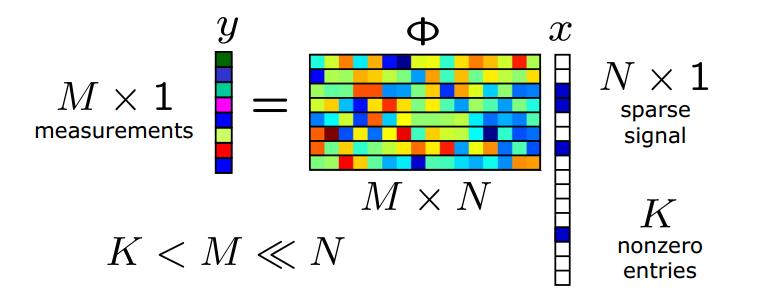
We have recently finished analyzing height using L1-penalization and the phase transition technique on a very large data set (many hundreds of thousands of individuals). The paper has been submitted for review, and the results support the claims made above with s ~ 10k, h2 ~ 0.5 for height.
Added: Here are comments from "Donoho-Student":
Donoho-Student says:
September 14, 2017 at 8:27 pm GMT • 100 Words
The Donoho-Tanner transition describes the noise-free (h2=1) case, which has a direct analog in the geometry of polytopes.
The n = 30s result from Hsu et al. (specifically the value of the coefficient, 30, when p is the appropriate number of SNPs on an array and h2 = 0.5) is obtained via simulation using actual genome matrices, and is original to them. (There is no simple formula that gives this number.) The D-T transition had only been established in the past for certain classes of matrices, like random matrices with specific distributions. Those results cannot be immediately applied to genomes.
The estimate that s is (order of magnitude) 10k is also a key input.
I think Hsu refers to n = 1 million instead of 30 * 10k = 300k because the effective SNP heritability of IQ might be less than h2 = 0.5 — there is noise in the phenotype measurement, etc.
Donoho-Student says:
September 15, 2017 at 11:27 am GMT • 200 Words
Lasso is a common statistical method but most people who use it are not familiar with the mathematical theorems from compressed sensing. These results give performance guarantees and describe phase transition behavior, but because they are rigorous theorems they only apply to specific classes of sensor matrices, such as simple random matrices. Genomes have correlation structure, so the theorems do not directly apply to the real world case of interest, as is often true.
What the Hsu paper shows is that the exact D-T phase transition appears in the noiseless (h2 = 1) problem using genome matrices, and a smoothed version appears in the problem with realistic h2. These are new results, as is the prediction for how much data is required to cross the boundary. I don’t think most gwas people are familiar with these results. If they did understand the results they would fund/design adequately powered studies capable of solving lots of complex phenotypes, medical conditions as well as IQ, that have significant h2.
Most ML people who use lasso, as opposed to people who prove theorems, are not aware of the D-T transition. Even most people who prove theorems have followed the Candes-Tao line of attack (restricted isometry property) and don’t think much about D-T. Although D eventually proved some things about the phase transition using high dimensional geometry, it was initially discovered via simulation using simple random matrices.
Friday, May 26, 2017
Borges, blogging, and a vast circle of invisible friends

This blog gets about 100k page views per month. My sense is that there are a lot of additional views through RSS feeds and social media (FB, G+, etc.), but those are hard to track. Most of the hits are on the main landing page, with a smaller fraction going to a specific article. I'd guess that someone hitting the landing page looks at a few posts, so there are probably at least 200k article views per month. I write somewhat fewer than 20 posts per month, which suggests that a typical post is read ~10k times. Some outlier posts get a lot of traffic from inbound links and search engine results even years after they were written. These have far more than 10k cumulative views, according to logs. From cookies, I can see that there are many thousands of regular readers (i.e., who visit at least several times a month).
Is there any better way to estimate impact/reach than what I've described above?
For comparison, I was told that a serious non-fiction book on the NY Times Best Seller list might sell ~10k copies. So it seems possible my blog has a significantly greater reach than what I could expect from writing a book. I've thought about writing books at various times, but have always been too busy. I fantasize about writing more when I retire, or later in my career :-)
When I attend meetings or conferences, I often bump into people I don't know who tell me they read my blog. This seems to be true whether the participants are scientists, technologists, investors, or academics. I'm guessing that for every person who tells me that they're a reader, there must be many more who are readers but don't volunteer the information. If you ever see me in person, please come right up and say hello! :-)
I've been told by some people that they have tried to read this blog but find it hard to understand. I suppose that regular readers are mostly well above average in intelligence.
Borges once said
... the life of a writer is a lonely one. You think you are alone, and as the years go by, if the stars are on your side, you may discover that you are at the center of a vast circle of invisible friends whom you will never get to know, but who love you. And that is an immense reward.
Friday, August 22, 2014
Two reflections on SCI FOO 2014
Two excellent blog posts on SCI FOO by Jacob Vanderplas (Astronomer and Data Scientist at the University of Washington) and Dominic Cummings (former director of strategy for the conservative party in the UK).


Few scientists know how to use the political system to effect change. We need help from people like Cummings.
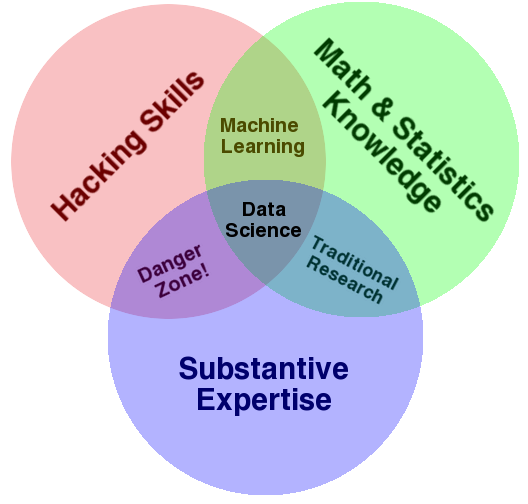
Hacking Academia: Data Science and the University (Vanderplas)
Almost a year ago, I wrote a post I called the Big Data Brain Drain, lamenting the ways that academia is neglecting the skills of modern data-intensive research, and in doing so is driving away many of the men and women who are perhaps best equipped to enable progress in these fields. This seemed to strike a chord with a wide range of people, and has led me to some incredible opportunities for conversation and collaboration on the subject. One of those conversations took place at the recent SciFoo conference, and this article is my way of recording some reflections on that conversation. ...
The problem we discussed is laid out in some detail in my Brain Drain post, but a quick summary is this: scientific research in many disciplines is becoming more and more dependent on the careful analysis of large datasets. This analysis requires a skill-set as broad as it is deep: scientists must be experts not only in their own domain, but in statistics, computing, algorithm building, and software design as well. Many researchers are working hard to attain these skills; the problem is that academia's reward structure is not well-poised to reward the value of this type of work. In short, time spent developing high-quality reusable software tools translates to less time writing and publishing, which under the current system translates to little hope for academic career advancement. ...
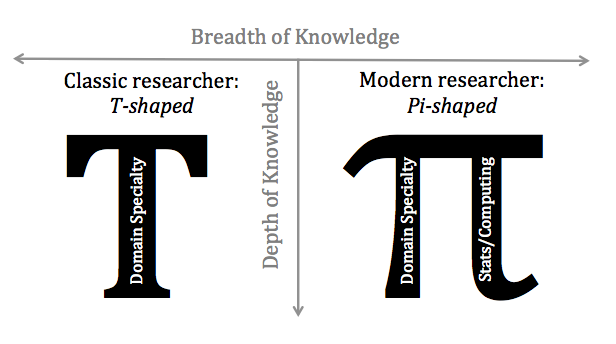

Few scientists know how to use the political system to effect change. We need help from people like Cummings.
AUGUST 19, 2014 BY DOMINIC CUMMINGS
... It was interesting that some very eminent scientists, all much cleverer than ~100% of those in politics [INSERT: better to say 'all with higher IQ than ~100% of those in politics'], have naive views about how politics works. In group discussions, there was little focused discussion about how they could influence politics better even though it is clearly a subject that they care about very much. (Gershenfeld said that scientists have recently launched a bid to take over various local government functions in Barcelona, which sounds interesting.)
... To get things changed in politics, scientists need mechanisms a) to agree priorities in order to focus their actions on b) roadmaps with specifics. Generalised whining never works. The way to influence politicians is to make it easy for them to fall down certain paths without much thought, and this means having a general set of goals but also a detailed roadmap the politicians can apply, otherwise they will drift by default to the daily fog of chaos and moonlight.
...
3. High status people have more confidence in asking basic / fundamental / possibly stupid questions. One can see people thinking ‘I thought that but didn’t say it in case people thought it was stupid and now the famous guy’s said it and everyone thinks he’s profound’. The famous guys don’t worry about looking stupid and they want to get down to fundamentals in fields outside their own.
4. I do not mean this critically but watching some of the participants I was reminded of Freeman Dyson’s comment:
‘I feel it myself, the glitter of nuclear weapons. It is irresistible if you come to them as a scientist. To feel it’s there in your hands. To release the energy that fuels the stars. To let it do your bidding. And to perform these miracles, to lift a million tons of rock into the sky, it is something that gives people an illusion of illimitable power, and it is in some ways responsible for all our troubles... this is what you might call ‘technical arrogance’ that overcomes people when they see what they can do with their minds.’
People talk about rationales for all sorts of things but looking in their eyes the fundamental driver seems to be – am I right, can I do it, do the patterns in my mind reflect something real? People like this are going to do new things if they can and they are cleverer than the regulators. As a community I think it is fair to say that outside odd fields like nuclear weapons research (which is odd because it still requires not only a large collection of highly skilled people but also a lot of money and all sorts of elements that are hard (but not impossible) for a non-state actor to acquire and use without detection), they believe that pushing the barriers of knowledge is right and inevitable. ...
Friday, May 30, 2014
Reader survey
Every now and then I look at the statistics for this blog. My rough estimate is that there is a core group of at least several thousand who read it regularly (i.e., a few times per week or more), and typical posts are eventually read by ~ 10 thousand people or more.
I know very little about my readers, hence this survey. Answer whichever parts you like and paste into the comments. Many thanks!
I know very little about my readers, hence this survey. Answer whichever parts you like and paste into the comments. Many thanks!
1. Age, gender, ethnicity, nationality?I can guess that there are several overlapping subgroups of readers: physicists, genomicists, financiers, tech / startup types, professors, ... But I'd really like to know more!
2. What's your background (education, profession, hobbies)?
3. What do you like best about this blog?
4. What do you like least about this blog?
5. How often do you find posts hard to understand?
6. Have we met in real life? Should we?
7. What should I do with my life? :-)
Thursday, October 10, 2013
Creation, Myths and Twitter
Great article by Nick Bilton on the creation myth (and true story) behind Twitter. To see that luck plays an unimaginably huge role in life you just need to look carefully at the story behind any successful company or entrepreneur.
NYTimes: ... Soon, the question of a name came up. Williams jokingly suggested calling the project “Friendstalker,” which was ruled out as too creepy. Glass became obsessive, flipping through a physical dictionary, almost word by word, looking for the right name. One late afternoon, alone in his apartment, he reached over to his cellphone and turned it to silent, which caused it to vibrate. He quickly considered the name “Vibrate,” which he nixed, but it led him to the word “twitch.” He dismissed that too, but he continued through the “Tw” section of the dictionary: twist, twit, twitch, twitcher, twitchy . . . and then, there it was. He read the definition aloud. “The light chirping sound made by certain birds.” This is it, he thought. “Agitation or excitement; flutter.” Twitter.This is from a 2009 post Me and Twitter. I had met Williams at Foo Camp, probably in 2007. In the 2009 post I didn't mention that most of the conversation was about Odeo, Williams' podcasting startup from which Twitter sprang as an almost accidental creation. His description to me of how the Twitter idea originated was a bit different than what Bilton reports.
... Whatever his reasons, Dorsey had recently met with Williams and threatened to quit if Glass wasn’t let go. And for Williams, the decision was easy. Dorsey had become the lead engineer on Twitter, and Glass’s personal problems were affecting his judgment. (For a while, portions of the company existed entirely on Glass’s I.B.M. laptop.) After conferring with the Odeo board, around 6 p.m. on Wednesday, July 26, 2006, Williams asked Glass to join him for a walk to South Park. Sitting on a green bench, Williams gave his old friend an ultimatum: six months’ severance and six months’ vesting of his Odeo stock, or he would be publicly fired. Williams said the decision was his alone.
... Williams and Dorsey started meeting for weekly dinners to discuss the problems, but one night Dorsey became defensive. “Do you want to be C.E.O.?” he said abruptly. Williams tried to evade the question, but eventually replied: “Yes, I want to be C.E.O. I have experience running a company, and that’s what Twitter needs right now.” ... told him that they were replacing him as C.E.O. with Williams. Dorsey sat before a bowl of uneaten yogurt and granola as he was offered stock, a $200,000 severance and a face-saving role as the company’s “silent” chairman. No one in the industry had to know that he was fired. (Investors would not want to be seen as pitting one founder against another anyway.) But Dorsey had no voting rights at the company. He was, essentially, out.
... Access to the tech blogosphere and press can help percolate a fledgling start-up into a multibillion-dollar business. But this access often relies on having a narrative — being an entrepreneur with just the right creation story. ... After he was stripped of his power at Twitter, Dorsey went on a media campaign to promote the idea that he and Williams had switched roles. He also began telling a more elaborate story about the founding of Twitter. In dozens of interviews, Dorsey completely erased Glass from any involvement in the genesis of the company. He changed his biography on Twitter to “inventor”; before long, he started to exclude Williams and Stone too.
... Without Williams and Stone influencing its development with the lessons they learned from Blogger, it still would not have taken off. Making it a company required Williams’s money, then Wilson, Sabet and Fenton’s and dozens of other investors, not to mention Costolo, who turned it into viable business, and 2,000 employees who helped shape it into one of the biggest social networks on the planet. Such is the case with every company in Silicon Valley, though you never hear it in their creation myth. Dorsey will make $400 million to $500 million when Twitter goes public. Glass stands to make about as much as Dorsey’s secretary at Square. ...
I met Twitter founder Evan Williams a few years ago, before Twitter was anywhere near a big thing. He told me about Blogger, which he sold to Google, and then the inevitable "So what are you working on now?" question came up.
He described Twitter to me, and two thoughts entered my mind. The first shows I am old, or out of touch, or have no feel for Web 2.0 consumer startups: "Who would use that?" I said to myself.
The second thought, which I actually verbalized, turns out to be a good question (still unanswered) and shows I may have VC potential: "How are you going to monetize that?" :-)
Thursday, September 19, 2013
University blogging
We've soft-launched a blogging channel for researchers at Michigan State. If you're a faculty member, researcher or graduate student who blogs (or would like to start!) you are welcome to contribute! We're hoping to grow the list of contributors into the hundreds, if possible. There are about 2000 tenure stream faculty and 10,000 graduate students at MSU...


Saturday, April 20, 2013
A blog is born

Raghu Parasarathy, a biophysicist at U Oregon, and my correspondent in this previous post on faculty blogging, has decided to try it out. Raghu is a deep and creative thinker, so I'm sure we have some interesting contributions to look forward to!
My key motivation ... hopefully recording a variety of thoughts will help them persist, and perhaps coalesce into something useful. And maybe some of the topics I expect to write about — the structure of higher education, biophysics and animal/microbe interactions, my sporadic efforts at painting — will be of interest.
Here's some video from recent imaging work Raghu has done (microbiome of a zebrafish).
Sunday, April 14, 2013
Why blog? A professor responds
A colleague responds to my earlier post Blogging professors, on how universities might encourage more faculty blogging.
What I had in mind was a university-wide platform that would aggregate the output of participating faculty. This kind of branded expert channel might have a place amid the economic collapse in journalism we are currently experiencing. If Huffington Post is worth $315 million (OK, not really, just another dumb move by AOL), what might a platform showcasing 100 clever faculty from a major research university be worth? 100 bloggers (say, each posting once every 10 days or so = 10 new posts per day) out of 2000 MSU faculty doesn't sound too crazy, does it?
What I had in mind was a university-wide platform that would aggregate the output of participating faculty. This kind of branded expert channel might have a place amid the economic collapse in journalism we are currently experiencing. If Huffington Post is worth $315 million (OK, not really, just another dumb move by AOL), what might a platform showcasing 100 clever faculty from a major research university be worth? 100 bloggers (say, each posting once every 10 days or so = 10 new posts per day) out of 2000 MSU faculty doesn't sound too crazy, does it?
Hi Steve,I certainly view blogging as a means of recording and organizing my thoughts. Sometimes I get really thoughtful and insightful feedback in the comments (although sometimes not). There's also the pleasure of self-expression! As James Salter wrote
I liked reading your "Blogging Professors" post, since I've thought several times, "Should I write a blog?" But I've also thought, "Why does anyone bother to write a blog?" The reasons to write are, as you note, to propagate one's "fabulous ideas and opinions worthy of wider attention and discussion" and to create dialogs and conversations. My own reasons not to write have been (1) that it would take time, and I have too little time as it is, and (2) that I doubt I'd be likely to make even the slightest ripple in the vast pool of the internet.
Reason (1) is, I'm sure, obvious. It's hard to find "work time" between experiments, meetings, classes, seminars, journal clubs, staring at data, writing analysis code, talking to students, planning classes, teachings classes, reading papers, reading books, and probably several other things I'm forgetting. And "free time" has its own constraints, and any new activities would have to compete with things I'm very fond of, like wandering the public library with the kids, or playing games with them in random taquerias, or painting pictures myself (which, sadly, has been steadily dwindling in frequency).
Of course, I'm sure most commenters will point out that it's all a matter of incentives: I have no incentive, as a faculty member, to blog. This is true, but not very explanatory in itself. We all do plenty of things that don't have concrete incentives. This past week, I've spent about two hours reviewing a paper. Next week I'll spend at least half an hour with a postdoc (not from my lab) starting a faculty position (elsewhere) giving advice on grants. Later this term, I'll probably put a lot of work into a talk on [ geeky science topic involving microscopy; unspecified to preserve anonymity ] for a journal club I don't usually attend -- it's a fascinating topic I've gotten increasingly involved with. I certainly don't get any reward from the University (or even the department) for doing these sorts of things. So why do them? In all these cases, there's some combination of reciprocity (I publish articles in journal X, so I should review papers for journal X), or personal interactions (I like to have conversations with colleagues), or both. Is any of this the case for blogging?
I'd guess -- though I have no data on this -- that most blogs, especially new ones, have very little readership. Certainly one often stumbles on blogs with a total absence of comments. (Not that blog comments in general are often worth reading…) And even if posts are read, is there likely to be much interaction or dialog, compared to the other activities noted above?
As you note, one way out of this would be group blogs, which might expand readership and reduce writing effort. Another would be if the university actively promoted blogs. (I'm constantly amazed at how little work the university puts into describing to the public what faculty do, and how ineptly what little they do is done.)
And, of course, another solution is to simply look at blogging as a way of recording and refining one's thoughts -- regardless of whether they're read or not. I've toyed with this; maybe I'll take it up…
There comes a time when you realize that everything is a dream, and only those things preserved in writing have any possibility of being real.
Saturday, April 13, 2013
Blogging professors
When I first started blogging in 2004, I thought it would be only a matter of a few years before a significant fraction -- say 10-30% -- of all professors would have their own blogs. Surely, I thought, many brilliant professors would have no shortage of (and no shortage of interest in expressing) fabulous ideas and opinions worthy of wider attention and discussion.
But I was wrong. My rough estimate is that, currently, typical research universities (with, say, 1000 or so professors!) have no more than a handful of active faculty bloggers (for some reasonable definition of active, which might include a minimum traffic or readership level).
However, it's not too late. With the continuing collapse of the economic model for traditional journalism, there is significant demand for expert opinion and new ideas. How should a university encourage faculty blogging?
Set up branded group blogs for faculty, using a common template, perhaps organized by themes: health science, engineering and technology, basic science, politics and economics, psychology and cognition, etc. These don't even need to be hosted by the university -- they could be on Wordpress or Blogger.
Group blogs can regularly produce fresh content, even if each contributor posts infrequently.
Hire a grad student to do some light editing, manage comments, and occasionally stimulate the faculty if the rate of posting falls off. Make posting really easy for the professors -- allow them just to shoot off an email with the post content, and have the student clean it up and upload it to the site.
Advertise the blogs in alumni communications, campus news, and other university publications.
Will it work? Ultimately it depends on the faculty...
But I was wrong. My rough estimate is that, currently, typical research universities (with, say, 1000 or so professors!) have no more than a handful of active faculty bloggers (for some reasonable definition of active, which might include a minimum traffic or readership level).
However, it's not too late. With the continuing collapse of the economic model for traditional journalism, there is significant demand for expert opinion and new ideas. How should a university encourage faculty blogging?
Set up branded group blogs for faculty, using a common template, perhaps organized by themes: health science, engineering and technology, basic science, politics and economics, psychology and cognition, etc. These don't even need to be hosted by the university -- they could be on Wordpress or Blogger.
Group blogs can regularly produce fresh content, even if each contributor posts infrequently.
Hire a grad student to do some light editing, manage comments, and occasionally stimulate the faculty if the rate of posting falls off. Make posting really easy for the professors -- allow them just to shoot off an email with the post content, and have the student clean it up and upload it to the site.
Advertise the blogs in alumni communications, campus news, and other university publications.
Will it work? Ultimately it depends on the faculty...
Monday, April 04, 2011
Comment moderation
I'm getting a lot of complaints about a certain commenter (if you read the comments you will already know who I am talking about). So, I've switched the DISQUS settings, making registration required to comment. I may also start deleting inappropriate comments, as time permits. I don't want to get into full blown moderation as it's too time consuming. We'll see how it goes.
Sorry for the inconvenience but this is an all too common problem on blogs.
Sorry for the inconvenience but this is an all too common problem on blogs.
Sunday, April 03, 2011
Dynamic blog views
Some cool ways to view this blog. There are 5 new views in total, which you can access from a drop down menu. Check it out!
http://infoproc.blogspot.com/view/flipcard
http://infoproc.blogspot.com/view/sidebar
http://infoproc.blogspot.com/view/mosaic
http://infoproc.blogspot.com/view/flipcard
http://infoproc.blogspot.com/view/sidebar
http://infoproc.blogspot.com/view/mosaic
Monday, February 21, 2011
Lunch with Razib
I had lunch with blogger and population geneticist Razib Khan today. Lunch turned into coffee which turned into hours of discussion. Razib told me he's been blogging for a decade now. See him discuss multiregional human evolution in light of recent discoveries of archaic DNA in certain human subgroups, with Michigan paleo anthropologist Milford Wolpoff:
One concrete outcome from the meeting is I've now created a twitter feed for my blog posts. See here: @hsu_steve.
One concrete outcome from the meeting is I've now created a twitter feed for my blog posts. See here: @hsu_steve.
Wednesday, June 30, 2010
Singapore from below
I recently came across the blog A Singapore Taxi Driver's Diary, which gives a unique perspective on the squeaky clean city-state of Singapore. It's not surprising that a former scientist who speaks Mandarin and English would have interesting stories to tell after driving a cab for a while.
Some good examples: Driving Miss Edgy, Indecent Proposal, Out of Innocence.
If you like these stories, you might also like my 1997 travelogue on Thailand and Japan.
I discovered the Singapore taxi driver via Kaleidoscope, the blog of a theoretical physics student in India.
Probably the only taxi driver in this world with a PhD from Stanford and a proven track record of scientific accomplishments, I have been forced out of my research job at the height of my scientific career, and unable to find another one, for reasons I can only describe as something "uniquely Singapore". As a result, I am driving taxi to make a living and writing these real life stories just to make the dull job a little more interesting. I hope that these stories are interesting to you too.
...
Preface
Since the takeover of leadership by some western “big shots” a few years ago, the Institute of Molecular and Cell Biology (IMCB) of ASTAR, Singapore, a place I have worked for 16 years as a PI (principal investigator), a place that was once flourishing, promising, and pleasant to work in, has been in a mess. Bestowed with the kind of power they had never seen before, these once reputable scientists turned everything in the institute upside down. The previous democratic and consensus-oriented management system that had worked well for more than a decade in the past was thrown out of window and replaced by one that was marked by domineering, manipulation, and incompetence. What they lacked in experience of management, adequate understanding of the institute, and proper respect for fellow scientists as their colleagues, they made up for in arrogance, prejudice, and naked muscle of political power. Some PIs were sent packing, and some were promoted, all up to the new leadership’s manipulative and twisted standards. Despite my considerable contribution to building up this place into what it is today, I was among the first few PIs to be told to go. My employment contract with IMCB was terminated by May, 2008, without any forms of compensation given.
I was hence forced into a deeply difficult position. Becoming jobless at my age is perhaps the worst nightmare that can happen to any ordinary man, not to mention the loss of life-long career. ...
Some good examples: Driving Miss Edgy, Indecent Proposal, Out of Innocence.
If you like these stories, you might also like my 1997 travelogue on Thailand and Japan.
I discovered the Singapore taxi driver via Kaleidoscope, the blog of a theoretical physics student in India.
Wednesday, March 10, 2010
Great Firewall and blogging

I will be behind a certain Great Firewall next week, so blogging might be interrupted :-(
I have taken some precautions, we'll see how it goes.
Saturday, September 05, 2009
Some favorite posts
NEW! Podcast show Manifold.
I started writing this blog in 2004 (it has had millions of visitors!), and by now the content is a bit unwieldy to navigate, even with labels and search. I thought I'd make a list of some of my favorite posts and topics. Please suggest other posts to add to the list!
Pessimism of the Intellect, Optimism of the Will.
Feynman and me, Memories of Feynman. Labels: Feynman, path integrals.
Richard Feynman and the 19 year old me at my Caltech graduation:

Mama said knock you out (learning how to fight).
Many Worlds and quantum mechanics, a brief guide. Label: Many Worlds. Note, the usual quantum probabilities do not emerge naturally in this interpretation. See my papers On the Origin of Probability in Quantum Mechanics and The measure problem in no-collapse (many worlds) quantum mechanics.
Cognitive limitations: statistics , higher ed. Label: bounded rationality, human capital. Brainpower and globalization.
Expert predictions in soft subjects are unreliable. Intellectual honesty. Frauds! Label: expert predictions.
We can (crudely) measure cognitive ability using simple tests. (It is amazing to me that this is a controversial statement.) Randomly sampled eminent scientists have (very) high IQs, and given the observed stability of adult IQ the causality is clear: psychometrics works. The cult of genius? Income, Wealth, and IQ, One hundred thousand brains. Bezos on the Big Brains. Label: psychometrics.
Historically isolated groups of humans cluster genetically according to geographical ancestry. Explained in pictures , words , more words.
I am skeptical of all but the weakest claims of market efficiency. My talk on the 2008 credit crisis. Venn diagram for economics.
Careers, advice to geeks: A tale of two geeks , success vs ability. Labels: careers , startups , entrepreneurs.
Net worth , life satisfaction , happiness , the gilded age.
What is the likely development path for China in the next decades? Sustainability of China growth , China development: how big is the middle class? , Back to the future , Shanghai from an Indian perspective.
That curious institution, Caltech. How did a 16 year old kid from Iowa end up there? (See memories of Feynman above.)
There are geniuses in the world. The cult of genius.
My lovely kids. Photos. Autobiographical.
Update:
Credentialism and elite careers , Defining merit , elitism , brainpower
Recent videos (talks on genomics): https://www.youtube.com/results?search_query=hsu+genomics
Talks (some with slides + video):
Cold Spring Harbor Laboratory
Berkeley Innovative Genomics Institute and OpenAI
Janelia Research Campus (HHMI)
Allen Institute (Seattle) meeting on Genetics of Complex Traits
Review article: On the genetic architecture of cognitive ability and other quantitative traits (2014)
I work on algorithms for phenotype prediction from genotype, using new methods from high dimensional statistics. My estimate is that prediction of complex traits such as height, cognitive ability, or highly polygenic disease conditions will require data sets of order one million individuals (i.e., to build a model which accounts for most of the genetic variance). Once these models are available, human reproduction (and evolution!) will be revolutionized.
These papers are somewhat technical:
https://arxiv.org/abs/1310.2264
http://arxiv.org/abs/1408.6583
This one is a bit less technical and gives a broader overview:
http://arxiv.org/abs/1408.3421
Cow genomics (an existence proof):
http://infoproc.blogspot.com/2012/08/genomic-prediction-no-bull.html
http://infoproc.blogspot.com/2014/08/its-all-in-gene-cows.html
These are for popular audiences (Nautilus Magazine):
http://nautil.us/issue/18/genius/super_intelligent-humans-are-coming
http://nautil.us/issue/28/2050/dont-worry-smart-machines-will-take-us-with-them
2018: As anticipated, we now have good height predictors thanks to the 500k genome release of UK Biobank data: Scientists of Stature
Genomic predictors for common disease risk, constructed via machine learning on hundreds of thousands of genotypes. The predictors use anywhere from a few tens (e.g., 20 or 50) to thousands of SNPs to compute the risk PGS (Poly-Genic Score) for conditions such as diabetes, breast cancer, heart attack, and more: Genomic Prediction of Complex Disease Risk.
The Economist on polygenic risk scores (2019).
Detailed analysis of genetic architectures of disease risk predictors. Implications for pleiotropy.
Sibling validation of genomic predictors.
Recent papers from my group:
https://www.genetics.org/content/210/2/477
https://www.nature.com/articles/s41598-019-51258-x
https://www.nature.com/articles/s41598-020-68881-8
https://www.nature.com/articles/s41598-020-69927-7
2021 review article, prepared for the book Genomic Prediction of Complex Traits, Springer Nature series Methods in Molecular Biology:
I started writing this blog in 2004 (it has had millions of visitors!), and by now the content is a bit unwieldy to navigate, even with labels and search. I thought I'd make a list of some of my favorite posts and topics. Please suggest other posts to add to the list!
Pessimism of the Intellect, Optimism of the Will.
Feynman and me, Memories of Feynman. Labels: Feynman, path integrals.
Richard Feynman and the 19 year old me at my Caltech graduation:

Mama said knock you out (learning how to fight).
Many Worlds and quantum mechanics, a brief guide. Label: Many Worlds. Note, the usual quantum probabilities do not emerge naturally in this interpretation. See my papers On the Origin of Probability in Quantum Mechanics and The measure problem in no-collapse (many worlds) quantum mechanics.
Cognitive limitations: statistics , higher ed. Label: bounded rationality, human capital. Brainpower and globalization.
Expert predictions in soft subjects are unreliable. Intellectual honesty. Frauds! Label: expert predictions.
We can (crudely) measure cognitive ability using simple tests. (It is amazing to me that this is a controversial statement.) Randomly sampled eminent scientists have (very) high IQs, and given the observed stability of adult IQ the causality is clear: psychometrics works. The cult of genius? Income, Wealth, and IQ, One hundred thousand brains. Bezos on the Big Brains. Label: psychometrics.
Historically isolated groups of humans cluster genetically according to geographical ancestry. Explained in pictures , words , more words.
I am skeptical of all but the weakest claims of market efficiency. My talk on the 2008 credit crisis. Venn diagram for economics.
Careers, advice to geeks: A tale of two geeks , success vs ability. Labels: careers , startups , entrepreneurs.
Net worth , life satisfaction , happiness , the gilded age.
What is the likely development path for China in the next decades? Sustainability of China growth , China development: how big is the middle class? , Back to the future , Shanghai from an Indian perspective.
That curious institution, Caltech. How did a 16 year old kid from Iowa end up there? (See memories of Feynman above.)
There are geniuses in the world. The cult of genius.
My lovely kids. Photos. Autobiographical.
Update:
Credentialism and elite careers , Defining merit , elitism , brainpower
Recent videos (talks on genomics): https://www.youtube.com/results?search_query=hsu+genomics
Talks (some with slides + video):
Cold Spring Harbor Laboratory
Berkeley Innovative Genomics Institute and OpenAI
Janelia Research Campus (HHMI)
Allen Institute (Seattle) meeting on Genetics of Complex Traits
Review article: On the genetic architecture of cognitive ability and other quantitative traits (2014)
I work on algorithms for phenotype prediction from genotype, using new methods from high dimensional statistics. My estimate is that prediction of complex traits such as height, cognitive ability, or highly polygenic disease conditions will require data sets of order one million individuals (i.e., to build a model which accounts for most of the genetic variance). Once these models are available, human reproduction (and evolution!) will be revolutionized.
These papers are somewhat technical:
https://arxiv.org/abs/1310.2264
http://arxiv.org/abs/1408.6583
This one is a bit less technical and gives a broader overview:
http://arxiv.org/abs/1408.3421
Cow genomics (an existence proof):
http://infoproc.blogspot.com/2012/08/genomic-prediction-no-bull.html
http://infoproc.blogspot.com/2014/08/its-all-in-gene-cows.html
These are for popular audiences (Nautilus Magazine):
http://nautil.us/issue/18/genius/super_intelligent-humans-are-coming
http://nautil.us/issue/28/2050/dont-worry-smart-machines-will-take-us-with-them
2018: As anticipated, we now have good height predictors thanks to the 500k genome release of UK Biobank data: Scientists of Stature
Genomic predictors for common disease risk, constructed via machine learning on hundreds of thousands of genotypes. The predictors use anywhere from a few tens (e.g., 20 or 50) to thousands of SNPs to compute the risk PGS (Poly-Genic Score) for conditions such as diabetes, breast cancer, heart attack, and more: Genomic Prediction of Complex Disease Risk.
The Economist on polygenic risk scores (2019).
Detailed analysis of genetic architectures of disease risk predictors. Implications for pleiotropy.
Sibling validation of genomic predictors.
Recent papers from my group:
https://www.genetics.org/content/210/2/477
https://www.nature.com/articles/s41598-019-51258-x
https://www.nature.com/articles/s41598-020-68881-8
https://www.nature.com/articles/s41598-020-69927-7
2021 review article, prepared for the book Genomic Prediction of Complex Traits, Springer Nature series Methods in Molecular Biology:
Friday, March 06, 2009
MIT Technology Review
My blog is now syndicated (is that the right word? aggregated?) by MIT Technology Review. For this I am paid a modest fee, which I promise won't compromise the integrity of my writing. Apologies to Caltech alumni all over the world, but money talks ;-)
Last time I was on the MIT campus I had a nice tour of the Stata Center, home of their Computer Science and Artificial Intelligence Laboratory (CSAIL). Call me Sisyphus.

Last time I was on the MIT campus I had a nice tour of the Stata Center, home of their Computer Science and Artificial Intelligence Laboratory (CSAIL). Call me Sisyphus.
Tuesday, August 08, 2006
Economist on blogging professors
Buried in the article, which is mainly about blogging economists (and mentions a number our favorites, like the two Brads, but unfortunately not Mark Thoma of Economist's View), is the nugget below on how the gap between faculty quality (or at least productivity) at the very top schools and elsewhere has narrowed due to new technology.
Another factor, at least in theoretical physics, has been the terrible job market that persisted through the last 30 years of the 20th century (it seems to be better now, as sputnik era professors finally seem to be retiring). From around 1970-2000 there were only a handful of jobs per year in particle theory, and even average research universities were able to hire exceptional people. In many of those years, the new crop of PhDs from any one of the top programs could have filled every faculty opening in the country. A little arithmetic is enough to understand the consequent logjam, and why there are so many former theorists in finance, technology, even biology.
Another factor, at least in theoretical physics, has been the terrible job market that persisted through the last 30 years of the 20th century (it seems to be better now, as sputnik era professors finally seem to be retiring). From around 1970-2000 there were only a handful of jobs per year in particle theory, and even average research universities were able to hire exceptional people. In many of those years, the new crop of PhDs from any one of the top programs could have filled every faculty opening in the country. A little arithmetic is enough to understand the consequent logjam, and why there are so many former theorists in finance, technology, even biology.
With professors spending so much time blogging for no payment, universities might wonder whether this detracts from their value. Although there is no evidence of a direct link between blogging and publishing productivity, a new study* by E. Han Kim and Adair Morse, of the University of Michigan, and Luigi Zingales, of the University of Chicago, shows that the internet's ability to spread knowledge beyond university classrooms has diminished the competitive edge that elite schools once held.
Top universities once benefited from having clusters of star professors. The study showed that during the 1970s, an economics professor from a random university, outside the top 25 programmes, would double his research productivity by moving to Harvard. The strong relationship between individual output and that of one's colleagues weakened in the 1980s, and vanished by the end of the 1990s.
The faster flow of information and the waning importance of location—which blogs exemplify—have made it easier for economists from any university to have access to the best brains in their field. That anyone with an internet connection can sit in on a virtual lecture from Mr DeLong means that his ideas move freely beyond the boundaries of Berkeley, creating a welfare gain for professors and the public.
Universities can also benefit in this part of the equation. Although communications technology may have made a dent in the productivity edge of elite schools, productivity is hardly the only measure of success for a university. Prominent professors with popular blogs are good publicity, and distance in academia is not dead: the best students will still seek proximity to the best minds. When a top university hires academics, it enhances the reputations of the professors, too. That is likely to make their blogs more popular.
Subscribe to:
Posts (Atom)