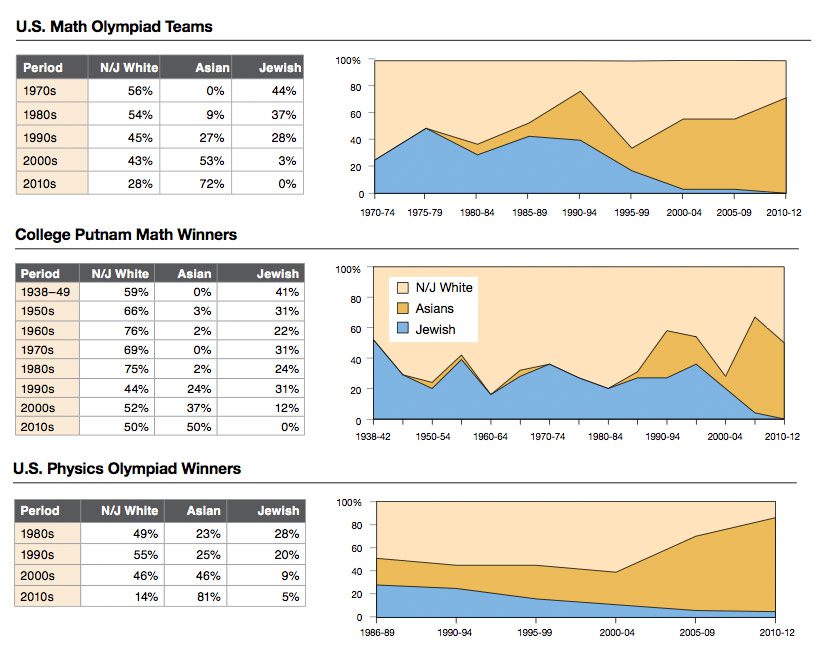
Showing posts sorted by relevance for query asian american. Sort by date Show all posts

Tuesday, June 19, 2018

Harvard Office of Institutional Research on Discrimination Against Asian-American Applicants

Harvard's Office of Institutional Research (OIR) produced a series of internal reports on discrimination against Asian-American applicants, beginning in 2013. I believe this was in response to Ron Unz's late 2012 article The Myth of American Meritocracy. These reports were shared with, among others, William Fitzsimmons (Dean of Admissions and Financial Aid) and Rakesh Khurana (Dean of Harvard College). Faced with an internal investigation showing systemic discrimination against Asian-American applicants, Harvard killed the study and quietly buried the reports. The Students For Fair Admissions (SFFA) supporting memo for Summary Judgment contains excerpts from depositions of these and other Harvard leaders concerning the internal reports. (Starting p.15 -- SAD!)

The second report included the figure below. Differences are in SDs, Asian = Asian-American (International applicants are distinct category), and Legacy and Recruited Athlete candidates have been excluded for this calculation.


As discussed in the previous post: When it comes to the score assigned by the Admissions Office, Asian-American applicants are given the lowest scores of any racial group. ... By contrast, alumni interviewers (who actually meet the applicants) rate Asian-Americans, on average, at the top with respect to personal ratings—comparable to white applicants ...

From the SFFA (Students For Fair Admissions) supporting memo for summary judgement:
OIR found that Asian-American admit rates were lower than white admit rates every year over a ten-year period even though, as the first of these two charts shows, white applicants materially outperformed Asian-American applicants only in the personal rating. Indeed, OIR found that the white applicants were admitted at a higher rate than their Asian-American counterparts at every level of academic-index level. But it is even worse than that. As the second chart shows, being Asian American actually decreases the chances of admissions. Like Professor Arcidiacono, OIR found that preferences for African American and Hispanic applicants could not explain the disproportionately negative effect Harvard’s admission system has on Asian Americans.
On David Card's obfuscatory analysis: the claim is that within the pool of "unhooked" applicants (excluding recruited athletes, legacies, children of major donors, etc.), Asian-Americans are discriminated against. Card's analysis obscures this point.
The task here is to determine whether “similarly situated” applicants have been treated differently on the basis of race; “apples should be compared to apples.” SBT Holdings, LLC v. Town of Westminster, 547 F.3d 28, 34 (1st Cir. 2008). Because certain applicants are in a special category, it is important to analyze the effect of race without them included. Excluding them allows for the effect of race to be tested on the bulk of the applicant pool (more than 95% of applicants and more than two-thirds of admitted students) that do not fall into one of these categories, i.e., the similarly situated applicants. For special-category applicants, race either does not play a meaningful role in their chances of admission or the discrimination is offset by the “significant advantage” they receive. Either way, they are not apples.

Professor Card’s inclusion of these applicants reflects his position that “there is no penalty against Asian-American applicants unless Harvard imposes a penalty on every Asian-American applicant.” But he is not a lawyer and he is wrong. It is illegal to discriminate against any Asian-American applicant or subset of applicants on the basis of race. Professor Card cannot escape that reality by trying to dilute the dataset. The claim here is not that Harvard, for example, “penalizes recruited athletes who are Asian-American because of their race.” The claim “is that the effects of Harvard’s use of race occur outside these special categories.” Professor Arcidiacono thus correctly excluded special-category applicants to isolate and highlight Harvard’s discrimination against Asian Americans. Professor Card, by contrast, includes “special recruiting categories in his models” to “obscure the extent to which race is affecting admissions decisions for those not fortunate enough to belong to one of these groups.” At bottom, SFFA’s claim is that Harvard penalizes Asian-American applicants who are not legacies or recruited athletes. Professor Card has shown that he is unwilling and unable to contest that claim.
This is an email from an alumni interviewer:
[M]y feelings towards Harvard have been slowly changing over the years. I’ve been interviewing for the college for almost 10 years now, and in those ten years, none of the Asian American students I’ve interviewed has been accepted (or even wait-listed). I’m 0 for about 20. This is the case despite the fact that their resumes are unbelievable and often superior to those of the non-Asian students I’ve interviewed who are admitted. I’ve also attended interviewer meetings where Asian candidates are summarily dismissed as “typical” or “not doing anything anyone else isn’t doing” while white or other minority candidates with similar resumes are lauded.
From p.18 of the SFFA memo:
Mark Hansen, the (now former) OIR employee, remembers far more. He remembers working with others in OIR on the project. He remembers gathering data, conducting the regression analysis, collaborating with colleagues, coordinating with the Admissions Office, and discussing the results of OIR’s investigation with Fitzsimmons and others on multiple occasions.  Hansen expressed no concerns with the quality and thoroughness of OIR’s statistical work. Moreover, he has a clear understanding of the implications of OIR’s findings. Hansen testified that the reports show that Asian Americans “are disadvantaged in the admissions process at Harvard.” And when asked: “Do you have any explanation other than intentional discrimination for your conclusions regarding the negative association between Asians and the Harvard admissions process?” Hansen responded: “I don’t.”
A very sad tweet:

Sunday, November 12, 2006

The ugly truth

Daniel Golden reports on discrimination against Asian-Americans in admissions to elite universities. I discussed his recent book here, and the Princeton study which concluded that Asian applicants faced discrimination equivalent to (on average) 50 points on the SAT here. Another article worth reading (thanks to Dave S. for the link) from Inside Higher Ed covers a panel called “Too Asian?” at the annual meeting of the National Association for College Admission Counseling. Particularly telling are the comments of a former Stanford admissions officer about an internal study which found evidence of higher admission rates for white applicants over Asians of similar academic and leadership qualifications (all applicants in the study were "unhooked" - meaning not in any favored categories such as legacies or athletes). Ugly, ugly, ugly.

The mechanism by which this discrimination operates is not overt. Admissions officers at elite universities are generally progressive and pro-diversity. They seek an ideal entering class with just the right balance of ethnic groups, and sprinklings of athletes, violinists, chess champions, junior entrepreneurs, etc. But this goal (especially the ethnic diversity part) conflicts with trying to get the intellectually strongest kids on campus, regardless of race. Of elite schools, only Caltech places the intellectual strength of the applicant above all else. Like it or not, admissions officers at elite schools are awarding preference to candidates based on their diversity goals. Too many high scoring Asians means not enough students from other groups, leading to a higher bar for Asian applicants.

Are individual admissions staffers aware of this consequence? Perhaps some are, but probably others prefer not to think about it. Those that do understand the consequences must be willing to sacrifice the lifelong goals and aspirations of Asian students like immigrant Jian Li, profiled in the article, on the altar of their diversity agenda.

If, for whatever reason, the distribution of bright, well-prepared students is very different in different ethnic groups, only discrimination against certain groups (Jews in the past, and Asians today) can keep their representation on campuses down. Cheers to immigrant kid Jian Li for challenging the discriminatory status quo, and cheers to Dan Golden for reporting diligently on this issue. See here for an Exeter senior's take on the college admissions process today.
WSJ: Though Asian-Americans constitute only about 4.5% of the U.S. population, they typically account for anywhere from 10% to 30% of students at many of the nation's elite colleges.

Even so, based on their outstanding grades and test scores, Asian-Americans increasingly say their enrollment should be much higher -- a contention backed by a growing body of evidence.

Whether elite colleges give Asian-American students a fair shake is becoming a big concern in college-admissions offices. Federal civil-rights officials are investigating charges by a top Chinese-American student that he was rejected by Princeton University last spring because of his race and national origin.

Meanwhile, voter attacks on admissions preferences for other minority groups -- as well as research indicating colleges give less weight to high test scores of Asian-American applicants -- may push schools to boost Asian enrollment. Tuesday, Michigan voters approved a ballot measure striking down admissions preferences for African-Americans and Hispanics. The move is expected to benefit Asian applicants to state universities there -- as similar initiatives have done in California and Washington.

If the same measure is passed in coming years in Illinois, Missouri and Oregon -- where opponents of such preferences say they plan to introduce it -- Asian-American enrollment likely would climb at selective public universities in those states as well.

During the Michigan campaign, a group that opposes affirmative action released a study bolstering claims that Asian students are held to a higher standard. The study, by the Center for Equal Opportunity, in Virginia, found that Asian applicants admitted to the University of Michigan in 2005 had a median SAT score of 1400 on the 400-1600 scale then in use. That was 50 points higher than the median score of white students who were accepted, 140 points higher than that of Hispanics and 240 points higher than that of blacks.

Roger Clegg, president and general counsel of the Center for Equal Opportunity, said universities are "legally vulnerable" to challenges from rejected Asian-American applicants.

Princeton, where Asian-Americans constitute about 13% of the student body, faces such a challenge. A spokesman for the Department of Education's Office for Civil Rights said it is investigating a complaint filed by Jian Li, now a 17-year-old freshman at Yale University. Despite racking up the maximum 2400 score on the SAT and 2390 -- 10 points below the ceiling -- on SAT2 subject tests in physics, chemistry and calculus, Mr. Li was spurned by three Ivy League universities, Stanford University and Massachusetts Institute of Technology.

The Office for Civil Rights initially rejected Mr. Li's complaint due to "insufficient" evidence. Mr. Li appealed, citing a white high-school classmate admitted to Princeton despite lower test scores and grades. The office notified him late last month that it would look into the case.

His complaint seeks to suspend federal financial assistance to Princeton until the university "discontinues discrimination against Asian-Americans in all forms by eliminating race preferences, legacy preferences, and athlete preferences." Legacy preference is the edge most elite colleges, including Princeton, give to alumni children. The Office for Civil Rights has the power to terminate such financial aid but usually works with colleges to resolve cases rather than taking enforcement action.

Mr. Li, who emigrated to the U.S. from China as a 4-year-old and graduated from a public high school in Livingston, N.J., said he hopes his action will set a precedent for other Asian-American students. He wants to "send a message to the admissions committee to be more cognizant of possible bias, and that the way they're conducting admissions is not really equitable," he said.

Princeton spokeswoman Cass Cliatt said the university is aware of the complaint and will provide the Office for Civil Rights with information it has requested. Princeton has said in the past that it considers applicants as individuals and doesn't discriminate against Asian-Americans.

When elite colleges began practicing affirmative action in the late 1960s and 1970s, they gave an admissions boost to Asian-American applicants as well as blacks and Hispanics. As the percentage of Asian-Americans in elite schools quickly overtook their slice of the U.S. population, many colleges stopped giving them preference -- and in some cases may have leaned the other way.

In 1990, a federal investigation concluded that Harvard University admitted Asian-American applicants at a lower rate than white students despite the Asians' slightly stronger test scores and grades. Federal investigators also found that Harvard admissions staff had stereotyped Asian-American candidates as quiet, shy and oriented toward math and science. The government didn't bring charges because it concluded it was Harvard's preferences for athletes and alumni children -- few of whom were Asian -- that accounted for the admissions gap.

The University of California came under similar scrutiny at about the same time. In 1989, as the federal government was investigating alleged Asian-American quotas at UC's Berkeley campus, Berkeley's chancellor apologized for a drop in Asian enrollment. The next year, federal investigators found that the mathematics department at UCLA had discriminated against Asian-American graduate school applicants. In 1992, Berkeley's law school agreed under federal pressure to drop a policy that limited Asian enrollment by comparing Asian applicants against each other rather than the entire applicant pool.

Asian-American enrollment at Berkeley has increased since California voters banned affirmative action in college admissions. Berkeley accepted 4,122 Asian-American applicants for this fall's freshman class -- nearly 42% of the total admitted. That is up from 2,925 in 1997, or 34.6%, the last year before the ban took effect. Similarly, Asian-American undergraduate enrollment at the University of Washington rose to 25.4% in 2004 from 22.1% in 1998, when voters in that state prohibited affirmative action in college admissions.

The University of Michigan may be poised for a similar leap in Asian-American enrollment, now that voters in that state have banned affirmative action. The Center for Equal Opportunity study found that, among applicants with a 1240 SAT score and 3.2 grade point average in 2005, the university admitted 10% of Asian-Americans, 14% of whites, 88% of Hispanics and 92% of blacks. Asian applicants to the university's medical school also faced a higher admissions bar than any other group.

Julie Peterson, spokeswoman for the University of Michigan, said the study was flawed because many applicants take the ACT test instead of the SAT, and standardized test scores are only one of various tools used to evaluate candidates. "I utterly reject the conclusion" that the university discriminates against Asian-Americans, she said. Asian-Americans constitute 12.6% of the university's undergraduates.

Jonathan Reider, director of college counseling at San Francisco University High School, said most elite colleges' handling of Asian applicants has become fairer in recent years. Mr. Reider, a former Stanford admissions official, said Stanford staffers were dismayed 20 years ago when an internal study showed they were less likely to admit Asian applicants than comparable whites. As a result, he said, Stanford strived to eliminate unconscious bias and repeated the study every year until Asians no longer faced a disadvantage.

Last month, Mr. Reider participated in a panel discussion at a college-admissions conference. It was titled, "Too Asian?" and explored whether colleges treat Asian applicants differently.

Precise figures of Asian-American representation at the nation's top schools are hard to come by. Don Joe, an attorney and activist who runs Asian-American Politics, an Internet site that tracks enrollment, puts the average proportion of Asian-Americans at 25 top colleges at 15.9% in 2005, up from 10% in 1992.

Still, he said, he is hearing more complaints "from Asian-American parents about how their children have excellent grades and scores but are being rejected by the most selective colleges. It appears to be an open secret."

Mr. Li, who said he was in the top 1% of his high-school class and took five advanced placement courses in his senior year, left blank the questions on college applications about his ethnicity and place of birth. "It seemed very irrelevant to me, if not offensive," he said. Mr. Li, who has permanent resident status in the U.S., did note that his citizenship, first language and language spoken at home were Chinese.

Along with Yale, he won admission to the California Institute of Technology, Rutgers University and the Cooper Union for the Advancement of Science and Art. He said four schools -- Princeton, Harvard, Stanford and the University of Pennsylvania -- placed him on their waiting lists before rejecting him. "I was very close to being accepted at these schools," he said. "I was thinking, had my ethnicity been different, it would have put me over the top. Even if race had just a marginal effect, it may have disadvantaged me."

He ultimately focused his complaint against Princeton after reading a 2004 study by three Princeton researchers concluding that an Asian-American applicant needed to score 50 points higher on the SAT than other applicants to have the same change of admission to an elite university.

"As an Asian-American and a native of China, my chances of admission were drastically reduced," Mr. Li claims in his complaint.

Saturday, June 16, 2018

Harvard discrimination lawsuit: data show penalization of Asian-Americans on subjective personality evaluation


Harvard and Students For Fair Admissions (SFFA), which is suing Harvard over discrimination against Asian-American applicants, have released a large set of documents related to the case, including statistical analysis of records of more than 160,000 applicants who applied for admission over six cycles from 2000 to 2015.

Documents here and here. NYTimes coverage.

The following point does not require any sophisticated modeling (with inherent assumptions) or statistical expertise to understand.

Harvard admissions evaluators -- staffers who are likely under pressure to deliver a target mix of ethnicities each year -- rate Asian-American applicants far lower on subjective personality traits than do alumni interviewers who actually meet the applicants. The easiest way to limit the number of A-A admits each year would be to penalize them on the most subjective aspects of the evaluation...

As stated further below: When it comes to the score assigned by the Admissions Office, Asian-American applicants are assigned the lowest scores of any racial group. ... By contrast, alumni interviewers (who actually meet the applicants) rate Asian-Americans, on average, at the top with respect to personal ratings—comparable to white applicants...
SFFA Memorandum: Professor Arcidiacono found that Harvard’s admissions system discriminates against Asian-American applicants in at least three respects. First, he found discrimination in the personal rating. Asian-American applicants are significantly stronger than all other racial groups in academic performance. They also perform very well in non-academic categories and have higher extracurricular scores than any other racial group. Asian-American applicants (unsurprisingly, therefore) receive higher overall scores from alumni interviewers than all other racial groupsAnd they receive strong scores from teachers and guidance counselors—scores that are nearly identical to white applicants (and higher than African-American and Hispanic applicants). In sum, Professor Arcidiacono found that “Asian-American applicants as a whole are stronger on many objective measures than any other racial/ethnic group including test scores, academic achievement, and extracurricular activities.

Yet Harvard’s admissions officials assign Asian Americans the lowest score of any racial group on the personal rating—a “subjective” assessment of such traits as whether the student has a “positive personality” and “others like to be around him or her,” has “character traits” such as “likability ... helpfulness, courage, [and] kindness,” is an “attractive person to be with,” is “widely respected,” is a “good person,” and has good “human qualities.” Importantly, Harvard tracks two different personal ratings: one assigned by the Admissions Office and another by alumni interviewers. When it comes to the score assigned by the Admissions Office, Asian-American applicants are assigned the lowest scores of any racial group. ... By contrast, alumni interviewers (who actually meet the applicants) rate Asian Americans, on average, at the top with respect to personal ratings—comparable to white applicants and higher than African-American and Hispanic applicants.
From the Crimson:
The report found that Asian American applicants performed significantly better in rankings of test scores, academics, and overall scores from alumni interviews. Of 10 characteristics, white students performed significantly better in only one—rankings of personal qualities, which are assigned by the Admissions Office. [italics added]
See also Too Many Asian Americans: Affirmative Discrimination in Elite College Admissions. (Source of figure at top; the peak in A-A representation at Harvard, in the early 1990s, coincides with external pressure from an earlier DOJ investigation of the university for discrimination.)

A very sad tweet:


For the statistically sophisticated, see Duke Professor Arcidiacono's rebuttal to David Card's analysis for Harvard. If these entirely factual and easily verified characterizations of Card's modeling (see below) are correct, the work is laughable.
Professor Card’s models are distorted by his inclusion of applicants for whom there is no reason to believe race plays any role.

As my opening report noted, there are several categories of applicants to whom Harvard extends preferences for reasons other than race: recruited athletes, children of faculty and staff, those who are on the Dean’s List or Director’s List [i.e., Big Donors], legacies, and those who apply for early admission.1 Because of the significant advantage that each of these categories confers on applicants, my report analyzed the effect of race on an applicant pool without these special categories of applicants (the baseline dataset), which allowed me to test for the effect of race on the bulk of the applicant pool that did not fall into one of these categories.2

Professor Card, however, includes all of these applicants in his model, taking the remarkable position that there is no penalty against Asian-American applicants unless Harvard imposes a penalty on every Asian-American applicant. But this is an untenable position. I do not assert that Harvard uses race to penalize Asian-American applicants who are recruited athletes, children of donors (or others identified on the Dean’s List), legacies, or other preferred categories. By including these special recruiting categories in his models, Professor Card obscures the extent to which race is affecting admissions decisions for all other applicants.

Professor Card further exacerbates this problem by including in his calculations the large majority of applicants whose characteristics guarantee rejection regardless of their race. Harvard admits a tiny fraction of applicants – only five or six percent in recent years. This means that a huge proportion of applicants have no realistic chance of admission. If an applicant has no chance of admission, regardless of his race, then Harvard obviously does not “discriminate” based on race in rejecting that applicant. Professor Card uses this obvious fact to assert that Harvard does not consider race at all in most of its admissions decisions. Further, he constructs his models in ways that give great weight to these applicants, again watering down the effect of race in Harvard’s decisions where it clearly does matter. (To put it in simple terms, it is akin to reducing the value of a fraction by substantially increasing the size of its denominator.)


Professor Card removes interaction terms, which has the effect of understating the penalty Harvard imposes on Asian-American applicants.

As Professor Card notes, his model differs from mine in that he removes the interaction terms. An interaction term allows the effects of a particular factor to vary with another distinct factor. In the context of racial discrimination, interaction terms are especially helpful (and often necessary) in revealing where certain factors operate differently for subgroups within a particular racial or ethnic group. For example, if a law firm singled out African-American women for discriminatory treatment but treated African-American males and other women fairly, a regression model would probably not pick up the discrimination unless it included an interaction between African-American and female.

Professor Card rightly recognizes that interaction terms should be included in a model when there is evidence that racial preferences operate differently for particular groups of applicants; yet he nonetheless removes interaction terms for variables that satisfy this condition. The most egregious instance of this is Professor Card’s decision not to interact race with disadvantaged status—even though the data clearly indicate that Harvard treats disadvantaged students differently by race.

...

Professor Card’s report changes none of my conclusions; to the contrary, given how easy it is to alter the results of his models and that my own models report the same results even incorporating a number of his controls, my opinions in this case have only been strengthened: Harvard penalizes Asian-American applicants; Harvard imposes heavy racial preferences in favor of Hispanic and African-American applicants; and Harvard has been manipulating its admission of single-race African-American applicants to ensure their admission rate approximates or exceeds the overall admission rate. Professor Card has demonstrated that it is possible to mask the true effects of race in Harvard’s admission process by changing the scope of the analysis in incorrect ways and choosing inappropriate combinations of control variables. But Professor Card cannot reach these results by applying accepted statistical methods and treating the data fairly.

Tuesday, November 27, 2012

The Myth of American Meritocracy

Ron Unz has performed an exhaustive analysis of elite university admissions in The Myth of American Meritocracy (December issue of the American Conservative). He finds strong evidence for de facto quotas on Asian-Americans at Ivy League universities. See below for a brief summary. I suggest reading his entire article, which is filled with additional insights, including one rather shocking surprise. Don't miss the statistical supplement.

Asian-American Quotas at Ivy League Universities?

November 28, 2012 - America’s elite Ivy League universities appear to follow a de facto Asian-American admissions quota policy according to “The Myth of American Meritocracy,”a 30,000-word cover story in the December issue of The American Conservative by publisher Ron Unz.

Unz provides detailed statistical evidence that the pattern of Asian-American enrollment over the last two decades is remarkably similar to what followed the establishment of Ivy League Jewish quotas in the mid-1920s. Soon after the U.S. Department of Justice closed its early 1990s investigation into allegations of anti-Asian admissions bias at the Ivy League:
  • Asian-American numbers at Harvard, Yale, and Columbia began large declines. 
  • Asian-American enrollments throughout the Ivy League strangely converged to very similar levels. 
  • The college-age population of Asian-Americans doubled during 1993-2011 as did their top academic awards, but none of this was reflected in their Ivy League enrollments. 
  • As one example, the percentage of college-age Asian-Americans at Harvard dropped by more than 50% during 1993-2011, a larger decline than that suffered by Jews following the 1925 establishment of ethnic quotas. 
  • Meanwhile, race-neutral Caltech saw its Asian-American enrollment increase closely in line with the growth of the college-age Asian-American population. 
  • Comparing the Ivy League enrollments of Asian-Americans with those of high-performing white subpopulations rules out general “diversity” factors as an explanation for these patterns.


See also Defining Merit. Guess which university produces the most Nobel prizes per student?


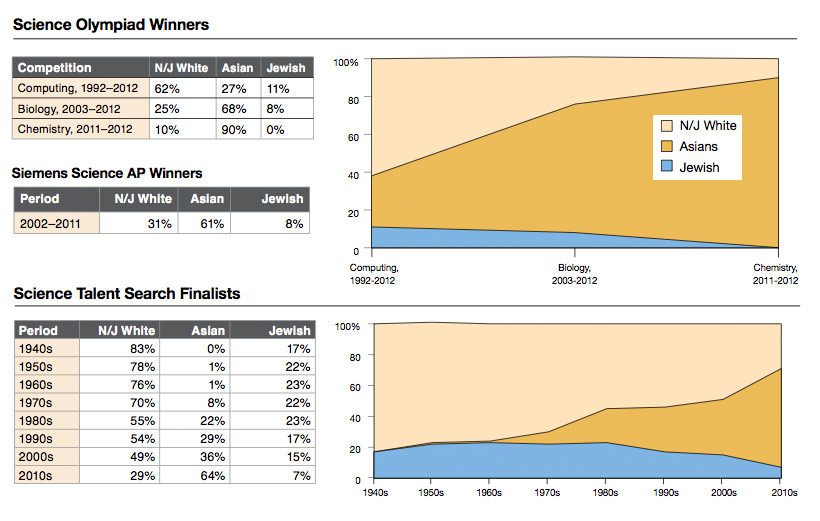
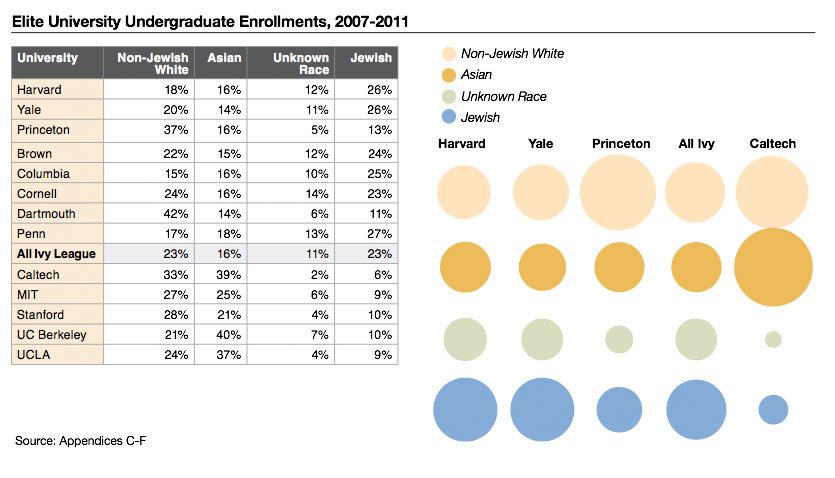
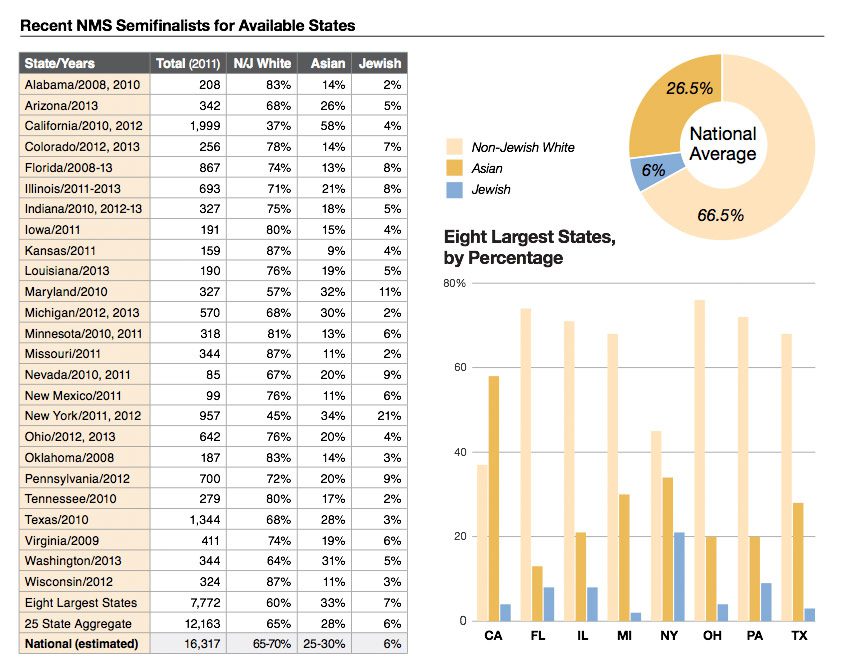
Some additional figures from the article (click for larger versions). Note that not only did the number of college age Asian-Americans increase in recent decades, so did (overwhelmingly) their performance at the high end of academic achievement. If admissions were race neutral (meritocratic) at Harvard, why did the percentage of Asians decrease?

The Caltech student population is demographically similar to the most intellectually talented portion of the US population (see below); the Ivy League student population is not -- there are curious distortions.


Sunday, April 17, 2011

Asian admissions in Boston Globe

Will disparate impact be applied in favor of Asian-American college applicants? Stay tuned! (Perhaps the NBA and NFL are next :-)

The article below appeared in today's Boston Globe Magazine. I'm sure that it will generate plenty of amusing comments there. A similar article in McLeans caused a furor in Canada.

Before commenting here, please peruse this earlier post and its 170+ comments to ensure you are contributing something new to the discussion ;-)

Competitive disadvantage: High-achieving Asian-American students are being shut out of top schools around the country. Is this what diversity looks like now?

... After all the attention given to the stereotype that Asian-American parents put enormous pressure on their children to succeed – provoked over the winter by Amy Chua’s controversial Battle Hymn of the Tiger Mother – came the indisputable reality this spring that, even if Asian-American students work hard, the doors of top schools were still being slammed shut in many faces.

And parents aren’t happy about it. “The entry barriers are higher for us than for everybody else,” says Chi Chi Wu, one of the organizers of the Brookline Asian American Family Network. “There’s a form of redlining or holding Asian-American students to higher standards than any other group.”

... However, in researching their 2009 book No Longer Separate, Not Yet Equal, Princeton sociologist Thomas Espenshade and researcher Alexandria Walton Radford examined data on students applying to college in 1997 and found what looks like different standards for different racial groups. They calculated that Asian-Americans needed nearly perfect SAT scores of 1550 to have the same chance of being accepted at a top private university as whites who scored 1410 and African-Americans who got 1100. Whites were three times, Hispanics six times, and blacks more than 15 times as likely to be accepted at a US university as Asian-Americans. >>Note: this is after controlling for grades, scores, family background (legacy status) and athletic status (whether the student was a recruited athlete.)<<

What about the argument that, in relation to the general population, Asian-Americans are already overrepresented at universities? “It’s both true that Asians are overrepresented and that they’re being discriminated against,” says Stephen Hsu, a professor of physics at the University of Oregon who speaks out against discrimination he says Asian-Americans face in university admissions. Both things can happen at the same time, he says.

Hsu and others allege that universities are more concerned about boosting black and Hispanic enrollment than admitting qualified Asian-Americans, and that old-fashioned xenophobia comes into play as well.

“My personal perspective is that if institutions are using race to keep Asian-American students out, it’s based on a fear [among non-minorities] that these ‘other’ students are taking over our institutions or taking ‘our spots’ at the best institutions,” says Sam Museus, a professor in the Asian-American studies program at the University of Massachusetts at Boston.

... Brookline organizer Chi Chi Wu, who is a lawyer and the mother of an 11-year-old, says it may be time to fight back, using a legal theory called disparate impact. “In other areas of civil rights law, when you have statistical disparities, you can often make a case. You don’t have to prove the university is saying, ‘We don’t want all these Asians,’ but just having those statistics and being able to point to disparities is enough.”

She adds, “If we Asian-Americans don’t organize, there’s no amount of piano practicing that will help us.”

Monday, October 15, 2018

Harvard Admissions on Trial


Now that the Harvard Asian American discrimination trial has started, let me share some previous correspondence with NYTimes reporters who are covering the proceedings.
... it's far too easy for the press to just report it as "Harvard's statistician disagrees with plaintiff's statistician" when in fact there are specific and important claims (e.g., regarding unhooked applicants) that are unanswered by Harvard.

Claim: when unhooked applicants are considered, Asians are discriminated against relative to all other groups.

Unhooked applicants are 95% of the total pool, but only ~2/3 of those admitted (see below). [ Unhooked = ordinary applicant = non-legacy, non-recruited athlete, etc. ]

http://infoproc.blogspot.com/2018/06/harvard-office-of-institutional.html

From the SFFA brief:

"The task here is to determine whether “similarly situated” applicants have been treated differently on the basis of race; “apples should be compared to apples.” SBT Holdings, LLC v. Town of Westminster, 547 F.3d 28, 34 (1st Cir. 2008). Because certain applicants are in a special category, it is important to analyze the effect of race without them included. Excluding them allows for the effect of race to be tested on the bulk of the applicant pool (more than 95% of applicants and more than two-thirds of admitted students) that do not fall into one of these categories, i.e., the similarly situated applicants. For special-category applicants, race either does not play a meaningful role in their chances of admission or the discrimination is offset by the “significant advantage” they receive. Either way, they are not apples.

Professor Card’s inclusion of these applicants reflects his position that “there is no penalty against Asian-American applicants unless Harvard imposes a penalty on every Asian-American applicant.” But he is not a lawyer and he is wrong. It is illegal to discriminate against any Asian-American applicant or subset of applicants on the basis of race. Professor Card cannot escape that reality by trying to dilute the dataset. The claim here is not that Harvard, for example, “penalizes recruited athletes who are Asian-American because of their race.” The claim “is that the effects of Harvard’s use of race occur outside these special categories.” Professor Arcidiacono thus correctly excluded special-category applicants to isolate and highlight Harvard’s discrimination against Asian Americans. Professor Card, by contrast, includes “special recruiting categories in his models” to “obscure the extent to which race is affecting admissions decisions for those not fortunate enough to belong to one of these groups.” At bottom, SFFA’s claim is that Harvard penalizes Asian-American applicants who are not legacies or recruited athletes. Professor Card has shown that he is unwilling and unable to contest that claim.

[ Card and Arcidiacono have exchanged criticisms of the other's analysis already, so Card's lack of response on this specific point is worthy of attention. ]
Will Harvard contest the claim that within the set of unhooked applicants, Asian Americans are discriminated against? As far as I know they have not.
The question about how unhooked applicants are treated has been discussed in college admissions circles for some time. See this from 2006:

https://infoproc.blogspot.com/2006/11/ugly-truth.html

Inside Higher Ed covers a panel called “Too Asian?” at the annual meeting of the National Association for College Admission Counseling. Particularly telling are the comments of a former Stanford admissions officer about an internal study which found evidence of higher admission rates for white applicants over Asians of similar academic and leadership qualifications (all applicants in the study were "unhooked" - meaning not in any favored categories such as legacies or athletes). 
[ So it is strange for Card / Harvard to claim that this specific question is not worth investigating! ]
Thanks to the lawsuit the results of a Harvard internal study in 2013 have been revealed, which concluded, like the Stanford study, that there was indeed discrimination against Asian American applicants. This will undoubtedly be discussed at trial.


The Content of their Character: Ed Blum and Jian Li
.
Jian Li: "I have a message to every single Asian-American student in the country who is applying to college: your civil rights are being violated and you must speak up in defense of them. If you've suffered discrimination you have the option to file a complaint with the Office for Civil Rights. Let your voice be heard .. not only through formal means but also by simply letting it be known in your schools and your communities, in the press and on social media, that university discrimination is pervasive and that this does not sit well with you. Together we will fight to ensure that universities can no longer treat us as second-class citizens."

Saturday, October 27, 2012

Asian hordes in the NYT and WSJ

Stuyvesant High School (traditionally the top high school in NYC; admission is by exam) is now over 70% Asian-American. Meanwhile, at elite universities that do not practice race-blind admissions (from earlier post Demography and destiny; IIRC, currently the Asian-American fraction at all Ivies is lower than at Harvard in the early 1990s):
OCR = Department of Education's Office of Civil Rights, which conducted an investigation of anti-Asian bias in Harvard admissions around 1990.
The Chosen, p.510: ... Asian-Americans had the highest SATs of all [among groups admitted to Harvard]: 1450 out of a possible 1600. In 1991 the Asian-American/white admission ratio [ratio of percentages of applicants from each group admitted] stood at 84 percent -- a sharp downturn from 98 percent in 1990, when the scrutiny from OCR was at its peak. Though [this ratio] never dropped again to the 64 percent level of 1986, it never returned to its 1990 zenith. Despite Asian-Americans' growing proportion of the national population, their enrollment also peaked in 1990 at 20 percent, where it more or less remained until 1994. ... by 2001 it had dropped below 15 percent.
So the "subjective but fair" measures used in admissions resulted in a record high admit rate for Asians during the year Harvard was under investigation by the federal government. But mysteriously the admit rate (relative to that of white applicants) went down significantly after the investigation ended, and the overall Asian enrollment has not increased despite the increasing US population fraction of Asians.
A child of privilege:
NYTimes: Ting Shi said his first two years in the United States were wretched. He slept in a bunk bed in the same room with his grandparents and a cousin in Chinatown, while his parents lived on East 89th Street, near a laundromat where they endured 12-hour shifts. He saw them only on Sundays. ...

The afternoon his acceptance letter to Stuyvesant High School arrived in the mail, he and his parents gathered at the laundromat, the smell of detergent and the whirl of the washing machines filling the air. “Everyone was excited,” Ting recalled.
As usual the article makes a big deal about test prep. Academic studies show that test prep is of limited value in raising scores (see figure below). On the other hand, very intense study over many years probably results in actual learning. We can't have that, can we?


This WSJ article is entitled "Rise of the Tiger Nation":
WSJ: ... The subtle vying for success in various realms of American life between Asian-Americans and American Jews makes one wonder what mores and tastes will look like when Asian-Americans begin to exert their own influence over the culture. Will the verbal brio and intellectual bent of Jews, their edgy irony and frank super-competitiveness give way to Asian discretion, deference to the community, and gifts for less verbal pursuits like music, science and math? Will things become, as they once were under WASP hegemony, quieter?

Not if the mercurial nature of culture has anything to do with it. Think of the wild Korean-American comedian Margaret Cho, who belongs on the same family tree of comic art as the wild Jewish-American comedian Sarah Silverman. Jeremy Lin himself, in his video for the class of 2012 at Stuyvesant, included an antic rap song performed with an Asian-American friend. And the speaker who addressed the high school's graduates in person last June was the 32-year-old Chinese-American actor Telly Leung, a star of the hit TV series "Glee."

Mr. Leung spoke for over 20 minutes, joking, shouting, making ironic quips, teasing and provoking. At one point, he boasted that he had overthrown his parents' middle-class expectations of stability and security and made them redefine their idea of the American dream. He sounded, dare I say it, like a certain type of Jew. Which is another way of saying that he sounded like everyone who comes to America from somewhere else and ends up exemplifying, anew, a native irreverence and vitality that is as old as the American hills.

Congratulations Stuyvesant High School Class of 2012!

Monday, February 08, 2010

Asian-American admissions in the Boston Globe

This Op-Ed appeared in the Boston Globe today. The author, a Yale grad and Babson College professor, wrote an earlier piece entitled My Lazy American Students, so she is no stranger to controversy :-)

Thanks to interlibrary loan I now have a copy of Thomas Espenshade's new book on elite admissions, but so far haven't found much that wasn't already leaked to the press. Related posts on Asian-American college admissions here.

Do colleges redline Asian-Americans?

By Kara Miller | February 8, 2010

SAT SCORES aren’t everything. But they can tell some fascinating stories.

Take 1,623, for instance. That’s the average score of Asian-Americans, a group that Daniel Golden - editor at large of Bloomberg News and author of “The Price of Admission’’ - has labeled “The New Jews.’’ After all, much like Jews a century ago, Asian-Americans tend to earn good grades and high scores. And now they too face serious discrimination in the college admissions process.

Notably, 1,623 - out of a possible 2,400 - not only separates Asians from other minorities (Hispanics and blacks average 1,364 and 1,276 on the SAT, respectively). The score also puts them ahead of Caucasians, who average 1,581. And the consequences of this are stark.

Princeton sociologist Thomas Espenshade, who reviewed data from 10 elite colleges, writes in “No Longer Separate, Not Yet Equal’’ that Asian applicants typically need an extra 140 points to compete with white students. In fact, according to Princeton lecturer Russell Nieli, there may be an “Asian ceiling’’ at Princeton, a number above which the admissions office refuses to venture.

Emily Aronson, a Princeton spokeswoman, insists “the university does not admit students in categories. In the admission process, no particular factor is assigned a fixed weight and there is no formula for weighing the various aspects of the application.’’

A few years ago, however, when I worked as a reader for Yale’s Office of Undergraduate Admissions, it became immediately clear to me that Asians - who constitute 5 percent of the US population - faced an uphill slog. They tended to get excellent scores, take advantage of AP offerings, and shine in extracurricular activities. Frequently, they also had hard-knock stories: families that had immigrated to America under difficult circumstances, parents working as kitchen assistants and store clerks, and households in which no English was spoken.

But would Yale be willing to make 50 percent of its freshman class Asian? Probably not.

Indeed, as Princeton’s Nieli suggests, most elite universities appear determined to keep their Asian-American totals in a narrow range. Yale’s class of 2013 is 15.5 percent Asian-American, compared with 16.1 percent at Dartmouth, 19.1 percent at Harvard, and 17.6 percent at Princeton.

“There are a lot of poor Asians, immigrant kids,’’ says University of Oregon physics professor Stephen Hsu, who has written about the admissions process. “But generally that story doesn’t do as much as it would for a non-Asian student. Statistically, it’s true that Asians generally have to get higher scores than others to get in.’’

In a country built on individual liberty and promise, that feels deeply unfair. If a teenager spends much time studying, excels at an instrument or sport, and garners wonderful teacher recommendations, should he be punished for being part of a high-achieving group? Are his accomplishments diminished by the fact that people he has never met - but who look somewhat like him - also work hard?

“When you look at the private Ivy Leagues, some of them are looking at Asian-American applicants with a different eye than they are white applicants,’’ says Oiyan Poon, the 2007 president of the University of California Students Association. “I do strongly believe in diversity, but I don’t agree with increasing white numbers over historically oppressed populations like Asian-Americans, a group that has been denied civil rights and property rights.’’ But Poon, now a research associate at the University of Massachusetts Boston, warns that there are downsides to having huge numbers of Asian-Americans on a campus.

In California, where passage of a 1996 referendum banned government institutions from discriminating on the basis of race, Asians make up about 40 percent of public university students, though they account for only 13 percent of residents. “Some Asian-American students feel that they lost something by going to school at a place where almost half of their classmates look like themselves - a campus like UCLA. The students said they didn’t feel as well prepared in intercultural skills for the real world.’’

But what do you do if you’re an elite college facing tremendous numbers of qualified Asian applicants? At the 2006 meeting of the National Association for College Admission Counseling, a panel entitled “Too Asian?’’ looked at the growing tendency of teachers, college counselors, and admissions officers to see Asians as a unit, rather than as individuals.

Hsu argues it’s time to tackle this issue, rather than defer it, as Asians’ superior performance will likely persist. “This doesn’t seem to be changing. You can see the same thing with Jews. They’ve outperformed other ethnic groups for the past 100 years.’’

Which leaves us with two vexing questions: Are we willing to trade personal empowerment for a more palatable group dynamic? And when - if ever - should we give credit where credit is due?

Wednesday, October 31, 2018

Glenn Loury and Laurence Kotlikoff on the Harvard Trial (video)


Glenn Loury is Merton P. Stoltz Professor of the Social Sciences, Department of Economics, Brown University. Laurence J. Kotlikoff is a William Fairfield Warren Distinguished Professor and Professor of Economics at Boston University.

Video should start at @49:06 Glenn: Affirmative Action undermines black students’ dignity.
@95:27

Kotlikoff: I think it's pretty obvious that at least based on the facts so far that Harvard probably did downgrade the personalities of the Asians in order to achieve ...

Glenn: [Interrupting] Well that's the ball game -- they discriminated. Civil Rights Act of 1960.
Yesterday David Card (Harvard's statistical expert in the Asian American discrimination trial) began his testimony. At least as reported in the Chronicle, he has yet to dispute Arcidiacono's (plaintiff expert) finding that among "unhooked" applicants (95% of applicants: not in the subset of legacies, recruited athletes, and major donor kids), Asian Americans are discriminated against relative to all others, including whites. I discuss this in detail here and here.

Card has questioned the legal relevance of Arcidiacono's finding (he does not want to consider unhooked applicants separately), but that is for the judge and lawyers to wrangle over (see excerpt below). As a statistical fact I have yet to see any claim from Harvard or Card that the result is incorrect.

Perhaps today's cross examination of Card will focus on this important question, which the media is largely ignoring.


From the SFFA brief:
"The task here is to determine whether “similarly situated” applicants have been treated differently on the basis of race; “apples should be compared to apples.” SBT Holdings, LLC v. Town of Westminster, 547 F.3d 28, 34 (1st Cir. 2008). Because certain applicants are in a special category, it is important to analyze the effect of race without them included. Excluding them allows for the effect of race to be tested on the bulk of the applicant pool (more than 95% of applicants and more than two-thirds of admitted students) that do not fall into one of these categories, i.e., the similarly situated applicants. For special-category applicants, race either does not play a meaningful role in their chances of admission or the discrimination is offset by the “significant advantage” they receive. Either way, they are not apples.

Professor Card’s inclusion of these applicants reflects his position that “there is no penalty against Asian-American applicants unless Harvard imposes a penalty on every Asian-American applicant.” But he is not a lawyer and he is wrong. It is illegal to discriminate against any Asian-American applicant or subset of applicants on the basis of race. Professor Card cannot escape that reality by trying to dilute the dataset. The claim here is not that Harvard, for example, “penalizes recruited athletes who are Asian-American because of their race.” The claim “is that the effects of Harvard’s use of race occur outside these special categories.” Professor Arcidiacono thus correctly excluded special-category applicants to isolate and highlight Harvard’s discrimination against Asian Americans. Professor Card, by contrast, includes “special recruiting categories in his models” to “obscure the extent to which race is affecting admissions decisions for those not fortunate enough to belong to one of these groups.” At bottom, SFFA’s claim is that Harvard penalizes Asian-American applicants who are not legacies or recruited athletes. Professor Card has shown that he is unwilling and unable to contest that claim.

[ Card and Arcidiacono have exchanged criticisms of the other's analysis already, so Card's lack of response on this specific point is worthy of attention. ]

UPDATE: The reporting below confirms what I wrote above. Card and Harvard maintain that looking specifically at unhooked applicants is irrelevant to the case, and do not dispute the statistical facts uncovered by SFFA regarding that group (95% of all applicants!). SFFA maintain (see case law cited above) that anti-Asian American discrimination in this category is itself a violation of law. Will any journalists report this part of the case, prominently discussed in the SFFA brief?
Chronicle: Card’s main objection to Arcidiacono’s model is that it omits recruited athletes, the children of alumni, the children of Harvard faculty and staff members, and students on a special list that includes children of donors. Excluding all those applicants, who are accepted at a relatively high rate, Card suggested, had skewed his counterpart’s results.

[ THIS EXCLUSION DID NOT "SKEW" THE RESULTS -- THE POINT IS THAT THIS ANALYSIS IS OF INTEREST IN AND OF ITSELF. SURELY THIS POINT WILL NOT BE LOST ON THE JUDGE. ]

Friday, December 02, 2011

"I'm not Asian"...

Increasing numbers of Asian-American college applicants understand the odds are stacked against them, and react by not declaring their ethnicity or (in the case of mixed race applicants) checking any box but Asian.

See previous related posts: here , here

I'm Not Asian (AP): Lanya Olmstead was born in Florida to a mother who immigrated from Taiwan and an American father of Norwegian ancestry. Ethnically, she considers herself half Taiwanese and half Norwegian. But when applying to Harvard, Olmstead checked only one box for her race: white.

"I didn't want to put 'Asian' down," Olmstead says, "because my mom told me there's discrimination against Asians in the application process."

For years, many Asian-Americans have been convinced that it's harder for them to gain admission to the nation's top colleges.

... The way it works, the critics believe, is that Asian-Americans are evaluated not as individuals, but against the thousands of other ultra-achieving Asians who are stereotyped as boring academic robots.

Now, an unknown number of students are responding to this concern by declining to identify themselves as Asian on their applications.

For those with only one Asian parent, whose names don't give away their heritage, that decision can be relatively easy. Harder are the questions that it raises: What's behind the admissions difficulties? What, exactly, is an Asian-American — and is being one a choice?

Olmstead is a freshman at Harvard and a member of HAPA, the Half-Asian People's Association. In high school she had a perfect 4.0 grade-point average and scored 2150 out of a possible 2400 on the SAT, which she calls "pretty low."

College applications ask for parent information, so Olmstead knows that admissions officers could figure out a student's background that way. She did write in the word "multiracial" on her own application.

Still, she would advise students with one Asian parent to "check whatever race is not Asian."

"Not to really generalize, but a lot of Asians, they have perfect SATs, perfect GPAs, ... so it's hard to let them all in," Olmstead says.

Amalia Halikias is a Yale freshman whose mother was born in America to Chinese immigrants; her father is a Greek immigrant. She also checked only the "white" box on her application.

"As someone who was applying with relatively strong scores, I didn't want to be grouped into that stereotype," Halikias says. "I didn't want to be written off as one of the 1.4 billion Asians that were applying."

... "If you know you're going to be discriminated against, it's absolutely justifiable to not check the Asian box," says Halikias.

"The whole Tiger Mom stereotype is grounded in truth," says Tao Tao Holmes, a Yale sophomore with a Chinese-born mother and white American father. She did not check "Asian" on her application.

"My math scores aren't high enough for the Asian box," she says. "I say it jokingly, but there is the underlying sentiment of, if I had emphasized myself as Asian, I would have (been expected to) excel more in stereotypically Asian-dominated subjects."

"I was definitely held to a different standard (by my mom), and to different standards than my friends," Holmes says. She sees the same rigorous academic focus among many other students with immigrant parents, even non-Asian ones.

Does Holmes think children of American parents are generally spoiled and lazy by comparison? "That's essentially what I'm trying to say."

Asian students have higher average SAT scores than any other group, including whites. A study by Princeton sociologist Thomas Espenshade examined applicants to top colleges from 1997, when the maximum SAT score was 1600 (today it's 2400). Espenshade found that Asian-Americans needed a 1550 SAT to have an equal chance of getting into an elite college as white students with a 1410 or black students with an 1100.

Top schools that don't ask about race in admissions process have very high percentages of Asian students. The California Institute of Technology, a private school that chooses not to consider race, is about one-third Asian. (Thirteen percent of California residents have Asian heritage.) The University of California-Berkeley, which is forbidden by state law to consider race in admissions, is more than 40 percent Asian — up from about 20 percent before the law was passed.

Steven Hsu, a physics professor at the University of Oregon and a vocal critic of current admissions policies, says there is a clear statistical case that discrimination exists.

"The actual dynamics of how it happens are really quite subtle," he says, mentioning factors like horse-trading among admissions officers for their favorite candidates.

Also, "when Asians are the largest group on campus, I can easily imagine a fund-raiser saying, 'This is jarring to our alumni,'" Hsu says. Noting that most Ivy League schools have roughly the same percentage of Asians, he wonders if "that's the maximum number where diversity is still good, and it's not, 'we're being overwhelmed by the yellow horde.'"

... Kara Miller helped read applications for the Yale admissions office when she was an undergraduate there, and participated in meetings where admissions decisions were made. She says it often felt like Asians were held to a higher standard.

"Asian kids know that when you look at the average SAT for the school, they need to add 50 or 100 to it. If you're Asian, that's what you'll need to get in," says Miller, now an English professor at the University of Massachusetts-Dartmouth.

... Hsu, the physics professor, says that if the current admissions policies continue, it will become more common for Asian students to avoid identifying themselves as such, and schools will have to react.

"They'll have to decide: A half-Asian kid, what is that? I don't think they really know." ...

Thursday, February 02, 2012

Transparency in college admissions

Daniel Golden (Bloomberg) reports that the Department of Education is now investigating both Princeton and Harvard regarding discrimination against Asian-American applicants.

Below is an excerpt from an op-ed Bloomberg asked me to write on this topic.

What Harvard Owes Its Top Asian-American Applicants: Stephen Hsu

It’s a common belief among Asian- American families that their children are held to higher academic standards than college applicants from other ethnic groups. Such practices were openly acknowledged after investigations at universities like Berkeley and Stanford in the 1980s and 1990s.

Have they been corrected?

The U.S. Education Department is investigating complaints that Harvard University and Princeton University discriminated against Asian-Americans in undergraduate admissions.

Statistics seem to support the claim of bias across most of elite higher education. For example, in comprehensive data compiled as part of Duke University’s Campus Life and Learning project (as reported in a recent analysis by Duke economist Peter Arcidiacono and collaborators), Asian-Americans who enrolled at the school in 2001 averaged 1457 out of 1600 on the math and reading part of the SAT, compared with 1416 for whites, 1347 for Hispanics and 1275 for blacks.

Holistic Admissions

There is every reason to believe that a similar pattern holds at nearly all elite universities in the U.S., with notable exceptions such as the California Institute of Technology. In fact, Duke may be one of the mildest offenders when it comes to Asian-American admissions: With the goal of increasing its overall student quality, Duke has reportedly been more friendly recently to Asian-American applicants than traditional powers such as Harvard and Princeton.

Schools like Harvard and Princeton brag that each year they reject numerous applicants such as Jian Li (who filed a complaint against Princeton) who score a perfect 2400 on the SAT. How would we feel if it were revealed that almost all of these rejected top scorers, year after year, were Asian- Americans? I challenge Harvard and Princeton to refute this possibility.

To be fair, most elite universities practice what is known as holistic admissions: Each candidate is evaluated on a variety of measures, including athletic and leadership activities in addition to academic performance. It is possible that the gap in academic average between Asian-American and white admitted students is compensated by gaps in the opposite direction on these other variables. Looking again at internal evaluations by Duke’s admissions office, we find Asian-Americans had higher averages than whites in the following categories: achievement, curriculum (each about one-third of a standard deviation) and letters of recommendation, while trailing very slightly (less than one-tenth of a standard deviation) in personal qualities.

Lacking data on factors such as legacy and recruited athlete status, we can’t make a complete determination of the fairness of the process, and in fact the appropriate weight of the various factors in a holistic admissions process will be subject to vigorous debate. ...

Wednesday, October 02, 2019

Harvard Discrimination Lawsuit: Judge Burroughs on Racial Balancing and "Unhooked" Applicants

As has been widely reported (WSJ):
U.S. District Judge Allison Burroughs found that Harvard’s practices were “not perfect” and could use improvements, including implicit bias training for admissions officers, but said “the Court will not dismantle a very fine admissions program that passes constitutional muster, solely because it could do better.”
I anticipate that this case will end up before the Supreme Court.

While I have not read the entire decision (PDF), I was curious to see how two important arguments made by the plaintiffs (Students For Fair Admissions, SFFA) were addressed. You can evaluate Burroughs' logic and use of evidence for yourself. In the excerpts below I first quote from the SFFA filing, and then from the decision.

Issue #1: Racial Balancing:
SFFA: ... Harvard is engaging in racial balancing. Over an extended period, Harvard’s admission and enrollment figures for each racial category have shown almost no change. Each year, Harvard admits and enrolls essentially the same percentage of African Americans, Hispanics, whites, and Asian Americans even though the application rates and qualifications for each racial group have undergone significant changes over time. This is not the coincidental byproduct of an admissions system that treats each applicant as an individual; indeed, the statistical evidence shows that Harvard modulates its racial admissions preference whenever there is an unanticipated change in the yield rate of a particular racial group in the prior year. Harvard’s remarkably stable admissions and enrollment figures over time are the deliberate result of systemwide intentional racial discrimination designed to achieve a predetermined racial balance of its student body.
This is a relevant figure from the Economist. It shows the increase in Asian representation at Caltech (mostly race-neutral admissions), tracking the overall population of college age Asian Americans, versus the suspicious Ivy league convergence at 15-20% of each class.


From page 80 of the decision:
Although Harvard tracks and considers various indicators of diversity in the admissions process, including race, the racial composition of Harvard’s admitted classes has varied in a manner inconsistent with the imposition of a racial quota or racial balancing. See [Oct. 31 Tr. 119:10–121:10; DX711]. As Figures 1 and 2 show, there has been considerable year-to-year variation in the portion of Harvard’s class that identifies as Asian American since at least 1980.   [ italics mine ]
Figure 1 seems merely to show that admittance by race tends to fluctuate by 5-10% from year to year. No attempt at analysis of correlations across years -- i.e., to detect racial balancing.


Figure 2 seems to show that Asian American applicants are a smaller fraction of the class relative to their share of the applicant pool, whereas, e.g., this ratio is reversed for African Americans. Racial balancing would be found only in detailed comparisons of these ratios across several years, adjusting for strength of application, etc.


Rather than giving a serious analysis of racial balancing (is it actually happening?), Burroughs seems to explicitly support the practice in her comments on racial diversity:
p.30 To summarize the use of race in the admissions process, Harvard does not have a quota for students from any racial group, but it tracks how each class is shaping up relative to previous years with an eye towards achieving a level of racial diversity that will provide its students with the richest possible experience. It monitors the racial distribution of admitted students in part to ensure that it is admitting a racially diverse class that will not be overenrolled based on historic matriculation rates which vary by racial group. [ Isn't this just a definition of racial balancing? ]
Quota Bad, Soft-Quota Good! Is this now the law of the land in the United States of America? SCOTUS here we come...


Issue #2: Is discrimination against Asian Americans especially obvious when one considers "unhooked" applicants separately?
SFFA: ... The task here is to determine whether “similarly situated” applicants have been treated differently on the basis of race; “apples should be compared to apples.” SBT Holdings, LLC v. Town of Westminster, 547 F.3d 28, 34 (1st Cir. 2008). Because certain applicants are in a special category, it is important to analyze the effect of race without them included. Excluding them allows for the effect of race to be tested on the bulk of the applicant pool (more than 95% of applicants and more than two-thirds of admitted students) that do not fall into one of these categories, i.e., the similarly situated applicants. For special-category applicants, race either does not play a meaningful role in their chances of admission or the discrimination is offset by the “significant advantage” they receive. Either way, they are not apples.

Professor Card’s inclusion of these applicants reflects his position that “there is no penalty against Asian-American applicants unless Harvard imposes a penalty on every Asian-American applicant.” But he is not a lawyer and he is wrong. It is illegal to discriminate against any Asian-American applicant or subset of applicants on the basis of race. Professor Card cannot escape that reality by trying to dilute the dataset. The claim here is not that Harvard, for example, “penalizes recruited athletes who are Asian-American because of their race.” The claim “is that the effects of Harvard’s use of race occur outside these special categories.” Professor Arcidiacono thus correctly excluded special-category applicants to isolate and highlight Harvard’s discrimination against Asian Americans. Professor Card, by contrast, includes “special recruiting categories in his models” to “obscure the extent to which race is affecting admissions decisions for those not fortunate enough to belong to one of these groups.” At bottom, SFFA’s claim is that Harvard penalizes Asian-American applicants who are not legacies or recruited athletes. Professor Card has shown that he is unwilling and unable to contest that claim.
The judge seems to have ignored or rejected the claim that discrimination within the pool of unhooked applicants (95% of the total!) is worth considering on its own. This seems to be an entirely legal (as opposed to statistical) question that may be tested in the appeal. (ALDC = Athletes, Legacies, Deans interest list (donors), and Children of Harvard faculty.)
p.52 Although ALDCs represent only a small portion of applicants and are admitted or rejected through the same admissions process that applies to other applicants, they account for approximately 30% of Harvard’s admitted class. [Oct. 30 Tr. 153:6–154:8, DX706; DD10 at 38, 40]. For reasons discussed more fully infra at Section V.F, the Court agrees with Professor Card that including ALDCs in the statistics and econometric models leads to more probative evidence of the alleged discrimination or lack thereof.
See also Former Yale Law Dean on Harvard anti-Asian discrimination case: The facts are just so embarrassing to Harvard... Quotas and a climate of dishonesty and comments therein.

Friday, December 16, 2011

National Review: Applying While Asian

Rich Lowry is the editor of National Review. Almost every journalist who has talked to me about this issue asks "Gee, how long has this been going on?" and are surprised when I tell them at least 30 years!

But who cares, those Asians don't make trouble: they'll just work harder ...

Applying While Asian


To check or not to check the Asian box? That is the pointed choice faced by Asian-American students applying for admission to what are supposed to be the most tolerant places on earth, the nation’s colleges.

The Associated Press ran a report on Asian students of mixed parentage checking “white,” if possible, on their applications to avoid outing themselves as Asian. The Princeton Review Student Advantage Guide counsels Asian-American students not to check the race box and warns against sending a photo.

... All of this is done to promote a “diversity” of a crude, bean-counting sort. The private California Institute of Technology doesn’t use quotas; its student body is 39 percent Asian. The University of California at Berkeley is forbidden by law from using quotas; its student body is more than 40 percent Asian. Only a bigot would believe that these schools are consequently worse learning environments, or that they are places characterized by monochromatic, lockstep thinking because so many students share a broad-brush ethnic designation.

The author of The Price of Admission, Daniel Golden, calls Asian-Americans “the new Jews,” a reference to the 20th-century quotas that once kept Jews out of top schools. The difference then was that Jews collectively didn’t stand for the policy, now a watchword for disgraceful bias. Stephen Hsu, a professor of physics at the University of Oregon and an outspoken critic of current admission practices, laments that Asians seem strangely accepting of the unfair treatment of their children. The official Asian-American groups tend to support anti-Asian quotas because they are captives of liberal orthodoxy before all else. ...

An NRO commenter writes

I'm whitebread umpteenth generation American. My husband is Chinese by way of Malaysia. We met at the same elite college. The discrimination against Asian students is an open secret--everyone Asian knew, or at least suspected, that it was the case. It's part of why my husband and I have decided to hyphenate my WASP last name with his (thankfully) not terribly ethnic sounding Chinese surname. We don't want our children, 20 years from now, to be hurt when applying for college, should saner winds have not prevailed.

Malaysia actually presents an instructive example. In Malaysia, about 25% of the population is Chinese, and government quotas which require a certain number of ethnic Malays win university places and jobs mean that Chinese students much earn much higher scores than Malay students to win university slots. The result of this is that academic expectation for Chinese students get ever higher, while those Chinese Malaysians who can afford it try to send their kids abroad. It's not an accident that my husband wound up at an American university--it's the result of my in-laws driving him for years to get him there.

And therein lies the rub. My husband comes from a country where racial quotas are explicit, published, and protesting them will cause the government to retaliate. (Malaysia's government recently essentially outlawed freedom of assembly.) Elections are rigged, and everyone knows this. The government has forged an ethnic, institutional and religious alliance to repress the Chinese population. My husband is still surprised that Americans are willing to openly speak out against and protest against the government.

Many Asian immigrants are only recently removed from governments that do not invite the opinions of their citizens. It takes time to learn, really learn, that it is acceptable to demand accountability of institutions and of governments, and I don't see that happening overnight.

But it is happening, slowly. Every Chinese American I've talked to of college age knows about these quotas, and I don't think these first generation Americans will stand for their children being treated in the same manner.

Wednesday, August 18, 2010

Asian-Americans in the Ivy League: A Portrait of Privilege and Discrimination

All of this should be common knowledge by now, but of course most of it can't be openly discussed in the mainstream media.

IBTimes: ... While "Asians" -- defined broadly as people who can trace their ancestry to East Asia, Southeast Asia, South Asia and the Pacific Islands -- account for only about 5 percent of the U.S. populace, they are believed to represent up to 20 percent of the enrollment at the top Ivy League schools.

However, the irony is that if the admission criteria and process in all U.S. universities were completely fair and equitable -- that is, based purely on academic qualifications -- the Asian weighting in the elite colleges would likely be significantly higher.

... Consider what happened in California -- a state with a very high Asian population of about 13 percent -- in late 1996. Voters passed Proposition 209, a referendum that essentially revoked Affirmative Action measures and deemed that entry into public colleges -- including the huge University of California (UC) system -- should be entirely race-blind.

"A direct consequence of this was that the percentage of Asian-Americans at universities like Berkeley, UC-Irvine, and UCLA immediately skyrocketed," said Stephen D.H. Hsu, a professor of physics at the University of Oregon in Eugene. "At those institutions, the Asian-American representation currently approaches 50 percent."

... The word "quota" is controversial and politically-charged; one must be careful when using it. However it's difficult not to conclude that some elite universities do indeed impose a quota -- officially or subconsciously -- upon Asian enrollment in order to control their numbers at some specified levels.

Consider a recent study undertaken by Thomas Espenshade, a Princeton sociologist. He calculated that in 1997 African-Americans who achieved scores of 1150 scores on two original SAT tests had the same chances of getting accepted to top private colleges as whites who scored in the 1460s and Asians who scored perfect 1600s.

Or put it another way, Asian applicants typically need to score an extra 140 or so points on their SATs to compete "equally" with white students.

Miller of Babson College also wrote that "most elite universities appear determined to keep their Asian American totals in a narrow range. Yale's class of 2013 is 15.5 percent Asian American, compared with 16.1 percent at Dartmouth, 19.1 percent at Harvard and 17.6 percent at Princeton."

However, white students are similarly victimized by admission policies at some elite schools.

Espenshade discovered that when comparing applicants with similar grades, scores, athletic qualifications, and family history for seven elite private colleges and universities: whites were three times as likely to get accepted as Asians; Hispanics were twice as likely to win admission as whites, and African-Americans were at least five times as likely to be accepted as whites.

Moreover, if all elite private universities enacted race-blind admissions, the percentage of Asian students would jump from 24 percent to 39 percent (similar to what they already are now at Caltech and Berkeley, two elite institutions with race-blind admissions; the former due to a belief in meritocracy, the latter due to Proposition 209).

What Asian-Americans are enduring now is reminiscent of the travails of American Jews in the 1930s and 1940s, when colleges like Harvard and Yale imposed quotas to limit their numbers at these elite institutions. And like many of those Jews from seven or eight decades ago, numerous Asian-American students today come from poor, humble immigrant households.

To head off some of the usual comments, yes, it makes sense (in terms of narrow institutional interests) for the top schools to impose a soft quota on Asians. No use spooking older alumni donors with an off-putting student body composition, or diluting the brand so carefully developed over the years. I predict most of the elites will ease into a higher Asian representation over the next 20 years or so.

Sunday, June 13, 2021

An Inconvenient Minority: The Attack on Asian American Excellence and the Fight for Meritocracy (Kenny Xu)


Kenny Xu is a brave young man. His new book An Inconvenient Minority: The Attack on Asian American Excellence and the Fight for Meritocracy expertly documents a number of unpleasant facts about American society that most major media outlets, education leaders, and social justice advocates have been obfuscating or outright suppressing for decades.

1. Asian Americans (not foreign students from Asia, but individuals of Asian heritage who are US citizens or permanent residents) have been discriminated against in admission to elite institutions of higher education for over 30 years. 

To put it bluntly, Asian Americans must, on average, outperform all other groups in order to have an equal chance of admission to universities like Harvard or Yale. If one were to replace Asian Americans with Jews in the previous sentence, it would describe the situation in the early 20th century. Looking back, we are rightfully ashamed and outraged at the conduct of elite universities during this period. Future Americans, and observers all over the world, will eventually have the same reaction to how Asian Americans are treated today by these same institutions.

2. Asian American success, e.g., as measured using metrics such as income, wealth, or education, is problematic for simplistic narratives that emphasize race and "white supremacy" over a more realistic and multifaceted analysis of American society.

3. Efforts to guarantee equal outcomes, as opposed to equal opportunities, are anti-meritocratic and corrosive to social cohesion, undermine basic notions of fairness, and handicap the United States in scientific and technological competition with other nations.

The Table of Contents, reproduced below, gives an idea of the important topics covered. Xu had an insider's view of the Students for Fair Admission v. Harvard trial, now awaiting appeal to the Supreme Court. He also describes the successful effort by a grass roots coalition of Asian Americans to defeat CA Proposition 16, which would have reinstated racial preferences in the public sector (including college admissions) which were prohibited by Proposition 209 in 1996.

Over the years I have had many conversations on this topic with well-meaning (but often poorly informed) parents of all ethnic and cultural backgrounds. I cannot help but ask these people
Are you OK with discrimination against your child? What did they do to deserve it? 
Are you going to let virtue-signaling administrators at the university devalue the hard work and hard-won accomplishments of your son or daughter? Are you going to do anything about it?
and I cannot help but think
If you won't do anything about it, then f*ck you. Your kids deserve better parents.

Kenny calls it a Fight for Meritocracy. That's what it is -- a fight. Don't forget that Meritocracy is just a fancy word for fairness. It's a fight for your kid, and all kids, to be treated fairly.

I highly recommend the book. These issues are of special concern to Asian Americans, but should be of interest to anyone who wants to know what is really happening in American education today.


Related posts: discrimination against Asian Americans at elite US universities, on meritocracy, and UC faculty report on the use of SAT in admissions.

Blog Archive

Labels