
New Yorker: ... Khruangbin plays a spellbinding twist on surf rock and soul that would be considered trite if it weren’t so appetizing. The band’s origins are delightfully nerdy: Speer bonded with the bassist Laura Lee and the drummer Donald Johnson over lo-fi digital rips of cassette tapes featuring obscure Thai funk bands from the sixties and seventies, which they’d downloaded from the cult blog Monrakplengthai. The cassette tapes catalogue stray releases from Thai musicians who, influenced by imported rock records from bands like Santana and the Shadows, blended the misty, coiling guitars of foundational rock and roll with the melodic sensibilities of their own traditional folk tunes. Many of the songs were used in Bollywood films, reaching wide swaths of Southeast Asian audiences. “Shadow music,” as the sound came to be called, is exhilarating in part for its traceable roots. Several cuts would fit seamlessly into your favorite countercultural film score, were it not for vocalists unspooling lyrics in their native tongue.
Speer, Lee, and Johnson would return to these tapes sporadically when they gathered in a barn in Burton, Texas (in addition to conferring via Skype when Lee briefly relocated to London), to write and record “Universe.” (The band’s name means “airplane” in Thai, but none of the members claim roots in the South Asian country.) ...
Thursday, March 31, 2016
Khruangbin


Tuesday, March 29, 2016
The Butlerian Jihad and Darwin among the Machines

Left: Samuel Butler, Right: Frank Herbert.
And when that which was foretold shall come to pass, for behold it is coming, then shall they know that a prophet hath been among them. -- Ezekiel 33:33
See also Don't worry -- smart machines will take us with them, and Philip K. Dick's first science fiction story.
Butlerian Jihad (Wikipedia): The Butlerian Jihad is an event in the back-story of Frank Herbert's fictional Dune universe. Occurring over 10,000 years before the events chronicled in his 1965 novel Dune, this jihad leads to the outlawing of certain technologies, primarily "thinking machines," a collective term for computers and artificial intelligence of any kind. This prohibition is a key influence on the nature of Herbert's fictional setting.19th-century author Samuel Butler introduced the idea of evolved machines supplanting mankind as the dominant species in his 1863 article "Darwin among the Machines" and later works. Butler goes on to suggest that all machines be immediately destroyed to avoid this outcome.
... "The target of the Jihad was a machine-attitude as much as the machines," Leto said. "Humans had set those machines to usurp our sense of beauty, our necessary selfdom out of which we make living judgments. Naturally, the machines were destroyed."... The chief commandment from the Orange Catholic Bible, "Thou shalt not make a machine in the likeness of a human mind", holds sway, as do the anti-artificial intelligence laws in which the penalty for owning an AI device or developing technology resembling the human mind is immediate death. This leads to the rise of a new feudalistic galactic empire which lasts for over ten thousand years. ...
To replace the analytical powers of computers without violating the commandment of the O.C. Bible, "human computers" known as Mentats are developed and perfected, their mental abilities ultimately honed to the point where they become superior to those of the ancient thinking machines. Similarly specialized groups of humans which arise after the Jihad include the Bene Gesserit, a matriarchal order with advanced mental and physical abilities, and the Spacing Guild, whose prescience makes safe, instantaneous space travel possible.
Darwin among the Machines (Wikipedia): ... article published in The Press newspaper on 13 June 1863 in Christchurch, New Zealand. Written by Samuel Butler but signed Cellarius (q.v.), the article raised the possibility that machines were a kind of "mechanical life" undergoing constant evolution, and that eventually machines might supplant humans as the dominant species:
We refer to the question: What sort of creature man’s next successor in the supremacy of the earth is likely to be. We have often heard this debated; but it appears to us that we are ourselves creating our own successors; we are daily adding to the beauty and delicacy of their physical organisation; we are daily giving them greater power and supplying by all sorts of ingenious contrivances that self-regulating, self-acting power which will be to them what intellect has been to the human race. In the course of ages we shall find ourselves the inferior race. ...The article ends by urging that, "War to the death should be instantly proclaimed against them. Every machine of every sort should be destroyed by the well-wisher of his species. Let there be no exceptions made, no quarter shown; let us at once go back to the primeval condition of the race."
Day by day, however, the machines are gaining ground upon us; day by day we are becoming more subservient to them; more men are daily bound down as slaves to tend them, more men are daily devoting the energies of their whole lives to the development of mechanical life. The upshot is simply a question of time, but that the time will come when the machines will hold the real supremacy over the world and its inhabitants is what no person of a truly philosophic mind can for a moment question.
Sunday, March 27, 2016
Science vs Advocacy: the benefits of diversity
This manuscript is based on the Presidential Address that Alice H. Eagly (Professor of Psychology and of Management at Northwestern University) delivered at the 2015 conference of the Society for the Psychological Study of Social Issues, “A Road Less Traveled: Forging Links between Psychological Science and Social Policy,” Washington, DC.
When Passionate Advocates Meet Research on Diversity, Does the Honest Broker Stand a Chance?From the paper
Journal of Social Issues, 72: 199–222. doi: 10.1111/josi.12163
Abstract: In an ideal world, social science research would provide a strong basis for advocacy and social policy. However, advocates sometimes misunderstand or even ignore scientific research in pursuit of their goals, especially when research pertains to controversial questions of social inequality. To illustrate the chasm that can develop between research findings and advocates’ claims, this article addresses two areas: (a) the effects of the gender diversity of corporate boards of directors on firms’ financial performance and (b) the effects of the gender and racial diversity of workgroups on group performance. Despite advocates’ insistence that women on boards enhance corporate performance and that diversity of task groups enhances their performance, research findings are mixed, and repeated meta-analyses have yielded average correlational findings that are null or extremely small. Therefore, social scientists should (a) conduct research to identify the conditions under which the effects of diversity are positive or negative and (b) foster understanding of the social justice gains that can follow from diversity. Unfortunately, promulgation of false generalizations about empirical findings can impede progress in both of these directions. Rather than ignoring or furthering distortions of scientific knowledge to fit advocacy goals, scientists should serve as honest brokers who communicate consensus scientific findings to advocates and policy makers in an effort to encourage exploration of evidence-based policy options.
... Establishing that the presence of women on corporate boards causes any of the positive or negative outcomes is far more challenging (see Adams, 2015). As in many other domains of nonexperimental research, relatively few researchers have addressed endogeneity in a manner that allows claims about causation (Antonakis, Bendahan, Jacquart, & Lalive, 2010). However, the “business case”—that is, the boldly causal claim that including women on corporate boards improves firms’ financial outcomes, lives on in communications directed to the public and business community (e.g., Committee for Economic Development, 2015), most often supported by citations of the least informative studies, which are those containing only simple group comparisons (e.g., Catalyst, 2004; Desvaux et al., 2007).Concluding paragraph
... Over the years, a very large research literature has accumulated relating workgroup diversity to group performance, published in academic journals mainly in industrial-organizational psychology and management. These investigators have distinguished two types of diversity: job-related, which pertains to differences in knowledge and expertise related to the problems that work groups are charged with solving, and demographic, which pertains to differences in attributes such as gender, race, and age (e.g., Mannix & Neale, 2005). Research has extensively examined both of these forms of diversity.
Several meta-analyses of the diversity-performance relation have been prominently published, with the latest and most inclusive produced by van Dijk, van Engen, and van Knippenberg (2012). Among this project's 146 studies, there were three types of settings: (a) laboratory experiments (b) field studies, and (c) studies conducted on teams composed of undergraduate or MBA students. These field and student studies generally provided correlational data relating amount of diversity to group performance. The finding that the classification of studies by these three types of settings did not moderate diversity-performance relations eases concerns about endogeneity, given the greater ability of the laboratory experiments to rule out alternative explanations based on uncontrolled variables.
The meta-analysis produced mainly very small average effect sizes: The key overall findings were that demographic diversity yielded a small negative relation to performance outcomes (r = –.02), which was present for both gender diversity (r = –.01) and racial/ethnic diversity (r = –.05); all of these relations were nonsignificant. In contrast, job-related diversity produced a significant, but small, positive relation (r = .05). These findings replicated four prior meta-analyses based on smaller samples of studies (Bell, Villado, Lukasik, Belau, & Briggs, 20100; Horwitz & Horwitz, 2007; Hülsheger, Anderson, & Salgado, 2009; Joshi & Roh, 2009). In addition, a meta-analysis of 68 studies produced a nonsignificant relation between gender diversity and team performance (r = -.01; Schneid, Isidor, Li, & Kabst, 2015). Moreover, these meta-analytic results were generally consistent with earlier narrative reviewers’ cautions that demographic diversity had yielded mixed and inconclusive effects (Harrison & Klein, 2007; Mannix & Neale, 2005; Milliken & Martins, 1996; Williams & O'Reilly, 1998).
... In summary, when aggregated across studies, an extensive research literature on group performance has shown no overall advantage for demographically diverse groups, with a small tendency toward disadvantage, especially on subjective measures of performance. However, these meta-analytic averages encompassed heterogeneous outcomes, whereby some studies did produce positive effects of diversity. Yet, approximately as many studies yielded negative effects, producing average effects that were near zero. In this respect, these findings are similar to the correlations between the representation of women as corporate directors and financial outcomes.
To conclude, this article conveys some ways in which science, advocacy, and policy have not related easily or harmoniously. I have told two somewhat complicated stories, one pertaining to women on corporate boards and the other to workgroup diversity—two domains with extensive social scientific research relating diversity to performance outcomes. Despite the striking lack of research support for the optimistic generalizations about these outcomes that have been widely shared among advocates, policy makers, and the general public, many social scientists with relevant expertise have remained silent. It is time for more social scientists to take stock of what diversity research has produced so far and join those who are addressing the complexities of diversity's effects on group and organizational performance. It is also time for all stakeholders in diversity initiatives to focus on the violations of social justice inherent in the limited access of women and minorities to decision making in most political and corporate contexts.
Saturday, March 26, 2016
Genetic ancestry and brain morphology
Note Added in response to 2020 Twitter mob attack which attempts to misrepresent my views: This is not my research. It is the work of a very well-funded (NIH) neuro-imaging collaboration primarily at UCSD. They are pointing out that an algorithm trained on MRI data and genomes can classify individuals by ancestry, based only on an image of their brain. No one is claiming, or has looked into, any functional implications of these morphological differences. It's simply data science at this point.
Racist inferences based on the results are the fault of the reader, not the authors of the paper or of this blog.

Population structure -- i.e., distribution of gene variants by ancestral group -- is reflected in brain morphology, as measured using MRI. Brain morphology measurements can be used to predict ancestry. Strictly speaking, the data only show correlation, not genetic causation, but the most plausible interpretation is that genetic differences are causing morphological differences. One could check this easily by comparing individuals raised in different environments and cultures.
See also Heritability of brain structure, IQ prediction from structural MRI, and Metabolic costs of human brain development.
Most of the authors are associated with UCSD. From the paper:
This figure shows ancestry admixture using PCA. The figure at top shows that brain morphological parameters can be used to build a reasonably good classifier.

Racist inferences based on the results are the fault of the reader, not the authors of the paper or of this blog.

Population structure -- i.e., distribution of gene variants by ancestral group -- is reflected in brain morphology, as measured using MRI. Brain morphology measurements can be used to predict ancestry. Strictly speaking, the data only show correlation, not genetic causation, but the most plausible interpretation is that genetic differences are causing morphological differences. One could check this easily by comparing individuals raised in different environments and cultures.
See also Heritability of brain structure, IQ prediction from structural MRI, and Metabolic costs of human brain development.
Most of the authors are associated with UCSD. From the paper:
PING (Pediatric Imaging, Neurocognition, and Genetics) was a multisite project recruiting children and adolescents from ages 3 to 21 at ten sites in the United States. All participants were screened for history of major developmental, psychiatric, and neurological disorders; brain injury; and other medical conditions that affect development. Participants then received neurodevelopmental assessments, standardized multi-modal neuroimaging, and genome-wide genotyping. The overall PING sample consisted of 1,493 participants; 1,152 individuals remained after quality control of the genotyping and neuroimaging data.
... Our data indicate that the unique folding patterns of gyri and sulci are closely aligned with genetic ancestry. The geometry robustly predicts each individual’s genetic background even though the population has been shaped by waves of migration and admixtures. A previous study, using only facial features, achieved 64% explained variance in YRI ancestry among African Americans [19]. Our 3D representation of cortical surface geometry performs similarly in predicting YRI ancestry and also performs well for the other three continental ancestries. As data in Table 1 show, the explanatory power is not due to the differences in total brain volumes, nor to the differences in areal expansion of the cortical surface. Instead, regional folding patterns characterize each ancestral lineage. ...
Modeling the 3D Geometry of the Cortical Surface with Genetic Ancestry
Chun Chieh Fan, Hauke Bartsch, Andrew J. Schork, Chi-Hua Chen, Yunpeng Wang, Min-Tzu Lo, Timothy T. Brown, Joshua M. Kuperman, Donald J. Hagler Jr., Nicholas J. Schork, Terry L. Jernigan, Anders M. Dale, the Pediatric Imaging, Neurocognition, and Genetics Study
Cell: Current Biology 25, 1–5 August 3, 2015
http://dx.doi.org/10.1016/j.cub.2015.06.006
Highlights
•Geometry of the human cortical surface contains rich ancestral information
•The most informative features are regional patterns of cortical folding and gyrification
•This study provides insight on the influence of population structure on brain shape
Summary
Knowing how the human brain is shaped by migration and admixture is a critical step in studying human evolution [1, 2], as well as in preventing the bias of hidden population structure in brain research [3, 4]. Yet, the neuroanatomical differences engendered by population history are still poorly understood. Most of the inference relies on craniometric measurements, because morphology of the brain is presumed to be the neurocranium’s main shaping force before bones are fused and ossified [5]. Although studies have shown that the shape variations of cranial bones are consistent with population history [6–8], it is unknown how much human ancestry information is retained by the human cortical surface. In our group’s previous study, we found that area measures of cortical surface and total brain volumes of individuals of European descent in the United States correlate significantly with their ancestral geographic locations in Europe [9]. Here, we demonstrate that the three-dimensional geometry of cortical surface is highly predictive of individuals’ genetic ancestry in West Africa, Europe, East Asia, and America, even though their genetic background has been shaped by multiple waves of migratory and admixture events. The geometry of the cortical surface contains richer information about ancestry than the areal variability of the cortical surface, independent of total brain volumes. Besides explaining more ancestry variance than other brain imaging measurements, the 3D geometry of the cortical surface further characterizes distinct regional patterns in the folding and gyrification of the human brain associated with each ancestral lineage.
This figure shows ancestry admixture using PCA. The figure at top shows that brain morphological parameters can be used to build a reasonably good classifier.

Friday, March 25, 2016
Genetic links between autism and typical variation in social behavior and adaptive function

The genetic etiology of autism is starting to become better understood. Common as well as rare variants are known to contribute to risk. ASD exists in the tail of a spectrum of behavioral traits, and sub-threshold traits are more likely to be found in relatives of an individual diagnosed with ASD. The paper reports a genetic correlation of 0.4 between ASD and IQ, which suggests that many ASD variants also affect general cognitive function (Supplement).
See also De novo mutations and autism and Disruptive mutations and the genetic architecture of autism.
Genetic risk for autism spectrum disorders and neuropsychiatric variation in the general populationFrom the paper
Nature Genetics (2016) doi:10.1038/ng.3529
Almost all genetic risk factors for autism spectrum disorders (ASDs) can be found in the general population, but the effects of this risk are unclear in people not ascertained for neuropsychiatric symptoms. Using several large ASD consortium and population-based resources (total n > 38,000), we find genome-wide genetic links between ASDs and typical variation in social behavior and adaptive functioning. This finding is evidenced through both LD score correlation and de novo variant analysis, indicating that multiple types of genetic risk for ASDs influence a continuum of behavioral and developmental traits, the severe tail of which can result in diagnosis with an ASD or other neuropsychiatric disorder. A continuum model should inform the design and interpretation of studies of neuropsychiatric disease biology.
... Consistent with traditional approaches to psychiatric phenotypes, most genetic studies of ASDs compare cases to controls to identify risk-associated variation. This approach has been highly productive— recent studies have linked common polygenic as well as de novo and inherited rare variation to ASD risk1,2. Common genotyped SNPs are estimated to account for at least 20% of ASD liability1,3,4. Contributing de novo variants are found in 10–20% of cases, but de novo mutations collectively explain less than 5% of overall ASD liability1,5,6.
Almost all genetic risk factors for ASDs can be found in unaffected individuals. For example, most people who carry a 16p11.2 deletion, the most common large mutational risk factor for ASDs, do not meet the criteria for an ASD diagnosis7. Across healthy populations, there is also substantial variability in capacity for social interaction and social communication8. Although such phenotypic variation is well established, the genetic relationship between neuropsychiatric disorders and typical social and behavioral variation remains unclear. From the first published descriptions of ASDs, clinical and epidemiological reports have commonly noted subthreshold traits of autism in the family members of many diagnosed individuals9,10. Twin and family studies have suggested that these similarities are at least in part inherited and also suggest that traits and diagnosis are correlated genetically11–13, but the correlation has yet to be estimated using measured genetic data.
... These data strongly suggest that genetic influences on ASD risk—both inherited and de novo—influence typical variation in the population in social and communication ability. They also link clinically significant problems to impairments that are less likely to be ascertained. The results have major implications for genetic models of neuropsychiatric disorder risk. It is likely that inherited liability for ASDs is reflected in the behavioral traits of some family members of affected individuals. This links genetic and phenotypic burden in an intuitively consistent fashion with complex, continuously distributed polygenic disease risk. For traits such as height, it is simple to conceptualize a model in which tall parents (for example, those with a height 2 s.d. above the mean) are more likely to have a child who is very tall (for example, one with a height 3 s.d. above the mean). Historically, this concept has been more complicated in neuropsychiatric disorders. Despite extensive evi- dence, some have even questioned the role of inheritance given that the parents of individuals with ASDs or schizophrenia rarely carry a diagnosis themselves. These results suggest that familiality should be studied in a manner beyond a count of categorically affected family members and that trait variation in controls can provide insight into the underlying etiology of severe neurodevelopmental and psychiatric disorders. The behavioral influence of de novo and inherited genetic risk for ASDs can be quantified, and studies assessing continuous trait variation are likely better equipped to examine the phenotypic correlates of neuropsychiatric disease risk.
Wednesday, March 23, 2016
Obama: "Don't do stupid sh*t"

Unlike Hillary, but like Donald Trump and George H.W. Bush, Obama is (mostly) a foreign policy realist.
The Atlantic ... Obama, unlike liberal interventionists, is an admirer of the foreign-policy realism of President George H. W. Bush and, in particular, of Bush’s national-security adviser, Brent Scowcroft (“I love that guy,” Obama once told me). Bush and Scowcroft removed Saddam Hussein’s army from Kuwait in 1991, and they deftly managed the disintegration of the Soviet Union; Scowcroft also, on Bush’s behalf, toasted the leaders of China shortly after the slaughter in Tiananmen Square. As Obama was writing his campaign manifesto, The Audacity of Hope, in 2006, Susan Rice, then an informal adviser, felt it necessary to remind him to include at least one line of praise for the foreign policy of President Bill Clinton, to partially balance the praise he showered on Bush and Scowcroft.See also The One Sided Clash of Civilizations.
At the outset of the Syrian uprising, in early 2011, [Samantha] Power argued that the rebels, drawn from the ranks of ordinary citizens, deserved America’s enthusiastic support. Others noted that the rebels were farmers and doctors and carpenters, comparing these revolutionaries to the men who won America’s war for independence.
Obama flipped this plea on its head. “When you have a professional army,” he once told me, “that is well armed and sponsored by two large states”—Iran and Russia—“who have huge stakes in this, and they are fighting against a farmer, a carpenter, an engineer who started out as protesters and suddenly now see themselves in the midst of a civil conflict …” He paused. “The notion that we could have—in a clean way that didn’t commit U.S. military forces—changed the equation on the ground there was never true.” The message Obama telegraphed in speeches and interviews was clear: He would not end up like the second President Bush—a president who became tragically overextended in the Middle East, whose decisions filled the wards of Walter Reed with grievously wounded soldiers, who was helpless to stop the obliteration of his reputation, even when he recalibrated his policies in his second term. Obama would say privately that the first task of an American president in the post-Bush international arena was “Don’t do stupid shit.”
Obama’s reticence frustrated Power and others on his national-security team who had a preference for action. Hillary Clinton, when she was Obama’s secretary of state, argued for an early and assertive response to Assad’s violence. In 2014, after she left office, Clinton told me that “the failure to help build up a credible fighting force of the people who were the originators of the protests against Assad … left a big vacuum, which the jihadists have now filled.” When The Atlantic published this statement, and also published Clinton’s assessment that “great nations need organizing principles, and ‘Don’t do stupid stuff’ is not an organizing principle,” Obama became “rip-shit angry,” according to one of his senior advisers. The president did not understand how “Don’t do stupid shit” could be considered a controversial slogan. Ben Rhodes recalls that “the questions we were asking in the White House were ‘Who exactly is in the stupid-shit caucus? Who is pro–stupid shit?’ ” The Iraq invasion, Obama believed, should have taught Democratic interventionists like Clinton, who had voted for its authorization, the dangers of doing stupid shit. (Clinton quickly apologized to Obama for her comments, and a Clinton spokesman announced that the two would “hug it out” on Martha’s Vineyard when they crossed paths there later.) ...
... Obama generally believes that the Washington foreign-policy establishment, which he secretly disdains, makes a fetish of “credibility”—particularly the sort of credibility purchased with force. The preservation of credibility, he says, led to Vietnam. Within the White House, Obama would argue that “dropping bombs on someone to prove that you’re willing to drop bombs on someone is just about the worst reason to use force.”
... I asked the president how he thought his foreign policy might be understood by historians. He started by describing for me a four-box grid representing the main schools of American foreign-policy thought. One box he called isolationism, which he dismissed out of hand. “The world is ever-shrinking,” he said. “Withdrawal is untenable.” The other boxes he labeled realism, liberal interventionism, and internationalism. “I suppose you could call me a realist in believing we can’t, at any given moment, relieve all the world’s misery,” he said. “We have to choose where we can make a real impact.” He also noted that he was quite obviously an internationalist, devoted as he is to strengthening multilateral organizations and international norms.
... Those who speak with Obama about jihadist thought say that he possesses a no-illusions understanding of the forces that drive apocalyptic violence among radical Muslims, but he has been careful about articulating that publicly, out of concern that he will exacerbate anti-Muslim xenophobia. He has a tragic realist’s understanding of sin, cowardice, and corruption, and a Hobbesian appreciation of how fear shapes human behavior. And yet he consistently, and with apparent sincerity, professes optimism that the world is bending toward justice. He is, in a way, a Hobbesian optimist.
... Libya proved to him that the Middle East was best avoided. “There is no way we should commit to governing the Middle East and North Africa,” he recently told a former colleague from the Senate. “That would be a basic, fundamental mistake.”
... The president also gets frustrated that terrorism keeps swamping his larger agenda, particularly as it relates to rebalancing America’s global priorities. For years, the “pivot to Asia” has been a paramount priority of his. America’s economic future lies in Asia, he believes, and the challenge posed by China’s rise requires constant attention.
... Obama believes, [Ash] Carter said, that Asia “is the part of the world of greatest consequence to the American future, and that no president can take his eye off of this.”
... One of the most destructive forces in the Middle East, Obama believes, is tribalism—a force no president can neutralize. Tribalism, made manifest in the reversion to sect, creed, clan, and village by the desperate citizens of failing states, is the source of much of the Muslim Middle East’s problems, and it is another source of his fatalism. Obama has deep respect for the destructive resilience of tribalism—part of his memoir, Dreams From My Father, concerns the way in which tribalism in post-colonial Kenya helped ruin his father’s life—which goes some distance in explaining why he is so fastidious about avoiding entanglements in tribal conflicts.
“It is literally in my DNA to be suspicious of tribalism,” he told me. “I understand the tribal impulse, and acknowledge the power of tribal division. I’ve been navigating tribal divisions my whole life. In the end, it’s the source of a lot of destructive acts.”
... “The fact is that Ukraine, which is a non-nato country, is going to be vulnerable to military domination by Russia no matter what we do,” he said.
I asked Obama whether his position on Ukraine was realistic or fatalistic.
“It’s realistic,” he said. “But this is an example of where we have to be very clear about what our core interests are and what we are willing to go to war for. And at the end of the day, there’s always going to be some ambiguity.”
... Obama has come to a number of dovetailing conclusions about the world, and about America’s role in it. The first is that the Middle East is no longer terribly important to American interests. The second is that even if the Middle East were surpassingly important, there would still be little an American president could do to make it a better place. The third is that the innate American desire to fix the sorts of problems that manifest themselves most drastically in the Middle East inevitably leads to warfare, to the deaths of U.S. soldiers, and to the eventual hemorrhaging of U.S. credibility and power. The fourth is that the world cannot afford to see the diminishment of U.S. power.
Tuesday, March 15, 2016
Geoff Hinton on Deep Learning
This is a recent, and fairly non-technical, introduction to Deep Learning by Geoff Hinton.
In the most interesting part of the talk (@25 min; see arxiv:1409.3215 and arxiv:1506.00019) he describes extracting "thought vectors" or semantic (meaning) relationships from plain text. This involves a deep net, human text, and resulting vectors of weights.
The slide below summarizes some history. Most of the theoretical ideas behind Deep Learning have been around for a long time. Hinton sometimes characterizes the advances as resulting from a factor of a million in hardware capability (increase in compute power and data availability), and an order of magnitude from new tricks. See also Moore's Law and AI.

In the most interesting part of the talk (@25 min; see arxiv:1409.3215 and arxiv:1506.00019) he describes extracting "thought vectors" or semantic (meaning) relationships from plain text. This involves a deep net, human text, and resulting vectors of weights.
The slide below summarizes some history. Most of the theoretical ideas behind Deep Learning have been around for a long time. Hinton sometimes characterizes the advances as resulting from a factor of a million in hardware capability (increase in compute power and data availability), and an order of magnitude from new tricks. See also Moore's Law and AI.

Monday, March 14, 2016
Demis Hassabis: The Future of Artificial Intelligence
Thanks to AlphaGo and Lee Sedol, even my wife is interested in AI :-)
Here's a recent talk by DeepMind CEO Demis Hassabis, whose comments start @5:30 min. The content of this talk is suitable for a non-technical audience.
@39 min: AlphaGo value / policy nets, and tree search.
@1h03: over the summer DeepMind will look at the internal representations used in the valuation engine to see how they correspond to expert human intuitions about Go. This is like peeking into the mind of an alien creature that evolved fighting for territory in a 2D world with discrete spacetime :-)
Here's a related comment that appeared on a HNN thread about the Lee Sedol match:
@1h04: No surprise, Hassabis seems to believe in strong AI.
See also
Moore's Law and AI
DeepMind and Demis Hassabis
Deep Neural Nets and Go: AlphaGo beats European champion.
Here's a recent talk by DeepMind CEO Demis Hassabis, whose comments start @5:30 min. The content of this talk is suitable for a non-technical audience.
@39 min: AlphaGo value / policy nets, and tree search.
@1h03: over the summer DeepMind will look at the internal representations used in the valuation engine to see how they correspond to expert human intuitions about Go. This is like peeking into the mind of an alien creature that evolved fighting for territory in a 2D world with discrete spacetime :-)
Here's a related comment that appeared on a HNN thread about the Lee Sedol match:
As someone who studied AI in college and am a reasonably good amateur player, I have been following the matches between Lee and AlphaGo.Note AlphaGo almost certainly uses chunking of some sort ("feature identification" in the neural net terminology), but perhaps not the kind familiar to our brains, which evolved in the physical/biological world.
AlphaGo plays some unusual moves that go clearly against any classically trained Go players. Moves that simply don't quite fit into the current theories of Go playing, and the world's top players are struggling to explain what's the purpose/strategy behind them.
I've been giving it some thought. When I was learning to play Go as a teenager in China, I followed a fairly standard, classical learning path. First I learned the rules, then progressively I learn the more abstract theories and tactics. Many of these theories, as I see them now, draw analogies from the physical world, and are used as tools to hide the underlying complexity (chunking), and enable the players to think at a higher level.
For example, we're taught of considering connected stones as one unit, and give this one unit attributes like dead, alive, strong, weak, projecting influence in the surrounding areas. In other words, much like a standalone army unit.
These abstractions all made a lot of sense, and feels natural, and certainly helps game play -- no player can consider the dozens (sometimes over 100) stones all as individuals and come up with a coherent game play. Chunking is such a natural and useful way of thinking.
But watching AlphaGo, I am not sure that's how it thinks of the game. Maybe it simply doesn't do chunking at all, or maybe it does chunking its own way, not influenced by the physical world as we humans invariably do. AlphaGo's moves are sometimes strange, and couldn't be explained by the way humans chunk the game.
It's both exciting and eerie. It's like another intelligent species opening up a new way of looking at the world (at least for this very specific domain). and much to our surprise, it's a new way that's more powerful than ours.
@1h04: No surprise, Hassabis seems to believe in strong AI.
See also
Moore's Law and AI
DeepMind and Demis Hassabis
Deep Neural Nets and Go: AlphaGo beats European champion.
Saturday, March 12, 2016
Steven Pinker, Stephen Hsu and Dalton Conley: Can Genius Be Genetically Engineered?
This is the video from our 92Y event on Thursday. Kudos to Jamie Metzl and the 92Y team for an excellent event!
Thanks to all the readers of this blog who showed up to listen :-)
If you like this video, you may also like this earlier discussion at the Helix Center: Understanding Genius.
Wednesday, March 09, 2016
Can Genius Be Genetically Engineered?

See you at the 92nd Street Y tomorrow (Thu, Mar 10, 2016, 8:15 pm)!
With rapid advances in genome sequencing, genetic analysis and precision gene editing, it’s becoming ever more likely that embryo selection and genetic engineering could be used to optimize the intelligence of our future children.The event will be video recorded, and possibly live streamed, see below:
Although the complexities of genetics, the brain and human experience will make maximizing human intelligence far more complicated than it may now seem to some, genetic brain optimization and enhancement could very well be a driver of our future evolution as a species. Jamie Metzl moderates Steven Pinker, Professor of Psychology at Harvard University, and Stephen Hsu, Professor of Theoretical Physics at Michigan State University, experts from the worlds of science and biotech, in a discussion of the practical, scientific, philosophical and ethical issues associated with engineering intelligence.
92Y OnDemand/Livestream: As we do with many of our events, we would love to have our event live streamed directly onto our on demand website. We also have another great opportunity with a new partnership and we will live stream on the MSNBC website as well. With your approval, we will coordinate the details on our end. I have attached our standard release to this email should you be able to sign and return in advance, if not, it can signed upon arrival.
Tuesday, March 08, 2016
Mapping the Future of Virtual Reality
This is a good discussion of VR technology, on the Andreesen Horowitz podcast. I recently bumped into a tech founder who swears the transition to full immersion is real and right around the corner technologically.
a16z Podcast: Mapping the Future of Virtual Reality
Virtual reality is coming fast, and everyone seems to assume that it will be gamers who get to have all the fun first. But there are other applications for VR that could also bring it into the mainstream. “It could very well be business users,” says 16z’s Chris Dixon. “It’s anything where you would want time travel or teleportation.”
Dixon is joined on this segment of the podcast by Saku Panditharatne and Kyle Russell, both on the firm’s deal team, to offer their perspective on how virtual reality is likely to enter all of our lives. This year promises to be the moment when more than a very small number of people will get their first taste of VR. What that looks and feels like, and what that shared experience sets in motion on this segment of the a16z podcast.
One funeral at a time?

A new scientific truth does not triumph by convincing its opponents and making them see the light, but rather because its opponents eventually die, and a new generation grows up that is familiar with it. -- Max PlanckI'm at the annual AAU meeting of research Vice-Presidents, and the "reproducibility crisis" (in some fields) is one of the topics on the agenda. Today I heard a nice talk by Brian Nosek on the Reproducibility Project and Open Science Framework. Afterwards I asked him whether other social psychologists were really absorbing the implications of the low reproducibility rate in their field. Nosek said that attitudes were changing rapidly and that in 10 years the field would be very different. If so, progress can happen much faster than in Max Planck's pessimistic quote. Let's hope Nosek is right!
As an example of soul searching (learning can hurt!) Nosek pointed me to this blog post, by Professor Michael Inzlicht of Toronto. To his credit, Inzlicht is taking seriously the replication difficulties of two effects he has worked on in the past: ego depletion (i.e., willpower fatigue) and stereotype threat. Anyone who has looked carefully at the literature (positive effects from small sample sizes, but failed replication or very small effect size results from much larger samples) has to question whether these much-hyped phenomena are real. There is also lots of evidence for publication bias.
Inzlicht: ... I have spent nearly a decade working on the concept of ego depletion, including work that is critical of the model used to explain the phenomenon. I have been rewarded for this work, and I am convinced that the main reason I get any invitations to speak at colloquia and brown-bags these days is because of this work. The problem is that ego depletion might not even be a thing. By now, many people are aware that a massive replication attempt of the basic ego depletion effect involving over 2,000 participants found nothing, nada, zip. Only three of the 24 participating labs found a significant effect, but even then, one of these found a significant result in the wrong direction!See also Is science self-correcting? Figure at top is from this meta-analysis of stereotype threat.
There is a lot more to this registered replication than the main headline, and deep in my heart, it is hard to believe that fatigue is not a real phenomenon. I promise to get to it in a later post. But for now, we are left with a sobering question: If a large sample pre-registered study found absolutely nothing, how has the ego depletion effect been replicated and extended hundreds and hundreds of times? More sobering still: What other phenomena, which we now consider obviously real and true, will be revealed to be just as fragile?
As I said, I’m in a dark place. I feel like the ground is moving from underneath me and I no longer know what is real and what is not.
I edited an entire book on stereotype threat, I have signed my name to an amicus brief to the Supreme Court of the United States citing stereotype threat, yet now I am not as certain as I once was about the robustness of the effect. I feel like a traitor for having just written that; like, I’ve disrespected my parents, a no no according to Commandment number 5. But, a meta-analysis published just last year suggests that stereotype threat, at least for some populations and under some conditions, might not be so robust after all. P-curving some of the original papers is also not comforting. Now, stereotype threat is a politically charged topic and I really really want it to be real. I think a lot more pain-staking work needs to be done before I stop believing (and rumor has it that another RRR of stereotype threat is in the works), but I would be lying if I said that doubts have not crept in. ...
Thursday, March 03, 2016
Jiujitsu: Kinetic Chess
These videos are from Roy Dean's BJJ academy in Bend, Oregon. In the first video Dean narrates each 5 minute match (shown first in slow motion, then at full speed), explaining the techniques, strategy, and mechanics of high level grappling. The competitors vary in style, skill level, and size (from ~160 to 220 lbs). The matches are what I would characterize as old-school (position --> submission) BJJ, not the boring win-on-advantage style that has become common in tournaments.
In the second video Dean pushes the action more aggressively, giving up a bit of the sparring "flow" found in the first.
In the second video Dean pushes the action more aggressively, giving up a bit of the sparring "flow" found in the first.
Monday, February 29, 2016
Moore's Law and AI
By now you've probably heard that Moore's Law is really dead. So dead that the semiconductor industry roadmap for keeping it on track has more or less been abandoned: see, e.g., here, here or here. (Reported on this blog 2 years ago!)
What I have not yet seen discussed is how a significantly reduced rate of improvement in hardware capability will affect AI and the arrival of the dreaded (in some quarters) Singularity. The fundamental physical problems associated with ~ nm scale feature size could take decades or more to overcome. How much faster are today's cars and airplanes than those of 50 years ago?
Hint to technocratic planners: invest more in physicists, chemists, and materials scientists. The recent explosion in value from technology has been driven by physical science -- software gets way too much credit. From the former we got a factor of a million or more in compute power, data storage, and bandwidth. From the latter, we gained (perhaps) an order of magnitude or two in effectiveness: how much better are current OSes and programming languages than Unix and C, both of which are ~50 years old now?

HLMI = ‘high–level machine intelligence’ = one that can carry out most human professions at least as well as a typical human. (From Minds and Machines.)
Of relevance to this discussion: a big chunk of AlphaGo's performance improvement over other Go programs is due to raw compute power (link via Jess Riedel). The vertical axis is ELO score. You can see that without multi-GPU compute, AlphaGo has relatively pedestrian strength.

ELO range 2000-3000 spans amateur to lower professional Go ranks. The compute power certainly affects depth of Monte Carlo Tree Search. The initial training of the value and policy neural networks using KGS Go server positions might have still been possible with slower machines, but would have taken a long time.
What I have not yet seen discussed is how a significantly reduced rate of improvement in hardware capability will affect AI and the arrival of the dreaded (in some quarters) Singularity. The fundamental physical problems associated with ~ nm scale feature size could take decades or more to overcome. How much faster are today's cars and airplanes than those of 50 years ago?
Hint to technocratic planners: invest more in physicists, chemists, and materials scientists. The recent explosion in value from technology has been driven by physical science -- software gets way too much credit. From the former we got a factor of a million or more in compute power, data storage, and bandwidth. From the latter, we gained (perhaps) an order of magnitude or two in effectiveness: how much better are current OSes and programming languages than Unix and C, both of which are ~50 years old now?

HLMI = ‘high–level machine intelligence’ = one that can carry out most human professions at least as well as a typical human. (From Minds and Machines.)
Of relevance to this discussion: a big chunk of AlphaGo's performance improvement over other Go programs is due to raw compute power (link via Jess Riedel). The vertical axis is ELO score. You can see that without multi-GPU compute, AlphaGo has relatively pedestrian strength.
ELO range 2000-3000 spans amateur to lower professional Go ranks. The compute power certainly affects depth of Monte Carlo Tree Search. The initial training of the value and policy neural networks using KGS Go server positions might have still been possible with slower machines, but would have taken a long time.
Saturday, February 27, 2016
Trump on Trump

Someone sent me a link to this 1990 Playboy interview with Donald Trump. There's much more in the interview than what I have excerpted below. See also Crazy like a fox.
What satisfaction, exactly, do you get out of doing a deal? I love the creative process. I do what I do out of pure enjoyment. Hopefully, nobody does it better. There's a beauty to making a great deal. It's my canvas. And I like painting it. I like the challenge and tell the story of the coal miner's son. The coal miner gets black-lung disease, his son gets it, then his son. If I had been the son of a coal miner, I would have left the damn mines. But most people don't have the imagination-or whatever-to leave their mine. They don’t have "it."
Which is? "It" is an ability to become an entrepreneur, a great athlete, a great writer. You're either born with it or you're not. Ability can be honed, perfected or neglected. The day Jack Nicklaus came into this world, he had more innate ability to play golf than anybody else.
Do you suppose your children inherited "it" from you? Statistically, my children have a very bad shot. Children of successful people are generally very, very troubled, not successful. They don't have the right shtick. You never know until they're tested. But I do well with my children.
Do you think they will have to make it? I would love them to be in business with me, but ninety-five percent of those children fail in a sophisticated big business. It takes confidence, intelligence, shtick. If any one of these traits is missing, you're not going to make it.
Your older brother, Fred, who died from heart failure brought on by acute alcoholism, had a more difficult time with him [Trump's father], didn't he? Take one environment and it will work completely differently on different children. Our family environment, the competitiveness, was a negative for Fred. It wasn't easy for him being cast in a very tough environment, and I think it played havoc on him. I was very close to him and it was very sad when he died . . . toughest situation I've had ...
What did you learn from his experience? [Pauses] Nobody has ever asked me that. But his death affected everything that has come after it. ... I think constantly that I never really gave him thanks for it. He was the first Trump boy out there, and I subconsciously watched his moves.
And the lesson? I saw people really taking advantage of Fred and the lesson I learned was always to keep up my guard one hundred percent, whereas he didn't. He didn't feel that there was really reason for that, which is a fatal mistake in life. People are too trusting. I'm a very untrusting guy. I study people all the time, automatically; it's my way of life, for better or worse.
Why? I am very skeptical about people; that's self-preservation at work. I believe that, unfortunately, people are out for themselves. At this point, it's to many people’s advantage to like me. Would the phone stop ringing, would these people kissing ass disappear if things were not going well? I enjoy testing friendship .... Everything in life to me is a psychological game, a series of challenges you either meet or don't. I am always testing people who work for me.
How? I will send people around to my buyers to test their honesty by offering them trips and other things. I've been surprised that some people least likely to accept a trip from a contractor did and some of the most likely did not. You can never tell until you test; the human species is interesting in that way. So to me, friendship can be really tested only in bad times. I instinctively mistrust many people. It is not a negative in my life but a positive. Playboy wouldn't be talking to me today if I weren't a cynic. So I learned that from Fred, and I owe him a lot. . . . He could have ultimately been a happy guy, but things just went the unhappy way.
How large a role does pure ego play in your deal making and enjoyment of publicity? Every successful person has a very large ego.
Every successful person? Mother Teresa? Jesus Christ? Far greater egos than you will ever understand.
A favorite word of yours, tough. How do you define it? Tough is being mentally capable of winning battles against an opponent and doing it with a smile. Tough is winning systematically.
Life? Or death? Both. We're here and we live our sixty, seventy or eighty years and we’re gone. You win, you win, and in the end, it doesn't mean a hell of a lot. But it is something to do-to keep you interested.
Do you agree with the T-shirt that says, WHOEVER HAS THE MOST TOYS WINS? Depends on your definition of winning. Some of my friends are unbelievably successful and miserable people. I truly believe that someone successful is never really happy, because dissatisfaction is what drives him. I've never met a successful person who wasn't neurotic. It's not a terrible thing ... it's controlled neuroses.
Do you think George Bush is soft? I like George Bush very much and support him and always will. But I disagree with him when he talks of a kinder, gentler America. I think if this country gets any kinder or gentler, it's literally going to cease to exist. I think if we had people from the business community-the Carl Icahns, the Ross Perots-negotiating some of our foreign policy, we'd have respect around the world.
You categorically don't want to be President? I don't want to be President. I’m one hundred percent sure. I'd change my mind only if I saw this country continue to go down the tubes.
Postdoc Position
Please help me fill this position! This search is a bit out of sync with the regular postdoc application process, so I need some help spreading the word.
Theoretical Physics Postdoc at Michigan State University
Stephen Hsu, Vice-President for Research and Professor of Physics at MSU, anticipates filling a postdoctoral position to start in the summer or fall of 2016. The successful applicant will have broad interests in theoretical physics and good computational skills. In addition to research in particle physics and cosmology, there will be opportunities to work on problems in machine learning and computational genomics.
The High Energy Theory group at MSU currently consists of eight faculty members: Sekhar Chivukula, Jon Pumplin, Wayne Repko, Carl Schmidt, Elizabeth Simmons, Dan Stump, C.-P. Yuan and Stephen Hsu, as well as postdoctoral fellows and several graduate students. Ongoing research encompasses QCD theory and phenomenology, electroweak symmetry breaking mechanisms, supersymmetry and other beyond-the-standard-model scenarios, cosmology, and collider phenomenology. Recently, a new group of 3 theorists have been hired in the area of lattice QCD. The Physics/Astronomy Department at MSU has 60 faculty members; it has strong research programs in Condensed Matter Physics, Nuclear Physics, and Astronomy, in addition to High Energy Physics (http://www.pa.msu.edu/hep/hept.html).
See MSU Applicant Page http://www.hr.msu.edu/hiring/msujobs.htm , posting 2859 (PA). Applications should be uploaded to MSU’s online job application site, https://jobs.msu.edu and should include a CV, research plan and publication list. In addition, three letters of recommendation should be submitted electronically by the recommenders through this application system. Review of applications will begin immediately and will continue until the position is filled. MSU is an affirmative action, equal opportunity employer MSU is committed to achieving excellence through cultural diversity. The university actively encourages applications and/or nominations of women, persons of color, veterans and persons with disabilities.
Friday, February 26, 2016
Crazy like a fox

Trump Unstoppable? Matt Taibbi writes in Rolling Stone. (Does Rolling Stone still exist? It's only a matter of time as the lawsuit(s) over the UVA fraternity rape hoax work their way through the system.)
See also Trump: the Master Persuader and American and Chinese Oligarchies.
How America Made Donald Trump Unstoppable: ... It turns out we let our electoral process devolve into something so fake and dysfunctional that any half-bright con man with the stones to try it could walk right through the front door and tear it to shreds on the first go.
And Trump is no half-bright con man, either. He's way better than average.
... in an insane twist of fate, this bloated billionaire scion has hobbies that have given him insight into the presidential electoral process. He likes women, which got him into beauty pageants. And he likes being famous, which got him into reality TV. He knows show business.
That put him in position to understand that the presidential election campaign is really just a badly acted, billion-dollar TV show whose production costs ludicrously include the political disenfranchisement of its audience. Trump is making a mockery of the show, and the Wolf Blitzers and Anderson Coopers of the world seem appalled. How dare he demean the presidency with his antics?
But they've all got it backward. The presidency is serious. The presidential electoral process, however, is a sick joke, in which everyone loses except the people behind the rope line. And every time some pundit or party spokesman tries to deny it, Trump picks up another vote.
... Trump's basic argument is the same one every successful authoritarian movement in recent Western history has made: that the regular guy has been screwed by a conspiracy of incestuous elites. The Bushes are half that conspiratorial picture, fronts for a Republican Party establishment and whose sum total of accomplishments, dating back nearly 30 years, are two failed presidencies, the sweeping loss of manufacturing jobs, and a pair of pitiable Middle Eastern military adventures – the second one achieving nothing but dead American kids and Junior's re-election.
[ CAN YOU BLAME WORKING CLASS AMERICANS FOR FEELING THIS WAY? When a majority of citizens disagrees with economic elites and/or with organised interests, they generally lose. ]
... Trump picked on Jeb because Jeb is a symbol. The Bushes are a dissolute monarchy, down to offering their last genetic screw-up to the throne.
Jeb took the high road for most of the past calendar year, but Trump used his gentlemanly dignity against him. What Trump understands better than his opponents is that NASCAR America, WWE America, always loves seeing the preening self-proclaimed good guy get whacked with a chair. In Greenville, Trump went after Jeb this time on the issue of his brother's invasion of Iraq.
"The war in Iraq was a big f ... fat mistake, all right?" he snorted. He nearly said, "A big fucking mistake." He added that the George W. Bush administration lied before the war about Iraq having WMDs and that we spent $2 trillion basically for nothing.
[ WHO CAN DISAGREE? ]
... Reporters have focused quite a lot on the crazy/race-baiting/nativist themes in Trump's campaign, but these comprise a very small part of his usual presentation. His speeches increasingly are strikingly populist in their content.
His pitch is: He's rich, he won't owe anyone anything upon election, and therefore he won't do what both Democratic and Republican politicians unfailingly do upon taking office, i.e., approve rotten/regressive policies that screw ordinary people.
[ VOTERS ARE NOT RATIONAL, AND TRUMP KNOWS IT. ]
...Cheryl Donlon says she heard the tariff message loud and clear and she's fine with it, despite the fact that it clashes with traditional conservatism.
"We need someone who is just going to look at what's best for us," she says.
I mention that Trump's plan is virtually identical to Dick Gephardt's idea from way back in the 1988 Democratic presidential race, to fight the Korean Hyundai import wave with retaliatory tariffs.
Donlon says she didn't like that idea then.
Why not?
"I didn't like him," she says.
[ TRUMP WILL EAT HILLARY ALIVE. ]
... At a Democratic town hall in Derry, New Hampshire, Hillary's strangely pathetic answer about why she accepted $675,000 from Goldman to give speeches – "That's what they offered" – seemed doomed to become a touchstone for the general-election contest. Trump would go out on Day One of that race and blow $675,000 on a pair of sable underwear, or a solid-gold happy-face necktie. And he'd wear it 24 hours a day, just to remind voters that his opponent sold out for the Trump equivalent of lunch money.
... The triumvirate of big media, big donors and big political parties has until now successfully excluded every challenge to its authority. But like every aristocracy, it eventually got lazy and profligate, too sure it was loved by the people. It's now shocked that voters in depressed ex-factory towns won't keep pulling the lever for "conservative principles," or that union members bitten a dozen times over by a trade deal won't just keep voting Democratic on cue.
Trump isn't the first rich guy to run for office. But he is the first to realize the weakness in the system, which is that the watchdogs in the political media can't resist a car wreck. The more he insults the press, the more they cover him: He's pulling 33 times as much coverage on the major networks as his next-closest GOP competitor, and twice as much as Hillary.
Trump found the flaw in the American Death Star. It doesn't know how to turn the cameras off, even when it's filming its own demise. ...
Wednesday, February 24, 2016
Monday, February 22, 2016
DeepMind and Demis Hassabis
Recent profile in the Guardian; 15 facts about Hassabis. The mastery of Atari games through reinforcement learning deep neural nets is described here (Nature). See also Deep Neural Nets and Go: AlphaGo beats European champion.
Guardian: ... “We’re really lucky,” says Hassabis, who compares his company to the Apollo programme and Manhattan Project for both the breathtaking scale of its ambition and the quality of the minds he is assembling at an ever increasing rate. “We are able to literally get the best scientists from each country each year. So we’ll have, say, the person that won the Physics Olympiad in Poland, the person who got the top maths PhD of the year in France. We’ve got more ideas than we’ve got researchers, but at the same time, there are more great people coming to our door than we can take on. So we’re in a very fortunate position. The only limitation is how many people we can absorb without damaging the culture.”See also Don’t Worry, Smart Machines Will Take Us With Them: Why human intelligence and AI will co-evolve.
That culture goes much deeper than beanbags, free snacks and rooftop beers. Insisting that the Google acquisition has not in any way forced him to deviate from his own research path, Hassabis reckons he spends “at least as much time thinking about the efficiency of DeepMind as the algorithms“ and describes the company as “a blend of the best of academia with the most exciting start-ups, which have this incredible energy and buzz that fuels creativity and progress.” He mentions “creativity” a lot, and observes that although his formal training has all been in the sciences, he is “naturally on the creative or intuitive” side. “I’m not, sort of, a standard scientist,” he remarks, apparently without irony. Vital to the fabric of DeepMind are what he calls his “glue minds”: fellow polymaths who can sufficiently grasp myriad scientific areas to “find the join points and quickly identify where promising interdisciplinary connections might be, in a sort of left-field way.” Applying the right benchmarks, these glue people can then check in on working groups every few weeks and swiftly, flexibly, move around resources and engineers where required. “So you’ll have one incredible, genius researcher and almost immediately, unlike in academia, three or four other people from a different area can pick up that baton and add to it with their own brilliance,” he describes. “That can result in incredible results happening very quickly.” The AlphaGo project, launched just 18 months ago, is a perfect case in point.
... “just thinking time. Until three or four in the morning, that’s when I do my thinking: on research, on our next challenge, or I’ll write up an algorithmic design document.” ... It’s not so much actual AI coding, he admits, “because my maths is too rusty now. [ Quel dommage! ] It’s more about intuitive thinking. Or maybe strategic thinking about the company: how to scale it and manage that. Or it might just be something I read in an article or saw on the news that day, wondering how our research could connect to that.”
Sunday, February 21, 2016
Missing Heritability and GCTA: Update on PNAS dispute
GCTA is a statistical method for estimating the heritability of a complex trait using (phenotype | genotype) data from unrelated individuals. It has been applied to many human phenotypes, including disease conditions and behavioral traits. GCTA results tend to be consistent with earlier twin and family studies of heritability, and suggest that significant heritability is due to common genetic variants that will be identified in the future through increased statistical power (sample size).
A recent PNAS paper by researchers at Stanford claims to identify many problems with GCTA. The conclusions of this paper have been hotly contested by the GCTA authors and others.
The next step should be a mini-workshop conducted online, with each group allowed 30 min to present their results, followed by questions :-)
I've always felt that the real weakness of GCTA is the assumption of random effects. A consequence of this assumption is that if the true causal variants are atypical (e.g., in terms of linkage disequilibrium) among common SNPs, the results could be biased. It is impossible to evaluate this uncertainty at the moment because we do not yet know the genetic architectures of any complex traits. See Why does GCTA work? for more discussion and a link to work by Lee and Chow examining this issue.
Recently, a promising new method (Heritability Estimates from Summary Statistics) has been proposed which does not make assumptions about the effect size distribution -- it uses GWAS estimates of effect size to directly estimate variance accounted for by each region of the genome. The initial application of this method also suggests significant heritability due to common variants.
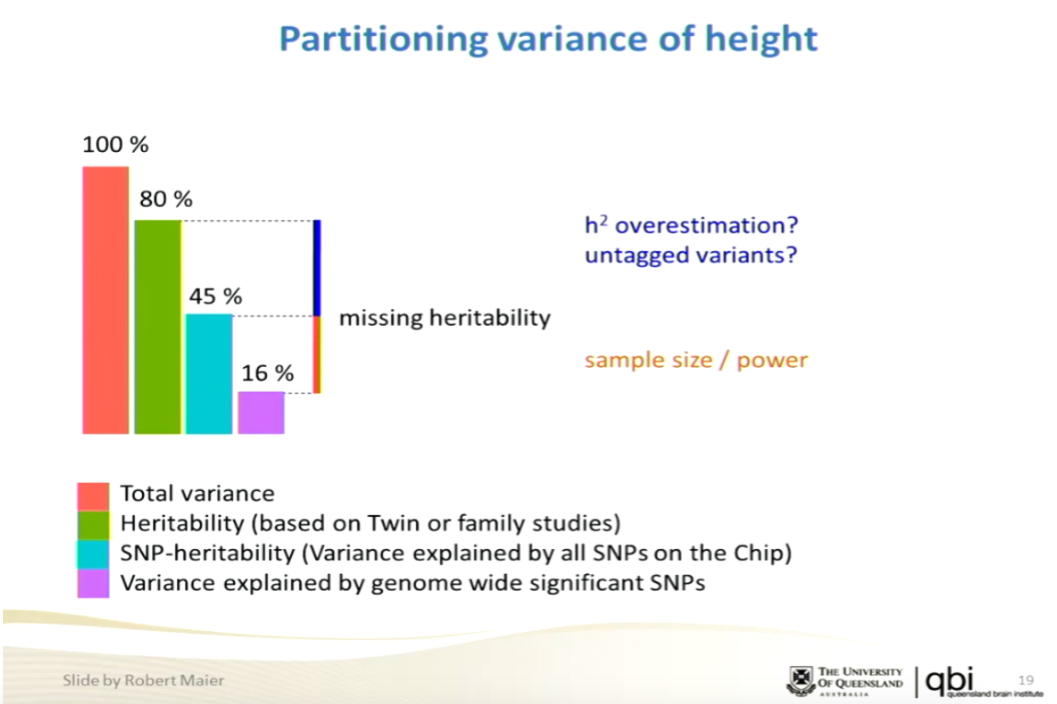
The broader debate over whether common variants will eventually account for significant heritability in many complex traits has been going on for years now. The centrality of GCTA results to this question decreases by the year as more and more heritability is accounted for by specific loci identified at genome wide significance in well-powered GWAS. For example, this slide (see talk on genomic prediction I gave in 2015 at NIH and HLI) shows that GWAS hits on height now account for 16% of total variance. That means a predictor could be constructed with correlation ~0.4 to the actual trait. I think the argument is basically over, unless you have some ulterior motive for denying the potential of genomic prediction.

A recent PNAS paper by researchers at Stanford claims to identify many problems with GCTA. The conclusions of this paper have been hotly contested by the GCTA authors and others.
Earlier post (January 1, 2016) on PNAS paper Limitations of GCTA as a solution to the missing heritability problem. (See also: many posts on this blog which mention GCTA.)This dispute shows the utility of blogs (Gusev) and biorxiv for rapid scientific discussion. Some of the commentaries listed above are 20+ pages long with figures and equations. This discussion would not have been possible (or would have taken months or years) in a journal setting.
Detailed comments and analysis here and here by Sasha Gusev. Gusev claims that the problems identified in Figs 4,7 are the result of incorrect calculation of the SE (4) and failure to exclude related individuals in the Framingham data (7).
GCTA authors Visscher, Yang, et al. respond to PNAS paper -- they accept none of the criticisms (February 13, 2016 biorxiv).
PNAS authors reply to Visscher, Yang, et al. comments (February 16, 2016 bioarxiv). They claim that relatedness thresholding used with GCTA analysis is flawed and that residual standard errors are much larger than claimed.
Gamazon and Park (February 18, 2016 bioarxiv) question spectral analysis and random matrix theory results in the PNAS paper. (I believe this is the first critique which looks at the mathematics of the PNAS paper, as opposed to simulation results.)
The next step should be a mini-workshop conducted online, with each group allowed 30 min to present their results, followed by questions :-)
I've always felt that the real weakness of GCTA is the assumption of random effects. A consequence of this assumption is that if the true causal variants are atypical (e.g., in terms of linkage disequilibrium) among common SNPs, the results could be biased. It is impossible to evaluate this uncertainty at the moment because we do not yet know the genetic architectures of any complex traits. See Why does GCTA work? for more discussion and a link to work by Lee and Chow examining this issue.
Recently, a promising new method (Heritability Estimates from Summary Statistics) has been proposed which does not make assumptions about the effect size distribution -- it uses GWAS estimates of effect size to directly estimate variance accounted for by each region of the genome. The initial application of this method also suggests significant heritability due to common variants.
The broader debate over whether common variants will eventually account for significant heritability in many complex traits has been going on for years now. The centrality of GCTA results to this question decreases by the year as more and more heritability is accounted for by specific loci identified at genome wide significance in well-powered GWAS. For example, this slide (see talk on genomic prediction I gave in 2015 at NIH and HLI) shows that GWAS hits on height now account for 16% of total variance. That means a predictor could be constructed with correlation ~0.4 to the actual trait. I think the argument is basically over, unless you have some ulterior motive for denying the potential of genomic prediction.
Wednesday, February 17, 2016
Elite schools, birthright, and credentials
In mixing together the truly talented with the rich and powerful, elite US universities perform a useful service to both groups.
Khan is discussing themes related to his book Privilege: The Making of an Adolescent Elite at St. Paul's School.
See also Credentialism and elite employment , Credentialism and elite performance, and Defining Merit.
Bloomberg View: Save Us From The Ivy League Oligarchy.
NIH peer review percentile scores are poorly predictive of grant productivity

The impacts of studies ranked in the 3rd to 20th percentile are more or less statistically indistinguishable. With current funding lines as low as 10th percentile, this means that many unfunded proposals are better than funded studies.
NIH peer review percentile scores are poorly predictive of grant productivity
DOI: 10.7554/eLife.13323.001
Peer review is widely used to assess grant applications so that the highest ranked applications can be funded. A number of studies have questioned the ability of peer review panels to predict the productivity of applications, but a recent analysis of grants funded by the National Institutes of Health (NIH) in the US found that the percentile scores awarded by peer review panels correlated with productivity as measured by citations of grant-supported publications. Here, based on a re-analysis of these data for the 102,740 funded grants with percentile scores of 20 or better, we report that these percentile scores are a poor discriminator of productivity. This underscores the limitations of peer review as a means of assessing grant applications in an era when typical success rates are often as low as about 10%.
Sunday, February 14, 2016
Free Harvard, Fair Harvard: Enrollment Trends
The graph below shows changes in the number of Harvard students by ethnic group, relative to the total college age US population of that group (Harvard Enrollment Per Capita = HEPC). Over the last 20 years, the Asian American HEPC has declined by almost 60%. Unless Asian American applicants to Harvard have, on average, declined significantly in relative quality (anecdotal evidence suggests that is far from true), we are left with a mystery: Why has Asian American HEPC declined so precipitously?
Only the innumerate can fail to be intrigued (alarmed? offended?) by this simple observation.
Some caveats: both numerator and denominator for HPEC are difficult to determine. The former comes from NCES data (National Center for Education Statistics), self-reported by universities. The denominator comes from Census bureau Current Population Survey data, and is a bit noisy year to year. I doubt we can trust the HEPC number from one year to the next, but the 20 year trend is probably roughly reliable.

The Economist covered this topic recently in an article entitled The model minority is losing patience. From their chart, one can see that the HEPC mystery extends to the rest of the Ivy League: Asian American enrollment at the Ivies has mysteriously converged at around 15-20%, despite the huge growth in college age Asian American population over the last 20 years.

Caltech is the one school among those in the graph which explicitly declines to use race as a preference (or penalty) in admissions. Caltech has the academically strongest student body and its alumni win more Nobel Prizes and major science and technology awards per capita than any other school.
If you are a Harvard degree holder, I urge you to vote for the Free Harvard, Fair Harvard slate in the coming Overseer elections this spring. We are asking for greater transparency in Harvard admissions, which would help resolve the HEPC mystery discussed above.
See also 20 years @15 percent: does Harvard discriminate against Asian-Americans?
Only the innumerate can fail to be intrigued (alarmed? offended?) by this simple observation.
Some caveats: both numerator and denominator for HPEC are difficult to determine. The former comes from NCES data (National Center for Education Statistics), self-reported by universities. The denominator comes from Census bureau Current Population Survey data, and is a bit noisy year to year. I doubt we can trust the HEPC number from one year to the next, but the 20 year trend is probably roughly reliable.

The Economist covered this topic recently in an article entitled The model minority is losing patience. From their chart, one can see that the HEPC mystery extends to the rest of the Ivy League: Asian American enrollment at the Ivies has mysteriously converged at around 15-20%, despite the huge growth in college age Asian American population over the last 20 years.

Caltech is the one school among those in the graph which explicitly declines to use race as a preference (or penalty) in admissions. Caltech has the academically strongest student body and its alumni win more Nobel Prizes and major science and technology awards per capita than any other school.
If you are a Harvard degree holder, I urge you to vote for the Free Harvard, Fair Harvard slate in the coming Overseer elections this spring. We are asking for greater transparency in Harvard admissions, which would help resolve the HEPC mystery discussed above.
See also 20 years @15 percent: does Harvard discriminate against Asian-Americans?
The historical parallels with anti-semitic practices of the early 20th century are reviewed in detail:
... In a letter to the chairman of the committee, President Lowell wrote that “questions of race,” though “delicate and disagreeable,” were not solved by ignoring them. The solution was a new admissions system giving the school wide discretion to limit the admission of Jewish applicants: “To prevent a dangerous increase in the proportion of Jews, I know at present only one way which is at the same time straightforward and effective, and that is a selection by a personal estimate of character on the part of the Admissions authorities ... The only way to make a selection is to limit the numbers, accepting those who appear to be the best.”
... The reduction in Jewish enrollment at Harvard was immediate. The Jewish portion of Harvard’s entering class dropped from over 27 percent in 1925 to 15 percent the following year. For the next 20 years, this percentage (15 percent) remained virtually unchanged.
... The new policy permitted the rejection of scholastically brilliant students considered “undesirable,” and it granted the director of admissions broad latitude to admit those of good background with weaker academic records. The key code word used was “character” — a quality thought to be frequently lacking among Jewish applicants, but present congenitally among affluent Protestants.
Friday, February 12, 2016
Epistasis and Complex Traits
Short summary: To first approximation we can ignore gene-gene interactions in the prediction of complex traits. This paper examines specifically how non-additive variance is driven to zero as the number of loci involved becomes large, assuming some dispersion in allele frequencies.
Earlier paper of Hill, Goddard, and Visscher and the simpler 2 locus case is discussed here.
Earlier paper of Hill, Goddard, and Visscher and the simpler 2 locus case is discussed here.
Influence of Gene Interaction on Complex Trait Variation with Multilocus ModelsSee also Determination of Nonlinear Genetic Architecture using Compressed Sensing, and related posts on epistasis and additivity.
Asko Mäki-Tanila, William G. Hill
GENETICS September 18, 2014 vol. 198 no. 1 355-367; DOI: 10.1534/genetics.114.165282
Although research effort is being expended into determining the importance of epistasis and epistatic variance for complex traits, there is considerable controversy about their importance. Here we undertake an analysis for quantitative traits utilizing a range of multilocus quantitative genetic models and gene frequency distributions, focusing on the potential magnitude of the epistatic variance. All the epistatic terms involving a particular locus appear in its average effect, with the number of two-locus interaction terms increasing in proportion to the square of the number of loci and that of third order as the cube and so on. Hence multilocus epistasis makes substantial contributions to the additive variance and does not, per se, lead to large increases in the nonadditive part of the genotypic variance. Even though this proportion can be high where epistasis is antagonistic to direct effects, it reduces with multiple loci. As the magnitude of the epistatic variance depends critically on the heterozygosity, for models where frequencies are widely dispersed, such as for selectively neutral mutations, contributions of epistatic variance are always small. Epistasis may be important in understanding the genetic architecture, for example, of function or human disease, but that does not imply that loci exhibiting it will contribute much genetic variance. Overall we conclude that theoretical predictions and experimental observations of low amounts of epistatic variance in outbred populations are concordant. It is not a likely source of missing heritability, for example, or major influence on predictions of rates of evolution.
Subscribe to:
Posts (Atom)