This change in zeitgeist makes the thought experiment proposed below much less outlandish. What, exactly, does Gork perceive? Why couldn't you be Gork? (Note that the AGI in Gork can be an entirely classical algorithm even though he exists in a quantum simulation.)
Slide from this [Caltech IQI] talk. See also illustrations in Big Ed.
Survey questions:
1) Could you be Gork the robot? (Do you split into different branches after observing the outcome of, e.g., a Stern-Gerlach measurement?)
2) If not, why? e.g.,
I have a soul and Gork doesn't! Copenhagen people, please use exit on your left.
Decoherence solved all that! Sorry, try again. See previous post.
I don't believe that quantum computers will work as designed, e.g., sufficiently large algorithms or subsystems will lead to real (truly irreversible) collapse. Macroscopic superpositions that are too big (larger than whatever was done in the lab last week!) are impossible.
QM is only an algorithm for computing probabilities -- there is no reality to the quantum state or wavefunction or description of what is happening inside a quantum computer. Tell this to Gork!
Stop bothering me -- I only care about real stuff like the Higgs mass / SUSY-breaking scale / string Landscape / mechanism for high-Tc / LIBOR spread / how to generate alpha.
[ 2018: Ha Ha -- first 3 real stuff topics turned out to be pretty boring use of the last decade... ]
Just as A. and B. above have become less outlandish assumptions, our ability to create large and complex superposition states with improved technology (largely developed for quantum computing; see Schrodinger's Virus) will make the possibility that we ourselves exist in a superposition state less shocking. Future generations of physicists will wonder why it took their predecessors so long to accept Many Worlds.
Bonus!I will be visiting Caltech next week (Tues and Weds 1/8-9). Any blog readers interested in getting a coffee or beer please feel free to contact me :-)
I have waited for this development since 2009 (see old post below).
The fact that a macroscopic, living organism can be placed in a superposition state may come as a shock to many people, including a number of physicists.
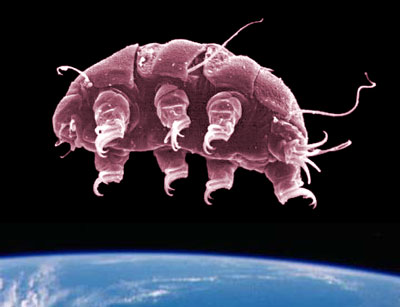
If a tardigrade can exist in a superposition state, why can't you?
Are you in a superposition state right now?
Is there some special class of objects that "collapse wavefunctions"? (Copenhagen) ... It's ridiculous, absurd. In any case we now know that tardigrades are not in that class.
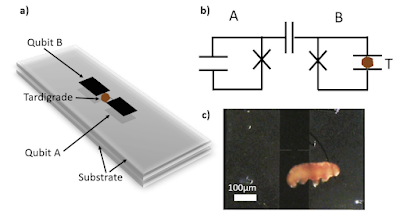
Quantum and biological systems are seldom discussed together as they seemingly demand opposing conditions. Life is complex, "hot and wet" whereas quantum objects are small, cold and well controlled. Here, we overcome this barrier with a tardigrade -- a microscopic multicellular organism known to tolerate extreme physiochemical conditions via a latent state of life known as cryptobiosis. We observe coupling between the animal in cryptobiosis and a superconducting quantum bit and prepare a highly entangled state between this combined system and another qubit. The tardigrade itself is shown to be entangled with the remaining subsystems. The animal is then observed to return to its active form after 420 hours at sub 10 mK temperatures and pressure of 6×10⁻⁶ mbar, setting a new record for the conditions that a complex form of life can survive.
From the paper:
In our experiments, we use specimens of a Danish population of Ramazzottius varieornatus Bertolani and Kinchin, 1993 (Eutardigrada, Ramazzottiidae). The species belongs to phylum Tardigrada comprising of microscopic invertebrate animals with an adult length of 50-1200 µm [12]. Importantly, many tardigrades show extraordinary survival capabilities [13] and selected species have previously been exposed to extremely low temperatures of 50 mK [14] and low Earth orbit pressures of 10−19 mbar [15]. Their survival in these extreme conditions is possible thanks to a latent state of life known as cryptobiosis [2, 13]. Cryptobiosis can be induced by various extreme physicochemical conditions, including freezing and desiccation. Specifically, during desiccation, tardigrades reduce volume and contract into an ametabolic state, known as a “tun”. Revival is achieved by reintroducing the tardigrade into liquid water at atmospheric pressure. In the current experiments, we used dessicated R. varieornatus tuns with a length of 100-150 µm. Active adult specimens have a length of 200-450 µm. The revival process typically takes several minutes.
We place a tardigrade tun on a superconducting transmon qubit and observe coupling between the qubit and the tardigrade tun via a shift in the resonance frequency of the new qubit-tardigrade system. This joint qubit-tardigrade system is then entangled with a second superconducting qubit. We reconstruct the density matrix of this coupled system experimentally via quantum state tomography. Finally, the tardigrade is removed from the superconducting qubit and reintroduced to atmospheric pressure and room temperature. We observe the resumption of its active metabolic state in water.
****
Note Added: I wrote this post the day after getting a Covid booster and a shingles vaccine, so I was a little zonked out and was not able to look at the details at the time.
The authors claim that the B qubit states B0 and B1 are entangled with two different internal states of T (tardigrade): B0 T0 , B1 T1.
Then they further entangle B with the other qubit A to make more complex states.
In the supplement they analyze the density matrix for this d=8 Hilbert space, and claim to have measured quantities which imply tripartite entanglement. The results seem to depend on theoretical modeling -- I don't think they made any direct measurements on T.
They do not present any uncertainty analysis of the tripartite entanglement measure π.
The line in the main body of the paper that sounds convincing is We reconstruct the density matrix of this coupled system experimentally via quantum state tomography (see Fig 3), but the devil is in the details:
... a microscopic model where the charges inside the tardigrade
are represented as effective harmonic oscillators that couple to the electric field of the qubit via the dipole mechanism... [This theoretical analysis results in the B0 T0 , B1 T1 system where T0 T1 are effective qubits formed of tardigrade internal degrees of freedom.]
...
We applied 16 different combinations of one-qubit gates on qubit A and dressed states of the joint qubit B-tardigrade system. We then jointly readout the state of both qubits using the cavity ...
Some commentary online is very skeptical of their claims, see here for example.
More (12/23/2021): One of the co-authors is Vlatko Vedral, a well-known theorist who works in this area. His recent blog post Entangled Tardigrades is worth a look.
After thinking a bit more, the B0 T0 , B1 T1 description of the system seems plausible to me. So, although they don't make direct measurements on T (only on the combined B-T system), it does seem reasonable to assert that the tardigrade (or at least some collective degree of freedom related to internal charges of it) has been placed into a superposition state.
If the creature above (a tardigrade arthropod) can be placed in a superposition state, will you accept that you probably can be as well? And once you admit this, will you accept that you probably actually DO exist in a superposition state already?
It may be disturbing to learn that we live in a huge quantum multiverse, but was it not also disturbing for Galileo's contemporaries to learn that we live on a giant rotating sphere, hurtling through space at 30 kilometers per second? E pur si muove!
Of course there is no wavefunction collapse, only unitary evolution.
Many people are confused about this -- they have not recovered from what they were taught as beginning students. They still believe in the Tooth Fairy ;-)
Gork is a robot name made up by Sidney Coleman for his talk Quantum Mechanics, In Your Face! (video, Gork @40m or so). Before the word entanglement became fashionable, Sidney summarized this talk to me in his office as "Quantum Mechanics is just a theory of correlations, and we live in this tangle of correlations." He may not have said "tangle" -- I am not sure. But he was describing the Everett formulation, trying not to scare a young postdoc :-)
arXiv:2011.11661, to appear in Foundations of Physics
For any choice of initial state and weak assumptions about the Hamiltonian, large isolated quantum systems undergoing Schrodinger evolution spend most of their time in macroscopic superposition states. The result follows from von Neumann's 1929 Quantum Ergodic Theorem. As a specific example, we consider a box containing a solid ball and some gas molecules. Regardless of the initial state, the system will evolve into a quantum superposition of states with the ball in macroscopically different positions. Thus, despite their seeming fragility, macroscopic superposition states are ubiquitous consequences of quantum evolution. We discuss the connection to many worlds quantum mechanics.
... Quantum technology has made great strides over the past two decades and physicists are now able to construct and manipulate systems that were once in the realm of thought experiments. One particularly fascinating avenue of inquiry is the fuzzy border between quantum and classical physics. In the past, a clear delineation could be made in terms of size: tiny objects such as photons and electrons inhabit the quantum world whereas large objects such as billiard balls obey classical physics.
Over the past decade, physicists have been pushing the limits of what is quantum using drum-like mechanical resonators measuring around 10 microns across. Unlike electrons or photons, these drumheads are macroscopic objects that are manufactured using standard micromachining techniques and appear as solid as billiard balls in electron microscope images (see figure). Yet despite the resonators’ tangible nature, researchers have been able to observe their quantum properties, for example, by putting a device into its quantum ground state as Teufel and colleagues did in 2017.
This year, teams led by Teufel and Kotler and independently by Sillanpää went a step further, becoming the first to quantum-mechanically entangle two such drumheads. The two groups generated their entanglement in different ways. While the Aalto/Canberra team used a specially chosen resonant frequency to eliminate noise in the system that could have disturbed the entangled state, the NIST group’s entanglement resembled a two-qubit gate in which the form of the entangled state depends on the initial states of the drumheads. ...
I don't believe that quantum computers will work as designed, e.g., sufficiently large algorithms or subsystems will lead to real (truly irreversible) collapse. Macroscopic superpositions larger than whatever was done in the lab last week are impossible.
QM is only an algorithm for computing probabilities -- there is no reality to the quantum state or wavefunction or description of what is happening inside a quantum computer.
Stop bothering me -- I only care about real stuff like the Higgs mass / SUSY-breaking scale / string Landscape / mechanism for high-Tc / LIBOR spread / how to generate alpha.
In quantum mechanics the state of the universe evolves deterministically: the state of the entire universe at time zero fully determines its state at any later time. It is difficult to reconcile this observation with our experience as macroscopic, nearly classical, beings. To us it seems that there are random outcomes: the state of an electron (spin-up in the z direction) does not in general determine the outcome of a measurement of its spin (x direction measurement probability 1/2 of either spin up or down). This is because our brains (information processing devices) are macroscopic: one macroscopic state (memory record) is associated with the spin up outcome, which rapidly loses contact (decoheres) from the other macroscopic state with memory record of the spin down outcome. Nevertheless, the universe state, obtained from deterministic Schrodinger evolution of the earlier state, is a superposition:
| brain memory recorded up, spin up >
+
| brain memory recorded down, spin down >.
We are accustomed to thinking about classical information processing machines: brains and computers. However, with the advent of quantum computers a new possibility arises: a device which (necessarily) resides in a superposition state, and uses superposition as an integral part of its information processing.
What can we say about this kind of (quantum) intelligence? Must it be "artificial"? Could there be a place in the multiverse where evolved biological beings use superposition and entanglement as a resource for information processing?
Any machine of the type described above must be vast and cold. Vast, because many qubits are required for self-awareness and consciousness (just as many bits are required for classical AI). Cold, because decoherence destroys connections across superpositions. Too much noise (heat), and it devolves back to isolated brains, residing on decohered branches of the wavefunction.
One could regard human civilization as a single intelligence or information processing machine. This intelligence is rapidly approaching the point where it will start to use entanglement as a significant resource. It is vast, and (in small regions -- in physics labs) cold enough. We can anticipate more and larger quantum computers distributed throughout our civilization, making greater and greater use of nearby patches of the multiverse previously inaccessible.
Perhaps some day a single quantum computer might itself be considered intelligent -- the first of new kind!
What will it think?
Consciousness in a mini multiverse... Thoughts which span superpositions.
The Simulation Hypothesis is the idea that our universe might be part of a simulation: we are not living in base reality. (See, e.g., earlier discussion here.)
There are many versions of the argument supporting this hypothesis, which has become more plausible (or at least more popular) over time as computational power, and our familiarity with computers and virtual worlds within them, has increased.
Modern cosmology suggests that our universe, our galaxy, and our solar system, have billions of years ahead of them, during which our civilization (currently only ~10ky old!), and others, will continue to evolve. It seems reasonable that technology and science will continue to advance, delivering ever more advanced computational platforms. Within these platforms it is likely that quasi-realistic simulations, of our world, or of imagined worlds (e.g., games), will be created, many populated by AI agents or avatars. The number of simulated beings could eventually be much larger than the number of biologically evolved sentient beings. Under these assumptions, it is not implausible that we ourselves are actually simulated beings, and that our world is not base reality.
One could object to using knowledge about our (hypothetically) simulated world to reason about base reality. However, the one universe that we have direct observational contact with seems to permit the construction of virtual worlds with large populations of sentient beings. While our simulation may not be entirely representative of base reality, it nevertheless may offer some clues as to what is going on "outside"!
The simulation idea is very old. It is almost as old as computers themselves. However, general awareness of the argument has increased significantly, particularly in the last decade. It has entered the popular consciousness, transcending its origins in the esoteric musings of a few scientists and science fiction authors.
The concept of a quantum computer is relatively recent -- one can trace the idea back to Richard Feynman's early-1980s Caltech course: Physical Limits to Computation. Although quantum computing has become a buzzy part of the current hype cycle, very few people have any deep understanding of what a quantum computer actually is, and why it is different from a classical computer. A prerequisite for this understanding is a grasp of both the physical and mathematical aspects of quantum mechanics, which very few possess. Individuals who really understand quantum computing tend to have backgrounds in theoretical physics, physics, or perhaps computer science or mathematics.
The possibility of quantum computers requires that we reformulate the Simulation Hypothesis in an important way. If one is willing to posit future computers of gigantic power and complexity, why not quantum computers of arbitrary power? And why not simulations which run on these quantum computers, making use of quantum algorithms? After all, it was Feynman's pioneering observation that certain aspects of the quantum world (our world!) are more efficiently simulated using a quantum computer than a classical (e.g., Turing) machine. (See quantum extension of the Church-Turing thesis.) Hence the original Simulation Hypothesis should be modified to the Quantum Simulation Hypothesis: Do we live in a quantum simulation?
There is an important consequence for those living in a quantum simulation: they exist in a quantum multiverse. That is, in the (simulated) universe, the Many Worlds description of quantum mechanics is realized. (It may also be realized in base reality, but that is another issue...) Within the simulation, macroscopic, semiclassical brains perceive only one branch of the almost infinite number of decoherent branches of the multiverse. But all branches are realized in the execution of the unitary algorithm running on qubits. The power of quantum computing, and the difficulty of its realization, both derive from the requirement that entanglement and superposition be maintained in execution.
Given sufficiently powerful tools, the beings in the simulation could test whether quantum evolution of qubits under their control is unitary, thereby verifying the absence of non-unitary wavefunction collapse, and the existence of other branches (see, e.g., Deutsch 1986).
We can give an anthropic version of the argument as follows.
1. The physical laws and cosmological conditions of our universe seem to permit the construction of large numbers of virtual worlds containing sentient beings.
2. These simulations could run on quantum computers, and in fact if the universe being simulated obeys the laws of quantum physics, the hardware of choice is a quantum computer. (Perhaps the simulation must be run on a quantum computer!)
If one accepts points 1 and 2 as plausible, then: Conditional on the existence of sentient beings who have discovered quantum physics (i.e., us), the world around them is likely to be a simulation running on a quantum computer. Furthermore, these beings exist on a branch of the quantum multiverse realized in the quantum computer, obeying the rules of Many Worlds quantum mechanics. The other branches must be there, realized in the unitary algorithm running on (e.g., base reality) qubits.
Quantum gravitational effects suggest a minimal length, or spacetime interval, of order the Planck length. This in turn suggests that Hilbert space itself may be discrete rather than continuous. One implication is that quantum states with norm below some very small threshold do not exist. The exclusion of what Everett referred to as maverick branches is necessary for the emergence of the Born Rule in no collapse quantum mechanics. We discuss this in the context of quantum gravity, showing that discrete models (such as simplicial or lattice quantum gravity) indeed suggest a discrete Hilbert space with minimum norm. These considerations are related to the ultimate level of fine-graining found in decoherent histories (of spacetime geometry plus matter fields) produced by quantum gravity.
From the Discussion:
No collapse (or many worlds) versions of quantum mechanics are often characterized as extravagant, because of the many branches of the wavefunction. However it is also extravagant to postulate that spacetime or Hilbert space are infinitely continuous. Continuous Hilbert space requires that for any two choices of orientation of a qubit spin (see Figure 1), no matter how close together, there are an infinite number of physically distinct states between them, with intermediate orientation. Instead, there may only be a finite (but very large) number of distinct orientations allowed, suggesting a minimum norm in Hilbert space. No experiment can probe absolute continuity, and indeed there seem to be fundamental limits on such experiments, arising from quantum gravity itself.
We illustrated a direct connection between discrete spacetime (the simplex length a) and discrete Hilbert space (minimum non-zero distance in Hilbert space produced by time evolution), in a specific class of quantum gravity models based on Feynman path integrals. It may be the case that maximally fine-grained decoherent histories generated within quantum gravity have discrete geometries and exist in a discrete Hilbert space. Consequently histories with sufficiently small norm are never generated, thereby solving Everett's problem with maverick branches. In the remaining branches, deviations from Born Rule probabilities are almost entirely hidden from semi-classical observers. ...
If the creature above (a tardigrade arthropod) can be placed in a superposition state, will you accept that you probably can be as well? And once you admit this, will you accept that you probably actually DO exist in a superposition state already?
It may be disturbing to learn that we live in a huge quantum multiverse, but was it not also disturbing for Galileo's contemporaries to learn that we live on a giant rotating sphere, hurtling through space at 30 kilometers per second? E pur si muove!
Economist: ONE of the most famous unperformed experiments in science is Schrödinger’s cat. In 1935 Erwin Schrödinger (pictured), who was one of the pioneers of quantum mechanics, imagined putting a cat, a flask of Prussic acid, a radioactive atom, a Geiger counter, an electric relay and a hammer in a sealed box. If the atom decays, the Geiger counter detects the radiation and sends a signal that trips the relay, which releases the hammer, which smashes the flask and poisons the cat.
The point of the experiment is that radioactive decay is a quantum process. The chance of the atom decaying in any given period is known. Whether it has actually decayed (and thus whether the cat is alive or dead) is not—at least until the box is opened. The animal exists, in the argot of the subject, in a “superposition” in which it is both alive and dead at the same time.
Schrödinger’s intention was to illuminate the paradoxes of the quantum world. But superposition (the existence of a thing in two or more quantum states simultaneously) is real and is, for example, the basis of quantum computing. A pair of researchers at the Max Planck Institute for Quantum Optics in Garching, Germany, now propose to do what Schrödinger could not, and put a living organism into a state of quantum superposition.
The organism Ignacio Cirac and Oriol Romero-Isart have in mind is the flu virus. [arxiv] Pedants might object that viruses are not truly alive, but that is a philosophical rather than a naturalistic argument, for they have genes and are capable of reproduction—a capability they lose if they are damaged. The reason for choosing a virus is that it is small. Actual superposition (as opposed to the cat-in-a-box sort) is easiest with small objects, for which there are fewer pathways along which the superposition can break down. Physicists have already put photons, electrons, atoms and even entire molecules into such a state and measured the outcome. In the view of Dr Cirac and Dr Romero-Isart, a virus is just a particularly large molecule, so existing techniques should work on it.
The other thing that helps maintain superposition is low temperature. The less something jiggles about because of heat-induced vibration, the longer it can remain superposed. Dr Cirac and Dr Romero-Isart therefore propose putting the virus inside a microscopic cavity and cooling it down to its state of lowest energy (ground state, in physics parlance) using a piece of apparatus known as a laser trap. This ingenious technique—which won its inventors, one of whom was Steven Chu, now America’s energy secretary, a Nobel prize—works by bombarding an object with laser light at a frequency just below that which it would readily absorb and re-emit if it were stationary. This slows down the movement, and hence the temperature, of its atoms to a fraction of a degree above absolute zero.
Once that is done, another laser pulse will jostle the virus from its ground state into an excited state, just as a single atom is excited by moving one of its electrons from a lower to a higher orbital. By properly applying this pulse, Dr Cirac believes it will be possible to leave the virus in a superposition of the ground and excited states.
For that to work, however, the virus will need to have certain physical properties. It will have to be an insulator and to be transparent to the relevant laser light. And it will have to be able to survive in a vacuum. Such viruses do exist. The influenza virus is one example. Its resilience is legendary. It can survive exposure to a vacuum, and it seems to be an insulator—which is why the researchers have chosen it. And if the experiment works on a virus, they hope to move on to something that is indisputably alive: a tardigrade.
Tardigrades are tiny but resilient arthropods. They can survive in vacuums and at very low temperatures. And, although the difference between ground state and an excited state is not quite the difference between life and death, Schrödinger would no doubt have been amused that his 70-year-old jeu d’esprit has provoked such an earnest following.
Of related interest, slides of a talk covering the same material, given at the Institute for Quantum Information at Caltech. (Check out Gork the robot!)
Title: Discreteness and the origin of probability in quantum mechanics
Authors: R. Buniy, S. Hsu, A. Zee
Attempts to derive the Born rule, either in the Many Worlds or Copenhagen interpretation, are unsatisfactory for systems with only a finite number of degrees of freedom. In the case of Many Worlds this is a serious problem, since its goal is to account for apparent collapse phenomena, including the Born rule for probabilities, assuming only unitary evolution of the wavefunction. For finite number of degrees of freedom, observers on the vast majority of branches would not deduce the Born rule. However, discreteness of the quantum state space, even if extremely tiny, may restore the validity of the usual arguments.
A relevant passage from a recent article by Steve Weinberg:
Bohr's version of quantum mechanics was deeply flawed, but not for the reason Einstein thought. The Copenhagen interpretation describes what happens when an observer makes a measurement, but the observer and the act of measurement are themselves treated classically. This is surely wrong: Physicists and their apparatus must be governed by the same quantum mechanical rules that govern everything else in the universe. But these rules are expressed in terms of a wavefunction (or, more precisely, a state vector) that evolves in a perfectly deterministic way. So where do the probabilistic rules of the Copenhagen interpretation come from?
Considerable progress has been made in recent years toward the resolution of the problem, which I cannot go into here. It is enough to say that neither Bohr nor Einstein had focused on the real problem with quantum mechanics. The Copenhagen rules clearly work, so they have to be accepted. But this leaves the task of explaining them by applying the deterministic equation for the evolution of the wavefunction, the Schrödinger equation, to observers and their apparatus. The difficulty is not that quantum mechanics is probabilistic—that is something we apparently just have to live with. The real difficulty is that it is also deterministic, or more precisely, that it combines a probabilistic interpretation with deterministic dynamics.