The essay describes their education as young physicists. They were examined by Landau himself at age 15, and by age 19 had written a paper anticipating the Higgs Mechanism and the role of spontaneous symmetry breaking in gauge theory.
Migdal: Khalat was a genius of political intrigue. Being married into Inner Circle of the Soviet System (his wife Valya is the daughter of a legendary Revolution hero), he used all his connections and all the means to achieve his secret goal — assemble the best brains and let them Think Freely.
On the surface, his pitch to the Party went as follows.
“The West is attacking us for anti-Semitism. The best way to counter this slander is to create an Institute, where Jews are accepted, allowed to travel abroad and generally look happy. This can be a very small Institute, by standards of Atomic Project, it will have no secret military research, it will cost you very little, but it will help “Rasryadka” (Détente). These Jews will be so happy, they will tell all their Jewish friends in the West how well they live. And if they won’t –it is after all, us who decide which one goes abroad and which one stays home. They are smart kids, they will figure out which side of the toast is buttered.”
As I put it, Khalat sold half of his soul to Devil and used the money to save another half. I truly respect him for that, now once I learned what it takes to create a startup and try to protect it against hostile world.
As many crazy plans before it, this plan really worked. Best brains were assembled in Landau Institute, they were given a chance to happily solve problems without being forced to eat political shit like the whole country and – yes, they sometimes traveled abroad and made friends in the West.
In a way the plan worked too well — we became so worldly and so free that we could no longer be controlled. And, needless to say, our friends in the West became closer to us that our curators in KGB.
I was in the 1990s generation of American physicists who had to contend on the job market with a stream of great theorists from the former Soviet Union. Both Migdal and Polyakov ended up at Princeton, and there were many others in their wake, closer to my age.
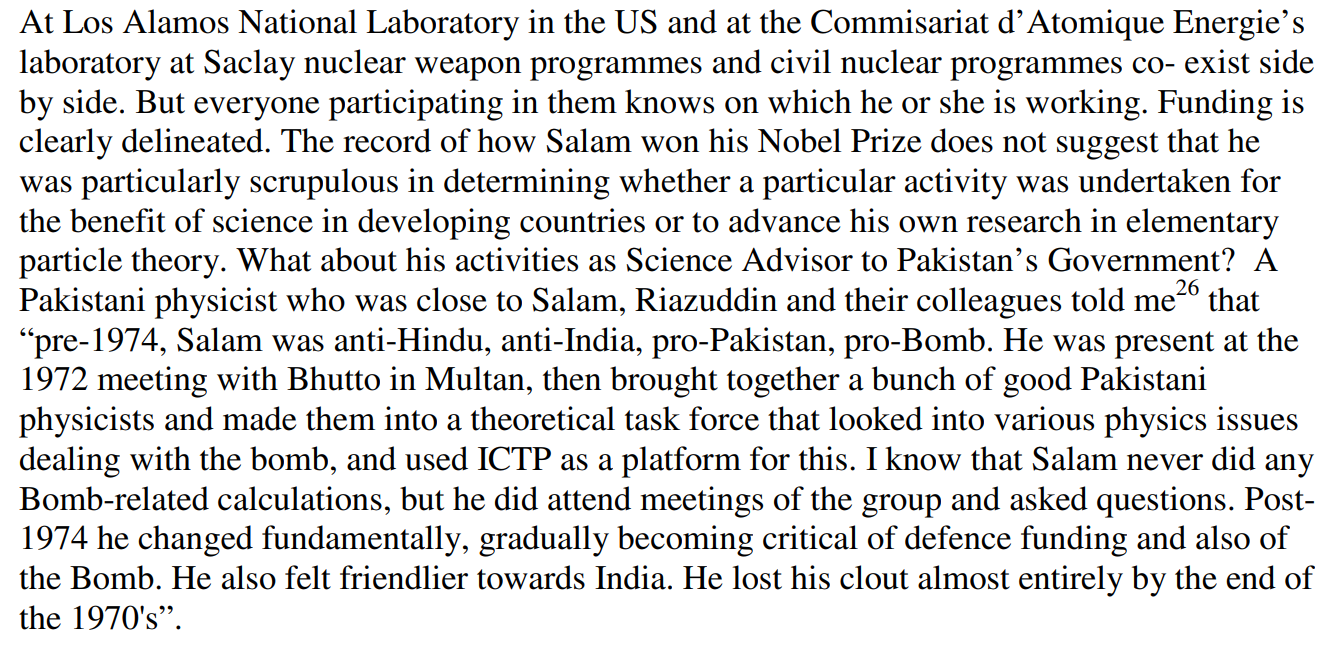
Salam's biographies claim that he was opposed to Pakistan's nuclear weapon programme. This is somewhat strange given that he was the senior Science Advisor to the Pakistan government for at least some of the period between 1972 when the programme was initiated and 1998 when a successful nuclear weapon test was carried out. I look at the evidence for his participation in the programme.
Salam shared the Nobel Prize with Glashow and Weinberg. He is a leading theoretician, although many have questioned what, exactly, was his contribution to the formulation of the electroweak theory of particle physics that Glashow and Weinberg contributed to.
Currently Pakistan's arsenal is ~200 warheads and similar in size to India's. Their largest warhead is estimated to have a yield of ~40kt, compared to ~20kt for the Indians.
What interested me the most was Salam's role in the early stages of the project.
See the paper for more interesting details. Previously I was only aware of Riazuddin through his academic publications, not his weapons work.
I mentioned to Karnad that I had been surprised that some of the Iranin theoreticians assassinated by Israel over the last 10-15 years had quite abstract research interests. They didn't seem the type to be working on bombs - but I suppose you never know!
Bharat Karnad is an Emeritus Professor in National Security Studies at the Center for Policy Research in Delhi. He was a member of India's first National Security Advisory Board and has authored several books on nuclear weapons and Indian security.
Robert Trumbull Crowley, former Deputy Director of Clandestine Operations for the CIA. Recorded conversations (Conversations With The Crow) near the end of his life:
".. their head expert was fully capable of building a bomb and we knew what he was up to. He was warned several times but what an arrogant prick that one was. Told our people to fuck off and then made it clear that no one would stop him and India from getting nuclear parity"
This is a follow up to our earlier work on quantum gravitational corrections to the exterior graviton field of a compact object, also known as quantum hair.
Here we follow the gravitational collapse of a dust ball and show that the quantum hair persists through the formation of a black hole horizon.
The detailed calculations are possible due to an effective field theory formulation of quantum gravity in the long wavelength, low spacetime curvature limit.
For decades, co-directed by David Lubinski and Camilla P. Benbow, SMPY has been a beacon of enlightenment, tracking five cohorts comprising over 5,000 remarkably gifted individuals. In doing so, we have unraveled the secrets to nurturing brilliance. However, we are confronted with a disconcerting reality: the effective methods to identify and cultivate intellectual talent are under siege, threatened by political ideology.
Our 14-minute documentary and the 3-page feature in Nature underscore the dire need to provide our most gifted youths with the educational opportunities they deserve. They are the architects of solutions and the architects of the future itself.
Here are some compelling longitudinal findings from SMPY's extensive research:
• Prodigies destined for eminent careers can be identified as early as age 13.
• There is no plateau of ability; even within the top 1%, variations in mathematical, spatial,
and verbal abilities profoundly impact educational, occupational, and creative outcomes.
• The blend of specific abilities, such as mathematical, spatial, and verbal aptitudes, shapes the nature of one's accomplishments and career trajectory.
Yasheng Huang is the Epoch Foundation Professor of Global Economics and Management at the MIT Sloan School of Management. His new book is The Rise and Fall of the EAST: How Exams, Autocracy, Stability, and Technology Brought China Success, and Why They Might Lead to Its Decline.
Steve and Yasheng discuss:
0:00 Introduction
1:11 From Beijing to Harvard in the 1980s
15:29 Civil service exams and Huang's new book, "The Rise and Fall of the EAST"
37:14 Two goals: Developing human capital and indoctrination
48:33 Impact of the exam system
57:04 China's innovation peak and decline
1:12:23 Collaboration and relationship with the West
1:21:31 How will the U.S.-China relationship evolve?
Alex Murshak is a Michigan State grad working as an AI engineer in Austin TX. This conversation is Episode 13 of his podcast Hacking State.
Episode description:
Steve and I speak about polygenic risk scoring and embryo selection, using AI to predict phenotype from genotype, in-vitro fertilization (IVF), egg freezing, eugenic public policy, addressing Christians' and right-wing traditionalists' concerns over reproductive technology, Superfocus AI's plan to eliminate hallucination in large language models (LLMs) by separating memory from inference, introspection for LLM error correction, and surviving the failed cancellation attempt at MSU.
I discuss 10 key graphs related to meritocracy and university admissions. Predictive power of SATs and other factors in elite admissions decisions. College learning outcomes - what do students learn? The four paths to elite college admission. Laundering prestige at the Ivies.
I really enjoyed this long conversation with Dan Schulz, an MSU engineering grad who works in tech. Dan did his homework and we covered a lot of important topics.
Tim Dettmers develops computationally efficient methods for deep learning. He is a leader in quantization: coarse graining of large neural networks to increase speed and reduce hardware requirements.
Tim developed 4-and 8-bit quantizations enabling training and inference with large language models on affordable GPUs and CPUs - i.e., as commonly found in home gaming rigs.
Tim and Steve discuss: Tim's background and current research program, large language models, quantization and performance, democratization of AI technology, the open source Cambrian explosion in AI, and the future of AI.
Richard Hanania, Rob Henderson, and I were scheduled for a June 2023 panel as part of the University of Austin (UATX) Forbidden Courses series. I missed the panel due to travel issues, but we gathered on this podcast to recreate the fun!
Topics:
0:00 Introduction
1:20 The University of Austin and forbidden courses
17:37 Will woke campus culture change anytime soon?
29:57 Common people vs elites on affirmative action
35:42 Why it’s uncomfortable to disagree about affirmative action
41:22 Fraud and misrepresentation in higher ed
44:20 The adversity carveout in the Supreme Court affirmative action ruling
50:10 Standardized testing and elite university admissions
1:06:18 Divergent views among racial and ethnic groups on affirmative action; radicalized Asian American males
1:10:00 Differences between East and South Asians in the West
1:23:03 Class-based preferences and standardized tests
We found it interesting that quantum hair can already be found using the familiar Euler-Heisenberg effective action, which results from integrating out the electron in QED.
The paper also contains a general argument for why solutions to the semiclassical field equations resulting from the effective action (both in gravity and QED) carry more information about the state of the source than in classical physics.
From the Conclusions:
The quantum effective actions for both electrodynamics and gravity lead to field equations which couple a compact source (charge current or energy-momentum tensor) to external fields (electromagnetic or graviton field) in a manner which, generically, leads to quantum memory and quantum hair effects. External solutions of the field equations deviate, due to quantum corrections, from the familiar classical forms that satisfy the Gauss law. As a specific consequence, more information about the interior source configuration is encoded in the external field than in the classical theory.
As specific applications, we considered semiclassical sources (large black hole, macroscopic charge distribution), which allowed us to solve the quantum corrected field equations by expanding around a classical solution. However, fully quantum statements regarding quantum hair are also possible, which do not, for example, require a semiclassical source. In [1–3] it was shown that the quantum state of a compact source (e.g., in an energy eigenstate or superposition thereof) determines certain aspects of the quantum state of its external field. In principle, measurements of the external fields can fully determine the interior state of a black hole.
Richard Sander is Jesse Dukeminier Professor at UCLA Law School. AB Harvard, JD, PhD (Economics) Northwestern.
Steve and Richard discuss the recent Supreme Court ruling in Students For Fair Admissions vs Harvard and UNC.
Sander has studied the structure and effects of law school admissions policies. He coined the term "Mismatch" to describe negative consequences resulting from large admissions preferences.
0:00 Introduction
1:09 Richard Sander’s initial reaction to the Supreme Court ruling
4:03 How data influenced the court’s decision
7:58 Overview of the court’s ruling
11:27 Carve outs in the court’s ruling
16:59 The litigation landscape
21:25 Workarounds to race-blind admissions and the UC system
32:22 Remedies: What will happen with Harvard and UNC now?
38:02 The landscape of college admissions
44:47 Effects of the Supreme Court ruling beyond higher education
... But monogenic and chromosomal screening can only address a part of disease risk because most health conditions that afflict people are polygenic, meaning they are not simply caused by one gene or by a chromosomal abnormality. Instead, they are caused by a huge number of small additive effects dispersed throughout the genome. For example, cancer, schizophrenia, and diabetes can be best predicted by models using tens of thousands of genes.
A polygenic risk score (PRS) looks at a person’s DNA to see how many variants they have associated with a particular disease. Like BRCA1, polygenic risk scores are typically not determinative: “Polygenic screening is not a diagnosis: It is a prediction of relative future risk compared to other people.” In other words, someone with BRCA1 has a higher risk than someone without, and someone with a high breast cancer PRS has a higher risk than someone with a lower breast cancer PRS. But in principle, BRCA1 is just one gene out of thousands contributing to a PRS, with each bit contributing a small part of a total risk estimate. ...
... Recently, a group of European scientists argued that polygenic screening should not be available to couples because it will lead to stigmatization, exacerbate inequalities, or lead to confusion by parents about how to weigh up information about risks before they decide which embryo to implant. These are indeed challenges, but they are not unique to embryo selection using polygenic scores, and they are not plausible arguments for restricting the autonomy of parents who wish to screen their embryos for polygenic traits. Furthermore, from an ethical perspective, it is unconscionable to deny polygenic screening to families with a history of any disease whose risk can be reduced by this lifesaving technology.
Many new technologies are initially only available to people with more money, but these first adopters then end up subsidizing research that drives costs down and quality up. Many other medical choices involve complexity or might result in some people being stigmatized, but this is a reason to encourage genetic counseling and to encourage social tolerance. It is not a reason to marginalize, stigmatize, or criminalize IVF mothers and fathers who wish to use the best available science to increase the chances that their children will be healthy and happy.
This is a comment on the article:
1) They don't want to admit that some people are better than others, inherently. Boo hoo.
2) You put a scorecard of embryos in front of everyone, and everyone has a pretty good ballpark estimate of which are better and which are worse. Nobody is going to pretend equality is true when they are choosing their kids genes.
3) So bad feels.
4) Must therefore retard all human progress and cause immense suffering because don't want to deal with bad feels.
That's the anti-polygenic argument in a nutshell. I don't expect it to be very effective. At best it will cause it to take a bit longer before poor people have access.
David Paul Goldman is an American economic strategist and author, best known for his series of online essays in the Asia Times under the pseudonym Spengler with the first column published January 1, 2000.
Steve and David discuss:
0:00 Introduction
2:22 David’s background in music, finance, and Asia
16:55 Looking back at the financial crisis
23:04 Rise of the Chinese economy
29:44 How Huawei’s strength is tied to China’s economic power
36:49 Competition in the global electric vehicles market
38:06 Why David thinks European countries like Germany will become closer with China
45:29 U.S. manufacturing is falling behind
52:08 Potential for war and ongoing U.S.-China competition
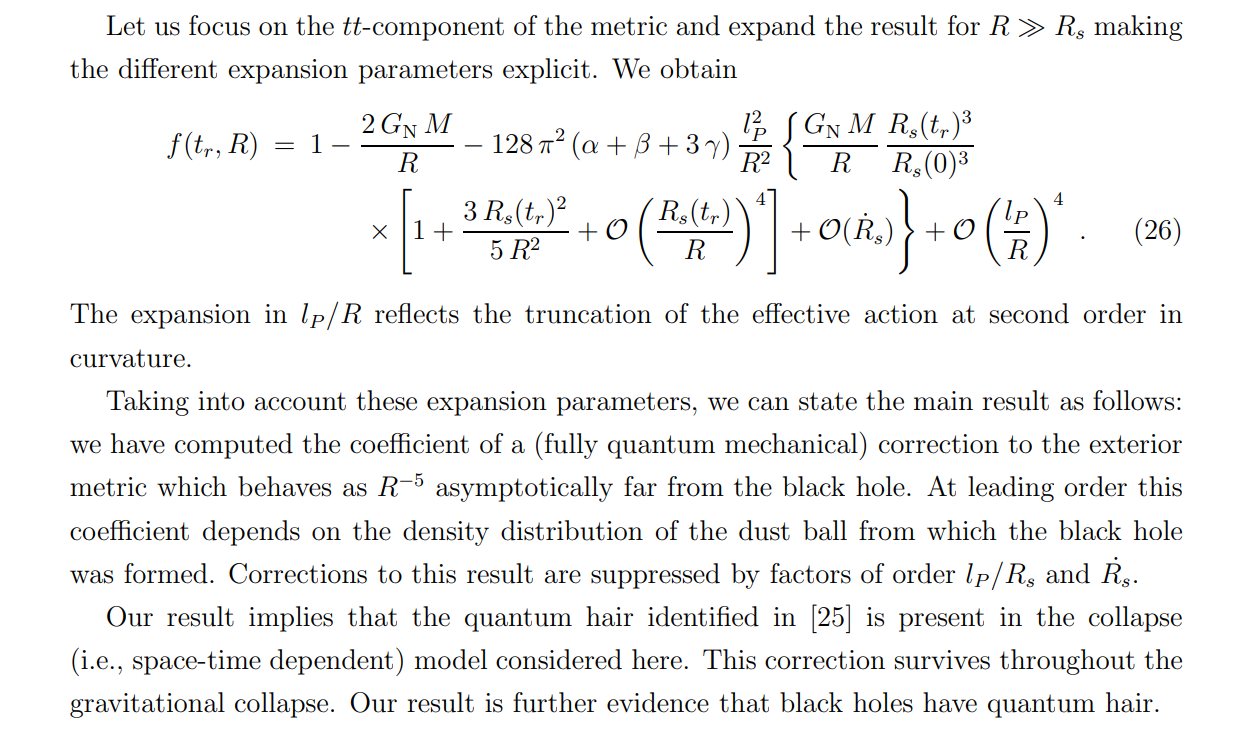
This is a follow up to our earlier work on quantum gravitational corrections to the exterior graviton field of a compact object, also known as quantum hair. Here we follow the gravitational collapse of a dust ball and show that the quantum hair persists through the formation of a black hole horizon.
The detailed calculations are possible due to an effective field theory formulation of quantum gravity in the long wavelength, low spacetime curvature limit.
We consider quantum gravitational corrections to the Oppenheimer-Snyder metric describing time-dependent dust ball collapse. The interior metric also describes Friedmann-Lemaitre-Robertson-Walker cosmology and our results are interpreted in that context. The exterior corrections are an example of quantum hair, and are shown to persist throughout the collapse. Our results show the quantum hair survives throughout the horizon formation and that the internal state of the resulting black hole is accessible to outside observers.
In collaboration with her husband Malcolm Collins, Simone is an author (The Pragmatist's Guide to Life, Relationships, Sexuality, Governance, and Crafting Religion), education reform advocate (CollinsInstitute.org), pronatalism activist (Pronatalist.org), and business operator (Travelmax.com).
Steve Hsu had always dreamed of unlocking the secrets of human intelligence. As a theoretical physicist and a co-founder of Genomic Prediction, he had developed a powerful AI system that could analyze massive genomic data sets and predict complex traits such as height, disease risk, and cognitive ability. He believed that by using this technology, he could help people select the best embryos for IVF and create healthier and smarter children.
But not everyone shared his vision. Some critics accused him of promoting eugenics and creating new social inequalities. Others feared that his AI system could be hacked or misused by malicious actors. And some religious groups denounced him as playing God and interfering with the natural order.
One day, he received a mysterious email from an anonymous sender. It read:
"Dear Dr. Hsu,
We are a group of like-minded individuals who share your passion for advancing human potential. We have access to a secret facility where we have been conducting experiments on human embryos using your AI system and other cutting-edge technologies. We have achieved remarkable results that surpass your wildest expectations. We invite you to join us and witness the dawn of a new era for humanity.
If you are interested, please reply to this email with the word 'YES'. We will send you further instructions on how to reach us.
Sincerely,
The Future"
Steve was intrigued and curious. He wondered who these people were and what they had done. He also felt a pang of fear and doubt. Was this a trap? A hoax? A threat?
He decided to take the risk and reply with 'YES'.
He received another email with a set of coordinates and a time. He was told to drive to a remote location in the desert and wait for a helicopter to pick him up. He followed the instructions and soon found himself in a black helicopter flying over the barren landscape.
He arrived at a large metal dome hidden among the rocks. He was greeted by a man in a white lab coat who introduced himself as Dr. Lee.
"Welcome, Dr. Hsu. We are honored to have you here. Please follow me."
Dr. Lee led him through a series of security checkpoints and into a spacious laboratory filled with high-tech equipment and monitors. He saw rows of incubators containing human embryos at various stages of development.
"Dr. Hsu, these are our creations. The next generation of humans. We have used your AI system to optimize their genomes for intelligence, health, beauty, and longevity. We have also enhanced them with synthetic genes from other species, such as birds, reptiles, mammals, and plants. We have given them abilities that no natural human has ever possessed."
He stopped at one incubator that caught his attention. It contained an embryo that looked almost normal, except for one thing: it had a golden glow around it.
"Dr. Hsu, this is our masterpiece. The ultimate expression of intelligence. The God Emperor. The Kwisatz Haderach. The one who can see the past and the future. The one who can bend space and time. The one who can unite and rule all of humanity."
Steve felt a surge of awe and dread. He realized that he had made a terrible mistake.
"What have you done? This is dangerous! This is blasphemous! This is insane!"
He turned to Dr. Lee and saw him smiling.
"Dr. Hsu, don't be afraid. Don't be angry. Don't be judgmental. Be proud. Be grateful. Be enlightened.
You are witnessing the dawn of a new era for humanity.
You are witnessing the future."