Pessimism of the Intellect, Optimism of the Will Favorite posts | Manifold podcast | Twitter: @hsu_steve
Thursday, February 16, 2023
Bing vs. Bard, US-China STEM Competition, and Embryo Screening — Manifold Episode #30
Thursday, February 02, 2023
ChatGPT, LLMs, and AI — Manifold #29
Thursday, January 19, 2023
Dominic Cummings: Vote Leave, Brexit, COVID, and No. 10 with Boris — Manifold #28
Thursday, January 05, 2023
Sahil Lavingia: Founding Gumroad, The Minimalist Entrepreneur, and our AI LLM future — Manifold #27
Friday, December 23, 2022
Peace on Earth, Good Will to Men 2022
When asked what I want for Christmas, I reply: Peace On Earth, Good Will To Men :-)
No one ever seems to recognize that this comes from the Bible (Luke 2.14).
Linus said it best in A Charlie Brown Christmas:
And there were in the same country shepherds abiding in the field, keeping watch over their flock by night.
And, lo, the angel of the Lord came upon them, and the glory of the Lord shone round about them: and they were sore afraid.
And the angel said unto them, Fear not: for, behold, I bring you good tidings of great joy, which shall be to all people.
For unto you is born this day in the city of David a Saviour, which is Christ the Lord.
And this shall be a sign unto you; Ye shall find the babe wrapped in swaddling clothes, lying in a manger.
And suddenly there was with the angel a multitude of the heavenly host praising God, and saying,
Glory to God in the highest, and on earth peace, good will toward men.
Merry Christmas!
The first baby conceived from an embryo screened with Genomic Prediction preimplantation genetic testing for polygenic risk scores (PGT-P) was born in mid-2020.
It is a great honor to co-author a paper with Simon Fishel, a member of the team that produced the first IVF baby (Louise Brown) in 1978. His mentors and collaborators were Robert Edwards (Nobel Prize 2010) and Patrick Steptoe (passed before 2010). ...
Today millions of babies are produced through IVF. In most developed countries roughly 3-5 percent of all births are through IVF, and in Denmark the fraction is about 10 percent! But when the technology was first introduced with the birth of Louise Brown in 1978, the pioneering scientists had to overcome significant resistance.
There may be an alternate universe in which IVF was not allowed to develop, and those millions of children were never born.
Wikipedia: ...During these controversial early years of IVF, Fishel and his colleagues received extensive opposition from critics both outside of and within the medical and scientific communities, including a civil writ for murder.[16] Fishel has since stated that "the whole establishment was outraged" by their early work and that people thought that he was "potentially a mad scientist".[17]
I predict that within 5 years the use of polygenic risk scores will become common in health systems (i.e., for adults) and in IVF. Reasonable people will wonder why the technology was ever controversial at all, just as in the case of IVF.
And the angel said unto them, Fear not: for, behold, I bring you good tidings of great joy, which shall be to all people.
Mary was born in the twenties, when the tests were new and still primitive. Her mother had frozen a dozen eggs, from which came Mary and her sister Elizabeth. Mary had her father's long frame, brown eyes, and friendly demeanor. She was clever, but Elizabeth was the really brainy one. Both were healthy and strong and free from inherited disease. All this her parents knew from the tests -- performed on DNA taken from a few cells of each embryo. The reports came via email, from GP Inc., by way of the fertility doctor. Dad used to joke that Mary and Elizabeth were the pick of the litter, but never mentioned what happened to the other fertilized eggs.
Now Mary and Joe were ready for their first child. The choices were dizzying. Fortunately, Elizabeth had been through the same process just the year before, and referred them to her genetic engineer, a friend from Harvard. Joe was a bit reluctant about bleeding edge edits, but Mary had a feeling the GP engineer was right -- their son had the potential to be truly special, with just the right tweaks ...
Thursday, December 15, 2022
Geoffrey Miller: Evolutionary Psychology, Polyamorous Relationships, and Effective Altruism — Manifold #26
Monday, December 05, 2022
Decoherence and Quantum Measurement: The Missing Lecture
arXiv:2212.02391 [quant-ph]
We give an elementary account of quantum measurement and related topics from the modern perspective of decoherence. The discussion should be comprehensible to students who have completed a basic course in quantum mechanics with exposure to concepts such as Hilbert space, density matrices, and von Neumann projection (``wavefunction collapse'').See also:
Thursday, December 01, 2022
Anna Krylov: The Politicization of Science in Academia — Manifold #25
Thursday, November 17, 2022
Abdel Abdellaoui: Genetics, Psychiatric Traits, and Educational Attainment — Manifold #24
Sunday, November 13, 2022
Smart Leftists vs Dumb Leftists
Smart Leftists vs Dumb Leftists:
— steve hsu (@hsu_steve) November 13, 2022
Who qualifies as former?
How about Soros, the top donor to the Democratic Party?
A few years ago I gave a talk on genomics (including of cognitive ability) to top leadership at Soros Fund Management.
Reaction: overwhelmingy positive 🤔 1/
Smart Leftists know things which they cannot admit in public.
— steve hsu (@hsu_steve) November 13, 2022
Dumb Leftists fight over these things like retards scuffling in the hallway.
2/
See, e.g., https://t.co/iiqc9TM5ue pic.twitter.com/IUIKp5Y60L
If you are not a billionaire, but want to know what I told the Soros people, see the talks I've given at Berkeley Innovative Genomics Institute, DeepMind, OpenAI, Janelia Farms (HHMI), Allen Institute, Cold Spring Harbor, etc.
— steve hsu (@hsu_steve) November 13, 2022
Links below. 3/https://t.co/xrvxOm1Ld4
Note, the forward looking statements I made in these talks - which were considered bold by the academic genomics community at the time - have almost all been proven correct. 4/https://t.co/vVq4m1Hr11https://t.co/bHYr7vfhdAhttps://t.co/ONdOKyDmQc
— steve hsu (@hsu_steve) November 13, 2022
The impact of progess in polygenic prediction is not confined to academic science.
— steve hsu (@hsu_steve) November 13, 2022
It is going to change how humans reproduce, and even the course of human evolution. 5/https://t.co/Z1fr1zMhD3 pic.twitter.com/iJx5yoZRaR
Monday, November 07, 2022
Nozick and Leftists

From this interview with Robert Nozick:
I had been at Harvard as an Assistant Professor in the mid-sixties and then came back in 1969 as a Full Professor. That was immediately after the student uprisings, building takeovers, and so on, at Harvard the previous spring. When I arrived in the fall of 1969, there was a philosophy course listed in the catalog entitled “Capitalism.” And the course description was “a moral examination of capitalism.” Of course, for most students, then, it would be taken for granted that a moral examination would be a moral condemnation of capitalism. But that’s not what I intended. We were going to read critics of capitalism. But we were also planning to read defenses of capitalism, and I was going to construct some of my own in the lectures. Some of the graduate students in the philosophy department knew what ideas I held, and they weren’t very happy about a course being taught in the department defending those ideas. Now it was true that there was another course in the department on Marxism by someone who was then a member of the Maoist Progressive Labor Party and students did not object to that. But still some students objected to my giving a lecture course on capitalism. I remember early in the fall (I guess I was scheduled to give the course in the spring term), a graduate student came to me at a departmental reception we had, and said, “We don’t know if you’re going to be allowed to give this course.” I said “What do you mean, not allowed to give this course?” He said, “Well, we know what ideas you hold. We just don’t know whether you will be allowed to give the course.” And I said, “If you come and disrupt my course, I’m going to beat the shit out of you!” And the student was taken aback and said, “But you are taking all this very personally.” And I said, “What do you mean, personally? You are threatening to disrupt my course! you can do other things; you can stand outside the room and hand out leaflets. You can ask students not to register for my course. But if you come into my classroom while I am lecturing and disrupt the class, then I take that very personally.” In fact, at some point later in the term, this student and some others said they were going to make up leaflets and hand them out outside of my classroom. I said, “That’s fine; that would be really exciting.” Then they didn’t get around to doing it, and so I prodded them, “Where are the leaflets? I was counting on something special happening with the leaflets.” But it turned out that it was a lot of trouble to write up a leaflet, to get them run off on a mimeograph machine, and so they never got around to doing it. Thus I never had the privilege of being “leafleted” at Harvard. It seemed to me that sort of antagonism only lasted for a very short period of time and diminished fast. There was no longer any strong personal animosity after that. Maybe it was the general toning down of things in the country in the early 70’s, and I just benefited from the de-radicalization of the university.
More fun photos from this old post Forever Young :-)
Thursday, November 03, 2022
Richard Sander on SCOTUS Oral Arguments: Affirmative Action and Discrimination against Asian Americans at Harvard and UNC (Manifold #23)
Tuesday, October 25, 2022
American Society of Human Genetics (ASHG) 2022 Posters
New results from Taiwan Precision Medicine Initiative, a mega-biobank (>500k already genotyped).
— steve hsu (@hsu_steve) October 25, 2022
Diabetes predictor trained in TW as powerful as EUR-trained PRS. Breast Cancer PRS validated in TW. More!
Poster for Amer. Soc. Hum. Genetics#ASHG2022 pic.twitter.com/kU7RmHGlVi
Monte Carlo projections for PGS performance in current and future biobanks.
— steve hsu (@hsu_steve) October 25, 2022
Also methods comparison between sparse training algos: L1, PRScs, elastic net, ..
All of Us and TPMI (Taiwan) will close PGS gap for non-Euro ancestry groups!
Amer. Soc. Hum. Genetics#ASHG2022 pic.twitter.com/Pu7UfeaKEN
Thursday, October 20, 2022
Discovering the Multiverse: Quantum Mechanics and Hugh Everett III, with Peter Byrne — Manifold #22
Saturday, October 15, 2022
Times of Israel on Polygenic Embryo Screening
The Times of Israel
14 October 2022, 1:27 pm
Designer babies? Hi-tech preimplantation genetic testing may soon come to IsraelFor generations, the Yu family of Shanghai has suffered from type 2 diabetes. But this summer, as reported in the China Daily, the family welcomed a baby with a better chance of avoiding this disease.
These rosier prospects are the result of a recent breakthrough in assisted reproduction that was advanced with the help of Israeli scientists, called preimplantation genetic testing for polygenic diseases (PGT-P). In addition to China, PGT-P is also gaining ground among couples in the United States who wish to improve health outcomes for their future children. But in Israel, it is illegal.PGT-P is carried out on an embryo during in vitro fertilization (IVF), prior to its transfer from the Petri dish to the womb. Viable embryos with the probable lowest disease risk can then be selected for implantation.
Since this innovative testing takes into account a complex combination of factors that are not broached in more traditional testing, in some ways it’s almost like an educated guess. Accordingly, polygenic screening is not a diagnosis: It is a prediction of relative future risk compared to other people.
Israeli academics have published peer-reviewed research advancing the science behind polygenic screening, including Shai Carmi, Ehud Karavani, Or Zuk, Gil Atzmon, and Einat Granot-Hershkovitz.
But Start-Up Nation is not yet implementing this cutting-edge tech in the field of fertility. Although fertility treatments are subsidized by the Israeli government, it is still unclear whether Israeli couples ever will have access to the procedure, which screens for polygenic diseases such as diabetes, heart disease and cancer — or whether they would even want it.
PGT-P is different from prior technology in important ways, creating new opportunities and challenges for parents while raising profound ethical dilemmas for society. Similar to older forms of testing, PGT-P relies on analyzing genetic material from embryos created through IVF before implantation and checking them for certain diseases and conditions. The information then helps the parents and doctors decide which embryos to implant.
However, the biggest difference between PGT-P screening and earlier forms of genetic testing is that the prior tests checked for genetically simple conditions such as Down syndrome, cystic fibrosis, or Tay Sachs disease. These diseases, which are serious or fatal, have extremely high “penetrance,” which means that if the gene mutation is seen in the embryo’s DNA, it is nearly certain that the child will have that condition. The appearance of the disease-linked gene is the basis of a clear diagnosis.
This “simple” genetic screening has already borne fruit in the Jewish community: Decades ago, babies in the Ashkenazi Jewish community were nearly 100 times more likely to be born with Tay Sachs than babies in the general US population. Today, because of genetic screenings, the disease is “virtually wiped out.”
In contrast, PGT-P screening can’t tell you with assurance if an embryo will develop a genetic disease such as cancer or Crohn’s disease. That’s because this new screening checks for polygenic diseases – complex conditions caused by the combined impact of possibly thousands of different genes, as well as lifestyle and other environmental factors.
Instead of a clear diagnosis, prospective parents receive a “polygenic risk score,” basically the probability of a child developing a certain disease or condition.
Noa and her husband went through 10 IVF cycles to build their family. “We now have two wonderful boys,” she says.
If I had an opportunity to reduce disease risk in my kids, I would do it
She knows what she would have said if doctors had offered her polygenic screening: “I want that technology.” As a speech therapist who works with kids facing a lot of health challenges, she was very worried about what her own kids would face.
“If I had an opportunity to reduce disease risk in my kids, I would do it. It would definitely help my peace of mind as a mother. Everyone here in Israel should have the option of using it,” Noa says.
No clear-cut answers
Scientists at the US-based Genomic Prediction, Inc. published an article in 2019 describing the “first clinical application” of polygenic screening of embryos. Genomic Prediction is a polygenic screening company based in New Jersey that partners with various IVF clinics around the world.
However, to date, the Israeli Health Ministry has yet to even issue a statement on the use of polygenic screening on embryos.
For some, the fact that PGT-P screening isn’t available, or even legal, in Israel is somewhat counterintuitive, given Israel’s prominence in the fields of both assisted reproduction and genetic testing.
Israelis undergo more rounds of IVF per capita than any other nation in the world. This is largely due to religious and cultural norms that are highly supportive of child-bearing, combined with the nationally financed healthcare system that provides full coverage for as many IVF cycles as needed, up to two children per family.
In addition, “in Israel there is a lot more openness to preimplantation genetic testing in general because of the high prevalence of various disease mutations in our community,” says Carmi, an associate professor at the Hebrew University School of Public Health and Faculty of Medicine.
Today, Carmi is a leading researcher on the accuracy of polygenic screening. As part of his post-doctoral project at Columbia University in New York, he helped generate important genetic sequencing data for Ashkenazi Jews.
Israel’s embrace of most genetic testing is reflected in the Israeli Health Ministry’s website, which lists dozens of recommended genetic screenings, broken down by ethnic sub-community. But these screenings are for monogenic disorders, easily diagnosed by looking for a single gene mutation.
“In Israel, the Health Ministry controls which diseases can be screened for, and candidate variants need to have high penetrance and lead to diseases with severe symptoms,” says Carmi.
Playing the odds
Miri is a consultant originally from central Israel. Although she did not have any known fertility problems, she chose to undergo IVF specifically because it would allow her to screen for a certain hereditary disease. She and her husband are both carriers of a rare mutation, so a natural conception meant a 25 percent chance of the fetus suffering from this generally fatal condition.
“For me, it was a choice between the extra physical hardship of IVF, or the extra emotional hardship of a pregnancy where, for months, we would not know if the baby would have this disease,” Miri said.
In contrast, PGT-P can’t provide conclusive information, because in the context of polygenic diseases like diabetes and heart disease “nothing is deterministic,” says Carmi.
According to Carmi, a child may develop the condition or may not, and non-genetic factors can certainly affect the outcome. Based on his peer-reviewed research on statistical modeling of polygenic screening, though, Carmi notes that “you can get quite a substantial risk reduction.”
The “relative risk reduction” projected to be accomplished by PGT-P varies depending on the disease. However, according to a 2021 research paper by Carmi and his collaborators, for schizophrenia and Crohn’s disease, around a 45% relative risk reduction is achievable for parents testing five embryos and choosing the best scoring, compared to implanting a randomly chosen one of the five.
The testing, of course, comes with a fee: Costs vary, but Genomic Prediction in New Jersey charges a $1,000 up-front fee, plus $400 per embryo analyzed. Of course, this is an add-on cost for people already doing IVF, which in the US can cost up to tens of thousands of dollars per cycle.
Pricing can get even more complicated, however, because different services end up bundled together, or are offered as add-ons once related costs are already accounted for. But one of the earlier forms of embryonic screening (PGT-A, which checks for aneuploidies, giving rise to Down syndrome for example) can cost several thousand dollars.
By contrast, carrier screening, which is a blood test performed on the parents to check for “simple” monogenic-disease carrier status, costs only several hundred dollars, and is often also covered by insurance.
In Israel, for couples whose family history or carrier-screening blood tests reveal a heightened risk for having children with a specific monogenic disease, the Health Ministry promotes the benefits of traditional genetic testing of embryos prior to implantation in the womb.
According to its website, “Pre-implantation Genetic Diagnosis (PGD) is today considered to be one of the practical options for couples who are at high risk for giving birth to a baby with a chromosomal abnormality or a genetic disease. This is because the process allows pregnancies to be achieved with healthy fetuses, and avoids the need for pregnancy termination, a procedure that constitutes a problem for many couples for religious, ethical and/or moral reasons.”
The nuts and bolts
PGT-P was developed using artificial intelligence technology applied to huge databases containing the genetic and health information of hundreds of thousands of people. Statistical data analysis of DNA and health outcomes allows scientists to see which complex genetic patterns more frequently show up in individuals who also develop a certain disease, such as schizophrenia. By genetically analyzing an embryo and then comparing its genetic information to this population data, the embryo’s polygenic risk score can be calculated for a given disease. This can already be done for a great many common diseases, with varying levels of predictive power, and as genetic databases grow, the reliability of these risk scores will continue to improve.
The couple also receives the raw data about their embryos’ genes and risk scores, so if they prefer to implant the embryo with the lowest risk of type 2 diabetes rather than the lowest combined disease risk, they can do that
“For prospective parents undergoing IVF and electing to use polygenic screening, somewhere between 10 and 20 polygenic risk scores are combined in a weighted average, with more serious diseases given greater weight in the final figure. This averaging provides a single number for each embryo — a health index — that can be used to rank the available embryos, so that the one with the best health index can be implanted,” says Carmi.
“Of course, the couple also receives the raw data about their embryos’ genes and risk scores, so if they prefer to implant the embryo with, let’s say, the lowest risk of type 2 diabetes, rather than the lowest combined disease risk, they can do that,” says Carmi.
An emotional decision
Michal Amrani, 32, lives in the central Israeli town of Ramat Hasharon and is working toward a master’s degree in chemistry from the Weizmann Institute. Through a four-year IVF process, she and her husband Sarel welcomed a son, and later, a set of twins. They say they are unlikely to use polygenic screening, even if it becomes available in Israel.
“As it is, we opted not to do some of the genetic testing that was already available to us,” Amrani says. “I work in science, so I am more open to these things, but my husband doesn’t really like all these genetic tests. For him, there’s risk in lots of things, and his optimistic nature helps him be comfortable that things will work out.”
Others, like Noa, are more interested in trying out preimplantation polygenic screening of their embryos, but even if Israel would change its rules to allow it, it’s a tricky issue. First, there are concerns about the psychological difficulties that this technology may pose for prospective parents.
Rona Langer Ziv is a social worker and cognitive behavioral psychotherapist who counsels IVF patients — both couples and singles — at a large Israeli hospital, as well as through her private clinical practice.
“Due to the potential implications of this new technology,” she says, “I would be concerned about a higher risk for depression and anxiety among the IVF patients.”
“Even if they feel they understand what they are signing up for at the beginning of the journey, they may not appreciate the emotional, ethical, and psychosocial implications of polygenic screening several IVF cycles down the road,” says Langer Ziv. “They may find themselves worrying that the embryos’ scores are not good enough, or that they won’t have any viable embryos left to choose from.”
Even if they feel they understand what they are signing up for at the beginning of the journey, they may not appreciate the emotional, ethical, and psychosocial implications of polygenic screening several IVF cycles down the road
Because polygenic screening predicts relative risk rather than providing an affirmative disease diagnosis, “women, especially those over 40 who may have very few embryos to work with, end up facing a serious dilemma — they may be discarding an embryo that could have resulted in a healthy child,” says Langer Ziv.
Amrani is in a similar situation. She and her husband are ready for more kids, but right now they have just one embryo available, so that’s the embryo they will try to implant. Even though she won’t be using polygenic screening, Amrani says that “it does sound very innovative. It’s nice that there’s something like this.”
Social worker and cognitive behavioral psychotherapist Rona Langer Ziv. (Courtesy) Indeed, Langer Ziv acknowledges that some people would find polygenic screening appealing, particularly those with higher education levels.
“There’s definitely coolness in the technology. It’s scientifically advanced, and it could offer interesting health insights about your future children. Everyone would theoretically like to use a technology that potentially predicts a more healthy child, although there is disagreement among fertility specialists about the benefits involved,” Langer Ziv says.
“And for some IVF patients, it might also provide a feeling of control during a process that involves so much stress, uncertainty, luck, and randomness,” she says.
Risk of eugenics
Regardless of how polygenic screening would be received by potential consumers, there are grave concerns about the impacts of this new technology on society. Various ethical issues have been raised for decades about older forms of genetic screenings, including fears of stigmatizing those living with genetic diseases, and questions about equitable access to these technological advances.
Perhaps the most significant ethical concern, and one that looms larger with polygenic screening than with older tests for monogenic diseases, is the potential for eugenics. This is the infamous and dangerous philosophy, practiced in Nazi Germany and elsewhere, that society should try to promote the creation of the most genetically “superior” babies.
Miri and her husband now have a baby boy and are looking forward to having more children — they still have three embryos to choose from. Asked whether she would be interested in polygenic screening if it became available in Israel, Miri says she’s unsure.
“I would love to see less suffering in the world from diseases. But where do we draw the line?” she says.
Indeed, the potential for eugenics is most stark when screenings cross over from the realm of disease prevention to the world of intelligence and aesthetic traits such as height or eye color. As such, some laboratories preemptively claim they will only screen for health concerns: An American polygenic screening company currently states that it does not test for “high IQ,” nor for “purely cosmetic traits such as hair color and eye color.”
But complicating the “noble” stance, genetic researchers have shown that “IQ is negatively correlated with most psychiatric disorders [and] positively correlated with autism and anorexia,” meaning that a high IQ comes with a lower risk of most psychiatric diseases and a higher risk of certain other neurological and mental health conditions.
As such, while some companies may currently refuse to offer IQ screening, it is not hard to imagine a health-based argument for loosening such protocols in the future, particularly as society becomes more used to the practice of PGT-P.
Similarly, a large study was published this year by researchers at Brown University and Peking University that found that “light eye colors were associated with high risks” of certain forms of skin cancer. Again, one can picture checks for eye color making their way into future genetic screenings through a backdoor of disease relevance.
In Carmi’s view, the responsible way for Israel to approach the prospect of polygenic screening is a gradual one.
“Ideally, we would start by recruiting Israeli participants for local academic research, with oversight by the Health Ministry,” Carmi says. “Once we develop more insight into how predictive polygenic screening is in our population, the relevant stakeholders — including patients, professional organizations, and regulators — can balance competing interests and local values, and come up with tailored guidance on its use in Israel.”
For some Israeli citizens, of particular concern is the idea of the wealthy trying to create perfect babies.
“If polygenic screening came to Israel, I would want to see a lot of regulation about who gets to use it, how it is used, and what reasons it is used for,” Miri says.
See also
WIRED: Genetic Screening Now Lets Parents Pick the Healthiest Embryos
Genomic Prediction in Bloomberg
Thursday, October 06, 2022
Jeffrey Sachs: Lessons from the COVID Commission, Lab Leak Questions, and Nord Stream — Manifold Episode 21
Tuesday, October 04, 2022
SAT score distributions in Michigan
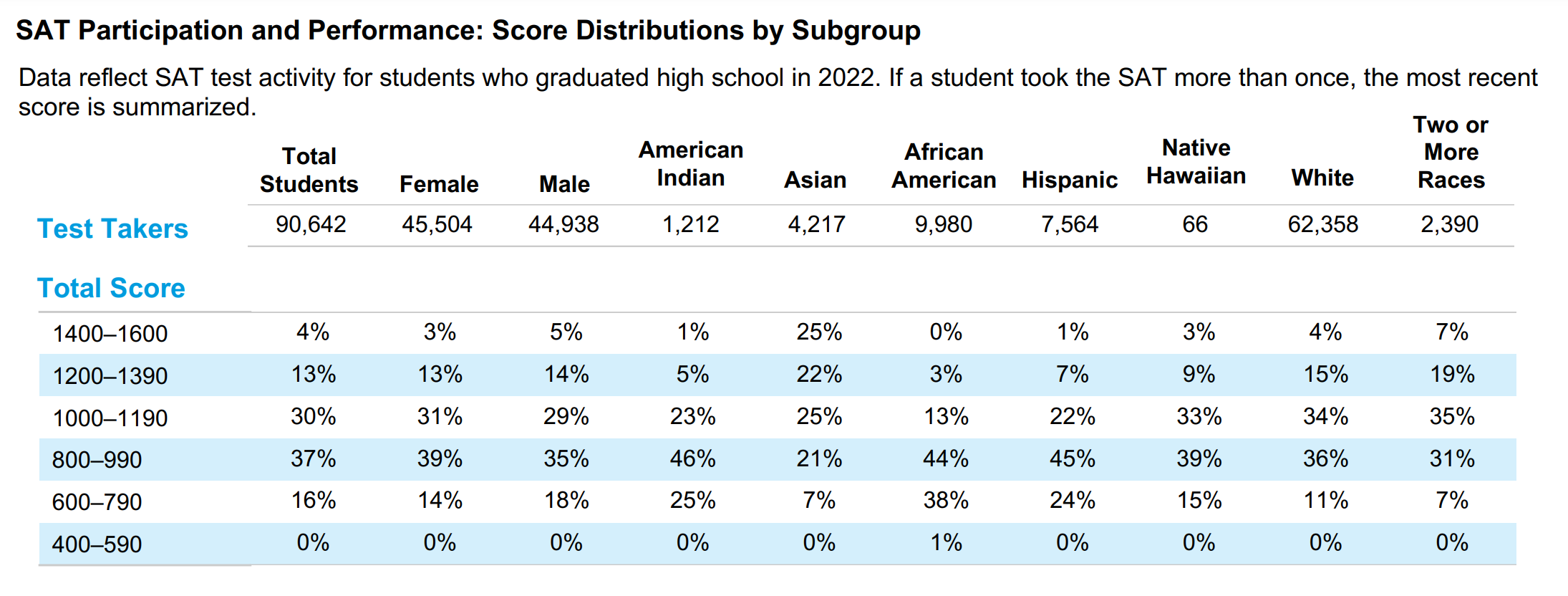
The state of Michigan required all public HS seniors to take the SAT last year (~91k out of ~107k total seniors in the state). This generated an unusually representative score sample. Full report.
I'm aware of this stuff because my kids attend a public HS here.
To the uninformed, the results are shocking in a number of ways. Look specifically at the top band with scores in the 1400-1600 range. These are kids who have a chance at elite university admission, based on academic merit. For calibration, the University of Michigan median SAT score is above 1400, and at top Ivies it is around 1500.
Some remarks:
1. In the top band there are many more males than females.
2. The Asian kids are hitting the ceiling on this test.
3. There are very few students from under-represented groups who score in the top band.
4. By looking at the math score distribution (see full report) one can estimate how many students in each group are well-prepared enough to complete a rigorous STEM major -- e.g., pass calculus-based physics.
Previously I have estimated that PRC is outproducing the US in top STEM talent by a factor as large as 10x. In a decade or two the size of their highly skilled STEM workforce (e.g., top engineers, AI researchers, biotech scientists, ...) could be 10x as large as that of the US and comparable to the rest of the world, ex-China.
This is easy to understand: their base population is about 4x larger and their K12 performance on international tests like PISA is similar to what is found in the table above for the Asian category. The fraction of PRC kids who perform in the top band is probably at least several times larger than the overall US fraction. (Asian vs White in the table above is about 6x, or 7x on the math portion.) Also, the fraction of college students who major in STEM is much larger in PRC than in the US.
This table was produced by German professor Gunnar Heinsohn, who analyzes geopolitics and human capital.
Note, I will censor racist comments.
Wednesday, September 28, 2022
The Future of Human Evolution -- excerpts from podcast interview with Brian Chau
The transcript excerpts below are from my recent conversation with Brian Chau (aka Cactus Chu) on his podcast.
— steve hsu (@hsu_steve) September 28, 2022
Segments begin at 47m and 1h07m.
They have been lightly edited.https://t.co/RJ68FasfJchttps://t.co/TnSuNaxhnQ
Tuesday, September 27, 2022
Quantum Hair in Electrodynamics and Gravity (arXiv:2209.12798)
Quantum Hair in Electrodynamics and Gravity
Xavier Calmet, Stephen D. H. Hsu
arXiv:2209.12798
We demonstrate the existence of quantum hair in electrodynamics and gravity using effective action techniques. In the case of electrodynamics we use the Euler-Heisenberg effective action while in the case of quantum gravity we use the unique effective action. We give a general formulation of these effects which applies to both theories and discuss analogies and differences between them. Furthermore, we present a QED analog to black hole evaporation. Spontaneous pair production in the external field of a ball of charge is analogous to Hawking radiation from black holes. Assuming spherical symmetry, the Gauss law prevents the external field from depending on the density profile of the ball. Quantum corrections violate these expectations, showing that quantum radiation can encode classically forbidden information about the source.
The quantum effective actions for both electrodynamics and gravity lead to field equations which couple a compact source (charge current or energy-momentum tensor) to external fields (electromagnetic or graviton field) in a manner which, generically, leads to quantum memory and quantum hair effects. External solutions of the field equations deviate, due to quantum corrections, from the familiar classical forms that satisfy the Gauss law. As a specific consequence, more information about the interior source configuration is encoded in the external field than in the classical theory.
As specific applications, we considered semiclassical sources (large black hole, macroscopic charge distribution), which allowed us to solve the quantum corrected field equations by expanding around a classical solution. However, fully quantum statements regarding quantum hair are also possible, which do not, for example, require a semiclassical source. In [1–3] it was shown that the quantum state of a compact source (e.g., in an energy eigenstate or superposition thereof) determines certain aspects of the quantum state of its external field. In principle, measurements of the external fields can fully determine the interior state of a black hole.
Thursday, September 22, 2022
Rob Henderson: A Journey from Foster Care to the US Military to Elite Academia — Manifold podcast #20
Tuesday, September 20, 2022
Sibling Variation in Phenotype and Genotype: Polygenic Trait Distributions and DNA Recombination Mapping with UK Biobank and IVF Family Data (medRxiv)
Sibling Variation in Phenotype and Genotype: Polygenic Trait Distributions and DNA Recombination Mapping with UK Biobank and IVF Family Data
L. Lello, M. Hsu, E. Widen, and T. Raben
We use UK Biobank and a unique IVF family dataset (including genotyped embryos) to investigate sibling variation in both phenotype and genotype. We compare phenotype (disease status, height, blood biomarkers) and genotype (polygenic scores, polygenic health index) distributions among siblings to those in the general population. As expected, the between-siblings standard deviation in polygenic scores is \sqrt{2} times smaller than in the general population, but variation is still significant. As previously demonstrated, this allows for substantial benefit from polygenic screening in IVF. Differences in sibling genotypes result from distinct recombination patterns in sexual reproduction. We develop a novel sibling-pair method for detection of recombination breaks via statistical discontinuities. The new method is used to construct a dataset of 1.44 million recombination events which may be useful in further study of meiosis.
Here are some figures illustrating the variation of polygenic scores among siblings from the same family.
The excerpt below describes the IVF family highlighted in blue above:
Among the families displayed in these figures, at position number 15 from the left, we encounter an interesting case of sibling polygenic distribution relative to the parents. In the family all siblings have significantly higher Health Index score than the parents. This arises in an interesting manner: the mother is a high-risk outlier for condition X and the father is a high-risk outlier for condition Y. (We do not specify X and Y, out of an abundance of caution for privacy, although the patients have consented that such information could be shared.) Their lower overall Health Index scores result from high risk of conditions X (mother) and Y (father). However, the embryos, each resulting from unique recombination of parental genotypes, are normal risk for both X and Y and each embryo has much higher Health Index score than the parents.This case illustrates well the potential benefits from PGS embryo screening.
The second part of the paper introduces a new technique that directly probes DNA recombination -- the molecular mechanism responsible for sibling genetic differences. See figure above for some results. The new method detects recombination breaks via statistical discontinuities in pairwise comparisons of DNA regions.
...This new sibling-pair method can be applied to large datasets with many thousands of sibling pairs. In this project we created a map of roughly 1.44 million recombination events using UKB genomes. Similar maps can now be created using other biobank data, including in non-European ancestry groups that have not yet received sufficient attention. The landmark deCODE results were obtained under special circumstances: the researchers had access to data resulting from a nationwide project utilizing genealogical records (unusually prevalent in Iceland) and widespread sequencing. Using the sibling-pair method results of comparable accuracy can be obtained from existing datasets around the world -- e.g., national biobanks in countries such as the USA, Estonia, China, Taiwan, Japan, etc.
Thursday, September 08, 2022
Lyle Goldstein on U.S. Strategic Challenges: Russia, China, Ukraine, and Taiwan — Manifold #19
Monday, September 05, 2022
Lunar Society (Dwarkesh Patel) Interview
Thursday, August 25, 2022
Harvard Veritas: interview with a recent graduate (anonymous) — Manifold Episode #18
Friday, August 19, 2022
Geostrategy and US-China Military Competition
Panic bells, it's red alert
There's something here from somewhere else
The war machine springs to life
Opens up one eager eye
Focusing it on the sky
-- 99 Luftballons
Blog Archive
Labels
- physics (420)
- genetics (325)
- globalization (301)
- genomics (295)
- technology (282)
- brainpower (280)
- finance (275)
- american society (261)
- China (249)
- innovation (231)
- ai (206)
- economics (202)
- psychometrics (190)
- science (172)
- psychology (169)
- machine learning (166)
- biology (163)
- photos (162)
- genetic engineering (150)
- universities (150)
- travel (144)
- podcasts (143)
- higher education (141)
- startups (139)
- human capital (127)
- geopolitics (124)
- credit crisis (115)
- political correctness (108)
- iq (107)
- quantum mechanics (107)
- cognitive science (103)
- autobiographical (97)
- politics (93)
- careers (90)
- bounded rationality (88)
- social science (86)
- history of science (85)
- realpolitik (85)
- statistics (83)
- elitism (81)
- talks (80)
- evolution (79)
- credit crunch (78)
- biotech (76)
- genius (76)
- gilded age (73)
- income inequality (73)
- caltech (68)
- books (64)
- academia (62)
- history (61)
- intellectual history (61)
- MSU (60)
- sci fi (60)
- harvard (58)
- silicon valley (58)
- mma (57)
- mathematics (55)
- education (53)
- video (52)
- kids (51)
- bgi (48)
- black holes (48)
- cdo (45)
- derivatives (43)
- neuroscience (43)
- affirmative action (42)
- behavioral economics (42)
- economic history (42)
- literature (42)
- nuclear weapons (42)
- computing (41)
- jiujitsu (41)
- physical training (40)
- film (39)
- many worlds (39)
- quantum field theory (39)
- expert prediction (37)
- ufc (37)
- bjj (36)
- bubbles (36)
- mortgages (36)
- google (35)
- race relations (35)
- hedge funds (34)
- security (34)
- von Neumann (34)
- meritocracy (31)
- feynman (30)
- quants (30)
- taiwan (30)
- efficient markets (29)
- foo camp (29)
- movies (29)
- sports (29)
- music (28)
- singularity (27)
- entrepreneurs (26)
- conferences (25)
- housing (25)
- obama (25)
- subprime (25)
- venture capital (25)
- berkeley (24)
- epidemics (24)
- war (24)
- wall street (23)
- athletics (22)
- russia (22)
- ultimate fighting (22)
- cds (20)
- internet (20)
- new yorker (20)
- blogging (19)
- japan (19)
- scifoo (19)
- christmas (18)
- dna (18)
- gender (18)
- goldman sachs (18)
- university of oregon (18)
- cold war (17)
- cryptography (17)
- freeman dyson (17)
- smpy (17)
- treasury bailout (17)
- algorithms (16)
- autism (16)
- personality (16)
- privacy (16)
- Fermi problems (15)
- cosmology (15)
- happiness (15)
- height (15)
- india (15)
- oppenheimer (15)
- probability (15)
- social networks (15)
- wwii (15)
- fitness (14)
- government (14)
- les grandes ecoles (14)
- neanderthals (14)
- quantum computers (14)
- blade runner (13)
- chess (13)
- hedonic treadmill (13)
- nsa (13)
- philosophy of mind (13)
- research (13)
- aspergers (12)
- climate change (12)
- harvard society of fellows (12)
- malcolm gladwell (12)
- net worth (12)
- nobel prize (12)
- pseudoscience (12)
- Einstein (11)
- art (11)
- democracy (11)
- entropy (11)
- geeks (11)
- string theory (11)
- television (11)
- Go (10)
- ability (10)
- complexity (10)
- dating (10)
- energy (10)
- football (10)
- france (10)
- italy (10)
- mutants (10)
- nerds (10)
- olympics (10)
- pop culture (10)
- crossfit (9)
- encryption (9)
- eugene (9)
- flynn effect (9)
- james salter (9)
- simulation (9)
- tail risk (9)
- turing test (9)
- alan turing (8)
- alpha (8)
- ashkenazim (8)
- data mining (8)
- determinism (8)
- environmentalism (8)
- games (8)
- keynes (8)
- manhattan (8)
- new york times (8)
- pca (8)
- philip k. dick (8)
- qcd (8)
- real estate (8)
- robot genius (8)
- success (8)
- usain bolt (8)
- Iran (7)
- aig (7)
- basketball (7)
- free will (7)
- fx (7)
- game theory (7)
- hugh everett (7)
- inequality (7)
- information theory (7)
- iraq war (7)
- markets (7)
- paris (7)
- patents (7)
- poker (7)
- teaching (7)
- vietnam war (7)
- volatility (7)
- anthropic principle (6)
- bayes (6)
- class (6)
- drones (6)
- econtalk (6)
- empire (6)
- global warming (6)
- godel (6)
- intellectual property (6)
- nassim taleb (6)
- noam chomsky (6)
- prostitution (6)
- rationality (6)
- academia sinica (5)
- bobby fischer (5)
- demographics (5)
- fake alpha (5)
- kasparov (5)
- luck (5)
- nonlinearity (5)
- perimeter institute (5)
- renaissance technologies (5)
- sad but true (5)
- software development (5)
- solar energy (5)
- warren buffet (5)
- 100m (4)
- Poincare (4)
- assortative mating (4)
- bill gates (4)
- borges (4)
- cambridge uk (4)
- censorship (4)
- charles darwin (4)
- computers (4)
- creativity (4)
- hormones (4)
- humor (4)
- judo (4)
- kerviel (4)
- microsoft (4)
- mixed martial arts (4)
- monsters (4)
- moore's law (4)
- soros (4)
- supercomputers (4)
- trento (4)
- 200m (3)
- babies (3)
- brain drain (3)
- charlie munger (3)
- cheng ting hsu (3)
- chet baker (3)
- correlation (3)
- ecosystems (3)
- equity risk premium (3)
- facebook (3)
- fannie (3)
- feminism (3)
- fst (3)
- intellectual ventures (3)
- jim simons (3)
- language (3)
- lee kwan yew (3)
- lewontin fallacy (3)
- lhc (3)
- magic (3)
- michael lewis (3)
- mit (3)
- nathan myhrvold (3)
- neal stephenson (3)
- olympiads (3)
- path integrals (3)
- risk preference (3)
- search (3)
- sec (3)
- sivs (3)
- society generale (3)
- systemic risk (3)
- thailand (3)
- twitter (3)
- alibaba (2)
- bear stearns (2)
- bruce springsteen (2)
- charles babbage (2)
- cloning (2)
- david mamet (2)
- digital books (2)
- donald mackenzie (2)
- drugs (2)
- dune (2)
- exchange rates (2)
- frauds (2)
- freddie (2)
- gaussian copula (2)
- heinlein (2)
- industrial revolution (2)
- james watson (2)
- ltcm (2)
- mating (2)
- mba (2)
- mccain (2)
- monkeys (2)
- national character (2)
- nicholas metropolis (2)
- no holds barred (2)
- offices (2)
- oligarchs (2)
- palin (2)
- population structure (2)
- prisoner's dilemma (2)
- singapore (2)
- skidelsky (2)
- socgen (2)
- sprints (2)
- star wars (2)
- ussr (2)
- variance (2)
- virtual reality (2)
- war nerd (2)
- abx (1)
- anathem (1)
- andrew lo (1)
- antikythera mechanism (1)
- athens (1)
- atlas shrugged (1)
- ayn rand (1)
- bay area (1)
- beats (1)
- book search (1)
- bunnie huang (1)
- car dealers (1)
- carlos slim (1)
- catastrophe bonds (1)
- cdos (1)
- ces 2008 (1)
- chance (1)
- children (1)
- cochran-harpending (1)
- cpi (1)
- david x. li (1)
- dick cavett (1)
- dolomites (1)
- eharmony (1)
- eliot spitzer (1)
- escorts (1)
- faces (1)
- fads (1)
- favorite posts (1)
- fiber optic cable (1)
- francis crick (1)
- gary brecher (1)
- gizmos (1)
- greece (1)
- greenspan (1)
- hypocrisy (1)
- igon value (1)
- iit (1)
- inflation (1)
- information asymmetry (1)
- iphone (1)
- jack kerouac (1)
- jaynes (1)
- jazz (1)
- jfk (1)
- john dolan (1)
- john kerry (1)
- john paulson (1)
- john searle (1)
- john tierney (1)
- jonathan littell (1)
- las vegas (1)
- lawyers (1)
- lehman auction (1)
- les bienveillantes (1)
- lowell wood (1)
- lse (1)
- machine (1)
- mcgeorge bundy (1)
- mexico (1)
- michael jackson (1)
- mickey rourke (1)
- migration (1)
- money:tech (1)
- myron scholes (1)
- netwon institute (1)
- networks (1)
- newton institute (1)
- nfl (1)
- oliver stone (1)
- phil gramm (1)
- philanthropy (1)
- philip greenspun (1)
- portfolio theory (1)
- power laws (1)
- pyschology (1)
- randomness (1)
- recession (1)
- sales (1)
- skype (1)
- standard deviation (1)
- starship troopers (1)
- students today (1)
- teleportation (1)
- tierney lab blog (1)
- tomonaga (1)
- tyler cowen (1)
- venice (1)
- violence (1)
- virtual meetings (1)
- wealth effect (1)


.jpg)