Sebastian Mallaby is a writer and journalist whose work covers financial markets, international relations, innovation, and technology. He is the author of "The Power Law: Venture Capital and the Making of the New Future."
Steve and Sebastian discuss venture capital, tech startups, business model and technology innovation, global adoption of the Silicon Valley model, and the future of innovation.
Xavier Calmet, Roberto Casadio, Stephen D. H. Hsu, and Folkert Kuipers
Phys. Rev. Lett. 128, 111301 – Published 17 March 2022
We explore the relationship between the quantum state of a compact matter source and of its asymptotic graviton field. For a matter source in an energy eigenstate, the graviton state is determined at leading order by the energy eigenvalue. Insofar as there are no accidental energy degeneracies there is a one to one map between graviton states on the boundary of spacetime and the matter source states. Effective field theory allows us to compute a purely quantum gravitational effect which causes the subleading asymptotic behavior of the graviton state to depend on the internal structure of the source. This establishes the existence of ubiquitous quantum hair due to gravitational effects.
The paper establishes that the quantum state of the graviton field (equivalently, the spacetime metric) of a compact matter source depends on the quantum state of the source. This can be established without a short distance theory of quantum gravity -- i.e., near the Planck length. Our results are long wavelength effects and are insensitive to the details of short distance physics, such as whether gravitons are excitations of strings, or something else, at the most fundamental level.
Classical theorems in General Relativity indicate that black holes are nearly featureless -- only a few aspects of the hole, such as its total mass, charge, and angular momentum, are manifested in its asymptotic gravitational field. We show that this "no hair" property does not extend to the quantum realm. Indeed at the quantum level the situation is the opposite: the full quantum state of the compact object can be recovered from the asymptotic graviton state.
In this companion paper we show how these results resolve Hawking's black hole information paradox, which has been an open problem for 46 years.
Physics Letters B Volume 827, 10 April 2022, 136995
Xavier Calmet and Stephen D.H. Hsu
It has been shown that the quantum state of the graviton field outside a black hole horizon carries information about the internal state of the hole. We explain how this allows unitary evaporation: the final radiation state is a complex superposition which depends linearly on the initial black hole state. Under time reversal, the radiation state evolves back to the original black hole quantum state. Formulations of the information paradox on a fixed semiclassical geometry describe only a small subset of the evaporation Hilbert space, and do not exclude overall unitarity.
Note to experts: the companion paper explains why Mathur's Theorem (i.e., entanglement entropy must always increase by ~ln 2 with each emitted qubit) is evaded once one considers BH evolution in the full radiation Hilbert space. The radiation Hilbert space is much larger than the small subspace which remains after conditioning on any specific spacetime background or BH recoil trajectory. Even exponentially small entanglement between different radiation states (mediated by quantum hair) can unitarize the evaporation process.
This is also explained in detail in the talk video and slides linked below.
The Sunday Times’ tech correspondent Danny Fortson brings on Stephen Hsu, co-founder of Genomic Prediction, to talk about the plummeting price of genomic sequencing (5:00), predicting height and cancer (9:10), mining biobanks (14:25), scoring embryos (19:00), why investors are staying anonymous (28:00), the need for a society-wide discussion (32:30), when he was accused of being a eugenicist (37:25), how powerful genetic prediction can be (43:15), genetic engineering (49:45), and why Denmark is the future (59:30).
Vlatko Vedral is Professor in the Department of Physics at the University of Oxford and Centre for Quantum Technologies (CQT) at the National University of Singapore. He is known for his research on the theory of Entanglement and Quantum Information Theory.
Steve and Vlatko discuss:
1. History of quantum information theory, entanglement, and quantum computing
2. Recent lab experiments that create superposition states of macroscopic objects, including a living creature (tardigrade)
3. Whether quantum mechanics implies the existence of many worlds: are you in a superposition state right now?
Physicist, startup founder, and polymath Steve Hsu discusses the end of the unipolar moment, the return of geopolitics, and the U.S.-China New Cold War. He believes China is not as fragile as some say. We talk Taiwan, how Beijing has caught up in military tech, and how the nature of naval warfare in the next war will be very different. On the technology and AI front, he feels the U.S. and China are at parity, but that the long-term trend is in China's favor. He feels the social credit system is advancing just as fast in the West as in China and that the digital yuan is rapidly gaining in stature. He gives his view on the Ukraine crisis and how it has been a huge strategic error by the U.S. because it has cemented the Eurasian alliance. He's concerned about a systemic financial meltdown, discusses being a victim of woke cancel culture, and knowing Richard Feynman.
I've had numerous requests to comment on the conflict in Ukraine, but have been too busy to write anything.
For background on the situation, I highly recommend the discussion in the video below, released March 3 2022.
To save time, just listen to the presentations by Mearsheimer and McGovern, and their final comments at the end of the video. Both present historical details from the last decade or so that will shock people who only pay attention to mainstream Western media. (Also in the discussion: Jack Matlock, former US Ambassador to the Soviet Union, and Ted Postol, MIT professor and missile expert.)
Ray McGovern is a retired CIA analyst who served as Chief of the Soviet Foreign Policy Branch and preparer/briefer of the President’s Daily Brief. I featured another interview with him in an earlier post on the US catastrophe in Afghanistan: Tragedy of Empire / Mostly Sociopaths at the Top.
Corey Washington and I interviewed John Mearsheimer for the original Manifold, but the episode was not released. It's possible that I might release it some time in the future.
While military and diplomatic aspects of the conflict in Ukraine are worthy of attention, far more important are the long term consequences of Western hysteria and economic war on Russia. Tacit support for Russia from China, India, Brazil, Turkey, OPEC states, indeed perhaps the majority of the world population, may presage a new era of multipolarity and hard power confrontation between great powers.
Why do educated citizens of the countries listed above understand the situation better than the typical American or European? Because they are familiar with Western media propaganda and the history of US imperialism. They are much more likely to understand the facts described by Mearsheimer and McGovern about the recent history of NATO, Ukraine, and Russia leading up to this conflict.
PS I'm surprised there isn't more discussion of systemic risks from defaults of highly networked financial entities that are affected by sanctions on Russia.
This looks dangerous -- like the Lehman Brothers bankruptcy in 2008. Or am I missing some structural reforms that prevent that from happening again? (Maybe the earlier round of sanctions have already decoupled Russia enough...) Or will the central banks that effectively run our economies now simply issue a blanket put, allowing all of our clever money men to go back to sleep? People used to complain about "zombie companies" in some countries with excessive state intervention in their economies. It looks to me like we've had zombie financial markets for some time now...
Of course I think individuals in TW and UKR have every right to vote / fight for the government they want.
But they are not likely to get their way as the issue is much more important to their giant neighbor (RUS, PRC) than to the USA or soft Europeans in Brussels.
They are probably better off negotiating a peaceful coexistence with the nearby great power. Finland "Finlandized" itself and that was probably the best it could do...
What you are seeing right now in UKR is what great power realists like Mearsheimer *predicted* would happen IF the West gave too much hope to UKR without being willing to actually back it up.
Now, you may say that Joe Smith in Iowa *should* want to back up UKR or TW, send his son to fight on the front lines there. But it is not the case and we know that. We also knew it 10-15y ago when NATO expansion mischief got started and Mearsheimer made his early cautionary statements on this, as did Kennan, Nitze, Perry, Sam Nunn -- all the old cold warriors who ACTUALLY DEFEATED USSR and understood things better than today's leaders.
US won't even sanction RUS energy imports to this country... How much pain are we willing to endure for UKR?
We're going to fight this war to the last Ukrainian... If there isn't a negotiated settlement soon UKR will end up like Iraq and Afghanistan -- abandoned by the US and destroyed.
I can predict something very similar for TW, even though I have extended family living there right now. Does that count towards emotional commitment / empathy? I'm descended from KMT military officers on both sides of my family tree!
TW should negotiate for the best deal it can get from PRC and not count on the US to protect it.
######
US war hawks want to see PRC blow itself up fighting for TW. The conflict will destroy Asian economies and leave USA largely unscathed (just as WWII did). They don't care about the well-being of ~2-3 billion Asians.
Some of them just can't help themselves and want to see RUS blow itself up fighting in a UKR trap. But this group is very stupid as they are driving RUS into the arms of PRC and that is going to be very bad for USA.
Some US war hawks are smarter than others...
######
US to Ukraine, pointing at Russia: "Let's you and him fight."
######
William Burns is Biden's CIA Director, and was Ambassador to the Russian Federation. What did he write about Ukraine and NATO expansion? From Peter Beinart's substack:
Two years ago, Burns wrote a memoir entitled, The Back Channel. It directly contradicts the argument being proffered by the administration he now serves. In his book, Burns says over and over that Russians of all ideological stripes—not just Putin—loathed and feared NATO expansion. He quotes a memo he wrote while serving as counselor for political affairs at the US embassy in Moscow in 1995. ‘Hostility to early NATO expansion,” it declares, “is almost universally felt across the domestic political spectrum here.” On the question of extending NATO membership to Ukraine, Burns’ warnings about the breadth of Russian opposition are even more emphatic. “Ukrainian entry into NATO is the brightest of all redlines for the Russian elite (not just Putin),” he wrote in a 2008 memo to then-Secretary of State Condoleezza Rice. “In more than two and a half years of conversations with key Russian players, from knuckle-draggers in the dark recesses of the Kremlin to Putin’s sharpest liberal critics, I have yet to find anyone who views Ukraine in NATO as anything other than a direct challenge to Russian interests.”
While the Biden administration claims that Putin bears all the blame for the current Ukraine crisis, Burns makes clear that the US helped lay its foundations. By taking advantage of Russian weakness, he argues, Washington fueled the nationalist resentment that Putin exploits today. Burns calls the Clinton administration’s decision to expand NATO to include Poland, Hungary, and the Czech Republic “premature at best, and needlessly provocative at worst.” And he describes the appetite for revenge it fostered among many in Moscow during Boris Yeltsin’s final years as Russia’s president. “As Russians stewed in their grievance and sense of disadvantage,” Burns writes, “a gathering storm of ‘stab in the back’ theories slowly swirled, leaving a mark on Russia’s relations with the West that would linger for decades.”
As the Bush administration moved toward opening NATO’s doors to Ukraine, Burns’ warnings about a Russian backlash grew even starker. He told Rice it was “hard to overstate the strategic consequences” of offering NATO membership to Ukraine and predicted that “it will create fertile soil for Russian meddling in Crimea and eastern Ukraine.” Although Burns couldn’t have predicted the specific kind of meddling Putin would employ—either in 2014 when he seized Crimea and fomented a rebellion in Ukraine’s east or today—he warned that the US was helping set in motion the kind of crisis that America faces today. Promise Ukraine membership in NATO, he wrote, and “There could be no doubt that Putin would fight back hard.”
Were a reporter to read Burns’ quotes to White House press secretary Jen Psaki today, she’d likely accuse them of “parroting Russian talking points.” But Burns is hardly alone. From inside the US government, many officials warned that US policy toward Russia might bring disaster. William Perry, Bill Clinton’s Defense Secretary from 1994 to 1997, almost resigned because of his opposition to NATO expansion. He has since declared that because of its policies in the 1990s, “the United States deserves much of the blame” for the deterioration in relations with Moscow. Steven Pifer, who from 1998 to 2000 served as US ambassador to Ukraine, has called Bush’s 2008 decision to declare that Ukraine would eventually join NATO “a real mistake.” Fiona Hill, who gained fame during the Trump impeachment saga, says that as national intelligence officers for Russia and Eurasia she and her colleagues “warned” Bush that “Putin would view steps to bring Ukraine and Georgia closer to NATO as a provocative move that would likely provoke pre-emptive Russian military action.”
Oh, there's some historical background to all this? Some context? Wait I'm told every day this crisis just happened because Putin went crazy and wants to rebuild the USSR / Russian Empire.
Who is full of crap? Western governments and media today, or our CIA Director and former Ambassadors and Secretaries of Defense? The whole world ex-USA/EU can see this. It's only Westerners who are brainwashed.
Added March 7 2022: This is a long Chinese analysis of the military aspects of the war so far. They also cite Oryx estimates. Note comparisons near the end of Russian and PLA capabilities.
I certainly sympathize with "Putin bad", "Russia bad place for me to live", "democracy good" sentiments.
But suppose the realistic possible outcomes are:
1. Ukr is dominated by Russia but not destroyed in a war
2. Ukr is dominated by Russia after a brutal war, with its economy destroyed
3. (Low probability) Ukr escapes Russian domination thanks to strong US support (avoiding WWIII).
4. (Low probability) US strongly supports Ukr, leading to MAD, WWIII
To be very definite, suppose that
I. Given actual past US policies of ~2010-2022 probabilities are P(#1) = P(#2) = 45% and P(#3) = 9% and P(#4) = 1%
II. Following advice of Mearsheimer, frmr SecDefs Perry and McNamara, CIA director Burns, etc. etc. we have
P(#1) = 95% P(#2) = 4%, others much less than 1%. [ i.e., this is a counterfactual scenario that, in my opinion, turns out better! ]
I think this is a REALISTIC characterization. You may disagree. Under my assumptions II is better than I.
But this is not primarily a normative or moral discussion... we don't disgree there.
Note, in a standard utilitarian framework P(#4) dominates everything else!
Richard Sander is Jesse Dukeminier Professor at UCLA Law School.
AB Harvard, JD, PhD (Economics) Northwestern.
Sander has studied the structure and effects of law school admissions policies. He coined the term "Mismatch" to describe negative consequences resulting from large admissions preferences.
Topics discussed:
1. Early life: educational background and experience with race and
politics in America.
2. Mismatch Theory: basic observation and empirical evidence; Law
schools and Colleges; Duke and UC data; data access issues.
3. CA Prop 209 and Prop 16.
4. SCOTUS and Harvard / UNC admissions case
5. Intellectual climate on campus, freedom of speech
A Conversation on the Nature, Effects, and Future of Affirmative Action in Higher Education Admissions (with Peter Arcidiacono, Thomas Espenshade, and Stacy Hawkins), University of Pennsylvania Journal of Constitutional Law 683 (2015)
It has been shown that the quantum state of the graviton field outside a black hole horizon carries information about the internal state of the hole. We explain how this allows unitary evaporation: the final radiation state is a complex superposition which depends linearly on the initial black hole state. Under time reversal, the radiation state evolves back to the original black hole quantum state. Formulations of the information paradox on a fixed semiclassical geometry describe only a small subset of the evaporation Hilbert space, and do not exclude overall unitarity.
The earlier paper, which established the existence of quantum hair, has been accepted by PRL and should also appear soon.
Hawking's information paradox has been the focus of intense interest for almost 50 years. In his 1992 lecture on the subject, John Preskill wrote [5]
I conclude that the information loss paradox may well presage a revolution in fundamental physics.
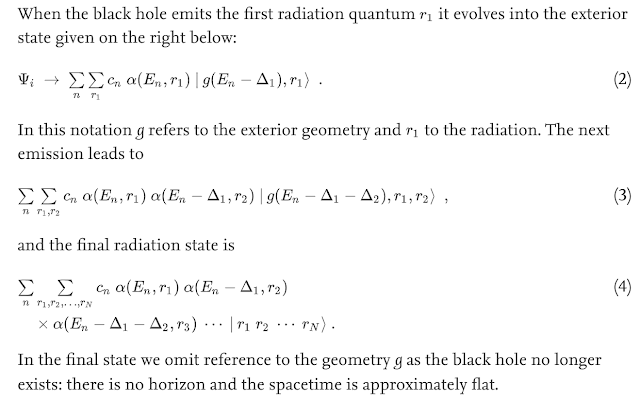
The resolution described here is conservative: the quantum state of the exterior gravity field is determined by the interior black hole state, allowing the latter to influence Hawking radiation produced at the horizon. Two distinct quantum states of the black hole may produce the same semiclassical external geometry, but the graviton states differ at the quantum level. The relationship between interior and exterior quantum states is not governed by classical no-hair theorems. Indeed, it has gradually been appreciated that gravity itself prevents the localization of quantum information [4], [9], [10], [11], [21], [22], [23], even behind a horizon. We stress that all formulations of the paradox require a degree of factorization between the black hole internal state and the radiation (see, e.g., (6)), which is clearly not true of our equation (4).
Certain aspects of our expressions (2)-(4) are very clear: the black hole information is spread over many branches of the final radiation state, and macroscopic superpositions of different spacetime geometries play a role in the evaporation. Some of the difficulty in resolving the paradox may originate from a reluctance to accept these aspects of quantum dynamics.
1. Shai's educational background. From statistical physics and network theory to genomics.
2. Shai's paper on embryo selection: Schizophrenia risk. Modeling synthetic sibling genomes. Variance among sibs vs general population. RRR vs ARR, family history and elevated polygenic risk.
1. The US stopped TSMC from fabbing leading edge Kirin CPUs for Huawei (designed by Huawei's chip design subsidiary HiSilicon). These were used in their smartphones. For a year or two Huawei was arguably the leading smartphone maker in the world and looked entirely capable of competing against Samsung and Apple. US Nat Sec concerns had more to do with Huawei's 5G business. But 5G infrastructure doesn't use leading edge chips (the base stations are big and don't rely on battery power the way phones do). The connection between Huawei's smartphone business and its 5G infrastructure business is very indirect -- they are entirely different businesses.
2. No sanctions were applied to ZTE which, unlike Huawei, is an actual state-owned entity and had previously been on the US entity list. ZTE also sells 5G infrastructure equipment. It is flourishing while Huawei is starting to run low on the non-leading edge chips (e.g., >20nm process) it buys for its base stations.
It's hard to explain what the US was up to with Huawei -- I would say it's a good example of the kind of incoherent "emergent" policy that Hanania writes about in his new book.
If you believe all the Western propaganda about Huawei and Xinjiang produced over the last few years you might be an NPC or at least someone who doesn't properly calibrate their Bayesian updates. As such it isn't really worth my effort to engage with you.
Regarding PRC invasion of Taiwan, missile technology, etc. see
Richard Hanania is President of the Center for the Study of Partisanship and Ideology (CSPI). He is a former Research Fellow at the Saltzman Institute of War and Peace Studies at Columbia University. His interests include personality differences between conservatives and liberals, morality in international politics, machine learning algorithms for text analysis, and American foreign policy. In addition to his academic work, he has written in The New York Times, The Wall Street Journal, and The Washington Post. Hanania holds a Ph.D. in Political Science from UCLA and a JD from the University of Chicago.
He is the author of the recently published Public Choice Theory and the Illusion of Grand Strategy: How Generals, Weapons Manufacturers, and Foreign Governments Shape American Foreign Policy.
This is video of a seminar I gave at the University of Sussex. Slides.
Has Hawking's Black Hole Information Paradox Been Resolved? Quantum Hair and Black Hole Information
Abstract: In 1976 Stephen Hawking argued that black holes cause pure states to evolve into mixed states. Put another way, quantum information that falls into a black hole does not escape in the form of radiation. Rather, it vanishes completely from our universe, thereby violating a fundamental property of quantum mechanics called unitarity. I give a pedagogical introduction to this paradox, suitable for non-experts. Then I discuss recent results concerning the quantum state of the gravitational field of a compact matter source. These results demonstrate the existence of quantum hair, violating the classical No Hair Theorems. I then discuss how this quantum hair affects Hawking radiation, allowing unitary evaporation of black holes.
Did it all start with High V, Low M, a 2011 post about Stephen J. Gould?
A famous theoretical physicist once complained acerbically to me about someone's paper we were discussing:
It is nothing more than the calculus of words.
Yet there are people who have nothing more than the calculus of words with which to build their models of the world.
See Bounded Cognition, and Oppenheimer:
Mathematics is "an immense enlargement of language, an ability to talk about things which in words would be simply inaccessible."
There are many verbally gifted writers and speakers that, when pressed to visualize some math problem in their mind's eye, must helplessly watch their normally high-octane intelligence sputter and fail. They often write or talk at a blistering clip, and can navigate complex mazes of abstractions — and yet, when it comes time to make contact with the real world or accomplish practical tasks, they may be helpless. They'll do great in English class, and terrible in Physics. They can be very fun to listen to due to their terrifying leaps in logic and the exceptional among them will be natural leaders.
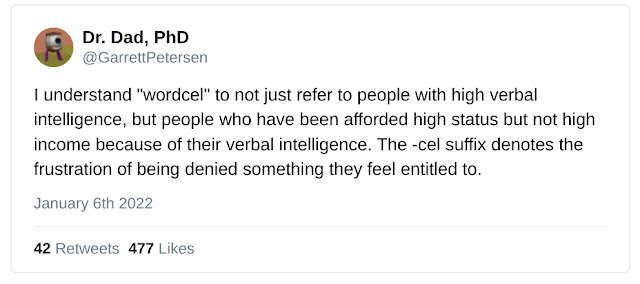
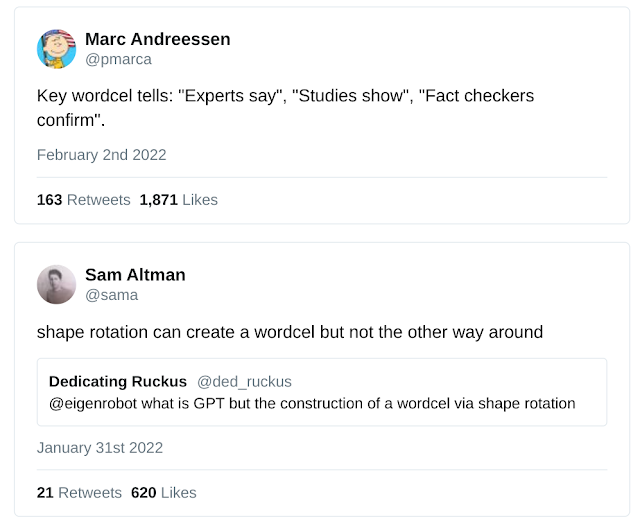
The wordcel moniker describes more than just one’s level of verbal skill: it’s also a socioeconomic classifier that refers to people whose verbal ability borders on self-sabotage (thus the “-cel”). Perhaps they’re driven mad by political rage, postmodernism, and disconnection from reality. It might refer to the priestly figures who work in the culture factories of the New York Times with their incomes and social prestige both precipitously declining only for the unperturbed masses on the internet to tell them in unison: “learn to code”! There’s even an implication that these folks are entirely rent-seekers (wrong, but directionally interesting).
...
The shape rotators have been a minor force until very recent history. Though they’ve produced a significant portion of human progress through feats of engineering excellence, they were rarely celebrated until the dawn of the Enlightenment, perhaps 500 years ago. While the long-lasting glory of the Roman aqueducts is renowned to this day, nobody knows the chief engineer behind the project (probably Marcus Vipsanius Agrippa, but who’s counting). Today their stock is climbing to the moon. The world’s richest (self-made) men are almost uniformly engineers, computer scientists, or physicists. Vast portions of society that in a prior age might have been organized by government bureaucrats or private sector shot-callers have been handed over to cybernetic self-organizing systems designed and run by mathematical wizards. We have been witness to the slow, and then rapid transfer of power from the smooth-talking Don Drapers of boardroom acclaim to the multi-armed bandits of Facebook Ads.
It’s clear that these big tech CEOs are verbally gifted, but by affinity and by practice they are in the rotator camp. Elon continually attributes his success to studying physics in college. Zuck programmed the original iteration of Facebook himself. Larry & Sergei did an entire PhD in linear algebra based information retrieval, a platonic ideal of shape rotation. Of the ten largest companies in the world, several are driven by fundamental technical breakthroughs. Society at large seems to respect and fear the forces of technology more and more as its cultural and financial capital rises.
There is some conflation between Math ability and Spatial ability in this recent talk of Wordcels and Shape Rotators. Math and Spatial ability are positively correlated but are actually separate factors that emerge from PCA in psychometrics. Look carefully at the arrows in the figure below -- if you can't read the figure you might be a wordcel ;-)
Note also that in the SMPY/SVPY data physicists dominated the wordcels even in their own verbal domain. This is also confirmed here.
See post from 2016 reproduced below, especially point #3.
This figure displays the math, verbal and spatial scores of gifted children tested at age 12, and their eventual college majors and career choices. This group is cohort 2 of the SMPY/SVPY study: each child scored better than 99.5 percentile on at least one of the M-V sections of the SAT.
Scores are normalized in units of SDs, within this cohort of gifted children. (So above and below average are defined with respect to the gifted population of >99th percentile kids, not relative to the general population.) The vertical axis is V, the horizontal axis is M, and the length of the arrow reflects spatial ability: pointing to the right means above the group average, to the left means below average; note the arrow for business majors should be twice as long as indicated but there was not enough space on the diagram. The spatial score is obviously correlated with the M score. More data here.
SMPY helps to establish a number of important facts about individuals of high ability:
1. We can (at least crudely) differentiate between individuals at the 99th, 99.9th and 99.99th percentiles. Exceptional talent can be identified through testing, even at age 13.
2. Probability of significant accomplishment, such as STEM PhD, patents awarded, tenure at leading research university, exceptional income, etc. continues to rise as ability level increases, even within the top 1%.
Needless to say, I think this Research Associate position will entail important and fascinating work.
Research Associate:
The Study of Mathematically Precocious Youth (SMPY) seeks a full-time post-doctoral Research Associate for study oversight, conducting research, writing articles, laboratory management, and statistical analyses using the vast SMPY data base. SMPY is a four-decade longitudinal study consisting of 5 cohorts and over 5,000 intellectually talented participants. One chief responsibility of this position will be to manage laboratory details associated with launching an age-50 follow-up of two of SMPY’s most exceptional cohorts: a cohort of 500 profoundly gifted participants initially identified by age 13 in the early 1980s, and a second cohort of over 700 top STEM graduate students identified and psychologically profiled in 1992 as first- and second-year graduate students. Candidates with interests in assessing individual differences, talent development, and particularly strong statistical-technical skills are preferred. Send vitae, cover letter stating interests, (pre)reprints, and three letters of recommendation to: Dean Camilla P. Benbow, Department of Psychology & Human Development, 0552 Peabody College, Vanderbilt University, Nashville, TN, 37203. The position will remain open until a qualified applicant is selected. For additional information, please contact either co-director: Camilla P. Benbow, camilla.benbow@vanderbilt.edu, or David Lubinski, david.lubinski@vanderbilt.edu.
http://www.vanderbilt.edu/Peabody/SMPY/. Vanderbilt University is an Equal Opportunity/Affirmative Action Employer.
We are aiming for a June 30th start date but that’s flexible.
Some relevant figures based on SMPY results of Lubinski, Benbow, and collaborators. See links above for more discussion of the data displayed.
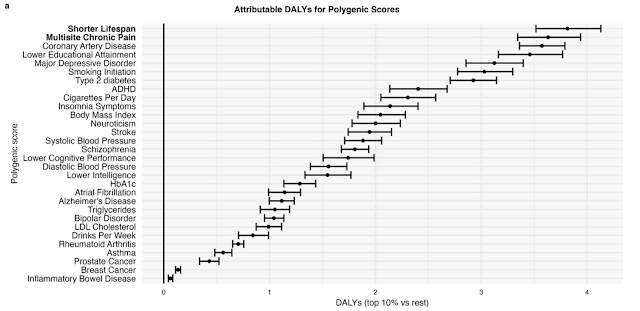
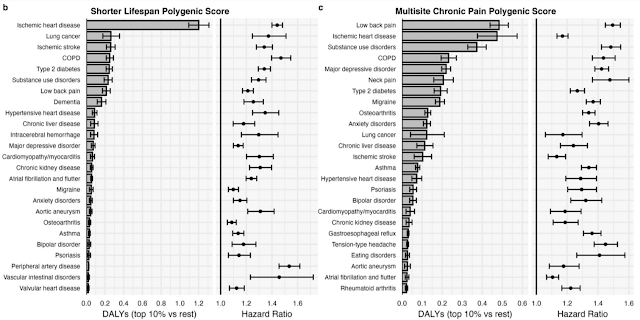
The impact of genetic variation on overall disease burden has not been comprehensively evaluated. Here we introduce an approach to estimate the effect of different types of genetic risk factors on disease burden quantified through disability-adjusted life years (DALYs, “lost healthy life years”). We use genetic information from 735,748 individuals with registry-based follow-up of up to 48 years. At the individual level, rare variants had higher effects on DALYs than common variants, while common variants were more relevant for population-level disease burden. Among common variants, rs3798220 (LPA) had the strongest effect, with 1.18 DALYs attributable to carrying 1 vs 0 copies of the minor allele. Belonging to top 10% vs bottom 90% of a polygenic score for multisite chronic pain had an effect of 3.63 DALYs. Carrying a deleterious rare variant in LDLR, MYBPC3, or BRCA1/2 had an effect of around 4.1-13.1 DALYs. The population-level disease burden attributable to some common variants is comparable to the burden from modifiable risk factors such as high sodium intake and low physical activity. Genetic risk factors can explain a sizeable number of healthy life years lost both at the individual and population level, highlighting the importance of incorporating genetic information into public health efforts.
The figure below shows DALYs attributable to being in the top 10% vs
bottom 90% of each PGS. (So, roughly, top 10% vs average individuals.)
The Shorter Lifespan Polygenic Score is a kind of index similar to the Embryo Health Score used by Genomic Prediction. Note that the difference between 90+ percentile and average individuals is roughly 4 DALYs!
In our 2019 sibling validation paper we showed that disease risk polygenic scores have roughly as much predictive power to differentiate high and low risk sibs as when applied to pairs of unrelated individuals.
By coincidence, I was just in contact over the weekend with several of the people involved in the effort to end discrimination against Asian Americans in elite college admissions.
This has been a long road, but perhaps victory is near.
... SFFA founder Edward J. Blum, who has spearheaded more than two dozen lawsuits challenging affirmative action and voting rights laws around the U.S., heralded the court’s move.
“Harvard and the University of North Carolina have racially gerrymandered their freshman classes in order to achieve prescribed racial quotas,” he wrote in a statement. “Every college applicant should be judged as a unique individual, not as some representative of a racial or ethnic group.”
... The facts are just so embarrassing to Harvard that with some modest adjustment in its admissions practices it might be able to absorb a judgment against it and get on with life more or less as usual. The vagueness of the category on which Harvard was relying to make sure that it kept its Asian undergraduates at the level that it wished, the so-called personality score, is such a floppy nothing of an empty basket — that’s not gonna do anymore.
There is something profoundly disturbing about Harvard using these flaccid categories to achieve something like a quota. The court papers show how the system was invented to keep the number of Jews down in the late 1920s and early 1930s. It’s all pretty bad, and part of the badness is that colleges have been both compelled and allowed to do what they’re doing under the rubric of "diversity," which conceals from view the actual operation of the whole system, and what they are in fact aiming to achieve. It’s substituting one vocabulary for another in a way that creates a climate of dishonesty. What goes on in the admissions office is increasingly mysterious, and what happens once students are admitted — that is something to which little attention is paid by educators themselves.
The post below appeared originally November 1 2021, just after the annual American Society for Reproductive Medicine meeting in October. The video of Dr. Wiemer's talk was embargoed so I could not include it. However, now that the embargo has passed you can view it at the link below.
Let me stress again that improved success rates resulting from higher accuracy in aneuploidy screening of embryos will affect millions of families around the world, and over 60% of all IVF families in the US.
[ NOTE ADDED NOVEMBER 12 2021: Research seminar videos from ASRM are embargoed until 12/31. So this video will not be available until then. ]
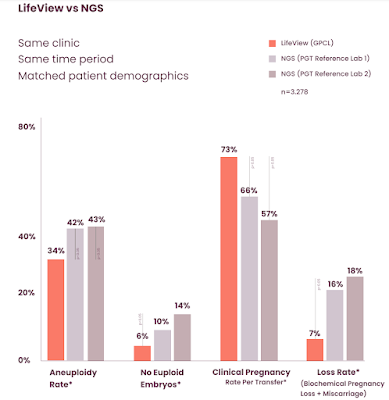
This talk describes a study of PGT-A (Preimplantation Genetic Testing - Aneuploidy, i.e., testing for chromosomal normality) using 2 different methods: NGS vs the new SNP array platform (LifeView) developed by my startup Genomic Prediction.
The SNP array platform allows very accurate genotyping of each embryo at ~1 million locations in the genome, and the subsequent bioinformatic analysis produces a much more accurate prediction of chromosomal normality than the older methods.
Millions of embryos are screened each year using PGT-A, about 60% of all IVF embryos in the US.
Klaus Wiemer is the laborator director for Poma Fertility near Seattle. He conducted this study independently, without informing Genomic Prediction. There are ~3000 embryos in the dataset, all biopsied at Poma and samples allocated to three testing labs A,B,C using the two different methods. The family demographics (e.g., maternal age) were similar in all three groups. Lab B is Genomic Prediction and A,C are two of the largest IVF testing labs in the world, using NGS.
The results imply lower false-positive rates, lower false-negative rates, and higher accuracy overall from our methods. These lead to a significantly higher pregnancy success rate.
The new technology has the potential to help millions of families all over the world.
Comparison of Outcomes from Concurrent Use of 3 Different PGT-A Laboratories
Oct 18 2021 annual meeting of the American Society for Reproductive Medicine (ASRM)
While Down Syndrome population incidence (i.e., in babies born) is only ~1 percent, the incidence of aneuploidy in embryos is much higher. Aneuploidy is more likely to result in a failed pregnancy than in the birth of a Downs baby -- e.g., because the embryo fails to implant, or does not develop properly during the pregnancy.
False positives mean fewer healthy embryos available for transfer, while false negatives mean that problematic embryos are transferred. Both of these screening accuracies affect the overall pregnancy success rate.
I'm working on the return of Manifold. I just did the first interview yesterday, with James Lee. I'm not sure when it will be released, but soon I hope.
Thanks to everyone who enjoyed the original show. I received a lot of requests to bring it back over the last 18 months since we went on hiatus. Please make suggestions for guests and show topics!
I'll try to get Dominic Cummings for a long interview. For now, see this great piece in the Guardian about his substack:
Michigan State University owns the copyright to the old stuff, so we may have to create a new channel and web site. This new project will be entirely mine and I will probably allow comments on the YouTube channel -- we turned those off because the university was/is risk averse about free expression ¯\_(ツ)_/¯
I hope to have Corey as a frequent guest on the show, but I will be restarting in solo mode.
Here's the first episode where Corey and I introduced ourselves. Very rough around the edges, but still fun for me to listen to again.
There is a widely-held perception that many of life’s key outcomes are fundamentally driven by people’s socio-economic status (SES). More specifically, there is a view that children’s educational attainment is largely a by-product of their familial SES. As a consequence of this pervasive paradigm, much of the energy in seeking to ameliorate or resolve poor educational attainment is based around trying to use SES as a social lever.
However, in the six papers listed below, published between 2019-2022, evidence has been gathered demonstrating that SES is only very modestly correlated with educational attainment. Furthermore, once a child’s cognitive ability is taken into account, even the modest link between SES and attainment diminishes to slight influence. This is true of datasets drawn from international groups of young people, as well as those from the US, UK, or Ireland. Future attempts to aid and study young people experiencing difficulty with educational attainment should be built on an awareness of the limited role of SES.
Gary N Marks Michael O’Connell
1. O’Connell, M. and Marks, G.N. (2022)
Cognitive ability and conscientiousness are more important than SES for educational attainment: An analysis of the UK Millennium Cohort Study
Personality and Individual Differences, 188
https://doi.org/10.1016/j.paid.2021.111471
Highlights
Antecedents of educational attainment of great interest
Dominant paradigm focuses on SES of children.
Cognitive ability and conscientiousness have stronger record in research findings.
Using new UK MCS longitudinal survey data, GCSE state exam performance assessed
Cognitive ability and conscientiousness explained far more than SES measures
2. Marks, G. N. (2021)
Is the relationship between socioeconomic status (SES) and student achievement causal? Considering student and parent abilities
Educational Research and Evaluation, 10.1080/13803611.2021.1968442: 1-24.
Abstract
Most studies on the relationship between students’ socioeconomic status (SES) and student achievement assume that its effects are sizable and causal. A large variety of theoretical explanations have been proposed. However, the SES–achievement association may reflect, to some extent, the inter-relationships of parents’ abilities, SES, children’s abilities, and student achievement. The purpose of this study is to quantify the role of SES vis-à-vis child and parents’ abilities, and prior achievement. Analyses of a covariance matrix that includes supplementary correlations for fathers and mothers’ abilities derived from the literature indicate that more than half of the SES–achievement association can be accounted for by parents’ abilities. SES coefficients decline further with the addition of child’s abilities. With the addition of prior achievement, the SES coefficients are trivial implying that SES has little or no contemporaneous effects. These findings are not compatible with standard theoretical explanations for SES inequalities in achievement.
3. Marks, G. N. and O’Connell, M. (2021)
No Evidence for Cumulating Socioeconomic Advantage. Ability Explains Increasing SES Effects with Age on Children’s Domain Test scores
Intelligence, 88
https://doi.org/10.1016/j.intell.2021.101582
Highlights
Data analysed for five domains for children of the NLSY79 mothers study.
SES effects increase for only some domains and not substantially.
No increase in SES effects when considering mother's or children's prior ability.
Effects of child's prior ability on test scores increase substantially with age.
SES effects are small net of mother's ability.
4. Marks, G. N. and O'Connell, M. (2021)
Inadequacies in the SES–Achievement model: Evidence from PISA and other studies
Review of Education, 9(3): e3293.
https://doi.org/10.1002/rev3.3293
Abstract
Students’ socioeconomic status (SES) is central to much research and policy deliberation on educational inequalities. However, the SES model is under severe stress for several reasons. SES is an ill-defined concept, unlike parental education or family income. SES measures are frequently based on proxy reports from students; these are generally unreliable, sometimes endogenous to student achievement, only low to moderately intercorrelated, and exhibit low comparability across countries and over time. There are many explanations for SES inequalities in education, none of which achieves consensus among research and policy communities. SES has only moderate effects on student achievement, and its effects are especially weak when considering prior achievement, an important and relevant predictor. SES effects are substantially reduced when considering parent ability, which is causally prior to family SES. The alternative cognitive ability/genetic transmission model has far greater explanatory power; it provides logical and compelling explanations for a wide range of empirical findings from student achievement studies. The inadequacies of the SES model are hindering knowledge accumulation about student performance and the development of successful policies.
5. O'Connell, M. and Marks, G. N. (2021)
Are the effects of intelligence on student achievement and well-being largely functions of family income and social class? Evidence from a longitudinal study of Irish adolescents
Highlights
Power of cognitive ability and social class contrasted.
Large representative sample from longitudinal study, waves 1–3, of 6216 children
Outcomes were attainments, difficulties and relationships.
Cognitive ability explained large amounts of variance.
Social background only minor effects
6. O'Connell, M. (2019)
Is the impact of SES on educational performance overestimated? Evidence from the PISA survey
Intelligence, 75: 41-47
https://doi.org/10.1016/j.intell.2019.04.005
Highlights Policy-makers overly attribute differences in educational performance to SES.
PISA survey used to assess roles of parental education and household income.
Combining them concealed differences in outcomes between rich and poor countries.
Household income important in poor countries, parental education in rich countries.
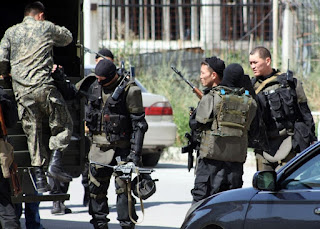
If you are scratching your head about what happened in Kazakhstan (perhaps as you were last summer about Afghanistan, remember that?), it may be because you only look at mainstream Western sources of information. You might also be the kind of person who swallows whole US propaganda stories about Ukraine, Syria, Xinjiang, Huawei, January 6, RussiaGate, etc.
Dmitry Orlov on January 09, 2022 · at 5:22 pm EST/EDT [ Comment on this blog post by the Saker ]
What happened in KZ was a paramilitary attack meticulously organized but launched in haste by Western intelligence that had the goal of destroying the statehood of KZ. It was not an attempt to take it over (no time for that) but simply to destroy. The entire state structure was sufficiently rotten that the defense/security agencies couldn’t even pick sides and became demoralized and inactive, but once the Russians were called in to help they immediately knew which side would win and fell back in line. The West’s goal was to set KZ ablaze prior to the talks in Geneva in order to have a better negotiating position vis-à-vis Russia: “You want to divide spheres of influence? Well, we already did that for you—in Kazakhstan!” Keep in mind, the RU-KZ border is open, undefendable and almost 8000km long, running from Volgograd to Tomsk in Siberia, making KZ, as a failed state, a major headache for Russia. Obviously, Russia knew that KZ, rife with Western NGOs and accompanying corruption, and with a weakening economy, could easily be tipped over, and prepared for just this case. Now that the attack on KZ statehood has failed and a mop-up operation is in progress, this has given Russia a huge trump card for the Geneva talks. The West has played its cards and lost. There will be no more color revolutions in the post-Soviet space. Its operatives in KZ are being hunted down and eliminated. Those in positions of authority in KZ have learned the same lesson as Lukashenko: they cannot trust the West; they have to trust Moscow.
On any particular issue Orlov might be right or he might be wrong, but guaranteed on certain topics he knows a lot more than the "experts" found on television or in the NYTimes. In recent years I have spent significant time with Western foreign policy and defense "experts" in think tank settings and I have to say that they are often poorly informed or miscalibrated in the confidence levels assigned to their predictions. Sadly, elites in the West have largely been fooled by their own propaganda, and often have entirely unrealistic views of what is really happening in the world. Alternative sources of information, especially individuals with good local knowledge, are always useful.
Wikipedia: Dmitry Orlov (Russian: Дми́трий Орло́в; born 1962) is a Russian-American engineer and writer on subjects related to "potential economic, ecological and political decline and collapse in the United States", something he has called "permanent crisis".[1] Orlov believes collapse will be the result of huge military budgets, government deficits, an unresponsive political system ...
Orlov was born in Leningrad (now Saint Petersburg) and moved to the United States at the age of 12. He has a BS in Computer Engineering and an MA in Applied Linguistics. He was an eyewitness to the collapse of the Soviet Union over several extended visits to his Russian homeland between the late 1980s and mid-1990s. ...
In 2006 Orlov published an online manifesto, "The New Age of Sail." In 2007 he and his wife sold their apartment in Boston and bought a sailboat, fitted with solar panels and six months supply of propane, and capable of storing a large quantity of food stuffs. He calls it a “survival capsule.” ...
Here is a different (internal coup and counter-coup) interpretation of events which is quite unlike Orlov's. I have not seen any evidence presented yet of foreign involvement, but perhaps I am not looking at the right sources...
which led me to the podcast interview below with Ryan Peterson, CEO and Founder of Flexport. It's one of the best startup founder interviews I've heard in a long time.
Is there any doubt that the best "generalist" talent among people aged 20-35 is in tech startups? Petersen understands more about the world (or, at least, how to get stuff done in the world) than any typical business school or social science prof, or any typical big company exec or government official.
Dan Wang of Gavekal is a great China tech and economics analyst -- well calibrated, in my opinion.
... China has strong entrepreneurs as well as a strong state, and these two sometimes reinforce each other. An interesting fact I noticed recently is that the party secretary of Zhejiang province, one of the country’s most important, used to be a director of China’s manned space program. A skim through the Wikipedia pages of provincial party secretaries would reveal a diverse range of technocratic experiences.
An important factor in China’s reform program includes not only a willingness to reshape the strategic landscape—like promoting manufacturing over the internet—but also a discernment of which foreign trends to resist. These include excessive globalization and financialization. Beijing diagnosed the problems with financialization earlier than the US, where the problem is now endemic. The leadership is targeting a high level of manufacturing output, rejecting the notion of comparative advantage. That static model constructed by economists with the aim of seducing undergrads has leaked out of the lecture hall and morphed into a political justification for only watching as American communities of engineering practice dissolved. And Beijing today looks prescient for having kept out the US social media companies that continuously infuriate their home government. ...
Only a retard (autistic economist) can overlook the pitfalls of blind acceptance of Comparative Advantage (Ricardo, etc.): "Gee, those guys are great at making hypersonic missiles and targeting radar. We'll let them do it and just buy the stuff from them. Everybody wins!" See Charlie Munger, Ricardo and finance.
Human Accelerated Regions (HARs) are regions of DNA that were conserved throughout prior (e.g., vertebrate) evolution but are significantly different in the human genome.
Allen Institute: ... of the known 3,171 human accelerated regions, 99 percent of these human-specific mutations fall into "non-coding" regions of DNA, or regions of DNA that don't contain instructions for making a protein. Many of them are in stretches of our genome known as enhancers, regions which regulate nearby genes, and about half of those are nestled in enhancers that are active in the developing human brain.
Our analysis of DNA regions used in predictors for common diseases and complex human traits found that large portions of phenotype variance reside in non-coding regions. This has important consequences for pleiotropy and for our understanding of genetic architecture.
This figure is from the Supplement (p.62) of a recent Nature paper describing a high quality genome sequence obtained from the toe of a female Neanderthal who lived in the Altai mountains in Siberia. Interestingly, copy number variation at 16p11.2 is one of the structural variants identified in a recent deCODE study as related to IQ depression; see earlier post Structural genomic variants (CNVs) affect cognition.
From the Supplement (p.62):
Of particular interest is the modern human-specific duplication on 16p11.2 which encompasses the BOLA2 gene. This locus is the breakpoint of the 16p11.2 micro-deletion, which results in developmental delay, intellectual disability, and autism5,6. We genotyped the BOLA2 gene in 675 diverse human individuals sequenced to low coverage as part of the 1000 Genome Project Phase I7 to assess the population distribution of copy numbers in homo-sapiens (Figure S8.3). While both the Altai Neandertal and Denisova individual exhibit the ancestral diploid copy number as seen in all the non-human great apes, only a single human individual exhibits this diploid copy number state.
Modern humans typically have many (e.g., 3-10) copies of BOLA2. In Neanderthals and apes, 2 copies.
Variation in copy number presumably affects gene expression, even if the actual protein (coding base pairs) structure is not changed. There may be other mechanisms at work, of course.
Mutations in this 16p11.2 region are associated with schizophrenia, autism, brain size, reduced IQ, anemia, and other things.
Since 2013 a number of papers have investigated the phenotype effects of BOLA2 copy number variation (CNV) and/or the 16p11.2 duplication/deletion. The latter is more complex as it affects multiple genes in addition to BOLA2. In the future, using whole exome or whole genome data in UKB, it should be possible to focus more specifically on effects of BOLA2 CNV.
16p11.2 C deletion: "We observe significant increases, on the order of one standard deviation, in weight, BMI, hip and waist circumference, reticulocyte count, and Cystatin C measures for these individuals. The larger 593 kb CNV associates with similar measures of body size and fat, as well as hypertension, diabetes/HbA1c, and abdominal hernia. These results are also indicative of effects due to developmental delay; namely, decreased measures of memory, higher Townsend deprivation (an index of material deprivation which considers employment, home/auto ownership, and household overcrowding in a person's neighborhood) ..."
Note the effect sizes, e.g., on Townsend deprivation index, are extremely large, roughly 1 SD. The effect size for Prospective Memory score (related to ability to read, remember, and execute directions) is 2 SD!