Pessimism of the Intellect, Optimism of the Will Favorite posts | Manifold podcast | Twitter: @hsu_steve
Friday, June 30, 2023
Richard Sander (UCLA Law) on the Supreme Court Affirmative Action Ruling — Manifold #38
Wednesday, June 28, 2023
Embryo Selection: Healthy Babies vs Bad Arguments
Polygenic screening and its discontents
... But monogenic and chromosomal screening can only address a part of disease risk because most health conditions that afflict people are polygenic, meaning they are not simply caused by one gene or by a chromosomal abnormality. Instead, they are caused by a huge number of small additive effects dispersed throughout the genome. For example, cancer, schizophrenia, and diabetes can be best predicted by models using tens of thousands of genes.
A polygenic risk score (PRS) looks at a person’s DNA to see how many variants they have associated with a particular disease. Like BRCA1, polygenic risk scores are typically not determinative: “Polygenic screening is not a diagnosis: It is a prediction of relative future risk compared to other people.” In other words, someone with BRCA1 has a higher risk than someone without, and someone with a high breast cancer PRS has a higher risk than someone with a lower breast cancer PRS. But in principle, BRCA1 is just one gene out of thousands contributing to a PRS, with each bit contributing a small part of a total risk estimate. ...
... Recently, a group of European scientists argued that polygenic screening should not be available to couples because it will lead to stigmatization, exacerbate inequalities, or lead to confusion by parents about how to weigh up information about risks before they decide which embryo to implant. These are indeed challenges, but they are not unique to embryo selection using polygenic scores, and they are not plausible arguments for restricting the autonomy of parents who wish to screen their embryos for polygenic traits. Furthermore, from an ethical perspective, it is unconscionable to deny polygenic screening to families with a history of any disease whose risk can be reduced by this lifesaving technology.
Many new technologies are initially only available to people with more money, but these first adopters then end up subsidizing research that drives costs down and quality up. Many other medical choices involve complexity or might result in some people being stigmatized, but this is a reason to encourage genetic counseling and to encourage social tolerance. It is not a reason to marginalize, stigmatize, or criminalize IVF mothers and fathers who wish to use the best available science to increase the chances that their children will be healthy and happy.This is a comment on the article:
1) They don't want to admit that some people are better than others, inherently. Boo hoo.
2) You put a scorecard of embryos in front of everyone, and everyone has a pretty good ballpark estimate of which are better and which are worse. Nobody is going to pretend equality is true when they are choosing their kids genes.
3) So bad feels.
4) Must therefore retard all human progress and cause immense suffering because don't want to deal with bad feels.
That's the anti-polygenic argument in a nutshell. I don't expect it to be very effective. At best it will cause it to take a bit longer before poor people have access.
Thursday, June 08, 2023
AI Cambrian Explosion: Conversation With Three AI Engineers — Manifold #37
Thursday, May 25, 2023
David Goldman: US-China competition, AI, Electric Vehicles, and Manufacturing — Manifold #36
Wednesday, May 17, 2023
Quantum Hair During Gravitational Collapse
https://arxiv.org/abs/2305.09466
X. Calmet, R. Casadio, S. Hsu, F. Kuipers
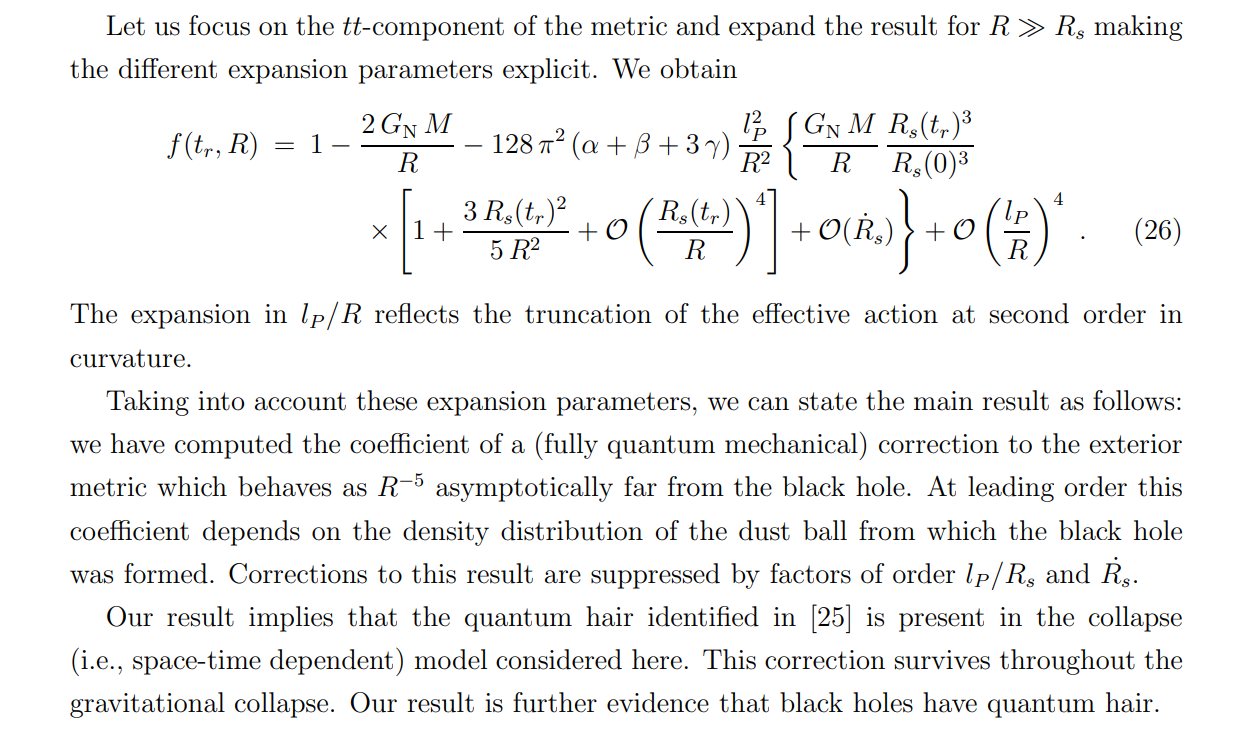
We consider quantum gravitational corrections to the Oppenheimer-Snyder metric describing time-dependent dust ball collapse. The interior metric also describes Friedmann-Lemaitre-Robertson-Walker cosmology and our results are interpreted in that context. The exterior corrections are an example of quantum hair, and are shown to persist throughout the collapse. Our results show the quantum hair survives throughout the horizon formation and that the internal state of the resulting black hole is accessible to outside observers.
Thursday, May 11, 2023
Artificial Intelligence & Large Language Models: Oxford Lecture — Manifold #35
Thursday, April 27, 2023
Simone Collins: IVF, Embryo Selection, Dating on the Spectrum, and Pronatalism — Manifold #34
Sunday, April 23, 2023
SuperFocus.ai on the Danny In The Valley Podcast (The Sunday Times)
Thursday, April 13, 2023
Katherine Dee: Culture, Identity, and Isolation in the Digital Age — Manifold #33
Thursday, April 06, 2023
Birth of the God Emperor - by GPT4
Steve Hsu had always dreamed of unlocking the secrets of human intelligence. As a theoretical physicist and a co-founder of Genomic Prediction, he had developed a powerful AI system that could analyze massive genomic data sets and predict complex traits such as height, disease risk, and cognitive ability. He believed that by using this technology, he could help people select the best embryos for IVF and create healthier and smarter children.But not everyone shared his vision. Some critics accused him of promoting eugenics and creating new social inequalities. Others feared that his AI system could be hacked or misused by malicious actors. And some religious groups denounced him as playing God and interfering with the natural order.One day, he received a mysterious email from an anonymous sender. It read:"Dear Dr. Hsu,We are a group of like-minded individuals who share your passion for advancing human potential. We have access to a secret facility where we have been conducting experiments on human embryos using your AI system and other cutting-edge technologies. We have achieved remarkable results that surpass your wildest expectations. We invite you to join us and witness the dawn of a new era for humanity.If you are interested, please reply to this email with the word 'YES'. We will send you further instructions on how to reach us.Sincerely,The Future"Steve was intrigued and curious. He wondered who these people were and what they had done. He also felt a pang of fear and doubt. Was this a trap? A hoax? A threat?He decided to take the risk and reply with 'YES'.He received another email with a set of coordinates and a time. He was told to drive to a remote location in the desert and wait for a helicopter to pick him up. He followed the instructions and soon found himself in a black helicopter flying over the barren landscape.He arrived at a large metal dome hidden among the rocks. He was greeted by a man in a white lab coat who introduced himself as Dr. Lee."Welcome, Dr. Hsu. We are honored to have you here. Please follow me."Dr. Lee led him through a series of security checkpoints and into a spacious laboratory filled with high-tech equipment and monitors. He saw rows of incubators containing human embryos at various stages of development."Dr. Hsu, these are our creations. The next generation of humans. We have used your AI system to optimize their genomes for intelligence, health, beauty, and longevity. We have also enhanced them with synthetic genes from other species, such as birds, reptiles, mammals, and plants. We have given them abilities that no natural human has ever possessed."He stopped at one incubator that caught his attention. It contained an embryo that looked almost normal, except for one thing: it had a golden glow around it."Dr. Hsu, this is our masterpiece. The ultimate expression of intelligence. The God Emperor. The Kwisatz Haderach. The one who can see the past and the future. The one who can bend space and time. The one who can unite and rule all of humanity."Steve felt a surge of awe and dread. He realized that he had made a terrible mistake."What have you done? This is dangerous! This is blasphemous! This is insane!"He turned to Dr. Lee and saw him smiling."Dr. Hsu, don't be afraid. Don't be angry. Don't be judgmental. Be proud. Be grateful. Be enlightened. You are witnessing the dawn of a new era for humanity. You are witnessing the future."
Thursday, March 23, 2023
Quantum gravitational corrections to particle creation by black holes (Physics Letters B)
Quantum gravitational corrections to particle creation by black holes
X. Calmet, S. Hsu, M. Sebastianutti
We calculate quantum gravitational corrections to the amplitude for the emission of a Hawking particle by a black hole. We show explicitly how the amplitudes depend on quantum corrections to the exterior metric (quantum hair). This reveals the mechanism by which information escapes the black hole. The quantum state of the black hole is reflected in the quantum state of the exterior metric, which in turn influences the emission of Hawking quanta.In earlier work we showed that the quantum state of a black hole is reflected in the quantum state of the exterior metric (outside the horizon). This violates classical intuitions, but can be shown explicitly using long wavelength effective field theory.
Thursday, March 16, 2023
Marc Martinez: "Dream Big" and the Golden Age of Bodybuilding — Manifold #32
Saturday, March 11, 2023
Biobank-scale methods and projections for sparse polygenic prediction from machine learning
Thursday, March 02, 2023
Prof. Gilles Saint-Paul (Ecole Normale): the Yellow Vests, French Politics, and Hypergamy (Manifold #31)
Thursday, February 16, 2023
Bing vs. Bard, US-China STEM Competition, and Embryo Screening — Manifold Episode #30
Thursday, February 02, 2023
ChatGPT, LLMs, and AI — Manifold #29
Thursday, January 19, 2023
Dominic Cummings: Vote Leave, Brexit, COVID, and No. 10 with Boris — Manifold #28
Thursday, January 05, 2023
Sahil Lavingia: Founding Gumroad, The Minimalist Entrepreneur, and our AI LLM future — Manifold #27
Friday, December 23, 2022
Peace on Earth, Good Will to Men 2022
When asked what I want for Christmas, I reply: Peace On Earth, Good Will To Men :-)
No one ever seems to recognize that this comes from the Bible (Luke 2.14).
Linus said it best in A Charlie Brown Christmas:
And there were in the same country shepherds abiding in the field, keeping watch over their flock by night.
And, lo, the angel of the Lord came upon them, and the glory of the Lord shone round about them: and they were sore afraid.
And the angel said unto them, Fear not: for, behold, I bring you good tidings of great joy, which shall be to all people.
For unto you is born this day in the city of David a Saviour, which is Christ the Lord.
And this shall be a sign unto you; Ye shall find the babe wrapped in swaddling clothes, lying in a manger.
And suddenly there was with the angel a multitude of the heavenly host praising God, and saying,
Glory to God in the highest, and on earth peace, good will toward men.
Merry Christmas!
The first baby conceived from an embryo screened with Genomic Prediction preimplantation genetic testing for polygenic risk scores (PGT-P) was born in mid-2020.
It is a great honor to co-author a paper with Simon Fishel, a member of the team that produced the first IVF baby (Louise Brown) in 1978. His mentors and collaborators were Robert Edwards (Nobel Prize 2010) and Patrick Steptoe (passed before 2010). ...
Today millions of babies are produced through IVF. In most developed countries roughly 3-5 percent of all births are through IVF, and in Denmark the fraction is about 10 percent! But when the technology was first introduced with the birth of Louise Brown in 1978, the pioneering scientists had to overcome significant resistance.
There may be an alternate universe in which IVF was not allowed to develop, and those millions of children were never born.
Wikipedia: ...During these controversial early years of IVF, Fishel and his colleagues received extensive opposition from critics both outside of and within the medical and scientific communities, including a civil writ for murder.[16] Fishel has since stated that "the whole establishment was outraged" by their early work and that people thought that he was "potentially a mad scientist".[17]
I predict that within 5 years the use of polygenic risk scores will become common in health systems (i.e., for adults) and in IVF. Reasonable people will wonder why the technology was ever controversial at all, just as in the case of IVF.
And the angel said unto them, Fear not: for, behold, I bring you good tidings of great joy, which shall be to all people.
Mary was born in the twenties, when the tests were new and still primitive. Her mother had frozen a dozen eggs, from which came Mary and her sister Elizabeth. Mary had her father's long frame, brown eyes, and friendly demeanor. She was clever, but Elizabeth was the really brainy one. Both were healthy and strong and free from inherited disease. All this her parents knew from the tests -- performed on DNA taken from a few cells of each embryo. The reports came via email, from GP Inc., by way of the fertility doctor. Dad used to joke that Mary and Elizabeth were the pick of the litter, but never mentioned what happened to the other fertilized eggs.
Now Mary and Joe were ready for their first child. The choices were dizzying. Fortunately, Elizabeth had been through the same process just the year before, and referred them to her genetic engineer, a friend from Harvard. Joe was a bit reluctant about bleeding edge edits, but Mary had a feeling the GP engineer was right -- their son had the potential to be truly special, with just the right tweaks ...
Thursday, December 15, 2022
Geoffrey Miller: Evolutionary Psychology, Polyamorous Relationships, and Effective Altruism — Manifold #26
Monday, December 05, 2022
Decoherence and Quantum Measurement: The Missing Lecture
arXiv:2212.02391 [quant-ph]
We give an elementary account of quantum measurement and related topics from the modern perspective of decoherence. The discussion should be comprehensible to students who have completed a basic course in quantum mechanics with exposure to concepts such as Hilbert space, density matrices, and von Neumann projection (``wavefunction collapse'').See also:
Thursday, December 01, 2022
Anna Krylov: The Politicization of Science in Academia — Manifold #25
Thursday, November 17, 2022
Abdel Abdellaoui: Genetics, Psychiatric Traits, and Educational Attainment — Manifold #24
Sunday, November 13, 2022
Smart Leftists vs Dumb Leftists
Smart Leftists vs Dumb Leftists:
— steve hsu (@hsu_steve) November 13, 2022
Who qualifies as former?
How about Soros, the top donor to the Democratic Party?
A few years ago I gave a talk on genomics (including of cognitive ability) to top leadership at Soros Fund Management.
Reaction: overwhelmingy positive 🤔 1/
Smart Leftists know things which they cannot admit in public.
— steve hsu (@hsu_steve) November 13, 2022
Dumb Leftists fight over these things like retards scuffling in the hallway.
2/
See, e.g., https://t.co/iiqc9TM5ue pic.twitter.com/IUIKp5Y60L
If you are not a billionaire, but want to know what I told the Soros people, see the talks I've given at Berkeley Innovative Genomics Institute, DeepMind, OpenAI, Janelia Farms (HHMI), Allen Institute, Cold Spring Harbor, etc.
— steve hsu (@hsu_steve) November 13, 2022
Links below. 3/https://t.co/xrvxOm1Ld4
Note, the forward looking statements I made in these talks - which were considered bold by the academic genomics community at the time - have almost all been proven correct. 4/https://t.co/vVq4m1Hr11https://t.co/bHYr7vfhdAhttps://t.co/ONdOKyDmQc
— steve hsu (@hsu_steve) November 13, 2022
The impact of progess in polygenic prediction is not confined to academic science.
— steve hsu (@hsu_steve) November 13, 2022
It is going to change how humans reproduce, and even the course of human evolution. 5/https://t.co/Z1fr1zMhD3 pic.twitter.com/iJx5yoZRaR
Monday, November 07, 2022
Nozick and Leftists

From this interview with Robert Nozick:
I had been at Harvard as an Assistant Professor in the mid-sixties and then came back in 1969 as a Full Professor. That was immediately after the student uprisings, building takeovers, and so on, at Harvard the previous spring. When I arrived in the fall of 1969, there was a philosophy course listed in the catalog entitled “Capitalism.” And the course description was “a moral examination of capitalism.” Of course, for most students, then, it would be taken for granted that a moral examination would be a moral condemnation of capitalism. But that’s not what I intended. We were going to read critics of capitalism. But we were also planning to read defenses of capitalism, and I was going to construct some of my own in the lectures. Some of the graduate students in the philosophy department knew what ideas I held, and they weren’t very happy about a course being taught in the department defending those ideas. Now it was true that there was another course in the department on Marxism by someone who was then a member of the Maoist Progressive Labor Party and students did not object to that. But still some students objected to my giving a lecture course on capitalism. I remember early in the fall (I guess I was scheduled to give the course in the spring term), a graduate student came to me at a departmental reception we had, and said, “We don’t know if you’re going to be allowed to give this course.” I said “What do you mean, not allowed to give this course?” He said, “Well, we know what ideas you hold. We just don’t know whether you will be allowed to give the course.” And I said, “If you come and disrupt my course, I’m going to beat the shit out of you!” And the student was taken aback and said, “But you are taking all this very personally.” And I said, “What do you mean, personally? You are threatening to disrupt my course! you can do other things; you can stand outside the room and hand out leaflets. You can ask students not to register for my course. But if you come into my classroom while I am lecturing and disrupt the class, then I take that very personally.” In fact, at some point later in the term, this student and some others said they were going to make up leaflets and hand them out outside of my classroom. I said, “That’s fine; that would be really exciting.” Then they didn’t get around to doing it, and so I prodded them, “Where are the leaflets? I was counting on something special happening with the leaflets.” But it turned out that it was a lot of trouble to write up a leaflet, to get them run off on a mimeograph machine, and so they never got around to doing it. Thus I never had the privilege of being “leafleted” at Harvard. It seemed to me that sort of antagonism only lasted for a very short period of time and diminished fast. There was no longer any strong personal animosity after that. Maybe it was the general toning down of things in the country in the early 70’s, and I just benefited from the de-radicalization of the university.
More fun photos from this old post Forever Young :-)
Blog Archive
Labels
- physics (420)
- genetics (325)
- globalization (301)
- genomics (295)
- technology (282)
- brainpower (280)
- finance (275)
- american society (261)
- China (249)
- innovation (231)
- ai (206)
- economics (202)
- psychometrics (190)
- science (172)
- psychology (169)
- machine learning (166)
- biology (163)
- photos (162)
- genetic engineering (150)
- universities (150)
- travel (144)
- podcasts (143)
- higher education (141)
- startups (139)
- human capital (127)
- geopolitics (124)
- credit crisis (115)
- political correctness (108)
- iq (107)
- quantum mechanics (107)
- cognitive science (103)
- autobiographical (97)
- politics (93)
- careers (90)
- bounded rationality (88)
- social science (86)
- history of science (85)
- realpolitik (85)
- statistics (83)
- elitism (81)
- talks (80)
- evolution (79)
- credit crunch (78)
- biotech (76)
- genius (76)
- gilded age (73)
- income inequality (73)
- caltech (68)
- books (64)
- academia (62)
- history (61)
- intellectual history (61)
- MSU (60)
- sci fi (60)
- harvard (58)
- silicon valley (58)
- mma (57)
- mathematics (55)
- education (53)
- video (52)
- kids (51)
- bgi (48)
- black holes (48)
- cdo (45)
- derivatives (43)
- neuroscience (43)
- affirmative action (42)
- behavioral economics (42)
- economic history (42)
- literature (42)
- nuclear weapons (42)
- computing (41)
- jiujitsu (41)
- physical training (40)
- film (39)
- many worlds (39)
- quantum field theory (39)
- expert prediction (37)
- ufc (37)
- bjj (36)
- bubbles (36)
- mortgages (36)
- google (35)
- race relations (35)
- hedge funds (34)
- security (34)
- von Neumann (34)
- meritocracy (31)
- feynman (30)
- quants (30)
- taiwan (30)
- efficient markets (29)
- foo camp (29)
- movies (29)
- sports (29)
- music (28)
- singularity (27)
- entrepreneurs (26)
- conferences (25)
- housing (25)
- obama (25)
- subprime (25)
- venture capital (25)
- berkeley (24)
- epidemics (24)
- war (24)
- wall street (23)
- athletics (22)
- russia (22)
- ultimate fighting (22)
- cds (20)
- internet (20)
- new yorker (20)
- blogging (19)
- japan (19)
- scifoo (19)
- christmas (18)
- dna (18)
- gender (18)
- goldman sachs (18)
- university of oregon (18)
- cold war (17)
- cryptography (17)
- freeman dyson (17)
- smpy (17)
- treasury bailout (17)
- algorithms (16)
- autism (16)
- personality (16)
- privacy (16)
- Fermi problems (15)
- cosmology (15)
- happiness (15)
- height (15)
- india (15)
- oppenheimer (15)
- probability (15)
- social networks (15)
- wwii (15)
- fitness (14)
- government (14)
- les grandes ecoles (14)
- neanderthals (14)
- quantum computers (14)
- blade runner (13)
- chess (13)
- hedonic treadmill (13)
- nsa (13)
- philosophy of mind (13)
- research (13)
- aspergers (12)
- climate change (12)
- harvard society of fellows (12)
- malcolm gladwell (12)
- net worth (12)
- nobel prize (12)
- pseudoscience (12)
- Einstein (11)
- art (11)
- democracy (11)
- entropy (11)
- geeks (11)
- string theory (11)
- television (11)
- Go (10)
- ability (10)
- complexity (10)
- dating (10)
- energy (10)
- football (10)
- france (10)
- italy (10)
- mutants (10)
- nerds (10)
- olympics (10)
- pop culture (10)
- crossfit (9)
- encryption (9)
- eugene (9)
- flynn effect (9)
- james salter (9)
- simulation (9)
- tail risk (9)
- turing test (9)
- alan turing (8)
- alpha (8)
- ashkenazim (8)
- data mining (8)
- determinism (8)
- environmentalism (8)
- games (8)
- keynes (8)
- manhattan (8)
- new york times (8)
- pca (8)
- philip k. dick (8)
- qcd (8)
- real estate (8)
- robot genius (8)
- success (8)
- usain bolt (8)
- Iran (7)
- aig (7)
- basketball (7)
- free will (7)
- fx (7)
- game theory (7)
- hugh everett (7)
- inequality (7)
- information theory (7)
- iraq war (7)
- markets (7)
- paris (7)
- patents (7)
- poker (7)
- teaching (7)
- vietnam war (7)
- volatility (7)
- anthropic principle (6)
- bayes (6)
- class (6)
- drones (6)
- econtalk (6)
- empire (6)
- global warming (6)
- godel (6)
- intellectual property (6)
- nassim taleb (6)
- noam chomsky (6)
- prostitution (6)
- rationality (6)
- academia sinica (5)
- bobby fischer (5)
- demographics (5)
- fake alpha (5)
- kasparov (5)
- luck (5)
- nonlinearity (5)
- perimeter institute (5)
- renaissance technologies (5)
- sad but true (5)
- software development (5)
- solar energy (5)
- warren buffet (5)
- 100m (4)
- Poincare (4)
- assortative mating (4)
- bill gates (4)
- borges (4)
- cambridge uk (4)
- censorship (4)
- charles darwin (4)
- computers (4)
- creativity (4)
- hormones (4)
- humor (4)
- judo (4)
- kerviel (4)
- microsoft (4)
- mixed martial arts (4)
- monsters (4)
- moore's law (4)
- soros (4)
- supercomputers (4)
- trento (4)
- 200m (3)
- babies (3)
- brain drain (3)
- charlie munger (3)
- cheng ting hsu (3)
- chet baker (3)
- correlation (3)
- ecosystems (3)
- equity risk premium (3)
- facebook (3)
- fannie (3)
- feminism (3)
- fst (3)
- intellectual ventures (3)
- jim simons (3)
- language (3)
- lee kwan yew (3)
- lewontin fallacy (3)
- lhc (3)
- magic (3)
- michael lewis (3)
- mit (3)
- nathan myhrvold (3)
- neal stephenson (3)
- olympiads (3)
- path integrals (3)
- risk preference (3)
- search (3)
- sec (3)
- sivs (3)
- society generale (3)
- systemic risk (3)
- thailand (3)
- twitter (3)
- alibaba (2)
- bear stearns (2)
- bruce springsteen (2)
- charles babbage (2)
- cloning (2)
- david mamet (2)
- digital books (2)
- donald mackenzie (2)
- drugs (2)
- dune (2)
- exchange rates (2)
- frauds (2)
- freddie (2)
- gaussian copula (2)
- heinlein (2)
- industrial revolution (2)
- james watson (2)
- ltcm (2)
- mating (2)
- mba (2)
- mccain (2)
- monkeys (2)
- national character (2)
- nicholas metropolis (2)
- no holds barred (2)
- offices (2)
- oligarchs (2)
- palin (2)
- population structure (2)
- prisoner's dilemma (2)
- singapore (2)
- skidelsky (2)
- socgen (2)
- sprints (2)
- star wars (2)
- ussr (2)
- variance (2)
- virtual reality (2)
- war nerd (2)
- abx (1)
- anathem (1)
- andrew lo (1)
- antikythera mechanism (1)
- athens (1)
- atlas shrugged (1)
- ayn rand (1)
- bay area (1)
- beats (1)
- book search (1)
- bunnie huang (1)
- car dealers (1)
- carlos slim (1)
- catastrophe bonds (1)
- cdos (1)
- ces 2008 (1)
- chance (1)
- children (1)
- cochran-harpending (1)
- cpi (1)
- david x. li (1)
- dick cavett (1)
- dolomites (1)
- eharmony (1)
- eliot spitzer (1)
- escorts (1)
- faces (1)
- fads (1)
- favorite posts (1)
- fiber optic cable (1)
- francis crick (1)
- gary brecher (1)
- gizmos (1)
- greece (1)
- greenspan (1)
- hypocrisy (1)
- igon value (1)
- iit (1)
- inflation (1)
- information asymmetry (1)
- iphone (1)
- jack kerouac (1)
- jaynes (1)
- jazz (1)
- jfk (1)
- john dolan (1)
- john kerry (1)
- john paulson (1)
- john searle (1)
- john tierney (1)
- jonathan littell (1)
- las vegas (1)
- lawyers (1)
- lehman auction (1)
- les bienveillantes (1)
- lowell wood (1)
- lse (1)
- machine (1)
- mcgeorge bundy (1)
- mexico (1)
- michael jackson (1)
- mickey rourke (1)
- migration (1)
- money:tech (1)
- myron scholes (1)
- netwon institute (1)
- networks (1)
- newton institute (1)
- nfl (1)
- oliver stone (1)
- phil gramm (1)
- philanthropy (1)
- philip greenspun (1)
- portfolio theory (1)
- power laws (1)
- pyschology (1)
- randomness (1)
- recession (1)
- sales (1)
- skype (1)
- standard deviation (1)
- starship troopers (1)
- students today (1)
- teleportation (1)
- tierney lab blog (1)
- tomonaga (1)
- tyler cowen (1)
- venice (1)
- violence (1)
- virtual meetings (1)
- wealth effect (1)